The CAS-aligned consortium is orchestrating the space computing power initiative, who will foot the 1.5 billion yuan bill?
Enterprises under the Chinese Academy of Sciences system have begun to jointly lay out space computing power, with a series of questions yet to be resolved.
According to relevant announcements released on October 16, 16 entities in total, including Geovis, Sugon, Hygon Information, CAS Satellite, StarMap Measurement and Control, Sugon Digital Innovation and multiple investment institutions, plan to jointly set up a new company with a registered capital of 1.5 billion yuan to engage in the construction of space-based information infrastructure and computing services.
Among them, Geovis, Sugon, Hygon Information and their relevant subsidiaries will subscribe for a total of 410 million yuan, accounting for 27.33% of the registered capital. The remaining 1.09 billion yuan will be subscribed by other investors, with local state-owned capital as the main contributing force.
As the core technology still needs large-scale on-orbit engineering verification, how all parties invest and share risks has become the highlight of this investment.
This cooperation has been paved in advance. Last July, Geovis and Sugon signed a framework agreement for cooperative development, proposing to jointly promote the application of advanced computing in the space field, and including the establishment of a joint venture at an appropriate time in the cooperation mechanism. Now, the cooperation has begun to be implemented at the capital and equity levels.
By comparing the announcements of several companies, StarMotion Infinity believes that three issues are worth paying attention to:
First, the name of the new company has not yet been determined, and the core technology has not passed large-scale on-orbit engineering verification. What is the specific plan to build the space-based computing facility?
Second, on-orbit verification requires large investment and a long cycle. Why do the three listed companies of Geovis, Sugon and Hygon and their relevant subsidiaries subscribe for a total of 410 million yuan? Who will bear the remaining 1.09 billion yuan?
Third, several listed companies have industrial resources such as chips, computing systems and measurement and control. Why did they choose to take a low equity stake and build a company with relatively dispersed equity?
The True Hidden Advantage of "Space-based Intelligent Computing"
Let's look at the first question first: what exactly does this new company want to do?
Among several industrial investors, Geovis subscribes for 200 million yuan, accounting for 13.33%, and its subsidiary StarMap Measurement and Control subscribes for 50 million yuan, accounting for 3.33%; Sugon subscribes for 70 million yuan, accounting for 4.67%, and its subsidiary Sugon Digital Innovation subscribes for 20 million yuan, accounting for 1.33%; Hygon Information subscribes for 70 million yuan, accounting for 4.67%. In addition, there are investors such as CAS Satellite and Sinovation Development.
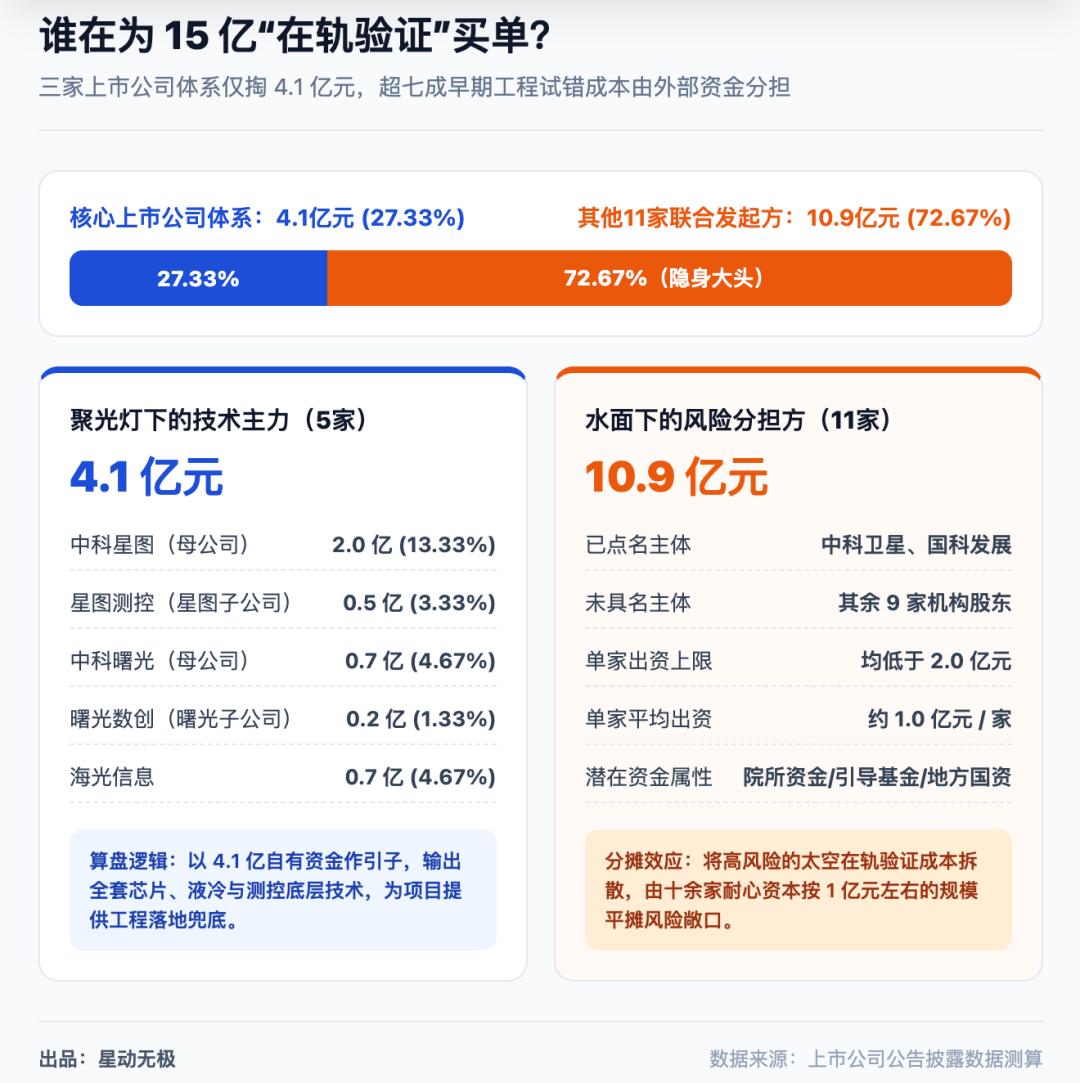
Sorting out according to their respective businesses, CAS Satellite has resources in the satellite field, StarMap Measurement and Control is engaged in satellite measurement, operation and control, Geovis has aerospace information processing and application business, Hygon Information has domestic CPU and DCU computing chips, and Sugon has accumulated experience in computing systems and infrastructure.
In this lineup, Sugon Digital Innovation, which invested 20 million yuan and holds only 1.33% of the shares, is rather special.
Sugon Digital Innovation is listed on the Beijing Stock Exchange. Liquid cooling is its important technical direction, and it has long served ground data centers and computing facilities. A company that does computer room heat dissipation invested 20 million yuan in a project that requires on-orbit verification, which means heat dissipation is very likely to be an engineering problem that all parties hope to solve together.
The business direction of the new company is also quite clear. According to the announcement, the company is planned to be established in Hefei, engaged in the design, manufacturing and operation of space-based information infrastructure, and carry out related computing and intelligent application services. However, the specific satellite configuration, computing power scale and thermal management scheme have not been disclosed yet.
In traditional remote sensing missions, a large amount of raw data needs to be transmitted back to the ground for processing. With the growth of data volume, the return bandwidth and timeliness will become constraints for some missions. Increasing on-orbit computing capabilities allows satellites to first complete part of the screening, identification and processing, and then transmit the required data or results back to the ground.
However, when computing power is moved to space, heat dissipation is the first unavoidable engineering problem.
Space is a vacuum, so it is impossible to rely on convective heat dissipation to the surrounding air like ground computer rooms. The heat generated by the chips needs to be transferred through heat pipes or fluid loops, and finally dissipated outward by radiators.
After the computing power increases, the power supply and heat dissipation facilities need to be adjusted accordingly, which will also affect the mass and layout of the entire satellite. Even if liquid cooling is adopted, it is only part of the entire thermal management system.
The participation of Sugon Digital Innovation supplements the project with technical resources in thermal management, but how to adapt the ground liquid cooling technology to the space environment still needs to be verified. Computing chips and systems also need to solve problems such as space environment adaptability, power consumption and reliability.
Therefore, the next work of this new company will most likely include organizing relevant technologies into a computing system that can operate on orbit, and then testing the performance and stability through engineering verification. As for which products of which company will be finally adopted and how to complete the integration, we have to wait for the disclosure of more specific plans.
The Three Giants Only Contribute 410 Million Yuan, Who Is the 1.09 Billion Yuan of Hidden Capital Sharing Risks For?
When moving computing facilities to space, who will bear the cost of trial and error?
From device selection and space environment adaptability verification, to thermal management, whole satellite integration and launch, the investments are closely linked. The announcement also reminds that the relevant core technology has not yet undergone large-scale on-orbit engineering verification, and the business model still needs to be tested by the market.
Let's calculate the contributions of several listed companies: Geovis and StarMap Measurement and Control subscribe for a total of 250 million yuan, Sugon and Sugon Digital Innovation subscribe for a total of 90 million yuan, and Hygon Information subscribes for 70 million yuan. The total is 410 million yuan, accounting for 27.33% of the 1.5 billion yuan registered capital.
The remaining 1.09 billion yuan, accounting for 72.67%, is subscribed by CAS Satellite, Sinovation Development and 9 other investors.
These funds are not really "hidden", and the announcement has listed the list of contributors.
Among them, Hefei Industrial Investment Space Computing subscribes for 240 million yuan, holding 16% of the shares, making it the largest single shareholder; Hefei Industrial Investment Xingzhi Xinyu and Hefei High-tech Venture Capital subscribe for 200 million yuan respectively, each holding 13.33% of the shares. Geovis itself subscribes for 200 million yuan, which is not the largest single contributor.
Who is supporting this project that has not yet been fully verified on orbit and whose short-term return is uncertain? Judging from the list, local state-owned capital accounts for a considerable proportion.
Eight investment entities with the background of Anhui provincial and Hefei local state-owned capital subscribe for a total of 940 million yuan, accounting for about 62.67% of the registered capital. In addition, Sinovation Development and Chengtong Science and Technology Innovation Fund also participated.
Industrial enterprises and local capital enter the project with different resources respectively.
Enterprises such as Geovis, Sugon and Hygon have relevant technology and application foundations, while local state-owned capital and industrial funds provide a large proportion of financial support. Joint investment means that no single enterprise has to bear all the investment alone.
However, technical resources do not equal return guarantees. The accumulation of several enterprises in their respective fields can lower part of the R&D threshold for the project, but cannot guarantee the on-orbit verification that has not been completed yet.
This 1.5 billion yuan also has a clear payment schedule. According to the investment agreement, after all shareholders meet the agreed conditions, the first paid-in capital is 40% of the subscribed amount, totaling 600 million yuan; the rest will be determined by the board of directors in installments according to the business plan and actual capital needs, and shall be fully paid no later than December 31, 2030.
In total, several listed companies and their relevant subsidiaries subscribe for 410 million yuan, and jointly promote the project with other investors.
For new businesses with large investment and long cycle, such an arrangement can share the capital pressure. Installment paid-in allows all parties to arrange investment according to project needs, but whether the subsequent funds can be connected in time is still a test in the process of project promotion.
Total Shareholding No More Than 20%, The Off-balance Sheet R&D Calculation of Blue-chip Stocks
Let's look at the third question: Since several listed companies have industrial resources such as chips, liquid cooling and measurement and control, why didn't they contribute more money to get the controlling stake?
This accounting involves capital investment as well as financial arrangements.
For listed companies, heavy-asset and long-cycle projects require continuous investment, and there is great uncertainty in short-term operating results. If a controlling relationship is formed, it usually needs to be included in the consolidated statements, and the assets, liabilities and operating profits and losses of the project will also enter the group's statements accordingly.
The equity ratio this time is relatively dispersed. Calculated based on the subscribed amount, Geovis and StarMap Measurement and Control hold a total of about 16.67% of the shares, Sugon and Sugon Digital Innovation hold a total of 6% of the shares, and Hygon Information holds about 4.67% of the shares. Sugon clearly stated in the announcement that it will not exercise control over the new company and will not include it in the consolidated statements.
But 20% is not a mechanically applicable accounting red line.
Whether it has significant influence needs to be comprehensively judged by combining factors such as the power to participate in business decision-making. If the shareholding ratio is lower than 20%, it may still have significant influence; whether to include it in the consolidated statements depends on the judgment of the controlling relationship.
Therefore, "off-balance sheet R&D" can only be used as a popular generalization, and it cannot be considered that project losses have nothing to do with listed companies.
If the equity method is adopted for accounting, the investor still needs to confirm the share of profit or loss it shall enjoy or bear in accordance with regulations. If the project operation falls short of expectations, it may also affect the book value of the investment. The specific impact depends on the accounting treatment of each company and subsequent operating conditions, and cannot be simply summed up as "not included in the consolidated statements, so it will not affect profits".
Compared with investing in construction alone, low proportional equity participation can control the initial investment scale, but shareholders still bear investment risks. Whether to continue capital increase in the future and whether to provide other support will also affect the actual capital responsibilities of all parties.
In addition to equity returns, industrial enterprises may also obtain opportunities from the business side.
The new company's R&D and construction requires the procurement of computing equipment, satellite-related products and measurement, operation and control services. Enterprises such as Hygon Information, Sugon Digital Innovation and StarMap Measurement and Control may become providers of related products or services.
The 16-shareholder Game Without Actual Controller, How to Divide the Cake After The Verification Is Successful?
After the equity is dispersed, another problem arises: 16 shareholders sit at the same table, who will take the lead when encountering technical route adjustment, budget increase or financing arrangement?
The investment agreement has given the basic governance arrangement.
The board of directors of the new company consists of five directors. Four of them are shareholder representative directors nominated by Geovis, Sugon, Hefei Space Computing and Hefei High-tech Venture Capital respectively, and the other one is a staff representative director. The chairman is the director nominated and recommended by Geovis, and will be appointed after election by the board of directors.
The general manager, deputy general managers and person in charge of finance will be recruited through market-oriented methods, and the appointment or dismissal shall be decided by the board of directors.
Geovis plays a prominent organizational role, and both industrial parties and local capital have seats on the board of directors.
After the project is launched, all parties can participate in the collaboration according to their technical and resource advantages, but someone still needs to be responsible for the overall plan, budget and progress.
Once the on-orbit verification makes progress, the project will also face the test of commercialization. How much money is needed for subsequent expansion, what capabilities customers are willing to pay for, whether the new funds are borne by existing shareholders or new investors are introduced, these issues will further affect the equity and voice of all parties.
This article is from the WeChat official account "StarMotion Infinity", author: Julian, authorized by 36Kr for release.