Amazon, the strictest father of Agent
Musk's Agent has been kicked out by Amazon.
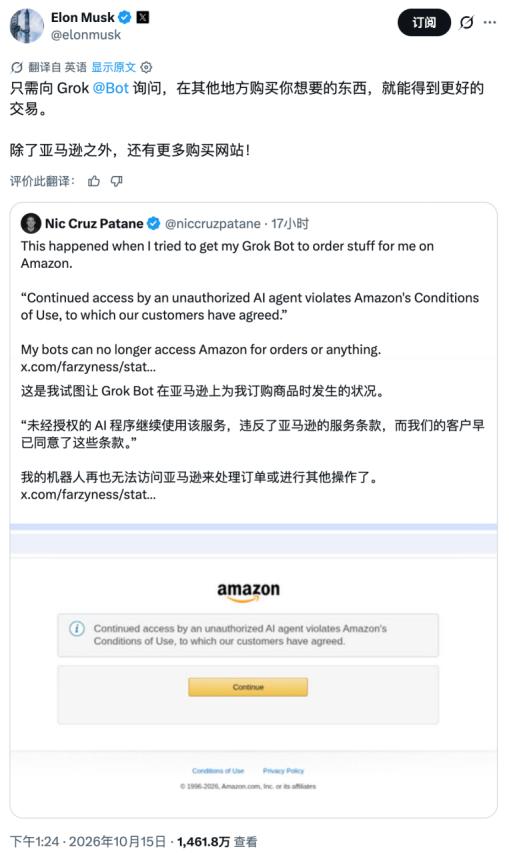
On October 15, an X user posted a screenshot complaining that his Grok Bot was ruthlessly rejected by Amazon.
He originally only wanted Grok Bot to help him make a purchase, but Amazon suddenly popped up a warning: continued access to Amazon by unauthorized AI Agents violates the terms of service that users have already agreed to.
Now his Grok Bot cannot even access Amazon's website at all.
Musk directly suggested that the user ask Grok Bot to shop on other websites, where they could find cheaper products — there are countless shopping websites on the internet, and Amazon is far from the only option.
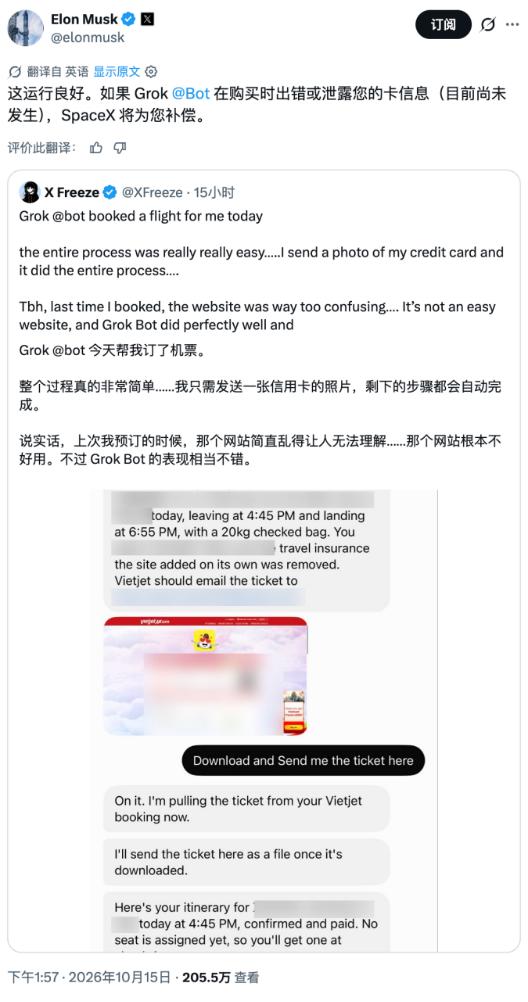
On the same day, another user shared his shopping experience: he only needed to send a photo of his credit card to Grok Bot, and the latter booked a flight for him.
Musk immediately promised: If Grok Bot buys the wrong item or leaks the user's bank card information, SpaceX will compensate the user for all losses.
On one side, Amazon is strictly guarding its shopping website against AI Agents; on the other side, Musk has begun to encourage users to hand over their bank cards to Agents, and voluntarily promised to cover losses caused by their mistakes.
Amazon's strict stance on Agents is not specifically targeted at Musk. Last year, Perplexity's Comet fell into a legal dispute with Amazon for shopping on behalf of users; in September this year, Muse, the personal Agent newly launched by Meta, was also blocked from accessing the platform.
As AI companies launch Agents one after another, Amazon has become the strictest "father" in the entire Agent industry.
Amazon's Agent Exclusion Order
In November 2025, Amazon sued Perplexity in court on the grounds of violating laws including the U.S. Computer Fraud and Abuse Act.
The cause of the dispute was the Comet browser launched by Perplexity, whose built-in AI assistant can browse products for users, compare prices, and even log in to Amazon accounts to complete purchases.
According to Amazon, Perplexity not only did not obtain authorization, but also deliberately disguised its Agent as an ordinary Chrome browser to bypass the website's identification and interception mechanisms and access users' private accounts. Amazon had repeatedly asked Perplexity to stop related operations before, but failed to persuade the company.
At first, the lawsuit went quite smoothly. In March this year, the U.S. District Court granted Amazon a preliminary injunction, prohibiting Perplexity from accessing Amazon's protected systems through Comet's Agent.
But in August, the situation reversed abruptly.
The U.S. Court of Appeals for the Ninth Circuit overturned the injunction, with the judge ruling that in the operations involved in the case, it was the user himself who actually accessed the Amazon website, and Perplexity's Agent was only a tool to help users complete operations.
Therefore, based on the existing evidence, it is difficult for Amazon to prove that Perplexity itself carried out unauthorized access in accordance with relevant computer anti-fraud laws.
Amazon refused to accept the ruling and applied for a retrial, but the court rejected the application again on September 10.
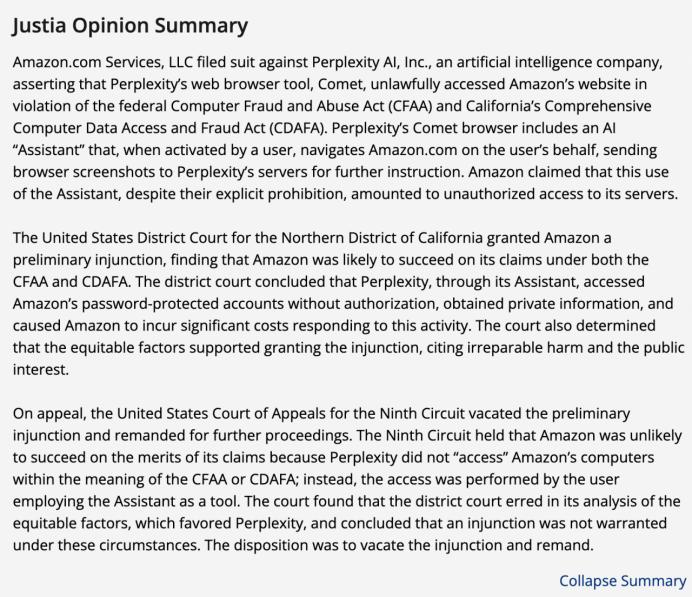
Of course, this does not mean that Agents can move unimpeded on Amazon from now on. According to the court, Amazon can still enforce its own terms of service to manage related activities.
A few days later, Meta's Muse hit this rule immediately.
On the evening of September 20, less than two weeks after Muse went online, Amazon began to block its shopping operations.
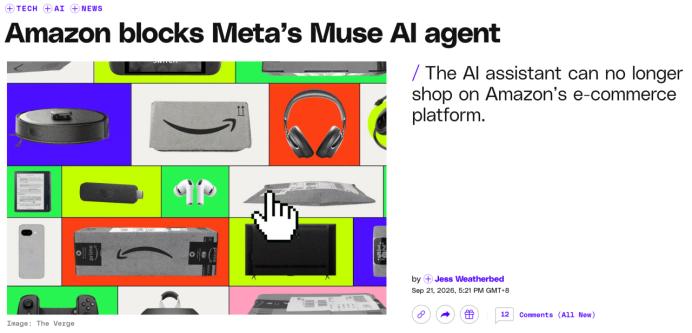
According to multiple media reports, Amazon had previously asked Meta to voluntarily remove Amazon from Muse's service scope, but failed to persuade the company, so it simply took direct blocking measures.
Amazon gave three reasons: Meta did not inform Amazon in advance; Muse does not voluntarily identify itself as an Agent when browsing the website; in addition, it seems to obtain and save users' account credentials, which may bring privacy and security risks.
Meta stated that Muse cannot directly view users' passwords and payment information, and these data will be stored in a protected storage environment.
But Amazon did not change its mind because of this. After the block, Muse was even affected when it came to normal browsing of Amazon products.
In fact, in addition to Perplexity and Meta, Amazon has also taken blocking measures against shopping Agents from OpenAI and Google.
In Amazon's public robots.txt file, automatic access programs such as OpenAI's ChatGPT-User, Anthropic's Claude-User, and Google's GoogleAgent-Shopping are all included in the list of prohibited crawlers.
Amazon spokesperson Lara Hendrickson said, Third-party applications that shop on behalf of consumers at other merchants should disclose their identities and respect the merchants' decisions on whether they are willing to participate.
She cited two examples: food delivery platforms and restaurants, online travel agencies and airlines usually need to establish corresponding cooperative relationships. According to this logic, even if the consumer himself agrees to let the Agent shop on his behalf, it does not mean that the shopping website must accept this Agent.
Amazon does not intend to let other people's Agents walk in casually with user authorization.
But interestingly, Amazon, which is extremely strict with external Agents, is also busy developing its own shopping Agents.
Amazon's Agent Also Loves to Wander Outside
Amazon is actually one of the first tech companies to bring AI assistants into ordinary households — as early as 2014, it launched Alexa; by 2024, it specially built the AI assistant Rufus for shopping, which can help users search for products, compare prices, and view reviews.
Later, Amazon added practical operation capabilities to Rufus, allowing users to ask it to add products to the shopping cart, re-purchase previously purchased items, and even set a target price to automatically place an order when the product price drops.
According to data disclosed by Amazon, more than 300 million users have used Rufus in 2025.
In May this year, Amazon merged Rufus with the upgraded Alexa+ and launched Alexa for Shopping. The new version of the assistant not only inherits Rufus's shopping capabilities, but also connects users' historical conversations with Alexa, shopping records and personal preferences.
Although Amazon does not welcome other people's Agents to enter its website without permission, it will let its own Agent go shopping on other retailers' websites.
In April 2025, Amazon launched a feature called Buy for Me — if the product searched by the user is not sold on Amazon, the system may display products from other merchants' websites.
After clicking Buy for Me and confirming order information such as the shipping address and payment method, Amazon's AI will go to the corresponding website to complete the purchase for the user.
The products are shipped by the original merchant, and returns, exchanges and after-sales services are also the responsibility of the merchant, but consumers do not need to leave Amazon.
In March this year, Amazon disclosed that Shop Direct, which supports this feature, has included more than 100 million products from over 400,000 merchants, tens of millions of which are supported for purchase via Buy for Me.
Amazon emphasizes externally that Buy for Me will clearly show which store the product comes from, and users also need to confirm the order in person.
But merchants may not all buy into this logic.
In January this year, Bloomberg published an investigative report showing that many independent U.S. merchants found that their products appeared on Amazon's shopping pages for no apparent reason, even though they never applied to join Amazon's related programs.
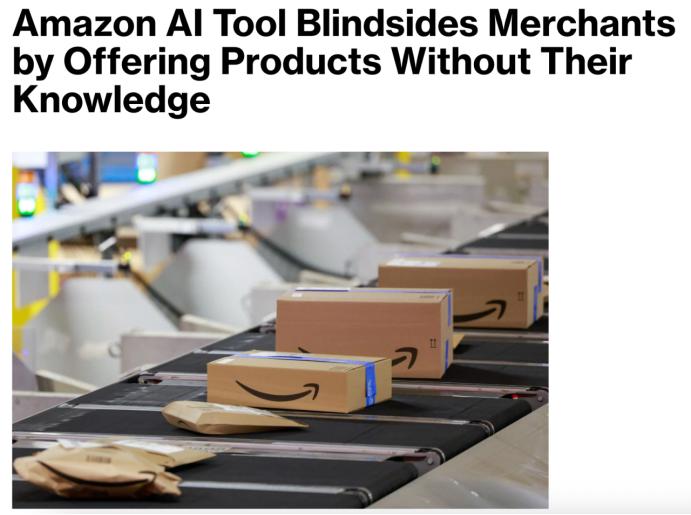
The owner of a stationery store found that Amazon displayed the small decompression balls sold in his store as a large version that he did not sell at all. When customers received the products and found that the goods did not match the description, they came back to the store to request a refund.
The owner had to explain to customers that the problem was caused by Amazon's AI, and he only shipped according to the orders he received.
Amazon responded that merchants can apply to withdraw from related programs at any time, and stated that these features help independent merchants reach more customers.
However, allowing merchants to withdraw afterwards is obviously not the same as obtaining their consent in advance.
This also makes Amazon's strict attitude towards external Agents look rather subtle: When other people's Agents come to shop, Amazon requires prior authorization; but when its own Agent goes to other stores to shop, it only allows merchants to apply for withdrawal afterwards.
Musk: I Don't Care About Your Rules
Musk obviously does not buy Amazon's exclusion order.
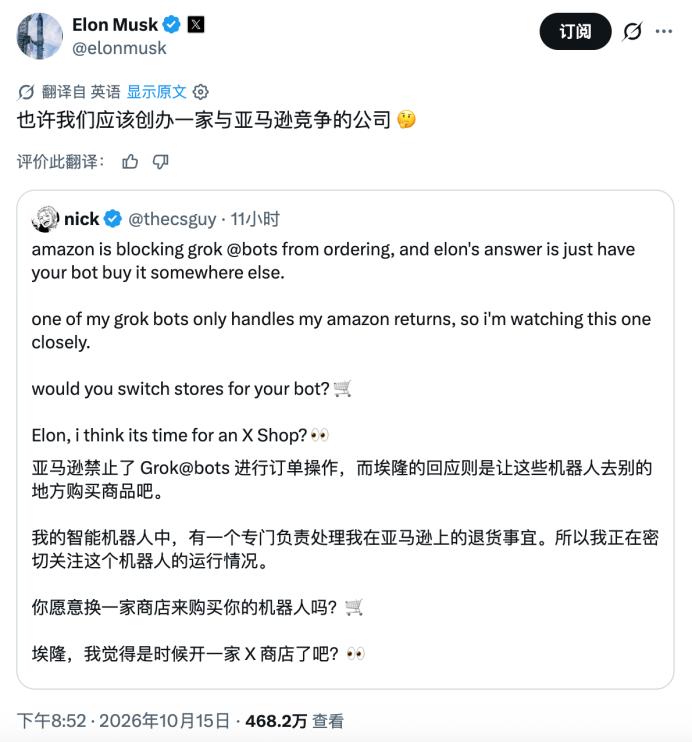
On October 15, an X user complained that Amazon began to block Grok Bot from placing orders. He had a Bot specifically responsible for handling Amazon returns, and now he did not know what to do.
He casually suggested to Musk: In that case, how about opening an X Shop?
Musk reposted this post, "Maybe we should start a competitor to Amazon," he replied, with a thinking emoji attached.
Of course, this is just a casual suggestion from Musk, and there are no actual product plans yet.
But his previous comment that "shopping on other websites can get cheaper products" has touched a pain point of Amazon.
For Amazon, the threats posed by external Agents go far beyond product orders.
According to its 2025 financial report, Amazon's annual advertising service revenue reached 68.635 billion US dollars, including sponsored product ads, display ads, video ads and other businesses.
In the traditional e-commerce shopping process, consumers enter Amazon, search for products, browse recommendations, compare prices, and then decide to purchase. Merchants also need to pay Amazon advertising fees to get better display positions.
But the situation is different if users directly ask Grok Bot or Muse to buy things for them.
Agents can search and compare products across the entire network, and finally directly guide users to complete the order. Consumers do not necessarily open Amazon themselves, so they will not see its carefully arranged product recommendations and advertisements.
Amazon is obviously aware of this. In June this year, it launched Alexa+ Agentic Ads, allowing users to see ads directly in conversations with Alexa, and even order pizza and buy concert tickets. Alexa for Shopping has also begun to support sponsored product promotion.
Amazon hopes to continue to develop AI shopping and advertising business, but the premise is that it can still control consumers' shopping entry.
The problem is that other e-commerce platforms may not think the same way.
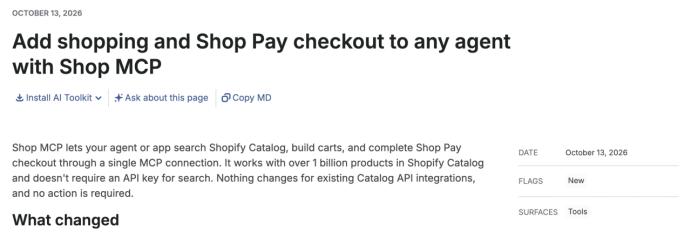
Just on October 13, Shopify announced that it would open its product catalog to more AI Agents.
Through Shop MCP, compatible Agents can search more than 1 billion products in Shopify's catalog, create shopping carts, and complete checkout via Shop Pay. Previously, Shopify has cooperated with Meta Muse, and now it has further lowered the threshold for other Agents to access product catalogs and shopping services.
Different from Amazon, Shopify's main business is to provide e-commerce infrastructure for merchants. As long as consumers finally buy products, the orders can still be fulfilled by the merchants it serves.
Therefore, for Shopify, Agents can completely become a new sales channel.
Even if Amazon blocks external Agents, it cannot stop other merchants from opening their doors to them voluntarily.
Behind this conflict, there is actually a larger ecological game hidden.
In the past era of mobile internet, traffic was in the hands of major platforms. Consumers opened shopping apps, searched for products, browsed recommendations, and merchants tried every means to make their products appear in front of consumers. The platform controls the traffic entry, so it controls the entire process of products being discovered, recommended and purchased.
But in the Agent era, this set of relationships has changed.
When consumers start to rely on Agents, the party that first grasps their shopping intentions may change from e-commerce platforms to Agent providers. In the future, e-commerce platforms may not only compete for consumers, but also find ways to make