Elon Musk's Roadster, the slowest car
Elon Musk once said he wanted to make a sports car fly. This time, he made it.
At the launch event in Texas, the new Roadster drove upside down along the track, flipped in the air, and soared over a row of Teslas. The underbody fans and compressed air thrusters turned a sports car launch event into a flight demonstration.
This sports car, which reservation holders have waited for nearly nine years to get, has the longest development cycle, but demonstrates capabilities far more exaggerated than "going faster".
The sports car leaves the ground
At SpaceX's rocket engine test site in McGregor, Texas, the Roadster launch was scheduled to start at 19:55.
When Elon Musk reposted the live stream link, he wrote: "Tesla x SpaceX."
At the scene, a white Roadster drove up a tall curved track until its body was nearly upside down.
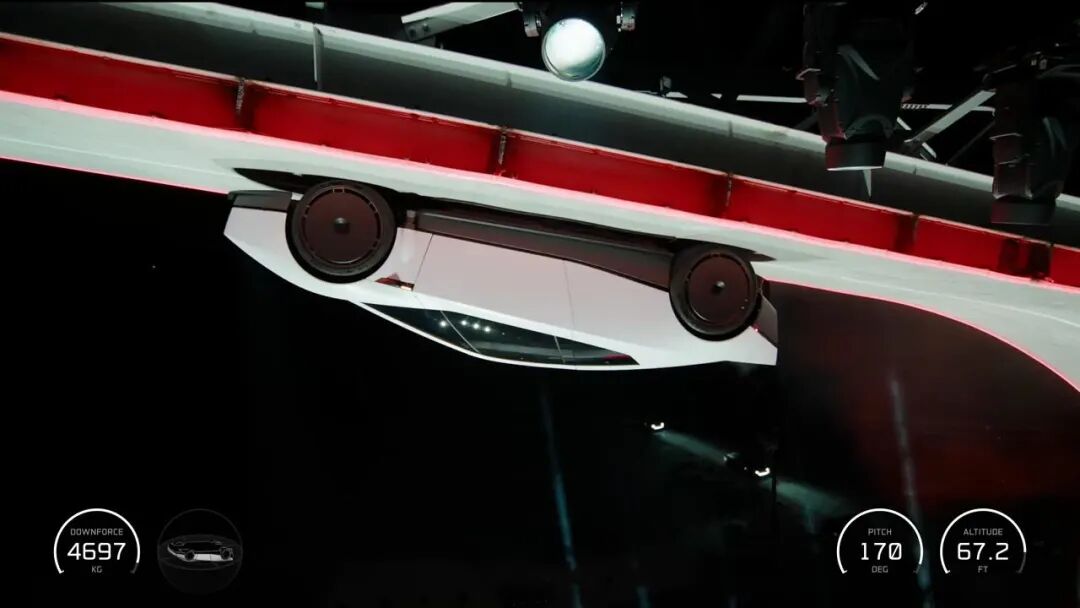
The live feed showed the vehicle reached a pitch angle of 170 degrees at a height of about 21 meters. The active fans under the car draw in air, "sucking" the vehicle toward the driving surface.
The following demonstration responded to public expectations for a "flying car". The Roadster left the track, flipped in the air with the help of attitude control thrusters, and then landed back on the ground.
In the subsequent display, it took off again while moving, passing over the Cybercab, Cybertruck, Semi, Model Y and Model 3.
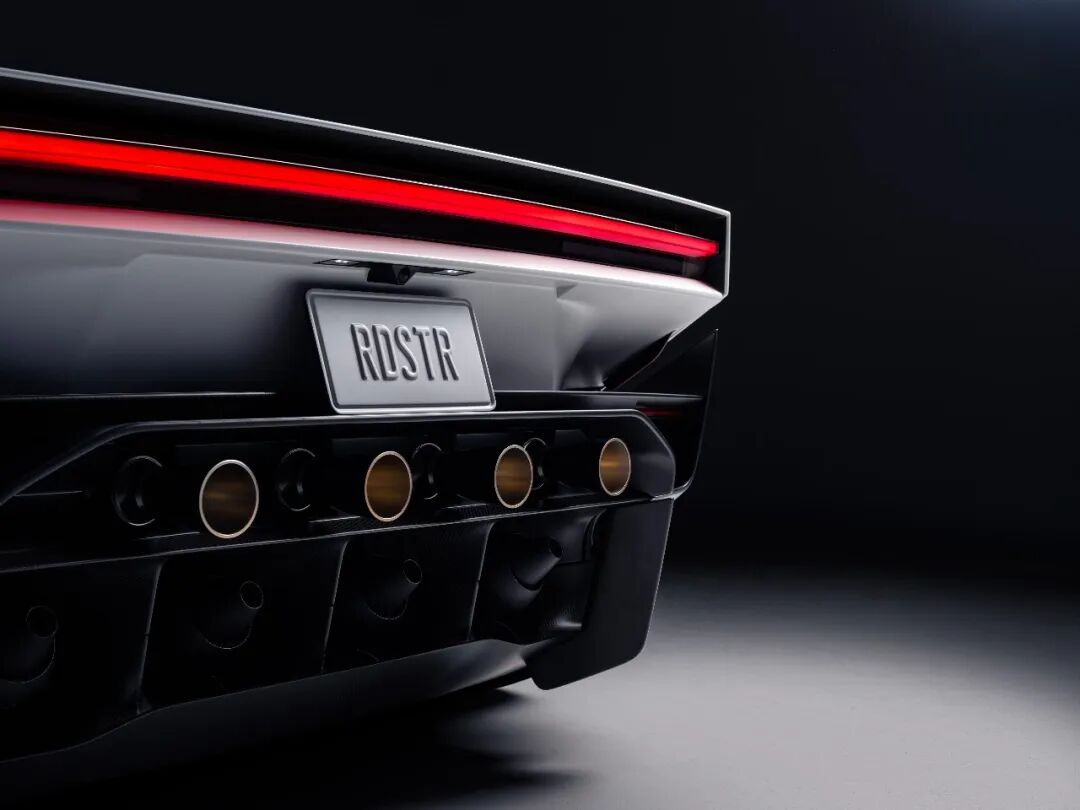
The device that makes the vehicle take off uses compressed air. The whole car is equipped with 10 nozzles connected to a 600-liter compressed air storage tank. The tank can be recharged, and the nozzles are used to provide thrust and adjust the attitude in the air.
The thrusters can also assist forward acceleration. In a 0-60 mph acceleration demonstration at the scene, Tesla achieved a result of 0.81 seconds.
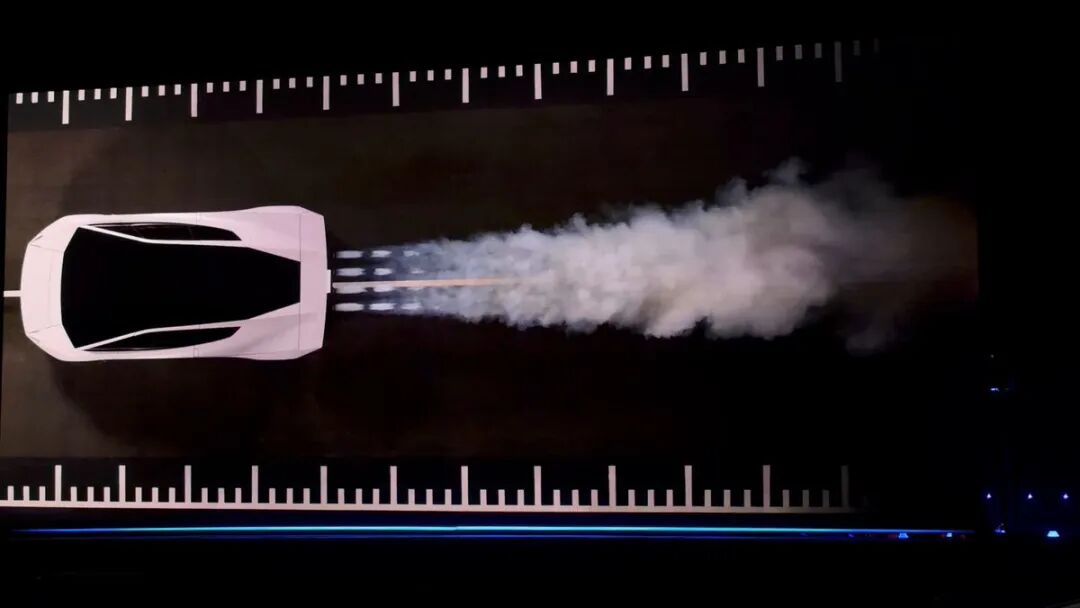
In 2017, Elon Musk attracted reservation holders with a 1.9-second acceleration figure; nine years later, he pushed the figure from the live demonstration to under 1 second, and extended the sports car's range of motion into the air.
The appearance of the new car is very different from the early prototype. The rounded lines are replaced by sharper edges and corners, and the body is equipped with scissor doors, deployable rear wings, and integrated propulsion devices.
Tesla explained in the post of its official design video that the new Roadster is inspired by the SR-71 reconnaissance aircraft and the F-35 fighter jet.
However, the flight capability is not available for every Roadster.
Tesla's official website divides the new car into three versions. The Performance is a two-seat model equipped with active aerodynamics and multi-mode adsorption system; the Thrust is also a two-seat model, with additional rear cold gas thrusters on the basis of the Performance version. The flyable Rocket version only has one seat, with thrusters distributed around the body to support forward and upward acceleration as well as aerial rotation, and it is only available by invitation for purchase.
The official website also notes that the Rocket version has not been approved for use on public roads.
The connection between Roadster and aerospace dates back even earlier. On February 6, 2018, SpaceX's Falcon Heavy rocket made its maiden test flight, sending a first-generation Roadster into an orbit around the Sun. A spacesuit-clad dummy named "Starman" sat in the driver's seat, with the Earth appearing in the picture behind it.
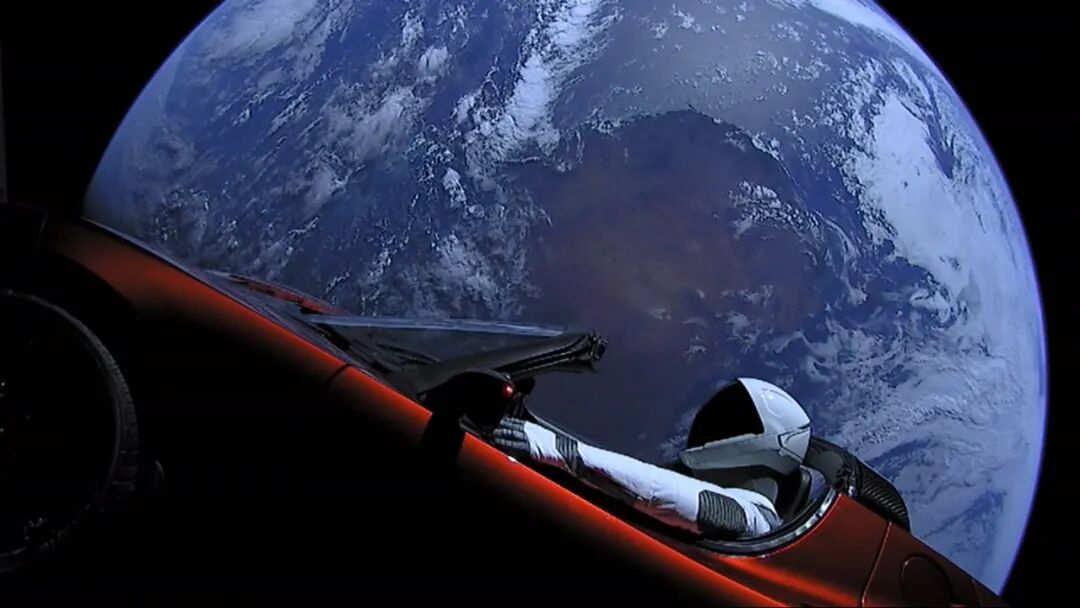
During this launch event, Tesla put that space photo and the new car photo in the same post, writing that Roadster and rockets have traveled together before.
The new plan Elon Musk announced is to put it into production in 2028, and no price has been announced. The specific date of the first batch of deliveries remains to be further clarified.
Some people have waited nearly nine years just to see this scene tonight.
Roadster, Elon Musk's slowest car
Householtz from Las Vegas is one of the people who paid for this car nine years ago. According to reports from The Wall Street Journal, he paid Tesla $250,000 in 2017 to reserve a "Founder Series" Roadster, which is limited to 1000 units globally.
On the evening of November 16, 2017, the second-generation Roadster made its debut. That day, Tesla was originally launching the Semi electric truck in Hawthorne, California. At the grand finale, a red sports car drove out from the truck's cargo compartment. "There's some cargo in the truck," Elon Musk joked on stage.
This "cargo" quickly stole the show from the truck. It was the fastest sports car Elon Musk had promised, with a base version priced at $200,000 and the "Founder Series" at $250,000. To get on the waiting list for the base version, you had to pay a $50,000 deposit first; for the "Founder Series", you had to pay the full amount.
For comparison, the Model 3, which opened for reservation earlier, initially only required a $1000 deposit, and the Cybertruck, which debuted two years later, initially only required a $100 deposit. At that time, Tesla set the production start time at 2020.
2020 came, but the car did not arrive. In a podcast, Elon Musk compared the Roadster to "dessert", saying that Tesla had to deal with more important tasks such as "meat and potatoes" first, including increasing the production of Model Y, building factories and advancing other vehicle models.
Rogan pressed and asked if the Roadster would arrive before the Cybertruck. Elon Musk said that the Cybertruck should be done first.
After that, the delivery time was delayed again and again, but the performance targets were raised again and again. On February 28, 2024, Elon Musk released a new arrangement: the demonstration was planned to be held by the end of that year, and the goal was to start delivery in 2025. He also announced that the 0-60 mph acceleration of the new Roadster would be less than 1 second.
At the shareholders' meeting on November 6, 2025, Elon Musk rescheduled the demonstration to April 1, 2026, and estimated that another 12 to 18 months would be needed after the demonstration before production. He also joked that by choosing April Fools' Day, he could argue that he was just playing a prank.
But not all buyers are willing to keep waiting.
In 2025, Sam Altman, CEO of OpenAI, submitted a refund application and complained on social platforms that the seven-and-a-half-year wait "feels very long".
Jerry Hissley, a Texas car collector and freelance automotive journalist, also successfully got back the $50,000 deposit he paid in 2017 in 2025. Before this launch event, he regretted a bit and told The Wall Street Journal that maybe he should have kept waiting.
This time, Tesla finally presented a new demonstration and also announced a new production year. But for the remaining buyers, the wait is not over yet.
In the era of autonomous driving, leave one car for humans to drive
The first-generation Roadster was the starting point of Elon Musk's "Secret Master Plan": first open the market with expensive sports cars, and then use the revenue to support the development of cheaper mass-market models. Eighteen years later, Tesla made a human-driven sports car fly.
The new Roadster takes the performance competition of sports cars to a more exaggerated direction. It not only relies on fans to grip the ground more firmly, but also can temporarily get rid of the ground with the help of thrusters. The capabilities available for drivers to purchase gradually increase from the grip performance of the Performance version, to the thrust assistance of the Thrust version, and then to the flight capability of the Rocket version.
At the same time, Tesla's other products are moving towards autonomous driving.
In October 2024, the Cybercab driverless taxi with no steering wheel and no pedals made its debut as a concept car. On July 22, 2026, Tesla announced in its Q2 report that the Cybercab had started production.
The same report also stated that the Model S and Model X production lines at the Fremont factory had been dismantled, and the company was installing the production line for the Optimus robot. At that time, the Roadster was still listed as being in the design and development stage.
At this launch event, Elon Musk further clarified that in the long run, Roadster will be the only Tesla car driven by humans.
What consumers reserved in 2017 was an electric flagship sports car. Nine years later, it has gained another identity: the exception Tesla retains for human driving.
Commercially, the Roadster also undertakes the task of a flagship model. A Reuters report on October 15 cited the judgment of Seth Goldstein, an analyst at Morningstar, that this car will showcase Tesla's best engineering and technology. He estimates that its annual sales volume may be around 2000 units.
Such a scale is hardly enough to change Tesla by sales volume, but it can make consumers refocus on its automobiles. Especially after the exit of the Model S and Model X, the Roadster can fill a sufficiently eye-catching position in the product line.
Domestic automakers are not idle either, using performance demonstrations to showcase technology and attract consumers. The mass-produced version of Xiaomi SU7 Ultra is equipped with a track package, and ran a lap time of 7 minutes 04.957 seconds at the Nürburgring Nordschleife, once setting the lap record for electric executive sedans.
In 2023, BYD's Yangwang U9 demonstrated the ability to jump in place and drive on three wheels with the Yunnan-X body control system; XPeng directly stuffed an aircraft into the trunk. Its ecological company, HT Aero, is developing the split-type flying car Land Carrier, which is planned to be mass-produced on a large scale within the year.
At least in the matter of "leaving the ground", domestic peers already have their own solutions, and there is no need to wait for "Saint Musk" to open source the technology.
However, a wonderful demonstration still needs a deliverable production plan. When talking about the 2028 production start, Elon Musk added the phrase "for real" — this time it's for real.
Doubts have not disappeared. A post-launch report from TechCrunch cited a post by tech blogger Marques Brownlee. He mentioned the arrangement that the vehicle can flip in the air but will not be available until 2028, and asked rhetorically: "This is a prank, right?"
Many media and analysts generally believe that the core purpose of this extremely hardcore cross-border show is to demonstrate the seamless technical collaboration between Tesla and SpaceX to the market, and further verify the rationality of the two companies' "integration".
But for reservation holders like Householtz, things are not that complicated. He paid $250,000 in 2017, and Elon Musk still owes him a drivable car.
This article is from the WeChat official account "Zhengu Research Lab" (ID: zhengulab), written by Li Yaqi, and authorized for release by 36Kr.