Which of ByteDance, Alibaba and Tencent is stronger in AI overseas marketing?
Traffic represents trends, and also represents the will of major tech giants.
On social media X (formerly Twitter), Alibaba is the most diligent, Tencent is the most laid-back, and ByteDance has had the most bumpy journey.
Social media X is the platform with the most concentrated discussions in the global AI industry. For Chinese AI teams expanding overseas, X has become one of the main positions for launching new products to global developers, and major manufacturers including ByteDance, Alibaba and Tencent are no exception.
According to incomplete statistics, as of the third quarter of this year, ByteDance, Tencent and Alibaba have a total of 2.647 million followers on X, including 13 accounts under the Alibaba ecosystem with 2.026 million followers in total; 7 accounts under the Tencent ecosystem with 437,000 followers; 11 accounts under the ByteDance ecosystem with 183,000 followers. However, if group accounts and non-AI accounts are excluded, Alibaba's AI-related accounts have actually accumulated 1.757 million followers, ByteDance 158,000, and Tencent 100,000.
Alibaba is the most diligent because it has the largest number of accounts on X, and its open-source models come with built-in communication power. Judging from the data of posts, exposure and interaction volume on X in the third quarter, Alibaba far outperformed ByteDance and Tencent.
Statistics from Grok show that the Alibaba ecosystem published 1698 posts in the third quarter, exceeding the 1286 posts of ByteDance and Tencent combined. The Qwen account alone contributed 39% of the total interactions of the three companies in the third quarter.
Compared with Alibaba's diligence, ByteDance's development on X has been somewhat bumpy.
Since March this year, the X account of ByteDance's Lark (the overseas version of Feishu) has not been updated for half a year, with only occasional interactions in the comment section; the X account of the large model team Seed was previously frozen, and the newly opened account @ByteDanceSeed_ a year later has only posted two pieces of content; compared with Doubao's leading advantage in the domestic market, Dola, the international version of Doubao, only has a few hundred followers on X, and its predecessor was Cici launched in 2023.
Only Tencent is the most laid-back, with the smallest number of accounts on X, but the interaction rate is not low.
According to Grok's calculation, Tencent's X accounts published 681 posts in the third quarter, with a total exposure of 63.96 million, which is much lower than that of Alibaba and ByteDance. However, in the single indicator of interaction rate, Tencent's accounts reached 0.24%, exceeding Alibaba's 0.17% and ByteDance's 0.05%.
The label of "laid-back" only represents one side of Tencent. In new businesses such as WorkBuddy, it also has a non-laid-back side.
LightVela, which attracted attention at the end of September, is Tencent's cloud-resident personal agent product launched in China, similar to Meta's Muse. The official X account of LightVela started promotion as early as June this year, while its official WeChat public account has not published any content yet. All its publicity efforts are focused on X — which is far earlier than ByteDance and Alibaba's overseas actions in the field of personal agents.
Of course, traffic data is increasingly difficult to reflect the real trend of AI. The real user engagement, payment rate and commercial value need to be perceived through more data dimensions. But the content on X undoubtedly represents part of the will of major tech giants. It is their public statement to overseas developers and users, from which we can see where they place their focus and resources for AI overseas expansion, and understand the wording of their external narratives.
ByteDance on X: Lark stops updating, AI office overseas expansion remains to be solved
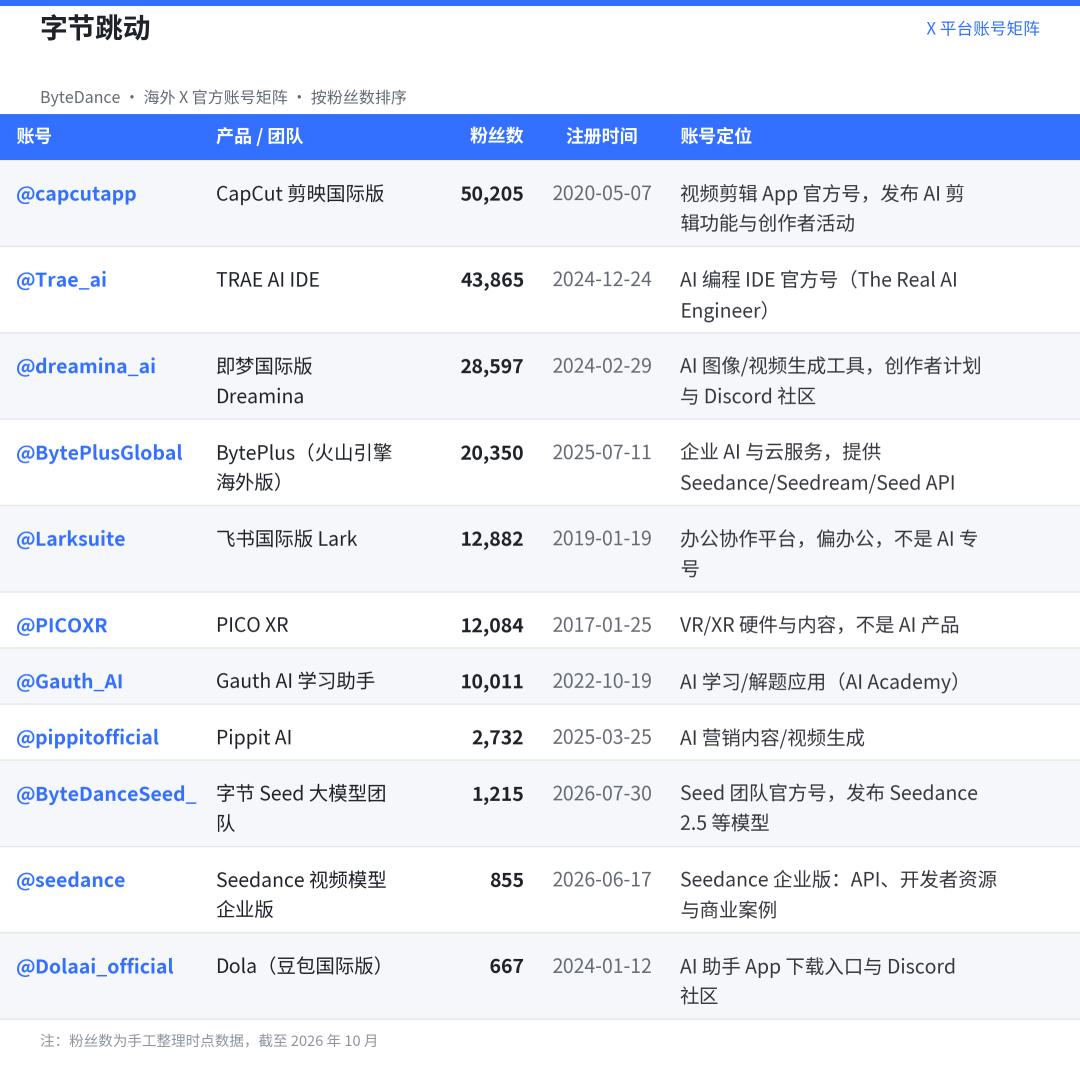
Leaving TikTok aside, the account with the largest number of followers under the ByteDance ecosystem on X is CapCut, the international version of Jianying, while the account with the least followers is Dola, the overseas version of Doubao.
Dola put on the Möbius ring 82 days earlier than Doubao Work. On June 3 this year, Dola, the international version of Doubao, updated its avatar to a purple Möbius ring. More than a month later, the domestic Feishu product team merged with the Doubao product team and launched "Doubao Work", whose avatar is exactly the same as Dola's, except that it is blue.
In the comment section after Dola's update, opinions were divided. Many comments thought the old version was better and asked to change it back.
Compared with its low profile on X, the development of Dola, the overseas version of Doubao in reality, is not slow. Dola's market is concentrated in Southeast Asia and Latin America. According to Sensor Tower's announcement in April this year, in the first quarter of 2026, Dola, the overseas version of ByteDance's AI Doubao, exceeded 72 million downloads in a single quarter, with a month-on-month increase of 47%. The cumulative downloads officially exceeded 200 million in this quarter, and the average daily active users in March was close to 12 million.
The one that is truly hidden is Lark, the overseas version of Feishu. Its official X account has not been updated for half a year.
Lark's product and overseas market revenue have been absent from Feishu's press conferences. In March this year, Lark published its last post: "Lark CLI is now open source, making your AI agent a power user of Lark. With just one installation, your agent can directly access your calendar, group chats and documents. It supports Claude Code, Codex, Cursor, etc."
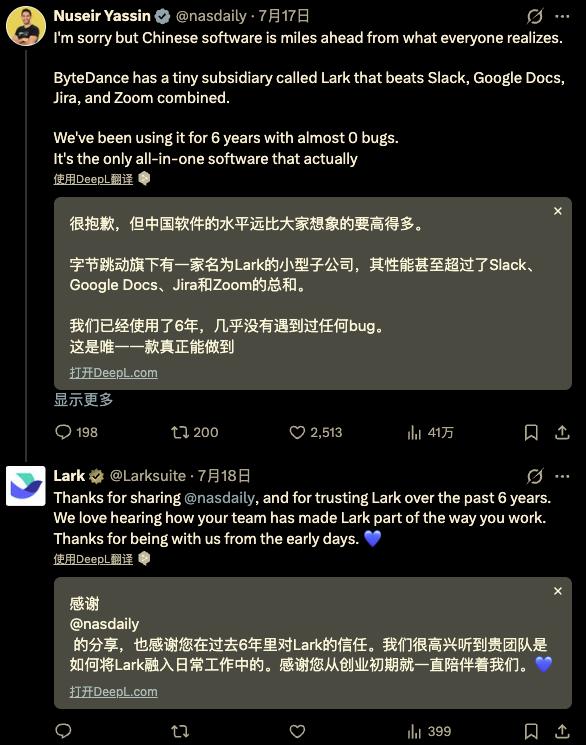
Interestingly, Lark's official account is active in the comment section. In July this year, Nas Daily founder Nuseir Yassin thanked Lark on X, and Lark's official account replied to express its gratitude, and no further updates were made after that.
Overall, compared with the rapid merger of Feishu and Doubao in China to fully embrace the AI office wave, Dola and Lark in overseas markets are still moving forward in a low-profile manner, and no actions following Alibaba and Tencent in AI office overseas expansion have been seen yet.
In the past six months, the most eye-catching content of ByteDance on X is undoubtedly the release of the Seedance 2.5 video model. The traffic of related topics surged, and the maximum exposure of a single post reached 15.75 million.
However, from the overall traffic effect, the post with the highest exposure under ByteDance's accounts is the behind-the-scenes editing tutorial released by CapCut, which explains how to control the results generated by AI, with an exposure of 24.11 million, the highest among all posts of the ByteDance ecosystem.
In addition, Trae still represents ByteDance's successful sample of AI Coding tool overseas expansion, and its number of followers on X is 3.5 times that of Alibaba's Qoder, with a clear leading advantage.
Alibaba on X: The most diligent, open-source models come with built-in communication power
With 13 X accounts, Alibaba has the most complete layout, and its number of followers is the highest, 11 times that of ByteDance and 4.6 times that of Tencent. Even @QwenDevs, an account for the developer community launched in July this year, has accumulated 20,000 followers in just two months.
Including @QwenDevs, Alibaba opened four new accounts on X this year.
Among them, @HappyOysterAI has a very high exposure of 52.4 million in the third quarter, but only 3617 followers. This is mainly because HappyOyster is a world model that generates a real-time interactive world, which is mainly oriented to games, interactive dramas and entertainment users, and the latest 2.0 preview version was released at the Yunqi Conference;
HappyHorseATH published 180 pieces of content in the third quarter, obtaining 15.1 million exposures. HappyHorse is a video generation model for advertisers, short drama and film creators. It launched the global call for entries for the HORSEPOWER AI Film Competition on June 22. This post has 4.62 million exposures, which is the post with the highest exposure and interaction;
@qwen_cloud only has 5792 followers, but the interaction rate is 0.42%. It can be said that the followers of Alibaba's X accounts are concentrated in the head accounts. Qwen supports the overall influence, and the new accounts are mainly used to lay out product lines.
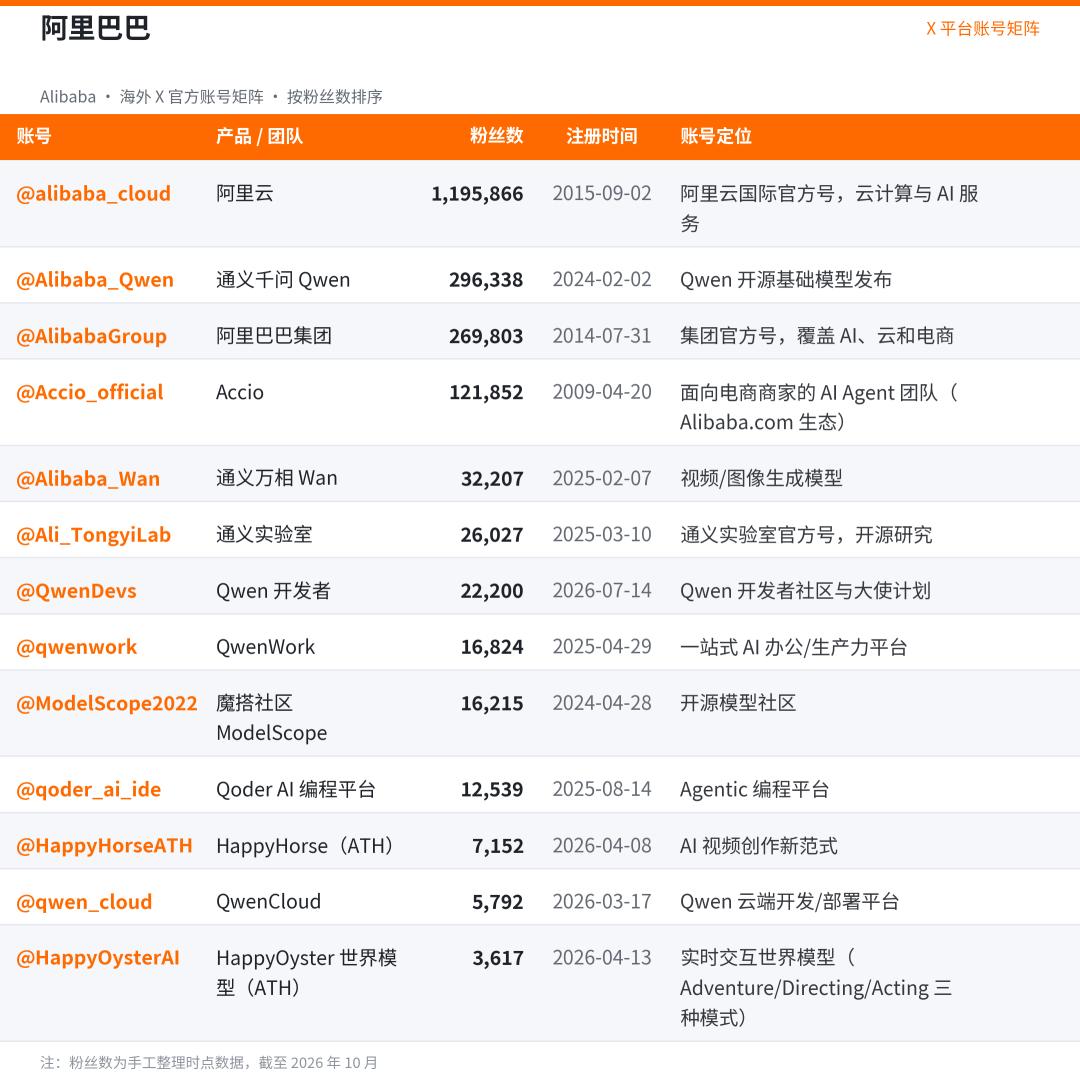
Interestingly, although Qwen's office overseas expansion started later than Tencent's WorkBuddy, the number of followers of QwenWork's X account exceeds that of WorkBuddy. This is because its followers were accumulated during the MuleRun period. After the name change in August, the original creation competition and community gameplay of MuleRun were not continued.
Alibaba is very diligent on X, but there are still some imperfections in product communication.
In the past two months, Qwen's office overseas marketing efforts were not as strong as WorkBuddy's. WorkBuddy published 93 original posts with a total exposure of 5.86 million, while QwenWork only published 27 posts in the same period, with a total exposure of 362,000, which is only 6% of WorkBuddy's. The only data that exceeds its competitor is the interaction volume.
Looking at the past six months, without exception, Alibaba's high exposure on X is all due to the release of open-source models.
Open-source models come with built-in communication power. In April, Tongyi Lab released Qwen3.6-Max-Preview, with an exposure of 34.15 million; in July, Qwen3.8 was released and open source was announced in advance, with 7.26 million exposures and more than 33,000 interactions. Then Wan3.0 entered public beta, which can directly generate 30-second videos, with 20.1 million exposures...
Overall, Alibaba on X leads ByteDance and Tencent in both exposure and interaction. The account with the most interactions is @Alibaba_Qwen, which has 469,000 interactions. 9 of the top 10 posts in the interaction list were published by Alibaba's Qwen accounts, which fully demonstrates Qwen's influence in the developer community.
Tencent on X: Laid-back is only the past
On X, Tencent's overall performance is relatively "laid-back", with a small number of posts and the least number of AI-related accounts. Excluding group accounts and WeChat, according to incomplete statistics, there are only 4 AI-oriented accounts, with a total of about 100,000 followers, the least among the three major manufacturers.
It can be said that Tencent on X does not have a strong "AI atmosphere".
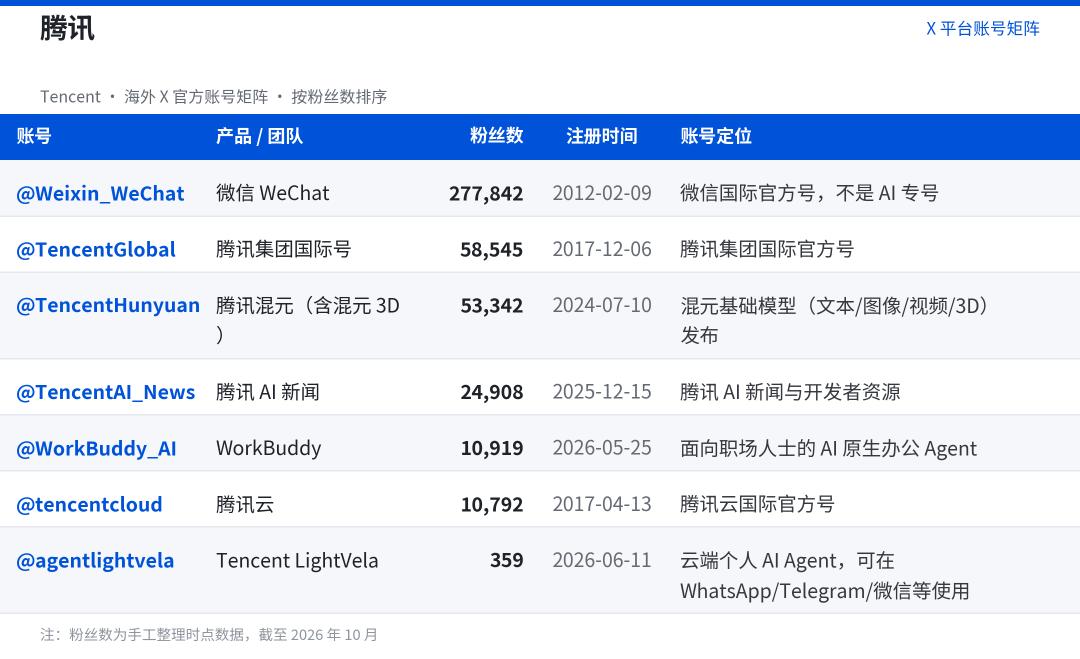
However, a closer look shows that WorkBuddy and the cloud-resident personal agent product LightVela on X are both making efforts to market overseas markets, making up for the previous shortcomings in AI Coding tools.
The AI Coding tool wave came earlier than the AI office wave. In 2025, ByteDance and Alibaba successively launched the international version of TRAE and Qoder overseas, both of which have reached millions of global users. ByteDance leads in this field, with TRAE having more than 40,000 followers on X, and Qoder also having more than 12,000 followers, while Tencent's CodeBuddy IDE has no official X account.
This does not mean that Tencent does not attach importance to CodeBuddy. In May this year, Tencent launched a development challenge on X, but only users in Indonesia, Japan, Singapore and Thailand can participate. The exposure of this event reached 42 million, far exceeding the most exposed posts of ByteDance and Alibaba.
In this year's AI office overseas expansion, the positions of the three major manufacturers have been reversed. Tencent has obviously accelerated. WorkBuddy took the lead in launching in May, and Qwen Work, Alibaba's international version, followed up in August, while ByteDance's Doubao Work has not yet launched its international version.
On X, @WorkBuddy_AI maintains high activity, is very good at leveraging marketing, and is the least laid-back one.
Its growth-driven gameplay includes offline sharing sessions, free trials, $7 for the first month, etc. The top 3 most interactive posts are all about the launch of third-party models, such as the free trial of DeepSeek V4.1-Flash, and the launch of GPT-6 Astra. The latter is also the post with the highest exposure in this period, with 1.11 million views, and the popularity of Tencent's own Hunyuan model was overshadowed instead.
At present, WorkBuddy has more than 10,000 followers on X. This number is not large, but a single post can get hundreds of thousands or even millions of views, which shows that the content has accurately reached the crowd interested in AI office agents, and the secondary communication of Tencent's AI news and other matrix accounts is also playing a promoting role.
There is no doubt that WorkBuddy is the current focus of Tencent AI. It occupies a leading position in the desktop AI-native office agent track, and has the highest per capita usage frequency in China, but can it replicate its domestic success overseas?
Compared with the previous model and AI Coding overseas expansion, AI office will inevitably involve the context data of overseas enterprises. WorkBuddy's opponents are the camp formed by Microsoft + OpenAI + Anthropic. WorkBuddy needs to find space in the battlefield full of giants, and the underlying Hunyuan model also needs to provide sufficient capabilities.
After the AI office wave, personal agents have become the new hotspot at present. The popularity of personal agents is to popularize AI capabilities to everyone, not just white-collar workers and developers.
Meta's Muse, OpenAI's Dots and xAI's Grok Bot are all layouts of major manufacturers in this track.
Alibaba released its personal AI assistant "Qwen Go!" on October 13, while Tencent made an earlier layout. It publicly tested LightVela in April this year, which is also a similar cloud-based personal AI assistant. It was officially launched globally in August to provide paid services, but in fact, the LightVela team recruited users for experience on X as early as June.
The WeChat public account registered by the LightVela team has not published any content, but it has attracted more than 350 followers on X, and has pinned the new user acquisition activity of "one-month free trial". For AI products, X is obviously a more suitable platform for publicity and closer to users.
There are also more AI creators on X, such as LightVela's product manager @ShowNowAI. She posted her thoughts after the product gained attention on X during the National Day holiday, summarizing the development history of LightVela, which all originated from the popularity of OpenClaw earlier this year.
Tencent's LightVela attracted attention on the eve of the National Day holiday, and then some problems of sold-out services and busy servers occurred. She said, "As the long holiday is approaching