The market has finally realized that the biggest bottleneck for AI is not electricity, not chips, but funding.
Money is fast becoming the scarcest bargaining chip in the high-stakes AI gamble.
Over the past two years, global capital markets have been convinced that computing power equals absolute truth, but power shortages can be alleviated through capacity expansion and chip supply can catch up with demand. Recently, the sharp plunge of CoreWeave and the surge of CDS for tech giants have made the entire industrial chain wake up to a harsh reality: the ultimate physical limit of AI's breakneck growth actually lies in capital supply capacity and financing cost.
When capital is no longer unlimited and no longer cheap, AI has retreated from the myth of technological miracle to the most basic arithmetic problem of return on investment (ROI).
The latest Goldman Sachs calculation shows that the capital expenditure of hyper-scale cloud giants will reach 1.2 trillion US dollars next year, while their operating cash flow in the same period will only be 1.1 trillion US dollars. At least 35% of construction expenditure will have to be raised through bond issuance, with the scale exceeding 400 billion US dollars. Meanwhile, the yield of 10-year US Treasury bonds once broke through 5.3% recently. The annual hundreds of billions of dollars of bond issuance demand from the AI industry is directly competing with the nearly 2 trillion US dollars of US fiscal deficit for limited funds in the long-end bond market.
Goldman Sachs warned, Tightening credit and rising capital costs have led to the risk of delays in computing power infrastructure construction, and the semiconductor supply chain will face a cliff of unconvertible demand into actual procurement orders between 2027 and 2028.
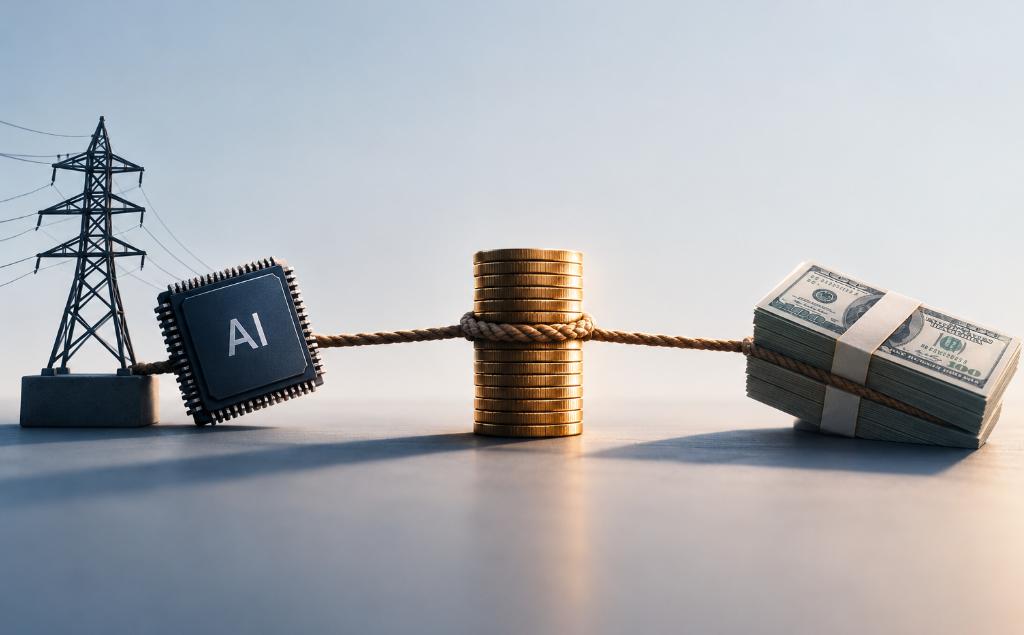
The fuse is lit: The math of borrowing to build computing power no longer adds up
CoreWeave, the core target of computing power leasing and the "vane of AI sentiment", was the first to tear a hole in the capital chain.
On Wednesday, October 14, CoreWeave plunged more than 15% in a single day, and fell nearly 6% further after hours. The trading price of its $2.75 billion unsecured bonds issued in April this year fell below 80 cents on the dollar, deep into the distressed asset range, and the yield to maturity directly soared past 15%. Dow Jones market data shows that its 5-year credit default swap (CDS) jumped to 881 basis points, and the market-priced implied default probability within five years has exceeded 50%.
Even if CEO Michael Intrator urgently issued an internal memo emphasizing that the company has $1042 billion of undelivered orders and more than $250 billion of new customer commitments in the third quarter, the market chose to vote with their feet.
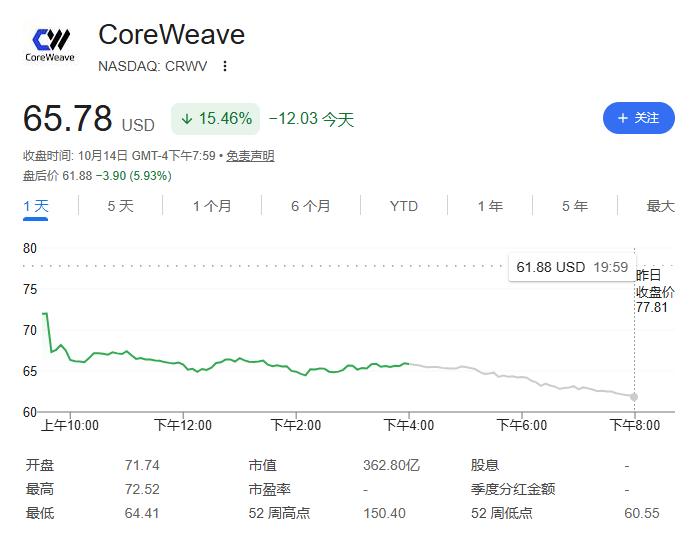
Orders are future expectations, but buying GPUs, renting data centers, and deploying high-voltage power grids require real money to be paid today. Gil Luria, head of technology research at D.A. Davidson, said bluntly:
"They have lost the ability to borrow at a 9% interest rate. If CoreWeave borrows at a 9% cost and can only get a 5% return, it makes no sense no matter how much scale it expands: they are destroying value at every step."
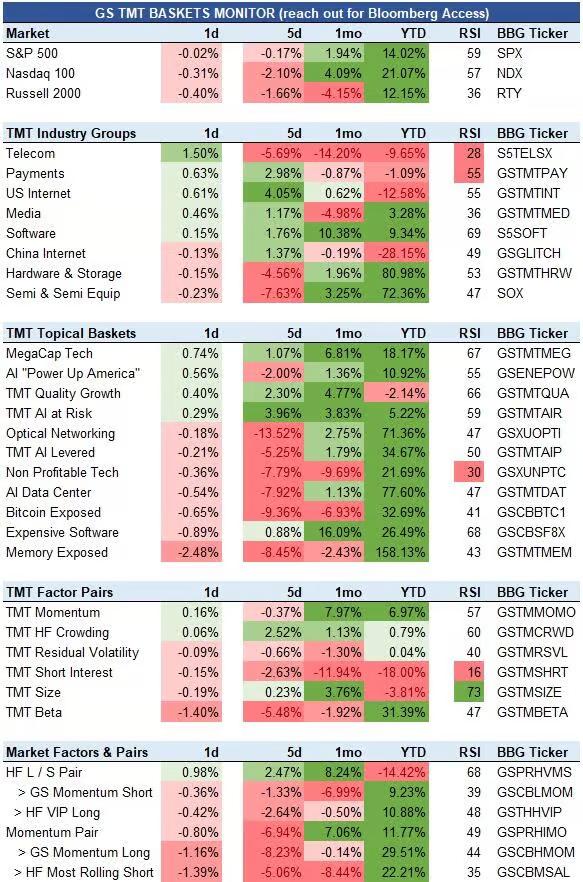
Panic quickly spilled over. On that day, Oracle fell more than 7%, Dell fell more than 10%, and data center targets such as Digital Realty and IREN plummeted nearly 10%. Goldman Sachs' TMT sector index shows that in the past five trading days, the US stock memory sector fell 8.5%, the AI data center sector fell 7.9%, the semiconductor sector fell 7.6%, while the S&P 500 index fell 0.17%. Elon Musk left a meaningful exclamation on the social platform: "yikes".
The heads of chip giants no longer hide their concerns about the capital chain. When Broadcom CEO Hock Tan and Intel CEO Lip-Bu Tan appeared on the same stage at the DBS Bank Summit in Singapore, they directly labeled capital as the biggest bottleneck of the industry. Hock Tan publicly stated:
"I think the biggest limiting factor is capital." "Many investors simply don't know what they are investing in."
Elon Musk then bluntly endorsed on the social platform: "Don't cry if you're in the casino." Intel CEO Lip-Bu Tan added:
"If there is any challenge ahead, it is capital and capital cost; on the other hand, in the long run, people need to see ROI."
Cash flow inversion: Even the most profitable giants have to borrow 400 billion dollars
If only small and medium-sized AI enterprises are short of money, the storm will not shake the overall market. The core crux is that the world's most cash-absorbing hyper-scale cloud giants have had their own hematopoietic capacity completely devoured by AI.
Goldman Sachs' equity strategy team disclosed a set of figures in its latest flow report: The total capital expenditure of global hyper-scale cloud service providers in 2027 will climb to 1.2 trillion US dollars, while the total expected operating cash flow of these giants will only be 1.1 trillion US dollars.
This is a rare cash flow inversion in the history of tech giants. Alphabet recorded its first single-quarter negative free cash flow in the company's history in the second quarter of this year, with a net outflow of 5.9 billion US dollars; Amazon's free cash flow turned negative by 7.6 billion US dollars in the past 12 months.
The cash earned is not enough to burn, and the remaining gap is completely filled by debt.
Goldman Sachs' credit strategy team estimates that at least 35% of the cloud giants' capital expenditure next year will need to be resolved through external bond issuance, which means that the public market will welcome more than 400 billion US dollars of huge tech company bonds. On the equity financing side, 45% of the approximately 430 billion US dollars of additional issuance fundraising in the US stock market this year has flowed to AI concept companies.
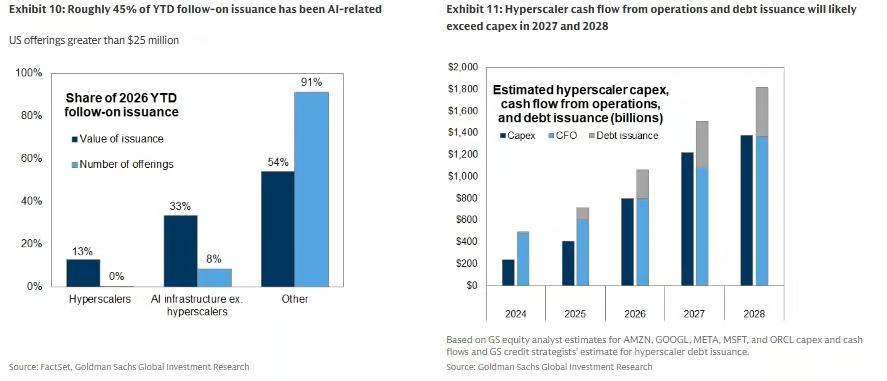
Goldman Sachs' research report points out the fragility of this passing-the-parcel game:
"As long as interest rates rise and the gap between debt cost and equity cost narrows, the path for enterprises to maintain valuation expansion through bond issuance and share repurchase will be severely suppressed."
Squeezed by huge national debt: The 10-year US Treasury yield breaking 5.3% acts as a liquidity pump
The biggest misfortune of borrowing to build computing power is hitting the rare sovereign debt great inflation in the post-war global history.
In the 2026 fiscal year ending at the end of September, the US federal fiscal deficit climbed to 1.993 trillion US dollars, with annual expenditure as high as 7.4 trillion US dollars, and net interest expenditure alone ate up 1.1 trillion US dollars of tax revenue.
To pay for the huge deficit, the Treasury Department is pressing the national debt market with historically massive supply. Recently, the yield of 10-year US Treasury bonds broke through the 5.3% mark again, the 2-year US Treasury yield jumped more than 7 basis points in a single day; the winning bid rate of the 30-year US Treasury auction hit the highest record since August 2000.
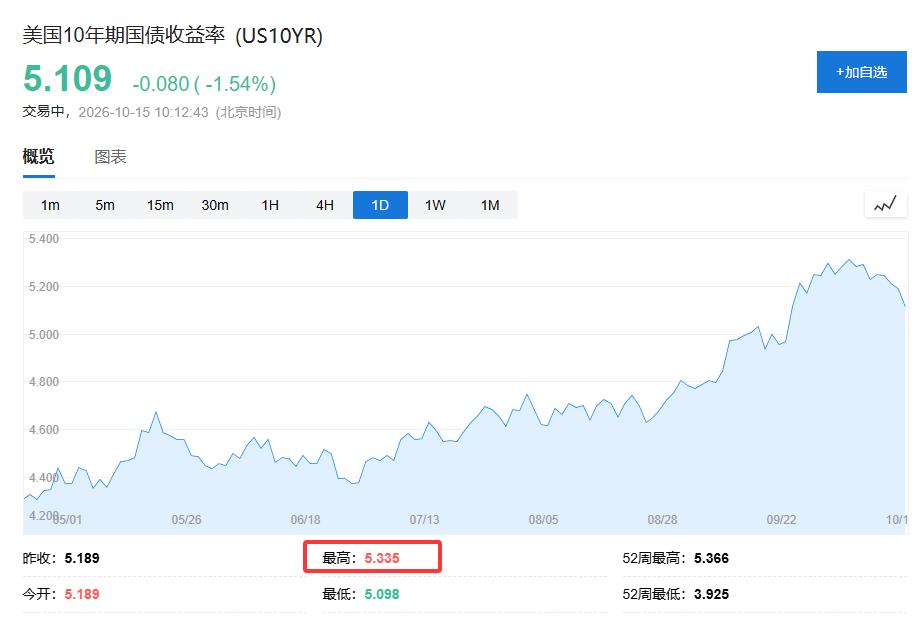
The AI bond issuance wave is forced to compete with the US Treasury Department for the same stock of US dollars in the deep water zone.
Ilir Xholi, head of swap trading at Goldman Sachs, pointed out that between September 22 and October 7, the 10y10y forward dollar swap rate surged abnormally by 47 basis points, while the 2-year rate representing the Fed's short-term policy expectation remained completely unchanged. Xholi wrote in the report:
"This wave of anomalies is completely disconnected from the Fed's interest rate path, and essentially the market is demanding extremely strict risk premium compensation when buying long-term assets."
"The massive bond issuance of AI hyper-scale cloud vendors and semiconductor companies in September directly engaged in hand-to-hand competition for funds with US Treasuries in the long-duration market."
At the same time, global capital is flowing back to its home market. Japan's 10-year government bond yield broke through 3%, and overseas institutions sharply reduced their long positions in US and European bonds. The global capital pool is continuously shrinking, and capital costs are systematically raised.
Credit buffer pad returns to zero: The whole industry faces hard capital rationing
The benchmark interest rate has climbed to the high level of 5.3%, but the protection pad of downstream credit spreads has disappeared completely.
Sara Grut, credit strategist at Goldman Sachs, warned that among the current US dollar investment-grade corporate bonds, the proportion of credit spreads in all nominal yields has fallen below 15%, far lower than the historical average of 45%:
"In the past, when government bond rates rose, credit spreads tended to narrow to absorb the impact. But in recent months, credit spreads and Treasury yields have started to rise in the same direction, and credit assets are facing double headwinds."
In the high-risk financing end, this kind of capital rationing is even harsher. Rich Privorotsky, head of Goldman Sachs' London trading desk, pointed out that the CCC-level spread in the junk bond market has jumped to around 1250 basis points, widening by more than 200 basis points within a month.
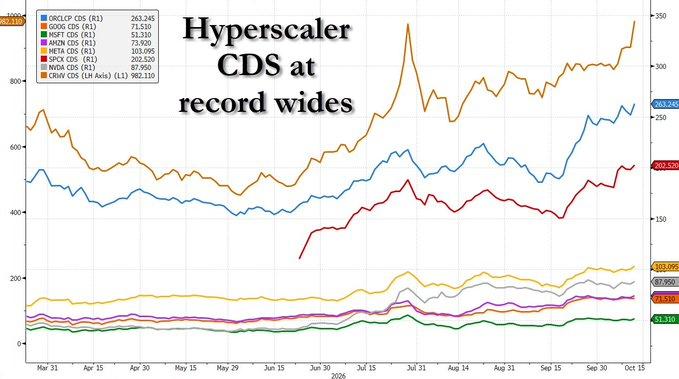
The prices of credit derivatives for core AI leaders have all sounded the alarm:
Broadcom's 5-year CDS rose to 136 basis points, a record high;
Oracle's 5-year CDS broke through 261 basis points, a record high; while its share price kept falling.
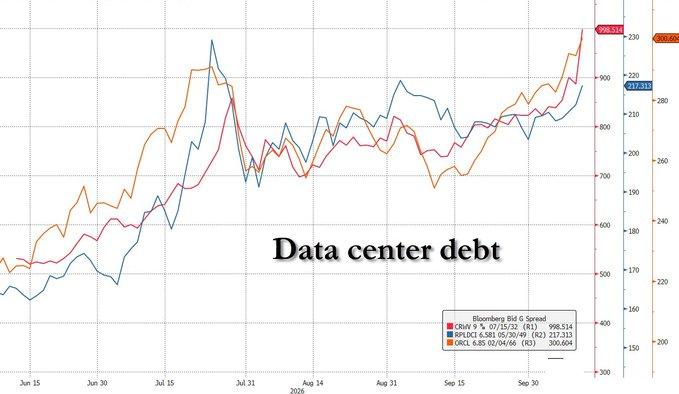
CoreWeave's unsecured bond spread directly broke through 1000 basis points;
The $5 billion leveraged loan launched by Norwegian data center operator Volta has a comprehensive financing rate approaching 11%.
Privorotsky prompted in the client report:
"Close attention should be paid to the spread of credit pressure to the single-B and leveraged loan markets. If credit pressure continues to spread, its destructive power will extend from AI to small and medium-sized enterprises, physical consumption and the entire macro economy."
Jamie Dimon, CEO of JPMorgan Chase, gave the same judgment before: When capital costs remain high, the private sector needs to borrow money to buy GPUs, and the public sector needs to borrow money to cover the deficit. The allocation of capital will no longer follow stories, but will be brutally forced to ration by price - that is, the high interest rate.
Goldman Sachs warns: The semiconductor supply chain may face the risk of order gap in 2027-2028
Capital cutoff and high financing thresholds are being transmitted to the terminal procurement chain.
The third-quarter financial report released by ASML on Wednesday is a microcosm: despite the performance far exceeding expectations and the raised lower limit of 2026 guidance, the management also emphasized that future production capacity is in short supply, but the share price still fell 3% at one point after the financial report was released.
The core logic of the market sell-off is that ASML did not raise its performance expectations for 2027 and beyond. Goldman Sachs TMT experts pointed out:
"Credit crunch has led to the delayed delivery of a large number of AI infrastructure projects, and this variable has become the biggest concern of the stock market."
Privorotsky thus gave the "air pocket" of the semiconductor industry chain:
"The real risk now is that high capital costs and actual delivery bottlenecks are preventing end demand from being converted into actual capital expenditure.
If you are a middleman in the supply chain between strong end demand and undeliverable reality, at a certain point, you will face the risk of sudden order gap. The semiconductor supply chain has extremely deep concerns about this, especially whether this will evolve into a crisis in 2027 or 2028."
Privorotsky wrote at the end of the report the most precise definition of the current AI boom:
"We are still optimistic about the prospect of this technology at the bottom, but we must more and more clearly admit that the ultimate bottleneck limiting this industrial revolution is no longer on the demand side, but whether we have the will and ability to raise enough cheap money for these super supplies."
This article does not constitute personal investment advice and does not represent the position of the platform. The market is risky, investment needs to be cautious, please make independent judgment and decision.
This article is from WeChat official account "Wall Street CN Max", author: Long Yue, published with authorization from 36Kr.