The Lithography Machine Paradox: Full production and full sales have locked the valuation space of the semiconductor industry.
On the evening of October 14, ASML, the Dutch lithography giant, released its latest third-quarter financial report, recording a revenue of 11.662 billion euros, a year-on-year increase of 55.2%. It exceeded 10 billion euros in a single quarter for the first time, but slightly lower than industry expectations. Of course, what ASML is doing now is a legal "monopoly" business, and revenue expectations are basically only linked to its own production capacity, which is of little significance.
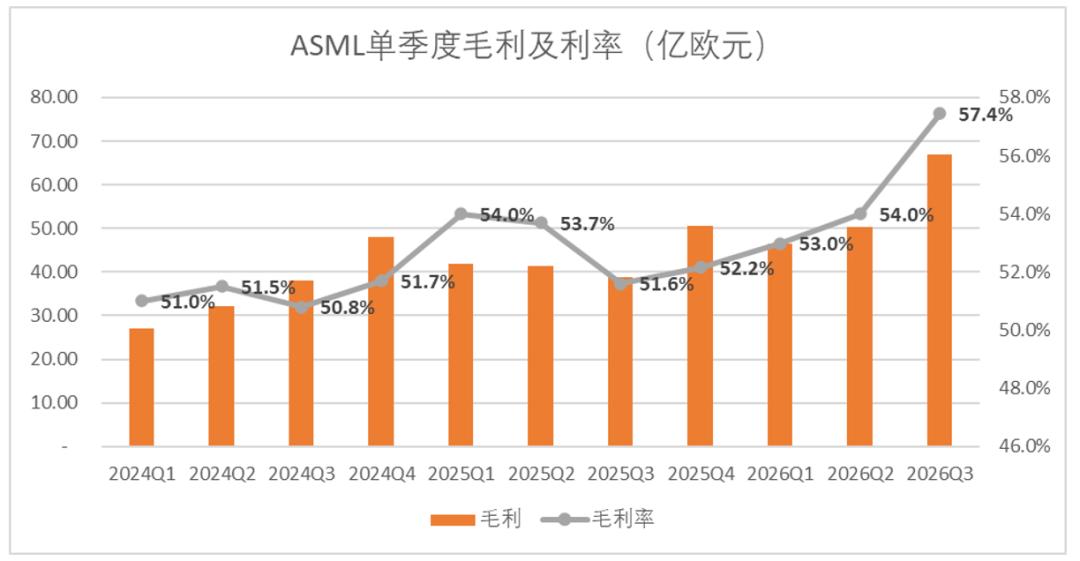
What exceeded expectations was the profit level. The gross profit margin in the third quarter reached 57.4%, and the net profit margin was 42.5%, both hitting all-time highs. Combined with ASML's previous one-size-fits-all 10% price increase for Samsung and SK Hynix, it is obvious that how much money ASML wants to make now is actually in its own hands.
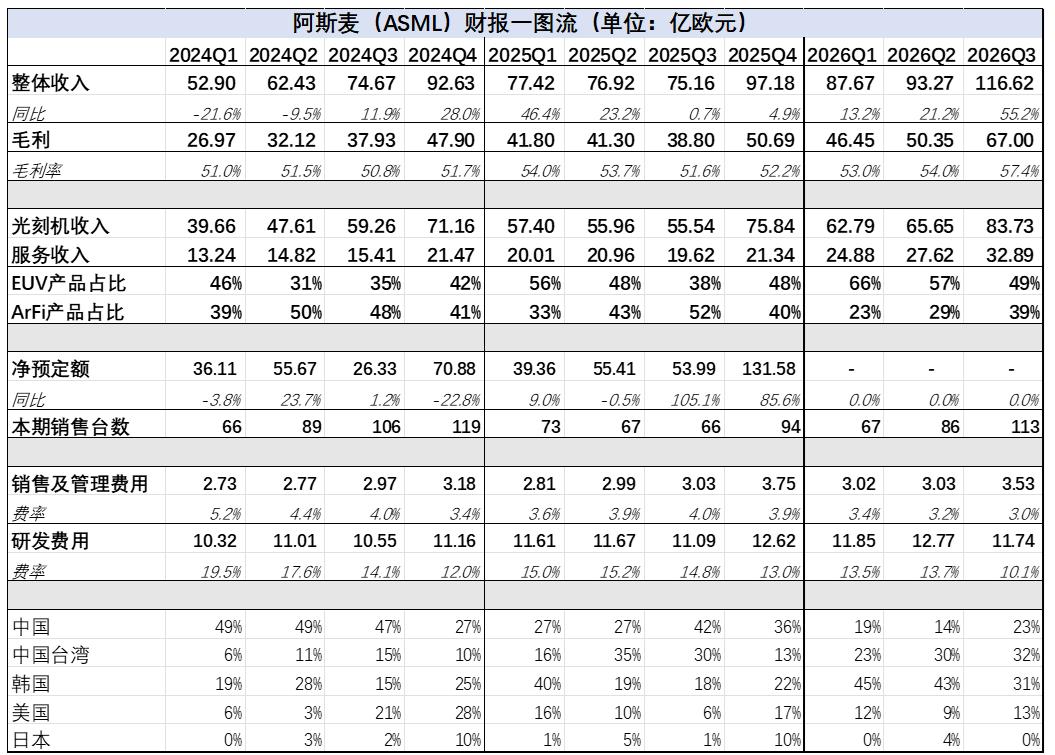
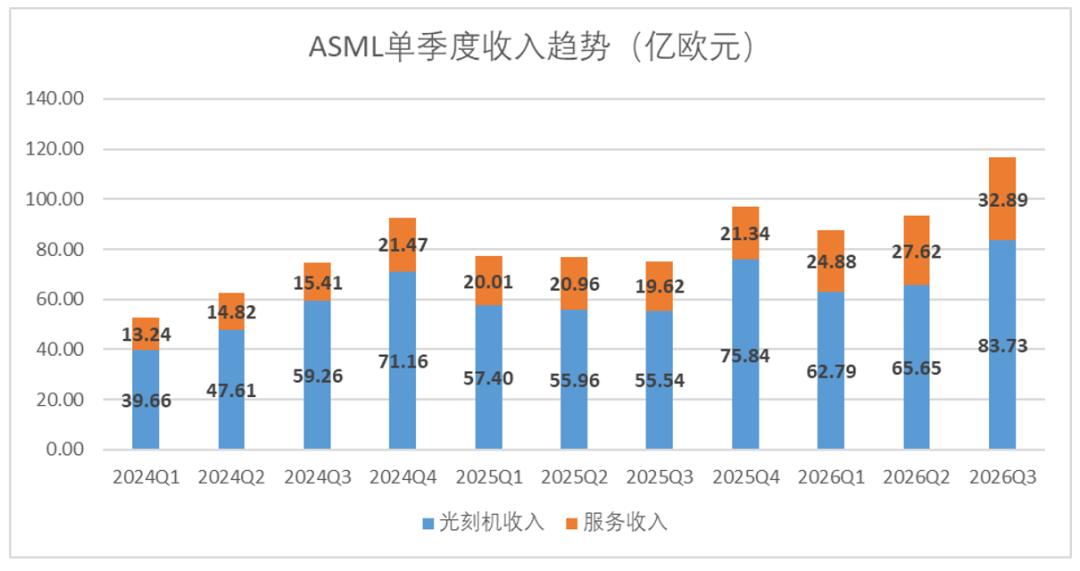
(The financial report is presented in the chart below, unit: 100 million euros, source: corporate financial report, sorted by Financial Report Chronicle)
Looking through the financial report, in our opinion, behind the brilliant performance, every family has a skeleton in the closet. On the other side of ASML's orders locked until 2028, it has actually locked ASML's valuation space.
Production capacity cannot keep up, supporting services are used to create opportunities, revenue breaks through the 10 billion euro mark for the first time
As the upstream source of the explicit value chain in the AI industry, ASML's revenue performance has always been relatively clear. The single-quarter performance revenue only depends on two items: the production capacity of the current quarter and the price per unit.
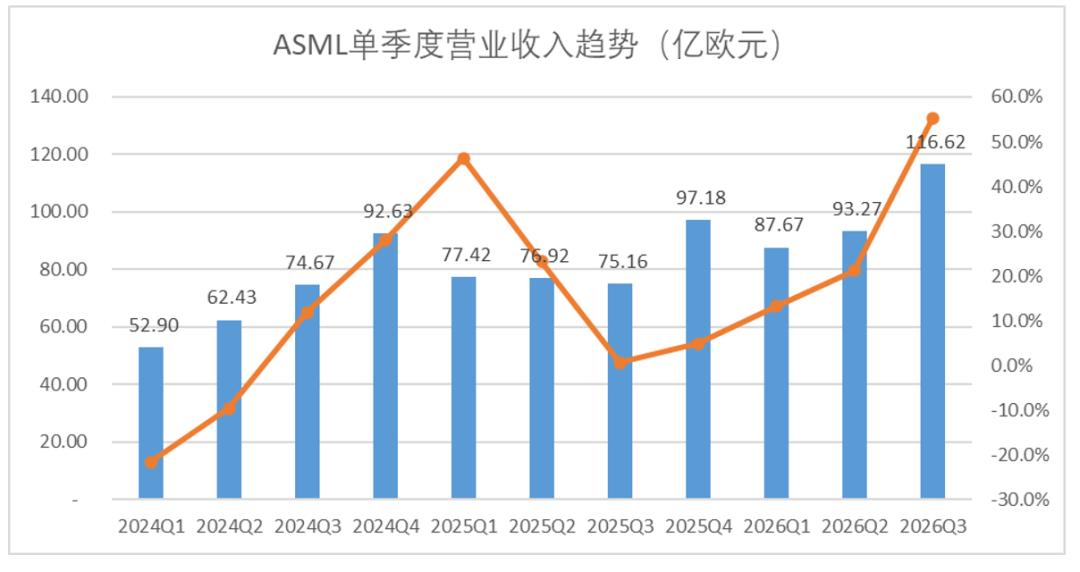
In the third quarter of this year, ASML's single-quarter revenue finally broke through the 10 billion euro mark, recording 11.662 billion euros, a year-on-year increase of 55.2%, which is also the fastest growing single-quarter financial report in the past three years. There are two core reasons:
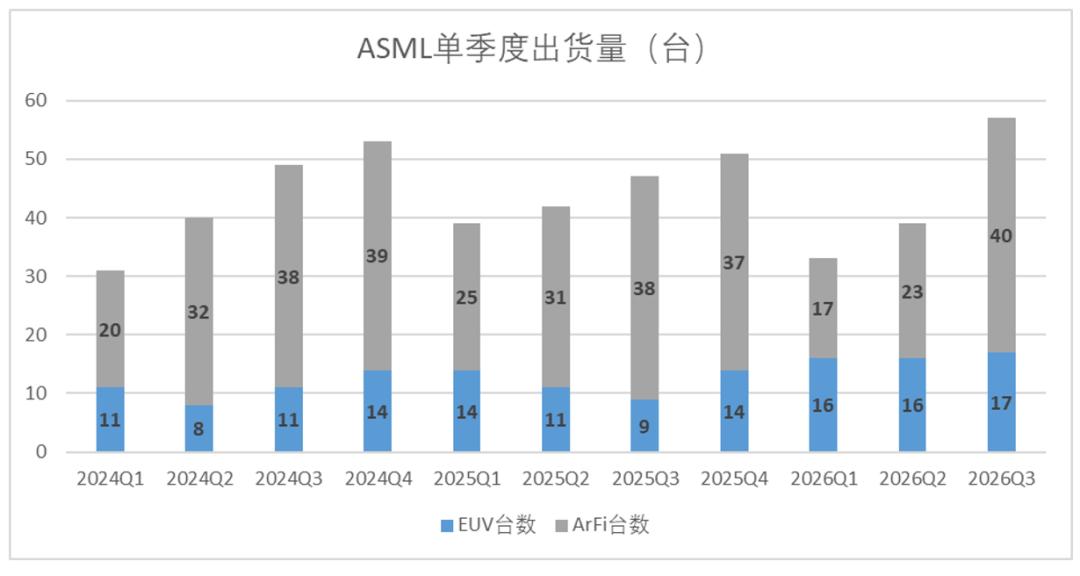
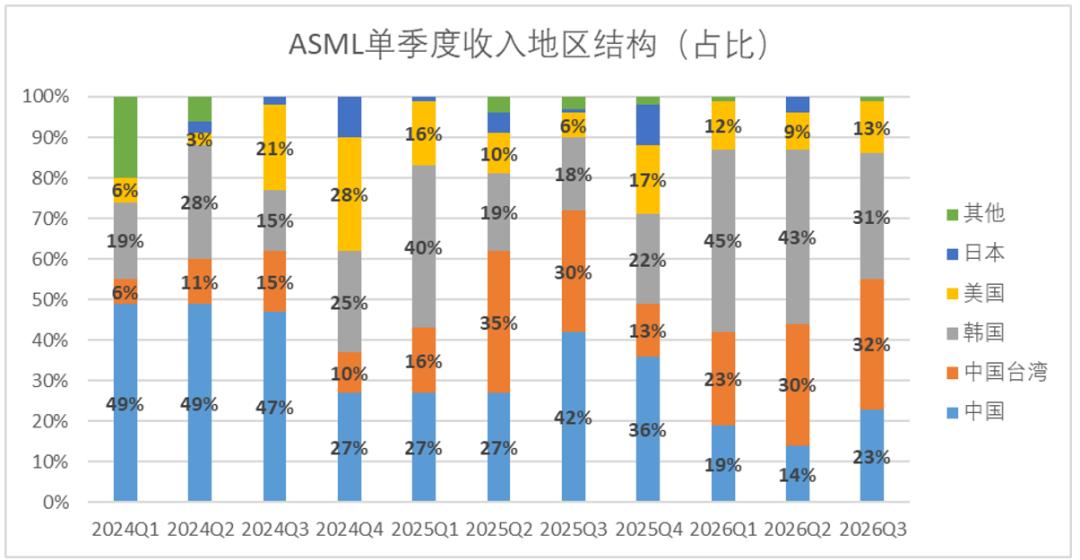
The first one is the expected acceleration of delivery. This quarter, ASML delivered a total of 17 EUV lithography machines, one more than the previous quarter, and the shipment volume of ArFi reached 40 units. The shipment volumes of the two core products both hit a single-quarter high. Among them, the recovery of orders in the Chinese mainland region is relatively obvious.
The second is that no incremental production capacity can be found, so we have to make the most of the existing stock. The stock service revenue hit a new single-quarter high. Looking at the breakdown of the revenue structure, ASML's service revenue in the third quarter reached 3.29 billion euros, setting a new single-quarter high. It is obvious that under the condition of limited production capacity, ASML hopes to grab more income from the maintenance and upgrading of existing products.
The management also said frankly at the performance meeting that the increment of service revenue: "mainly comes from the strong demand of customers for productivity upgrade products of EUV and DUV", and the demand for maintenance and iteration of delivered products has increased sharply.
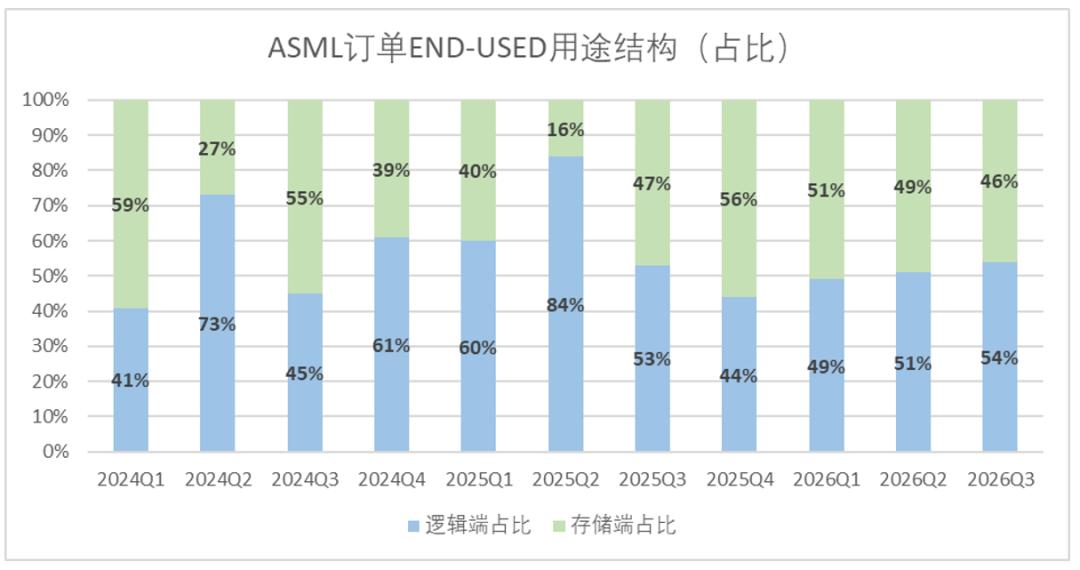
From the perspective of the order structure, the current end-use proportion of lithography machines is quite stable. Since the big explosion of the memory cycle in the third quarter of 2025, the orders for logic chips and memory chips have basically been in a 50-50 situation, so is the third quarter of this year.
At the same time, contract liabilities have increased significantly. The long-term deferred income from customer prepayments and invoiced items increased by 5.7 billion euros in a single quarter to 9.3 billion euros. The production capacity has basically been locked. In the short and medium term, ASML's revenue fluctuation will not be too large.
Under the legal "monopoly", net profit breaks through 40%
Compared with the revenue performance, the most over-expected performance of ASML this quarter is the profit level. In the third quarter, ASML recorded a gross profit of 6.7 billion euros, and the single-quarter gross profit margin reached a new high of 57.4%, the main reason is the increase of high-margin service revenue.
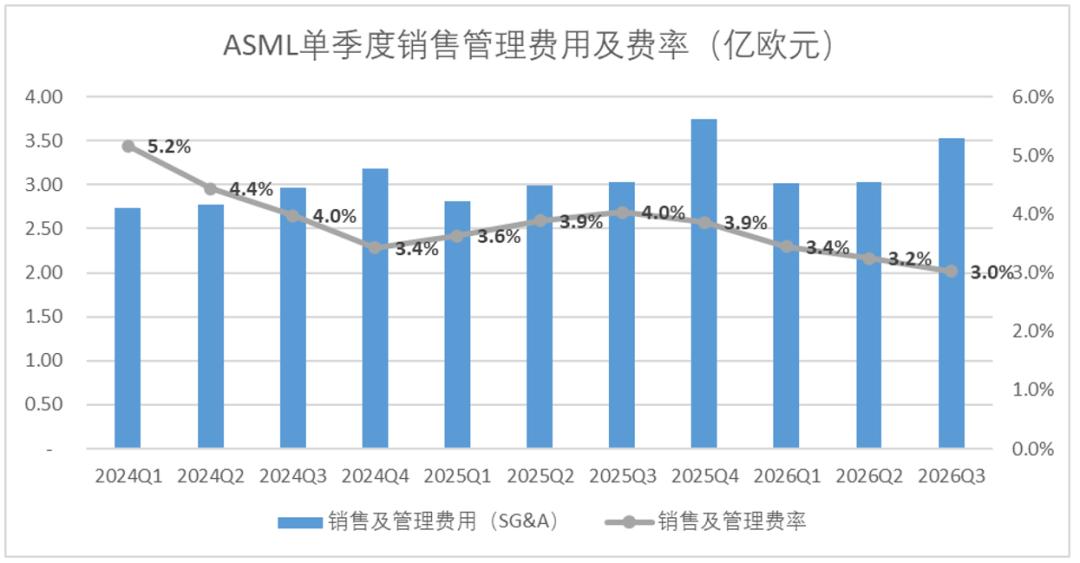
In addition to the high selling price, ASML does not need to over-invest on the cost side, the expense control is very stable, and the marginal cost of the expense rate is diluted to almost negligible. The overall expense rate in the third quarter of this year decreased by 570bp year-on-year and 380bp quarter-on-quarter.
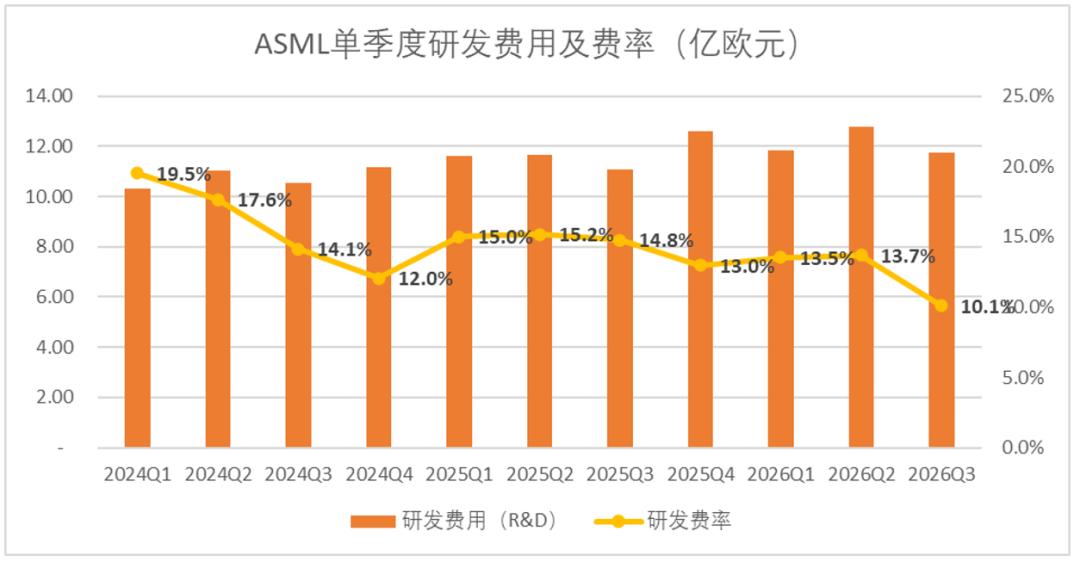
For this reason, ASML recorded a net profit of 4.96 billion euros in the third quarter, hitting a new single-quarter high, and the net profit margin reached a staggering 42.5%. Of course, this includes a revaluation gain of 510 million euros on the stake in Mistral AI. Excluding the impact of this part of investment income, the operating profit also doubled, and the net profit margin still stood at 38%.
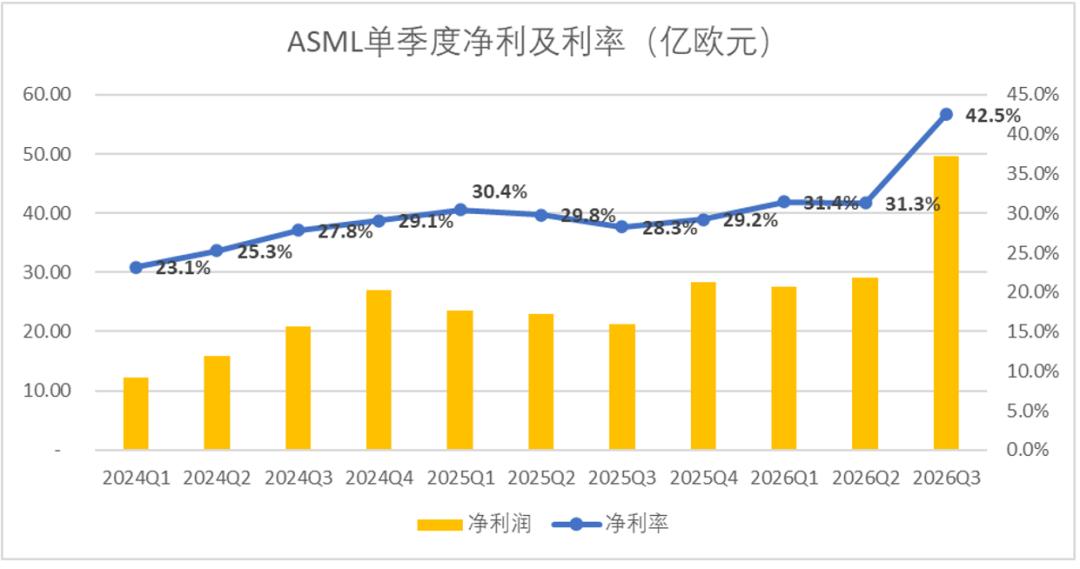
For ASML, even if it charges 5%-10% more, the impact on the demand of the downstream industrial chain is negligible. After all, since the beginning of this year, the prices of memory and logic chips have been changing rapidly day by day. It is expected that when the production capacity is not fully released in the next two years, ASML's profit margin will rise significantly.
The downstream is making huge profits, and ASML is also jealous
In the third quarter, the shipment price of ASML lithography machines remained at a high level. According to the rough calculation of the financial report, although the shipment volume increased, the average price of EUV products remained at around 336 million euros, and that of ArFi products remained at around 114 million euros, both of which have increased significantly compared with last year.
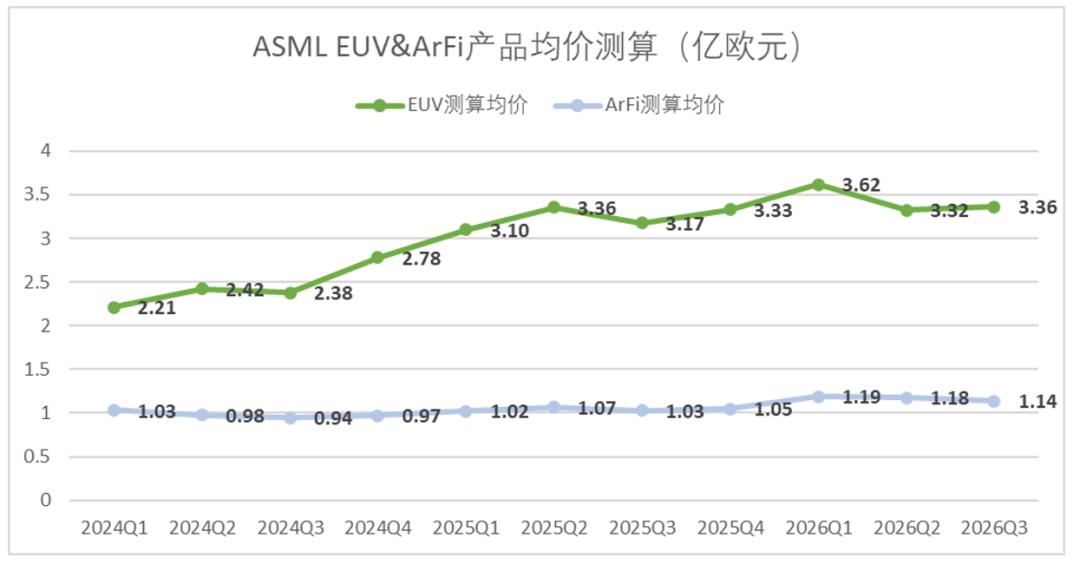
Benefiting from this, the management raised the lower limit of the revenue guidance for the fourth quarter, but obviously, this cannot satisfy ASML's ambition.
There is no doubt that ASML's customers are in a rare profit cycle in industrial history. Now the stars in the downstream industrial chain, SK Hynix, Samsung, Micron and other memory chip manufacturers, have raised their gross profit margin to about 76%, which is much higher than that of the monopolist ASML.
SEMI predicts that the global semiconductor manufacturing equipment sales will reach 165.9 billion US dollars in 2026, a year-on-year increase of 23.2%, of which DRAM equipment will grow by 39%.
ASML is also jealous. At this year's performance meeting, ASML's management emphasized the future price increase plan, and said that the price increase of key products has been discussed with customers, which is expected to start contributing in 2027 and show full impact in 2028. Previous reports said that starting from January next year, ASML will uniformly increase the price of replacement parts for lithography machines supplied to the South Korean market by 10%. After negotiation, Samsung and SK Hynix have accepted this price adjustment.
Under the background of limited production capacity, ASML can only raise prices if it wants to make money. However, not all customers are willing to accept this cost. TSMC, its largest customer, has expressed opposition to the price increase plan. However, from the confident statements of the management at the performance meeting and the successive shipments of High-NA EUV, the price increase may be inevitable.
Every family has its own set of problems, full production locks ASML's room for imagination
The third-quarter report released by ASML shows that revenue is basically in line with expectations, profits exceed expectations, and the management raised the guidance. At the performance meeting, it also clearly stated the price increase plan and capacity expansion plan for the next year, which seems to be thriving. However, after the financial report was released, the market reaction was relatively mediocre, the stock price fell by 4%, and the retracement from the high point at the end of June was about 17%.
The key reason behind this lies in a sentence from the management:
"We now expect that according to the current plan, the output in 2027 and 2028 cannot fully meet customer demand."
This sentence seems to be showing off, but in fact it exposes two major problems faced by ASML:
(1) From the perspective of production capacity, ASML is not the absolute upstream of the industrial chain, and it is also subject to others
At the performance meeting, most of the questioners focused on ASML's capacity expansion plan. The most representative one is Krish Sankar, an analyst from TD Securities in Toronto. This analyst is obviously dissatisfied with ASML's capacity expansion plan, and directly asked:
"In an environment of strong demand, is there a natural upper limit for EUV output, such as being restricted by the expansion pace of Dutch table supplier VDL or the production capacity of Zeiss."
After the official polite remarks, the management denied that it was subject to Zeiss's production capacity, but also said that it was negotiating with Zeiss to expand production capacity, which feels a little self-deceiving.
At present, the management has set the capacity growth rate for the next two years at 30%, which is actually slightly lower than market expectations. It can also be seen from the financial report that ASML has a sense of powerlessness, and the actual capital expenditure has not accelerated.
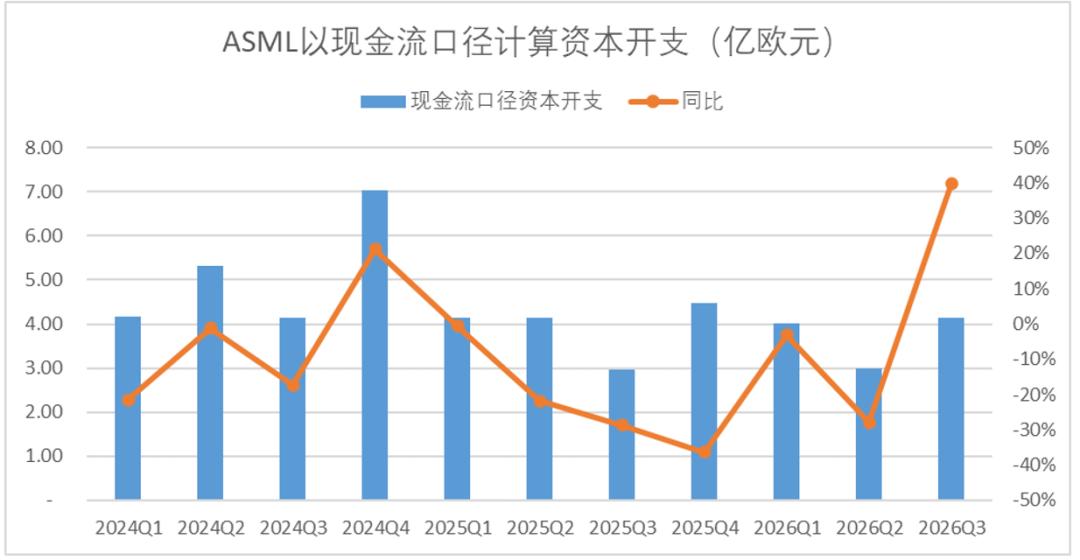
In a word, no matter it is VDL, Zeiss, or even more upstream raw material suppliers, ASML is now also subject to others.
(2) ASML understands that opportunity knocks only once, but restricted by production capacity, the return to investors is limited
Scheduling to 2028, "full production and full sales, supply falling short of demand" is good news for most enterprises. But for ASML, which is at the forefront of the century-old opportunity and the tide of the times, it is a little awkward. The simplest truth is that in the short and medium cycle, the golden demand of the industry cannot be converted into profits on the books.
There is still a certain gap between ASML's market performance and investors' expectations. Since the beginning of this year, ASML's market value has increased by 55%, while downstream customers SK Hynix and Samsung have both doubled their valuations. Even after recent corrections, their growth from the beginning of the year has reached 95% and 77% respectively.
Obviously, investors are not satisfied. The management also understands that the window period is precious, and frantically explained the potential profit realization space in the future at the performance meeting, and came up with a solution: under the condition of limited production capacity, use service revenue to paint a bright future:
"The ability to increase production capacity by upgrading within the same footprint is extremely attractive to our customers, because its effect is to immediately improve output capacity. We will continue to promote this important value driver, expand the product portfolio of upgrades in the next few years, and provide customers with new productivity improvement options."
But