The detailed regulatory rules of Shenzhen and Hangzhou are rolled out on the same day, bringing both tightened and loosened adjustments to the capital accounts of real estate enterprises.
On October 15, the detailed implementation rules for completed housing sales in Shenzhen and Hangzhou were released on the same day.
By this point, the number of cities that have released the detailed rules for the "August 28 New Policy" has risen to 7.
Although the two cities of Shenzhen and Hangzhou released their rules on the same day, their orientations are different. The core of Shenzhen's rules is tightening the quota (the maximum deposit is 3%), and delegating supervision to the district level. The core of Hangzhou's rules is providing options, opening access channels, and reserving sufficient transition time.
Comparing the 7 cities, the overall framework is fully consistent, and different choices are made in quantifiable aspects: the maximum allowable deposit amount, the deadline of the transition period, the number of years allowed for land payment installments, and the responsible party for fund supervision. These differences determine the new housing supply rhythm of each city after 2027, and also determine the cash flow curve that real estate enterprises need to bear when developing the same project in different cities.
01
On October 15, Shenzhen Municipal Housing and Construction Bureau, Shenzhen Municipal Planning and Natural Resources Bureau, and Shenzhen Regulatory Bureau of the National Administration of Financial Regulation jointly issued the "Implementation Opinions on Implementing the Notice on Improving the Commodity Housing Sales System", which consists of six parts, with a structure basically consistent with that of Shanghai and Guangzhou. From the specific content, Shenzhen's rules mainly have the following characteristics:
1. The capping standard is clearly defined with no room for ambiguity
Shenzhen clarifies that the standard for main structure topping out is that the building applying for pre-sale has completed the concrete pouring of the roof structure, and submitted the "Main Structure Sub-project Quality Acceptance Record" signed and sealed by four parties: the project construction unit, design institute, construction contractor, and supervision unit, which blocks the operation space of applying for pre-sale with partial topping out.
2. The maximum deposit is 3%
Shenzhen stipulates that for existing housing sales projects that have obtained the construction permit for the main structure of residential buildings, development enterprises can sign commodity housing deposit contracts with home buyers, and the deposit generally shall not exceed 3% of the total housing purchase price. Among the four first-tier cities, Beijing has the strictest standard of 1%, Guangzhou has the most lenient standard of 5%, and Shenzhen chose to tighten the limit to 3% after Guangzhou relaxed its rule, keeping consistent with Shanghai.
3. Land transfer premiums shall be paid off within one year in principle
Shenzhen requires that if the land transfer price is paid in installments, the remaining balance shall be paid off within one year in principle. For special projects, the payment period can be extended to two years after collective decision-making by the land transfer coordination and decision-making institution. Beijing directly stipulates that the payment shall be completed within two years, Shanghai and Guangzhou adopt the rule of one year plus one more year of extension, and Shenzhen is the only one among first-tier cities that sets the two-year period as an exception.
4. Fund supervision is delegated to the district level
Shenzhen clarifies that the housing construction departments of all districts shall perform the territorial supervision duties of pre-sale funds within their respective jurisdictions, and the specific daily supervision affairs shall be undertaken by the Municipal Housing Provident Fund Management Center, which shall open a fund supervision account at the lead bank. Shenzhen is the only first-tier city that adopts the two-layer structure of district-level territorial supervision and municipal-level institution handling.
02
On October 15, Hangzhou Municipal Housing Security and Real Estate Administration Bureau, Hangzhou Municipal Planning and Natural Resources Bureau, Hangzhou Municipal Commission of Urban-Rural Development, and Zhejiang Regulatory Bureau of the National Administration of Financial Regulation jointly released the "Trial Implementation Opinions on Implementing the Notice on Improving the Commodity Housing Sales System"
Hangzhou's document is the only one marked "Trial" among the seven cities. On the same day, the Office of Hangzhou Leading Group for High-Quality Promotion of Urban and Rural Construction and Management also released the "Notice on Promoting the High-Quality Development of the Real Estate Market in Our City", and the two documents are implemented as supporting policies. From the specific content, Hangzhou's rules mainly have the following characteristics:
1. Return the right of choice to enterprises
Hangzhou clarifies that except for projects where completed housing sales are explicitly specified in the land transfer announcement, real estate development enterprises can independently choose pre-sale or completed housing sales. Although this provision is stated in the supporting "Notice on Promoting the High-Quality Development of the Real Estate Market in Our City" rather than the main text of the implementation opinions, the orientation is very clear: use the flexibility of supply-side choice to ensure a smooth transition during the system switching period.
2. Move the sales node forward and open the channel for mortgaged housing sales
Hangzhou stipulates that for projects that obtain land use rights after August 28 and implement completed housing sales, sales can be carried out after completing the completion filing, meeting the delivery conditions and filing with the municipal and district-level real estate administrative departments, and there is no mandatory requirement to complete the first housing registration. Among the seven cities, only Hangzhou and Guangzhou move the sales window to the completion filing link, and the other five cities require the first registration to be completed in advance.
Sales with mortgage is a unique policy of Hangzhou. All seven cities require that the housing source and construction land use right are free of mortgage and seizure, while Hangzhou opens a separate exception: after reaching an agreement with the mortgagee for sales, submitting the consent certificate, publicizing the mortgage status, and clearly specifying the mortgage status and promising the cancellation deadline in the subscription agreement, the contract filing procedures can be completed only after the mortgage of the house and construction land use right is cancelled. Development enterprises no longer need to raise bridge funds at one time to release the mortgage of the whole project, and can release the mortgage per unit while selling the properties.
3. Split large projects into small units to allow completed buildings to enter the market first
Hangzhou supports the separate handling of construction project planning permits, construction permits, pre-sale permits and completion acceptance filings. For phased development projects, after obtaining the construction planning permit, the pre-number of real estate registration units can be pre-compiled and the pre-registration certificate of real estate and land can be processed. With the pre-registration certificate, sales procedures can be handled for the housing sources of which the land transfer premium has been paid off by phases and by buildings; at the same time, Hangzhou explores the collective handling of development loan mortgage registration according to the divided household land use rights.
The two policies together solve the same problem: large projects do not need to wait for the entire land to be fully developed, and the mortgage does not need to be released for the whole plot at one time, and the completed buildings of any batch can be sold first.
4. The most lenient standards are adopted for the transition period and land payment rules
Hangzhou divides the new-old transition into four categories. For the last category, real estate projects with historical legacy issues that have obtained state-owned construction land use rights before August 28, after risk assessment by the district and county government where they are located and filing with the municipal real estate administrative department, can apply for pre-sale according to the original pre-sale conditions before the end of 2028. This transition period is the longest among the seven cities, the same as Wuhan, but with wider coverage. The down payment of land transfer premium shall not be less than 50% within 30 natural days after the contract is signed, and the remaining balance can be extended to be paid off within two years without interest, which is the most lenient standard parallel with Beijing and has no additional decision-making prerequisites.
In general, Hangzhou's detailed rules are the current released version with relatively high cash flow friendliness for real estate enterprises.
03
Up to now, a total of 7 cities have released the detailed rules for the "August 28 New Policy", namely Beijing, Shanghai, Guangzhou, Wuhan, Tianjin, Hangzhou and Shenzhen.
All cities take August 28, 2026 as the node for the new-old transition, prioritize completed housing sales for newly transferred land, raise the pre-sale threshold to the completion of main structure topping out, move the mortgage loan issuance to after the completion filing, and adopt the lead bank system to realize closed management of project funds. The top-level design of the central government has not been diluted at the local level.
The truly informative content is in the specific detailed rules. The most important ones are the maximum deposit and the length of the transition period. The maximum deposit ranges from 1% to 5%, and the seven cities are divided into three tiers: 1% for Beijing, 3% for Shanghai and Shenzhen, and 5% for Guangzhou, Wuhan, Tianjin and Hangzhou. The general transition period of all seven cities extends to the end of 2027, and only Shenzhen specifies the exact deadline as December 31, 2027. For historical legacy projects, Wuhan and Hangzhou set the deadline to the end of 2028, and the other five cities implement according to the caliber of ongoing projects or leave the rules for subsequent research.
Judging from the maximum deposit and the length of the transition period, Beijing has the strictest rules among the 7 cities, while Wuhan and Hangzhou have the most lenient rules, but the lenient parts of the two cities are different.
At present, the detailed rules of all first-tier cities have been fully released. We believe that most second-tier cities will probably adopt a combination between the Wuhan model and the Hangzhou model.
The core of the Wuhan model is the longest transition period plus the most lenient deferral space for payment, and the core of the Hangzhou model is the earliest filing node plus the most complete cycle management tools. Both models aim to reduce the friction cost of system switching. For second- and third-tier cities with long inventory digestion cycles and high dependence on land finance, the replication cost of these two sets of combinations is the lowest, and they can best balance the stability of land transactions and the property market.
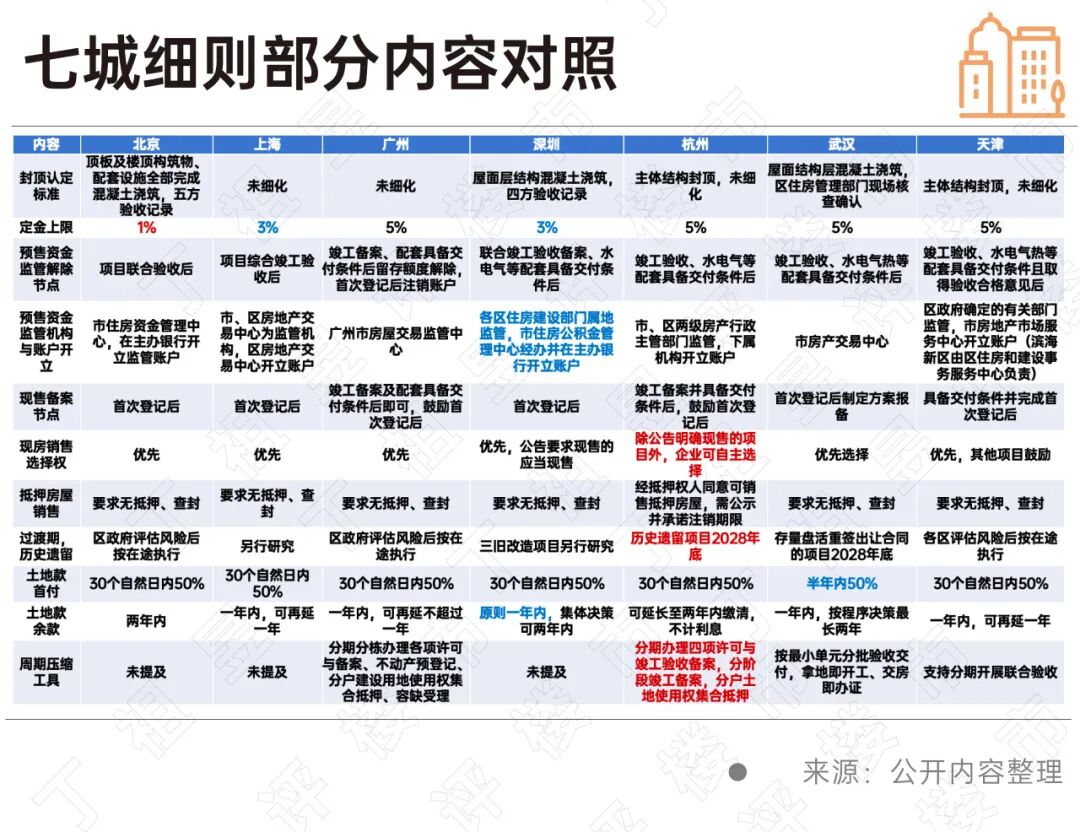
The release of the detailed rules of the seven cities means that the "August 28 New Policy" has entered the implementation stage from the institutional framework in first-tier cities and leading second-tier cities. The differences in the detailed rules are mainly concentrated in the maximum deposit, the deadline of the transition period, the number of years allowed for land payment installments, and the fund supervision institution, and their actual implementation effect will be tested in the approval process of the first batch of projects under the new rules in 2027.
According to the calculation of Pury Research Center, the projects that have obtained pre-sale permits and started construction before the "August 28 New Policy" are sufficient to survive the one-and-a-half-year transition period. The supply volume in first-tier cities will even increase, and there will be no shortage of housing supply in the short term (see "Logic Restructuring | Supply: The Supply in the First Three Quarters Decreased by 31.4%, But There Will Be No Housing Shortage in the Short Term?" for details).
Project cooperation and consortium land acquisition will become a more common choice in the future (see "After the August 28 New Policy, Real Estate Enterprises Begin to 'Form Teams to Acquire Land'" for details).
The orientation of the detailed rules in major cities is essentially to find a balance between maintaining the continuity of land transactions and keeping the property market stable, rather than simply heating up or cooling down the market.
For enterprises, in the era of completed housing sales, the efficiency of completion filing and product strength are the real core competitiveness.
This article is from WeChat Official Account "Ding Zuyu's Real Estate Review", written by the Editorial Department, and authorized for release by 36Kr.