Witness history, the rocket-powered sports car soars into the sky.
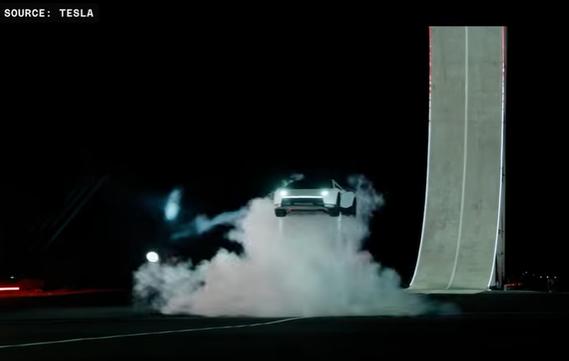
Early on October 16 Beijing time, at SpaceX's rocket test site in McGregor, Texas, a Roadster sped along the giant U-shaped runway into the sky, hovered upside down in the air relying on the cold gas thrusters at its rear, then turned around and landed.
Musk said on site that this is the greatest product demonstration in history. To convince the audience that the footage was not tampered with, he also asked everyone present to stand up one by one to testify that "this is not AI".
Since the Easter egg at the Semi launch event in November 2017, the Roadster has been waiting for nearly nine years. Its mass production timeline has been pushed back from 2020 all the way to 2028, and it is hard to count how many rounds of delays it has gone through in between.
This event, originally scheduled for October 1, was postponed for two weeks due to strong winds. The Federal Aviation Administration of the United States once designated a temporary no-fly zone for the original date, with a radius of 1.5 nautical miles and an altitude up to 10,000 feet.
The system that lifted the car is a cold gas propulsion system codenamed A71 internally, jointly developed with SpaceX, whose technical origin is the attitude control nozzles of Falcon 9 and Starship.
Lars Moravy, Vice President of Engineering at Tesla, said that 10 nozzles are installed at the rear of the car, connected to 600 liters of compressed air, and every gap in the car body is filled with carbon fiber-wound pressure vessels.
There is no fuel combustion throughout the whole process, only short-distance jumps and attitude adjustments, which is far from space driving. In terms of design, the body-in-white of the new car is more angular, inspired by the SR-71 reconnaissance aircraft and the F-35 fighter jet.
This set of configurations is divided into three tiers. The Performance version is the road-legal variant with an active aerodynamics kit, can seat two people, and requires a $50,000 deposit.
The Thrust version adds rear cold gas thrusters, with an official 0-100 km/h acceleration of less than 1 second, and a deposit of $250,000.
The top tier is the Rocket version, which is equipped with 10 cold gas thrusters on the body, can only seat one person, and is only open to invited guests. All three tiers have a range of 300 miles and a top speed of over 230 mph. The base version is priced at $200,000, and the Founder's Series is priced at $250,000 with a limited run of 1,000 units.
Looking back at the original specification sheet in 2017, the first-generation Roadster was configured with a three-motor all-wheel drive system, a ~200kWh battery, 0-100 km/h acceleration in 1.9 seconds, a CLTC range of 1,000 km, and wheel torque of 10,000 N·m. Nine years later, most of these figures are still waiting to be fulfilled, and the progress that has been realized at present is that the set of thrusters at the rear has actually been activated.
Musk's guidance for mass production is 2028, which is a step back from the previous statement of Tesla's Texas Gigafactory, and the production site is still set in Texas. He mentioned that "safety is not the primary goal", and also said that he would like to try to jump the Snake River Canyon if he gets the chance.
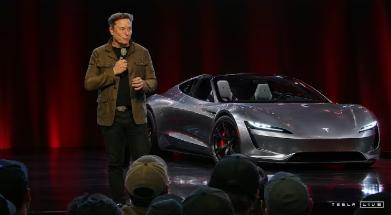
The capital market's patience with this narrative is being consumed little by little.
Tesla's current price-to-earnings ratio exceeds 340 times, and its forward valuation is close to 190 times, ranking among the top of the Magnificent Seven. Historically, Tesla's stock price has not performed well after its press conferences. After the Cybertruck window shattered in 2019, the stock price fell by 6%. After the Cybercab was unveiled in October 2024, it fell by 8.3%. Most people who bet on the rally driven by press conferences have not gained much benefit over the years.
The more troublesome part is the general environment. A higher-than-expected inflation report rekindled concerns about interest rate hikes, the 10-year U.S. Treasury yield touched around 5.32%, and the Nasdaq posted its worst single-day performance in nearly three months. High-valued growth stocks are inherently more likely to be scrutinized in such an environment.
Tesla delivered 486,500 vehicles in the third quarter, and its Q3 earnings report is scheduled to be released after the market closes on October 21.
Barclays put forward a more radical judgment, believing that there is a potential merger between Tesla and SpaceX, and the announcement may be released before the annual general meeting of shareholders, with the time window no later than December 6.
The xAI line is also moving forward. xAI has been merged into SpaceX and renamed SpaceXsi. Grok Voice 3.0 released on October 14 scored 86.9 on the speech-to-speech synthesis index, ranking first, priced at $0.08 per minute, with an average first response time of 0.81 seconds.
This set of voice capabilities has been installed in Tesla vehicles, and is also used in the Starlink customer service center, receiving about 20,000 incoming calls per day, of which about 70% do not require manual intervention. From in-vehicle infotainment interaction to customer service call handling, AI is becoming a hidden connecting line between Tesla and SpaceX.
Back to the market, US stocks closed last night, Tesla fell 1.29%, once fell more than 3% during the trading session, closing at $356.1. Since the beginning of this year, Tesla has fallen by about 18% cumulatively, ranking at the bottom of the Magnificent Seven.
In the early trading of October 16, the Shanghai Composite Index stood at 3728.21 points, up 0.56%, the ChiNext Index stood at 2801.50 points, up 0.66%, and more than 4900 individual stocks rose. Communication equipment, semiconductors, electronic components, optical fibers, and PCB all rose together, while shipping, coal, and oil and gas sectors trended downward.
The commercial aerospace concept also strengthened accordingly. The CSI Satellite Industry Index rose by 2.08%, Fudan Microelectronics rose by 9.34%, Guangku Technology rose by 6.25%, and Guoji Precision Industry rose by 5.36%. Sanhua Holding closed at 30.92 yuan in early trading, up 1.28%.
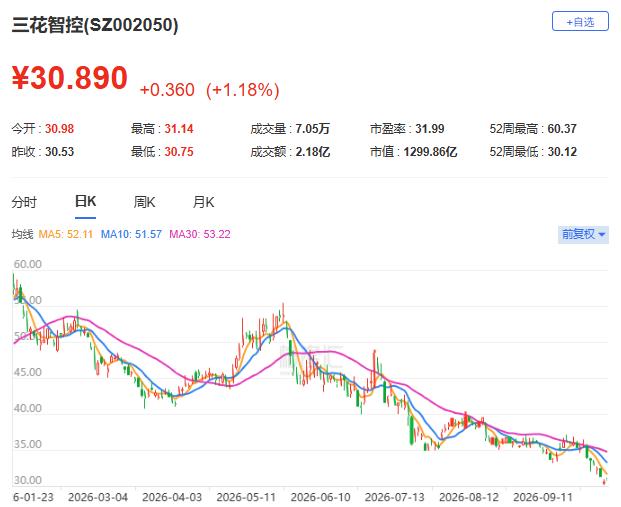
(Trend chart of Sanhua Holding; Gelonghui)
The humanoid robot track has also given production capacity guidance. Optimus is produced at a rate of hundreds of units per week at the Fremont factory, about ten times higher than the dozens of units per week in the second quarter, with a year-end target of more than 1,000 units per week. IDC data shows that in the first half of 2026, global humanoid robot shipments reached nearly 25,000 units, a year-on-year increase of 432.1%, of which China accounted for more than 19,000 units.
Tesla has three consecutive milestones in October: the Optimus lecture on the 15th, the Roadster launch event on the 16th, and the Q3 earnings conference on the 21st and 22nd.
Nine years on, Tesla has pushed the sports car from the drawing board to mid-air, and also pushed investors' expectations to a quite high level. The next test will be the Q3 earnings report after the market closes on October 21.
This article is from the WeChat official account "Gelonghui APP" (ID: hkguruclub), written by Geji La, and authorized for release by 36Kr.