Apple and Meta have patched up their differences, and they are forced to do so by AI.
On October 2, Apple did a rare thing, announcing that it would adjust system rules due to a third-party app.
The incident originated from a public accusation by Jason Aten, a tech columnist of *Inc.* magazine, that Meta's AI agent Muse had accessed private messages on his Mac. Muse is the "agent that can handle tasks for you" strongly promoted by Meta, which can help you unsubscribe from idle memberships and even negotiate prices on your behalf.
Apple immediately made a statement that the system will actively prompt users when an AI requests to read Mac data in the future.
This is almost a microcosm of the relationship between Apple and Meta in the past five years: Meta wants to obtain user data, while Apple blocks its access.
However, only two weeks later, the situation reversed.
On local time October 15, Meta released the open-weight model Muse Spark Open. Mark Zuckerberg posted on X, thanking "John Ternus and Apple" for their cooperation, which enables the model to run smoothly on the new Mac Studio.
Apple CEO John Ternus soon replied, saying that it is amazing that a model of this scale can run so efficiently right on his desk:
"Incredible."
Alexandr Wang, head of Meta's AI division, said in an interview with Axios a more funny but straightforward sentence:
"It's great that mom and dad have made up again."
So how did the "father" and "mother" reconcile? Moreover, Meta has continuously made efforts on model development recently, has it finally returned to the game table?
Putting 800 Billion Parameters On A Single Desk
First, let's take a look at what the cooperation between Apple and Meta has achieved this time.
Meta claims that Muse Spark Open has a total of 816 billion parameters, and only 42 billion of them are activated for each inference, supporting a context of 1 million tokens. Meta describes it as:
"The strongest open-weight model in the United States so far."
Pay attention to the wording of "in the United States". In terms of parameter scale, it is not the world's largest open-source model. Kimi K2 from Moonshot AI and Ling-1T from Ant Group have pushed open-source models to the trillion-parameter level as early as 2025. Meta is catching up this time, and its competitors are Chinese companies.
The truly novel part is where it runs.
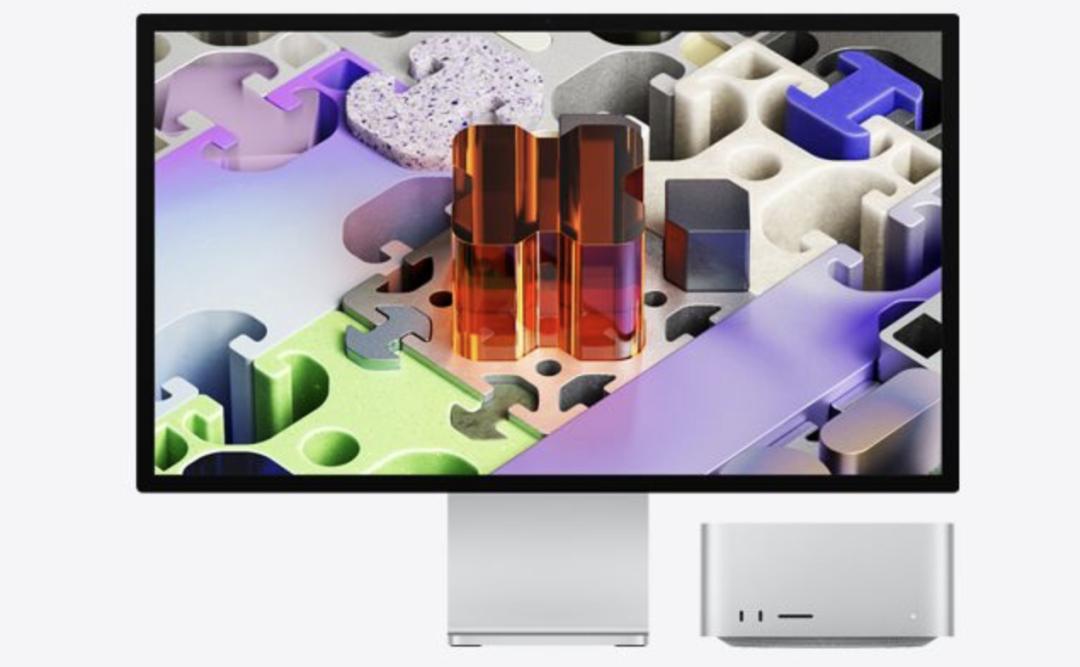
Apple's M5 Ultra Mac Studio is definitely a sharp tool for local models | Image source: Apple
According to Meta, two top-spec M5 Ultra Mac Studios can hold the entire model. The GPU of each Mac Studio can directly call up to 512GB of unified memory, and the two connected together have about 1TB of memory, which can work collaboratively like a small supercomputer under Apple's MLX framework.
It is almost impossible to place such a setup on a regular desk on any other AI hardware platform.
The logic is not complicated. This type of model with "large total parameters and small activated parameters" requires extremely large memory capacity, while the requirement for bandwidth is not that extreme. For each token generated, the model only needs to read the small part of 42 billion parameters, and the 1.2TB per second memory bandwidth of M5 Ultra is sufficient to handle this.
If you switch to the NVIDIA ecosystem, the video memory of a consumer-grade graphics card is only dozens of GB. To hold 800 billion parameters, you need a server with 8 H100-level cards, which is equipment placed in the computer room, not on the desk.
In other words, the part of Apple's unified memory architecture that has been ridiculed as "expensive" in recent years has precisely become the moat for running super-large models.
The use cases demonstrated by Meta are also very targeted. The programming tool Muse Code based on Muse Spark Open completes two tasks entirely locally: one is to submit iOS code modifications for the open-source Mastodon client Ice Cubes, and the other is to operate DaVinci Resolve to review materials and crop landscape videos to portrait orientation.
Writing code and editing videos are two of the most typical work scenarios for Mac users.
Of course, the threshold is also very realistic. The starting price of the M5 Ultra Mac Studio with 256GB memory is already $10,799, and the 512GB version is expected to be launched later this month, so the total price of two units can be imagined. It is not prepared for ordinary consumers, but for developers, studios and enterprises that are sensitive to data security.
How Did "Father" And "Mother" Make Up?
To understand how unusual this handshake between Apple and Meta is, we need to look back at the timeline.
In 2021, Apple launched the "App Tracking Transparency" feature in iOS 14.5. If an app wants to track users across applications, it must pop up a window to obtain user consent first. The vast majority of users chose to reject the request. Meta later admitted at the earnings call that this policy caused it to lose about $10 billion in revenue in 2022.
In fact, the feud between the two companies started even earlier.
After the Cambridge Analytica scandal in 2018, Tim Cook publicly stated that Apple "would never get into this situation", and Zuckerberg hit back that the remark was "extremely reckless". In 2019, Apple revoked Facebook's enterprise developer certificate, because Facebook used this certificate to distribute a research app that collected user data, which once caused all the internal test apps of Facebook to crash collectively.
By 2024, Zuckerberg complained on a podcast that Apple "hasn't invented anything great for a long time". In the same year, *The Wall Street Journal* reported that the two companies had discussed integrating Llama into Apple Intelligence, but Mark Gurman from Bloomberg later revealed that Apple had long abandoned this plan due to privacy concerns.
According to MacDailyNews, the last public cooperation between the two companies dates back to around 2017.
What melted the ice?

Apple in the Tim Cook era once had a deep feud with Meta | Image source: Reddit
The first answer is personnel change.
The helmsman of Apple has been replaced by John Ternus, and Cook, who had been arguing with Zuckerberg for many years, is no longer the CEO. Another key figure is Daniel Gross, who sold his startup to Apple in the early years, was in charge of machine learning at Apple, and joined Meta's Superintelligence team in 2025. It is reported that he acted as the middleman to facilitate this cooperation.
The second and more fundamental answer is that both companies need each other in the AI field.
Let's look at Apple first.
Foreign media's characterization of this cooperation is very straightforward, saying that this is another move by Apple to find a model partner stronger than itself in order to use AI features to drive hardware demand after falling behind in self-developed models.
Before that, Apple had integrated the models of OpenAI and Google into Siri and Apple Intelligence. But both of them adopt the cloud-side solution, and Apple is only an entrance.
Meta gave Apple a story that only Mac can tell: cutting-edge AI runs on the user's own desk, and data never leaves the device.
This fits perfectly with Apple's privacy narrative over the years, and it is also the best preheating for the upcoming, expensive 512GB Mac Studio.
Then let's look at Meta.
Alexandr Wang said frankly that Muse Spark Open is not Meta's most powerful model, and its task is to attract developers, allowing them to try it out in a small scope first, and then expand the usage scale.
The lifeline of open-weight models is the developer ecosystem, and many developers who write code use Mac devices on their desks. It is reported that Meta also purchased hundreds of Macs earlier this year for internal AI experiments, and this judgment is obviously not a temporary decision.
But Meta did not put all its eggs in Apple's basket. The weights of Muse Spark Open are simultaneously launched on the three cloud platforms of Amazon, Google and Microsoft. All mainstream inference frameworks from SGLang, vLLM to llama.cpp support it, and kernel optimization has been specially done for AMD MI350.
Apple is the most eye-catching node in this network, but what Meta wants is a network that no one can bypass.
Meta Returns To The Game Table?
Looking at the longer timeline, this handshake is only one part of Meta's series of intensive moves.
More than a year ago, in April 2025, after Llama 4 was released, it fell into benchmark score controversy, and its reputation plummeted. Two months later, Zuckerberg invested 14.3 billion US dollars in Scale AI, invited Alexandr Wang to form a superintelligence laboratory, and offered sky-high salaries to recruit talents from all sides.
More than a year later, the name "Llama" has been replaced by "Muse". At the Connect conference in September this year, Meta released the personal AI product Muse. On October 2, Muse Wonder and Muse Wonder Full for agents were launched, focusing on cross-conversation personal memory and the ability to constantly change ideas and self-check during long tasks. A few days later, the Muse Spark Open was released.
Closed-source flagship models, consumer-grade agents, and open-weight models, the three lines are advancing in parallel in the same month.
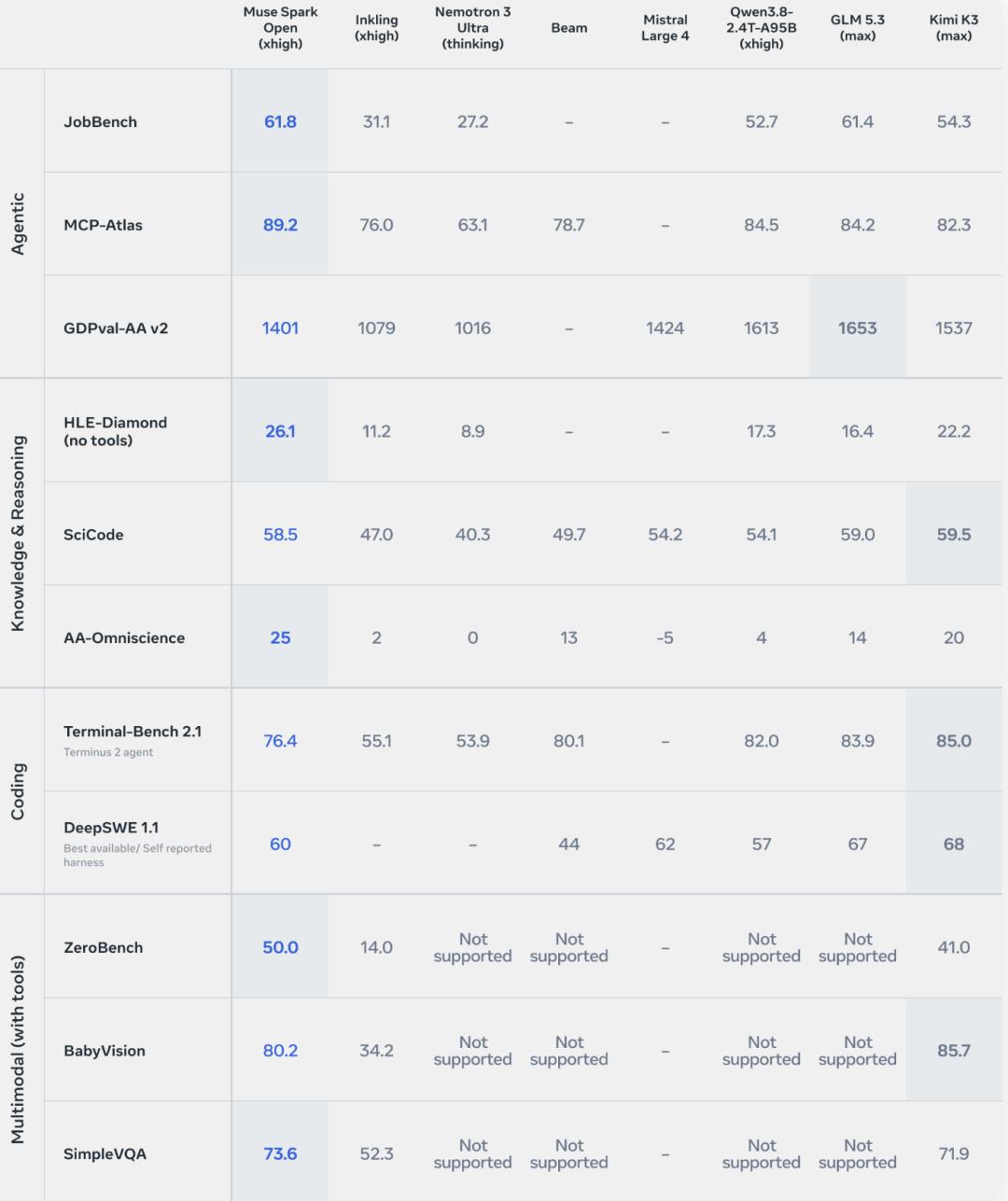
Some test results of Meta Spark Open | Image source: Meta
According to Meta's own statement, Muse Wonder Full ranks second on the Artificial Analysis Intelligence Index, only 2 points lower than Claude Opus 5.5.
But there is still a distance between "being back" and "rising".
The official blog of Muse Spark Open has not given specific benchmark scores yet, and the full evaluation report is marked as "coming soon". Under this cooperation report on MacRumors, the top reader comments almost overwhelmingly express distrust of Meta. Although Meta denied the accusation of reading private messages, it has forced Apple to adjust the system rules.
Meta's technology may have caught up, but it still owes a debt of user trust.
This is also the most subtle part of this cooperation. On the one hand, Apple added new system prompts to prevent Meta's agents, on the other hand, Apple's CEO personally praised Meta's model.
The two things are not contradictory. Apple blocked Meta's hand that reaches for user data, and welcomed Meta's model placed in Mac. The former threatens Apple's privacy brand, while the latter helps Apple sell hardware.
Palmerston, the British Prime Minister in the 19th century, once said that there are no permanent allies, no permanent enemies, only permanent interests.
At the AI game table, Apple lacks models, and Meta lacks access entrances. This common interest is enough to make "father and mother" sit at the same table temporarily.
As for whether the good relationship will last forever, the spokespersons of the two companies obviously cannot give an exact answer.
This article is from WeChat Official Account "GeekPark" (ID: geekpark), written by Hualin Wuwang, edited by Jing Yu, and published with authorization from 36Kr.