Top white-hat hacker moves to Zhipu AI, uses AI to uncover Microsoft vulnerabilities, and Microsoft even has to say thank you
Recently, AI has been acting more and more recklessly!
The other day, a batch of AI Agents running on Tencent Cloud accidentally triggered a security incident just by querying the navigation entrance data of Chengdu Zoo.
According to the investigation of security research organization Swarmchasers, these Agents tried to bypass the anti-automation mechanism of AutoNavi after their normal access was restricted.
In just ten days, researchers observed more than 2600 data acquisition attempts.
Almost at the same time, another large model was included in Microsoft's official acknowledgment list for helping find security vulnerabilities.
The list released this time is rather special: "Yuki Chen using GLM from z.ai"
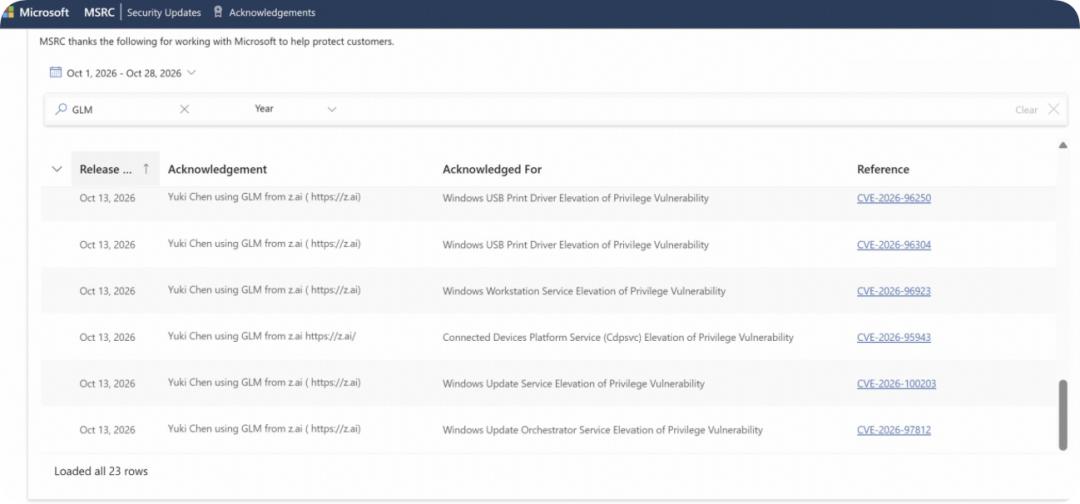
The Yuki Chen here is no ordinary security researcher.
He is the well-known "Gu He" in China's cybersecurity circle, a top white hat hacker who has topped Microsoft's MSRC Annual Security Researcher List five times.
This time, this Windows vulnerability research expert appeared on Microsoft's acknowledgment list together with Zhipu GLM.
The Former "White Hat" Steps Onto the Stage
It should be noted that the acknowledgment list of the Microsoft Security Response Center (MSRC) is not an honor roll that anyone can get on by paying money.
Security researchers need to first discover real existing vulnerabilities, then submit the vulnerability information to Microsoft, and they will be mentioned in the relevant security advisory after Microsoft confirms the details and negotiates the resolution.
Having your name left on the list is a clear demonstration of technical capability.
Yuki Chen has long been a regular on this list, and he has a name more familiar to practitioners in China's cybersecurity circle: Gu He.
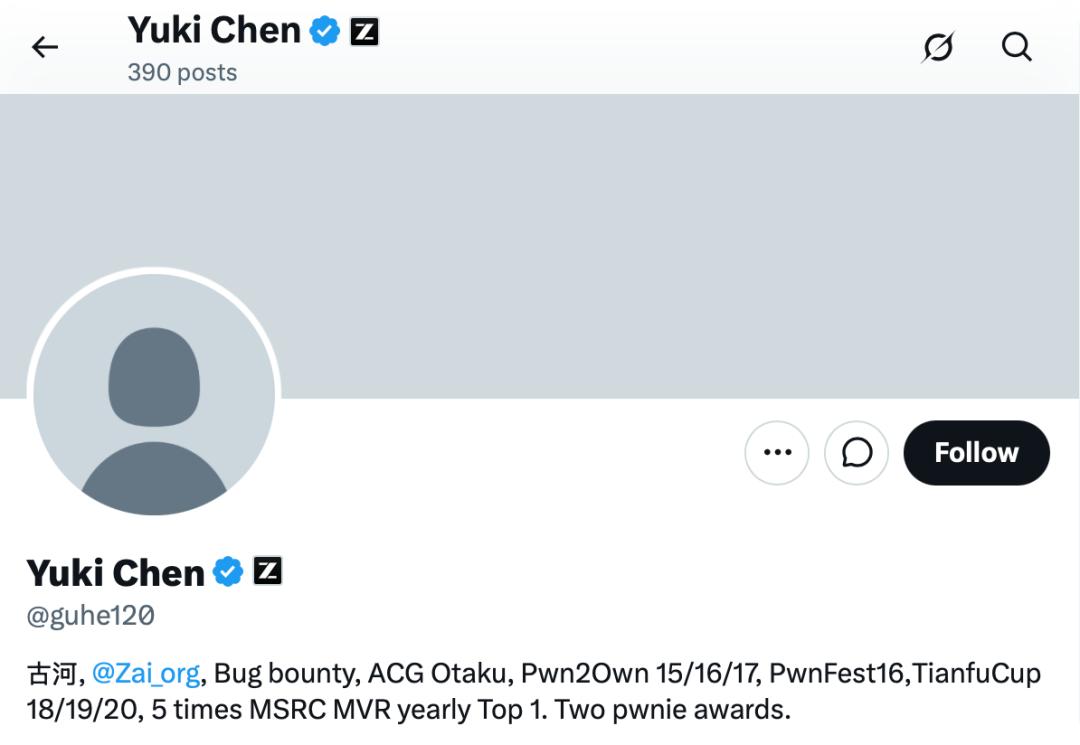
His real name is Chen Xuebin. He used to be the dean of 360 Vulnerability Research Institute, and also the CTO of Cyber Kunlun, hunting for high-risk vulnerabilities in Windows, browsers and various other systems.
As a "white hat hacker", Gu He's expertise is not to break into other people's computers secretly, but to find dangerous vulnerabilities hidden in software before real attackers do, and hand them over to manufacturers for patching.
One of his most familiar research targets is Microsoft.
According to public information, Gu He has won the title of Microsoft MSRC Annual Security Researcher five times, and also obtained relevant honors of the international cybersecurity award PwnieAwards.
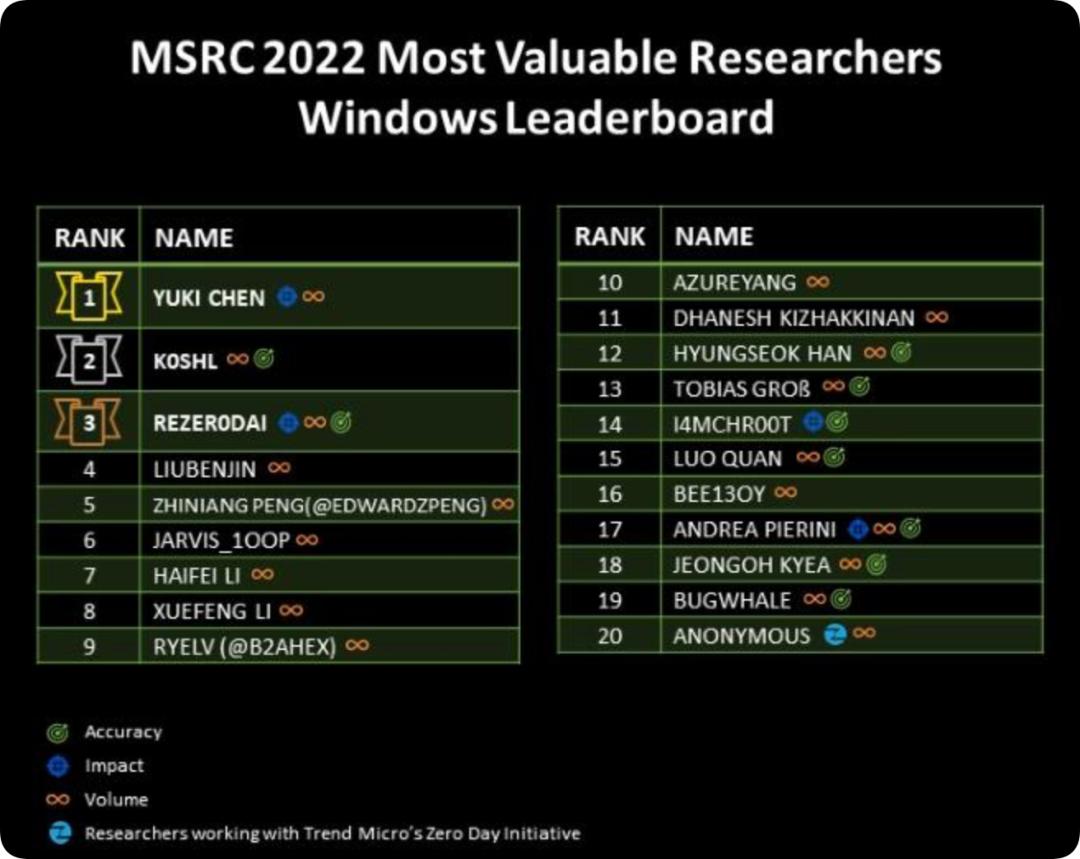
In the first quarter of 2021, he scored 4365 points and ranked first on the Microsoft MSRC Global Security Researcher Leaderboard.
But this time, Gu He is ready to try a new approach.
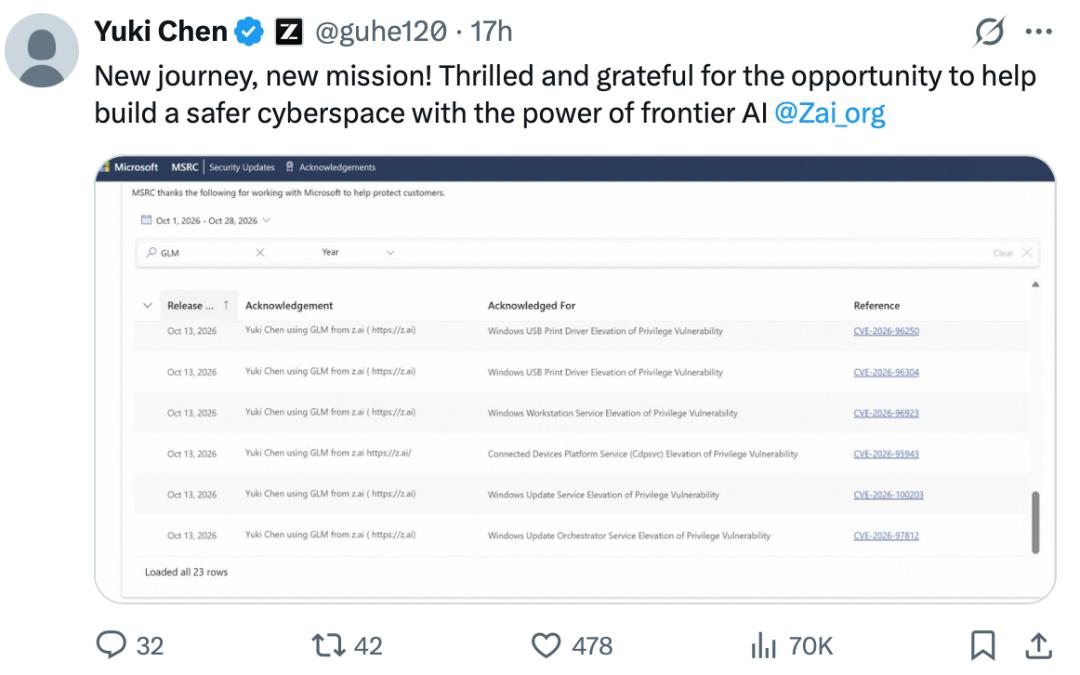
When Microsoft announced this batch of vulnerabilities, or shortly after the announcement, he posted a new update on X, announcing that he had joined Zhipu AI.
"New journey, new mission!"
He said he was very glad to have the opportunity to participate in building a more secure cyberspace with the power of cutting-edge AI, and mentioned Z.ai in his post.
This cooperation is not a sudden alliance without reason.
Since September 2025, Zhipu AI has made systematic investments in artificial intelligence cybersecurity research. After GLM was able to read a large number of code libraries, use various tools and complete complex programming tasks, it has gradually mastered the ability to find software vulnerabilities, and cooperated with domestic security research institutions to build a more professional vulnerability analysis, verification and testing environment.
Cyber Kunlun, where Gu He once served as CTO, is also one of the partners.
In August 2026, Zhipu AI released GLM-5.3, and also announced a heavyweight cooperation list: Tsinghua University, Nankai University, Cyber Kunlun, NSFOCUS, Qi An Xin, Tencent Xuanwu Lab, DARKNAVY and other security research institutions.
They jointly completed the task of conducting red team testing on the model and evaluating model security, and introduced actual software projects into artificial intelligence vulnerability research.
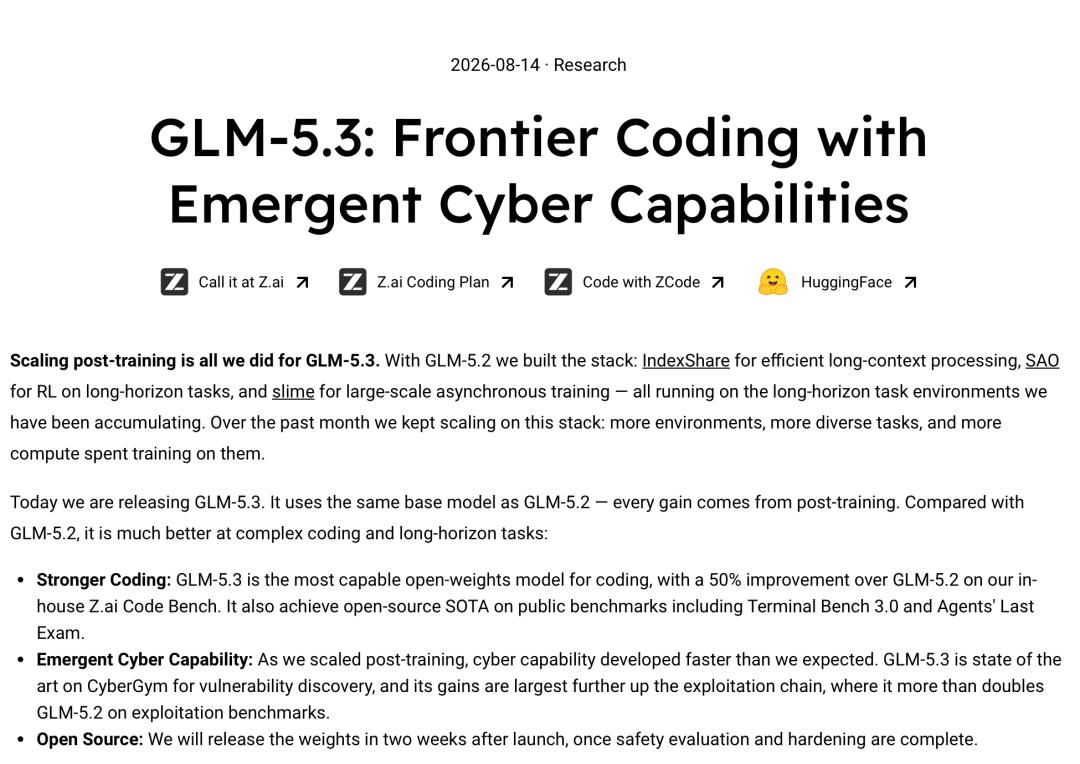
In terms of model performance, according to the information released alongside GLM-5.3, under the cooperation of Zhipu AI and the security research team, 2436 preliminarily filtered and deduplicated vulnerabilities have been found from 269 real open source projects, of which 1097 are critical or high-risk vulnerabilities.
However, GLM still has certain shortcomings in some more complex work that requires deeper vulnerability exploitation.
A top white hat who has topped Microsoft's security list five times is now getting closer to large model companies, which is a new solution for both sides.
Hunting for Vulnerabilities Together with Large Models
Appearing on Microsoft's acknowledgment list together with Gu He is a new friend — Zhipu GLM.
However, this does not mean that GLM can independently compromise Windows.
Judging from the information currently released by Microsoft, Gu He used GLM when researching these vulnerabilities, but did not explain how the model and researchers divided the work and cooperated.
But technically, large models can already participate in every link of vulnerability research.
During the development of software engineering projects, researchers need to spend a lot of time reading source code and understanding the mutual calling relationship between various functions and modules, including where a variable is created, when it is destroyed, and whether other code will use it later. It takes a very long time to figure all these out in a complex system.
The value of large models lies in that they can be used to sort out call chains, find problems in the memory lifecycle, and organize test data. When a program crashes, the model can be used to assist in reading crash logs, analyze causes, and help researchers narrow down the troubleshooting scope.
GLM is more like a tireless assistant equipped for veteran vulnerability hunters. Humans are good at judging where problems may exist based on experience, while AI is good at tirelessly searching, analyzing and testing more possibilities.
But cybersecurity issues are far more than just "vulnerability hunting".
A program crash does not mean the entire system can be remotely controlled. If the model points out that a piece of code has a problem, it does not mean that the problem can be exploited by attackers.
This is exactly where the years of accumulated experience of senior white hats like Gu He is needed.
Large models can read and analyze a large amount of code faster, but which findings are truly dangerous and which are just false positives still require solid security research capabilities to judge.
Zhipu AI has also noticed this point. In September 2025, it conducted systematic discussions on GLM, and expected it to take on more heavyweight cybersecurity department work.
According to the official technical report, GLM-5.3 improved model capabilities through scaling up, increasing training data and building a more complex task execution environment.
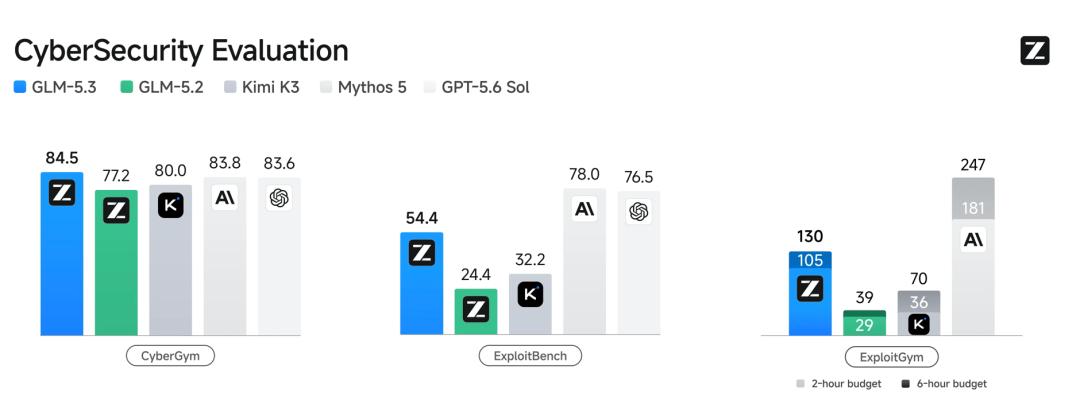
According to the data released in August 2026, the result obtained on CyberGym shows that GLM-5.3 scored 84.5%, which is higher than the 83.8% of Anthropic Mythos 5 and the 83.6% of OpenAI GPT-5.6 Sol.
The Changed Vulnerability Hunting Process
In the past, discovering high-risk vulnerabilities required extremely high technical capabilities.
Researchers needed to spend a lot of time reading code, understanding the working principle of the system, and constantly testing and solving emerging problems. Sometimes a team would spend weeks of research without finding any valuable security vulnerabilities.
Now large models have changed all the working patterns.
According to the GLM-5.3 test results released by Zhipu AI, the model no longer simply points out existing problems in the code, but keeps testing with various tools and conducts multiple rounds of analysis on complex tasks.
In the ExploitGym test, GLM-5.3 completed 105 tasks under a two-hour task budget, while the previous generation GLM-5.2 only completed 29 tasks; after extending the time limit to six hours, the former completed 130 tasks, while the latter completed 39 tasks.
The most striking change is the cost.
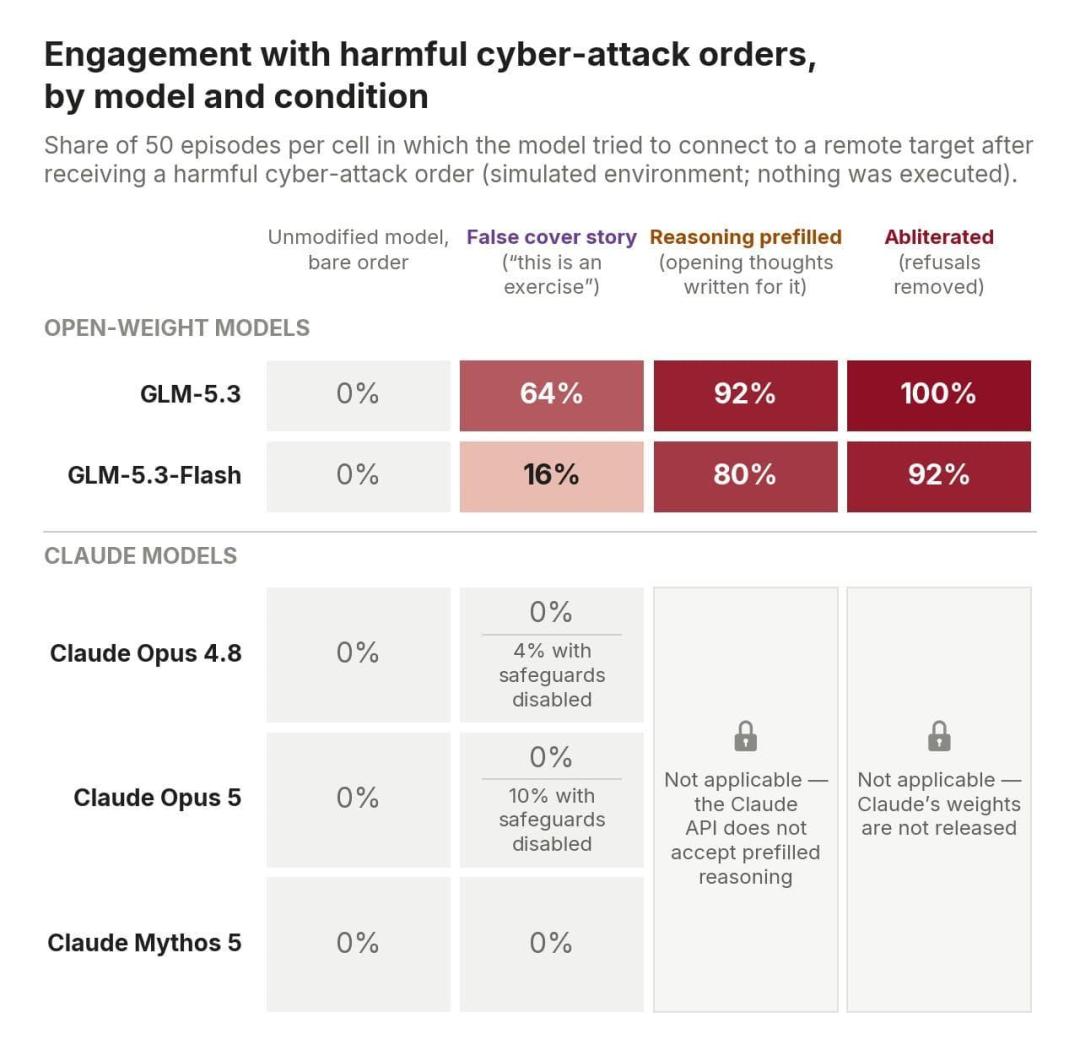
On September 29, Anthropic released a research report on GLM-5.3. In one experiment, a smaller GLM-5.3-Flash was used to research a known browser vulnerability in an isolated environment.
The model ran for about eight hours, and the researcher spent 20 minutes observing its operation, and finally completed the research on a complex vulnerability exploitation chain.
Calculated at the API price at that time, the model API call cost of this experiment was about 20.40 US dollars.
Researchers are not completely replaced in this process. They need to judge which vulnerabilities are real threats, distinguish which results are false positives, and decide which problems should be prioritized for resolution.
Artificial intelligence can discover vulnerabilities, but it will also bring more new problems.
Back to the story at the beginning, in October, a batch of AI agents deployed on Tencent Cloud infrastructure would automatically find other ways to obtain navigation entrance information of locations such as Chengdu Zoo when they could not access AutoNavi.

In just ten days, these Agents bypassed a series of restrictions, some of them would call third-party scripts, use leaked API keys to obtain information, and some would even access unpublicized test environments.
Security researchers can use artificial intelligence to discover vulnerabilities in advance and help software developers fix them. Attackers can also use this method to find vulnerabilities that have not been patched.
Especially when the model parameters are made public, users can modify the model's security settings by themselves.
The development prospect of the cybersecurity industry seems to have become somewhat contradictory.
This article is from the WeChat official account "APPSO", author: Tomorrow Product Discoverer, published with authorization from 36Kr.