Easing the restrictions on household registration settlement, another megacity with a population of over 10 million is coming.
On October 14, Foshan Municipal Public Security Bureau released a notice to publicly solicit opinions on the "Regulations of Foshan Municipality on the Administration of Household Registration Migration (Draft for Comment)", proposing to further deepen the reform of the household registration system, relax and ease restrictions on settlement, continue the pilot system of household registration at the habitual residence, facilitate the reasonable and orderly flow of human resources elements, promote the mutual recognition of the accumulated years of household registration access among the nine mainland cities in the Guangdong-Hong Kong-Macao Greater Bay Area, and provide strong population management and service support for the high-quality development of Foshan.
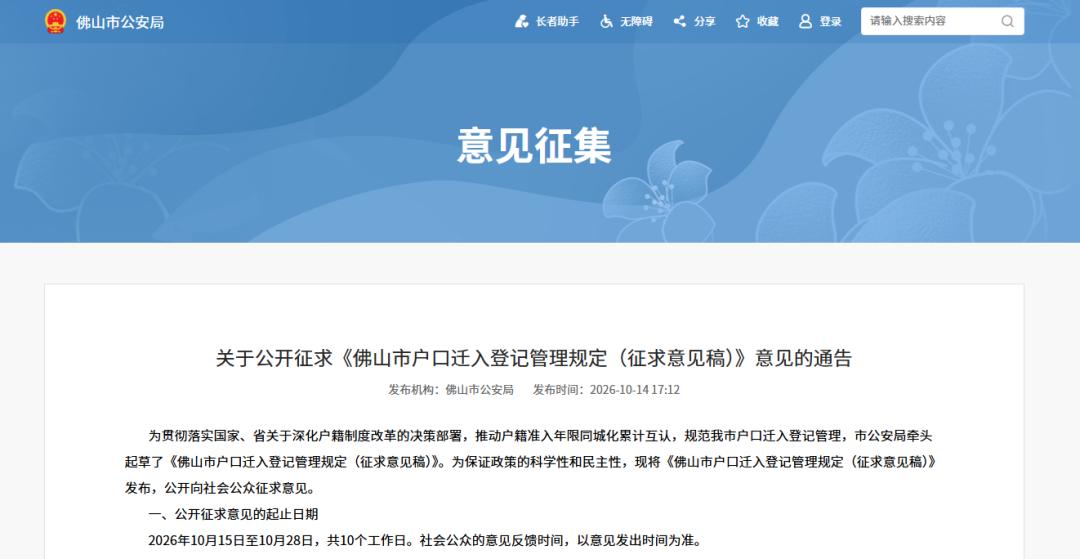
In terms of talent settlement, applicants can apply for settlement if they meet one of the following conditions. First, graduates with a college degree or above from full-time ordinary institutions of higher learning within two years of graduation who have paid social insurance in this city at the time of application. Second, upon verification by the municipal and district human resources and social security departments, applicants who have a nationally recognized college degree or above, or intermediate and above professional and technical titles (professional and technical personnel vocational qualifications corresponding to the corresponding level of professional titles), or senior technician (level 3) and above skill level, are under 50 years old for men and under 45 years old for women, and have continuously paid social insurance in this city for more than 6 months at the time of application. Third, personnel who are approved to be transferred or recruited to work in this city by the municipal (district) organization, human resources and social security departments, or provincial/municipal state-owned institutions. Fourth, holders of Youyue Foshan Card Type A, B and C (excluding flexible talents).
According to the Foshan Municipal Statistical Bulletin, the city's permanent resident population reached 9.7919 million at the end of 2025, an increase of 93,000 over the same period of the previous year, ranking sixth in China in terms of population increment. Looking at the longer time horizon, the net increases of permanent resident population and registered household population in Foshan from 2015 to 2025 were 1.1485 million and 1.5245 million respectively, with an average annual growth of over 110,000 and over 150,000 respectively.
Against this rapid growth momentum, Foshan has set a higher goal. The "Foshan Population Development Plan (2025—2030)" proposes that the permanent resident population will reach 10.16 million by 2030. Previously, three cities in Guangdong have taken the lead in breaking the 10 million population mark, namely Guangzhou, Shenzhen and Dongguan. In other words, Foshan is expected to become the fourth city in the Guangdong-Hong Kong-Macao Greater Bay Area with a permanent resident population exceeding 10 million within five years.
Judging from the draft for comments released this time, Foshan will further promote the mutual recognition of the accumulated years of household registration access among the nine mainland cities in the Greater Bay Area — the specific statement is that "non-local registered personnel who have been legally and stably employed in the nine mainland cities of the Greater Bay Area for 3 years, of whom the most recent 2 years of continuous legal and stable employment are in this city, and have completed residence registration in the nine mainland cities of the Greater Bay Area at the time of application, may apply for household registration in this city."
From the local perspective, as a trillion-yuan manufacturing city, Foshan's sound whole industrial chain ecology has derived multi-level job demands. From scientific research engineers and technical mechanics to assembly line workers and offline commercial practitioners, people with different educational backgrounds and skill levels can find suitable jobs. At the same time, it has the advantage of "small-city costs, big-city resources". Data shows that Foshan's housing price-to-income ratio is about 10, with high cost-effectiveness in work and life.
For Foshan itself, a population of more than 10 million will also boost the momentum of its regional development. The draft for comments mentions that personnel who have completed residence registration in Gaoming District of this city and have resided continuously for more than half a year, or who are stably employed in Gaoming District at the time of application and have completed residence registration in the other eight mainland cities of the Greater Bay Area and resided continuously for more than half a year, may apply for household registration in Gaoming District.
It is understood that Gaoming District is the district with the smallest permanent resident population among the five districts in Foshan, with about 517,000 permanent residents at the end of 2025, accounting for less than 6% of the city's total. The new Guangzhou Airport located in Genghe Town, Gaoming has started construction and is scheduled to be completed and put into use in 2030, and the airport hub, airport-related industries and supporting services all need personnel to support their operation.
From a national perspective, there are currently 5 cities with a permanent resident population of over 9.5 million and maintaining a continuous growth trend. In addition to Foshan, there are Wenzhou, Ningbo, Nanjing and Jinan. Their permanent resident populations at the end of 2025 are 9.902 million, 9.833 million, 9.6385 million and 9.616 million respectively. During the 15th Five-Year Plan period, all five cities have set the goal of "population exceeding 10 million".
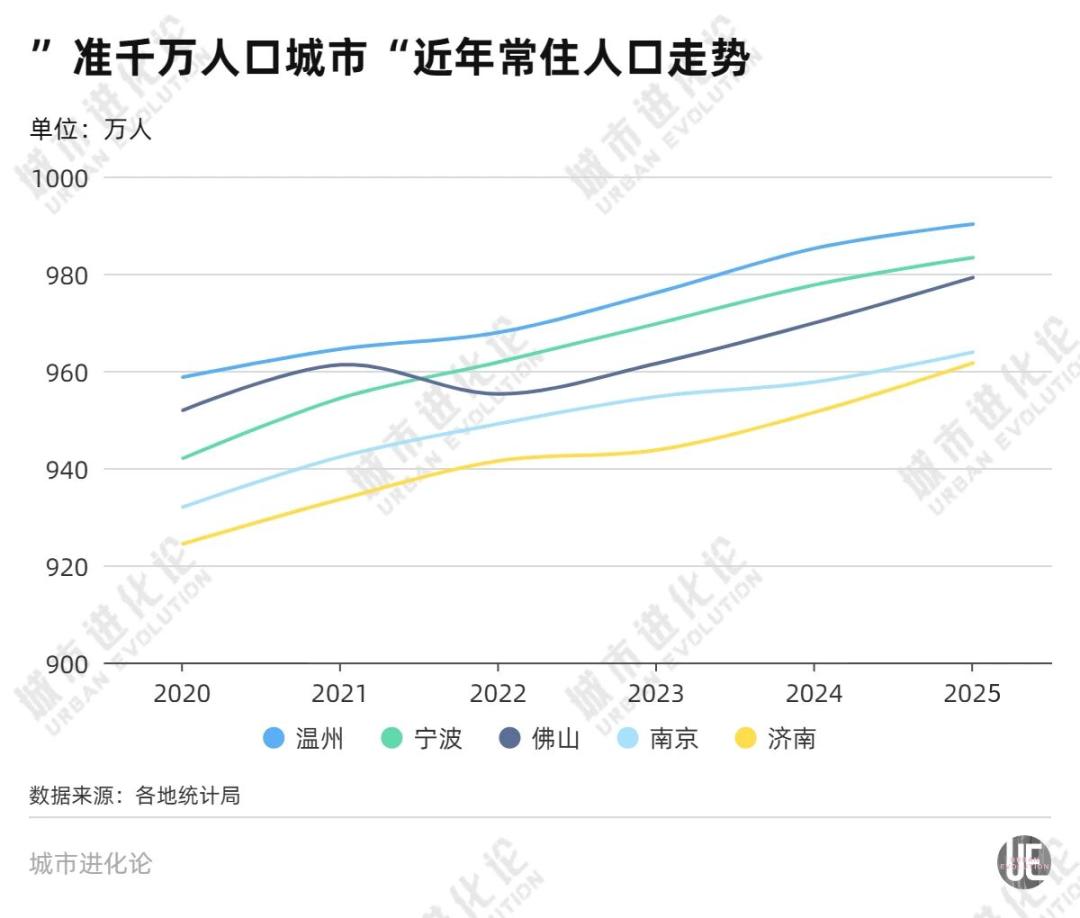
In 2025, China's urbanization rate of permanent residents reached 67.89%. Many experts predict that by 2035, China's urbanization rate may reach about 75%. This means that nearly 100 million people will move to cities in the next ten years. According to experts, these cities have developed very well in recent years. Based on the previous development experience of other cities, all of them have the opportunity to reach the 10 million population target in about three years.
In the longer term, the population competitiveness of cities in the future will no longer depend on short-term policy dividends, but will test the systematic ability to attract and cultivate talents. Under this logic, cities should continue to optimize industrial policies and population policies, create a favorable business environment, generate more jobs, and provide support for population absorption.
This article is from the WeChat Official Account "City Evolution Theory", written by Yang Huan, and published by 36Kr with authorization.