Is the first prefecture-level "rice-shaped" high-speed railway hub located in Anhui?
The competition among provincial capitals for the "meter-shaped high-speed rail hub" has not yet seen a clear winner, while many prefecture-level cities have long joined the fray.
The latest move comes from Fuyang, a small city in Anhui Province. Recently, the Ministry of Ecology and Environment publicized the environmental impact assessment review information of the Fuyang-Huanggang high-speed railway, marking that this high-speed railway has officially entered the critical stage of environmental impact assessment approval. This means that the Fuyang-Huanggang high-speed railway, as a key section of the main corridor of the "Eight Vertical and Eight Horizontal" Beijing-Hong Kong (Taiwan) high-speed railway connecting multiple regions in Anhui, Henan and Hubei, is finally about to enter the final sprint before the start of construction.
This step is particularly important for Fuyang. The outline of Fuyang's 15th Five-Year Plan specifically names this railway line, and puts forward to "accelerate the construction of a dual 'meter-shaped' hub layout for ordinary railways and high-speed railways", and "consolidate and enhance Fuyang's position as an important hub in the national railway network". In Fuyang's existing "meter-shaped" high-speed railway plan, the Fuyang-Huanggang high-speed railway just draws the key "vertical line" pointing to the south.
What brings more imagination is that this also makes Fuyang take the lead in joining the competition for "meter-shaped high-speed rail hubs" among prefecture-level cities. Across the country, relevant descriptions of "meter-shaped" high-speed rail hubs have appeared in the plans or reports of cities such as Xuzhou in Jiangsu, Linyi, Weifang, Heze and Liaocheng in Shandong, Xiangyang in Hubei, Shangqiu and Luoyang in Henan, Huaihua in Hunan, and Ganzhou in Jiangxi. Among a series of urban plans, Fuyang has taken significantly faster actions and its "meter-shaped" plan is relatively complete.
One question is worth paying attention to: What makes Fuyang stand out from the competition?
Quasi-Hub
Fuyang is located in the northwest of Anhui, adjacent to the southeast area of Henan in the west. Historically, it was originally a "city pulled up by trains".
Since the 1970s, in order to develop the Huaibei coalfield and solve the problem of coal transportation in northern Anhui, Fuyang entered the "railway era" very early. From the Qingfu Railway, Luofu Railway, to the Fuhuai Railway, Fuliu Railway, and even the Beijing-Kowloon Railway chose to pass through Fuyang and bypass Hefei between the two route schemes, which not only gave Fuyang the opportunity to have the intersection of north-south trunk railways, but also made it the earliest "quasi-meter-shaped" railway hub in Anhui.
Subsequently, Fuyang also experienced the fate of most hub cities in the ordinary railway era, and once fell behind other cities in the high-speed railway era. However, Hefei, the provincial capital, transformed from a "dead end" to a "heart", not only becoming the starting point of the first high-speed railway in Anhui, but also developing rapidly later, and even becoming the second "meter-shaped" high-speed rail hub in China.
The turning point came in 2015.
In that year, as one of the busiest high-speed railway sections in China, the Xuzhou-Shanghai section of the Beijing-Shanghai high-speed railway faced huge passenger transport pressure. The Shangqiu-Fuyang section of the Shangqiu-Hefei-Hangzhou high-speed railway, which is positioned as the "second channel in East China", started construction, making Fuyang enter the national high-speed railway network for the first time. What is quite special is that the Zhengzhou-Fuyang high-speed railway also started construction in the same year as the Shangqiu-Hefei-Hangzhou high-speed railway. The two high-speed railways were opened at the end of 2019 at the same time, allowing Fuyang to draw three radiation lines pointing to the north, northwest and southeast at one go.
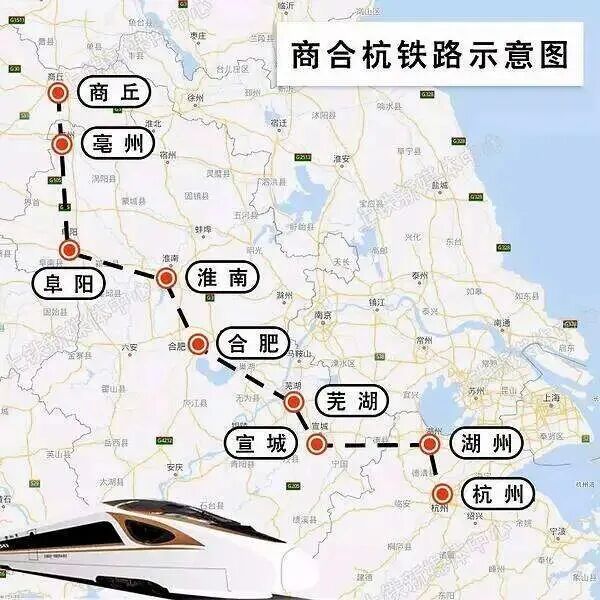
Image source: Shanghai Railway New Media Center
In this sense, Fuyang's dream of building a "meter-shaped" high-speed rail hub has benefited from the driving of major regional strategic plans from the very beginning.
In 2022, the Fuyang-Huainan high-speed railway started construction in a substantive manner. This high-speed railway is funded and built by Anhui Province and its subordinate cities, aiming to promote the construction of the northern Anhui industrial transfer cluster, boost the revitalization and development of northern Anhui, and bring northern Anhui into the 3-hour economic circle of Shanghai, making the "northern wing of the Yangtze River Delta" a reality from a concept.
The under-construction Fuyang-Huanggang high-speed railway, on the one hand, is an important connecting line of the main corridor of the Beijing-Hong Kong (Taiwan) high-speed railway, and on the other hand, it is expected to become part of the Wuhan-Qingdao high-speed railway which is still in the planning stage, allowing Fuyang to further catch up with the fast track of the "Eight Vertical and Eight Horizontal" high-speed railway network.
This is not the end. According to the "Fuyang Territorial Space Master Plan (2021-2035)", the Huaiyan Railway running from Nanyang via Fuyang to Huai'an is also under planning. This railway line was clearly proposed for promotion in the "Huaihe Ecological Economic Belt Development Plan" approved by the State Council in 2018, and was included in the promotion plan of the "Outline of the Yangtze River Delta Regional Integrated Development Plan".
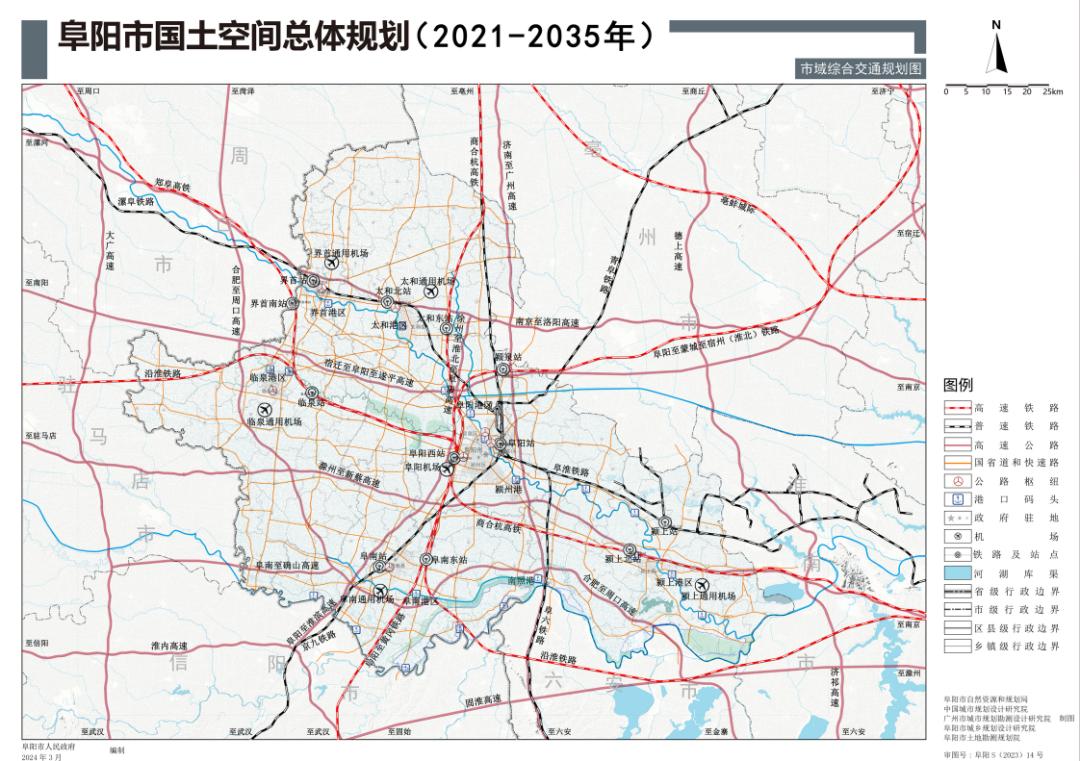
As a result, Fuyang has connected high-speed railway lines in seven directions, only one step away from the "meter-shaped" high-speed rail hub, and has become the second largest high-speed rail hub in Anhui after Hefei.
Leverage Point
In addition to taking the "free ride" of strategic planning, the efforts of Fuyang and even the whole Anhui Province cannot be ignored.
Looking at the main corridor of the Beijing-Hong Kong (Taiwan) high-speed railway, a "loop" extending from Fuyang is particularly eye-catching — the east side is the opened Shangqiu-Hefei-Hangzhou high-speed railway, and the west side is the under-construction Fuyang-Huanggang high-speed railway. The two lines eventually meet at Jiujiang. Behind this, there was once a competition between the east and west routes of the Beijing-Hong Kong high-speed railway.
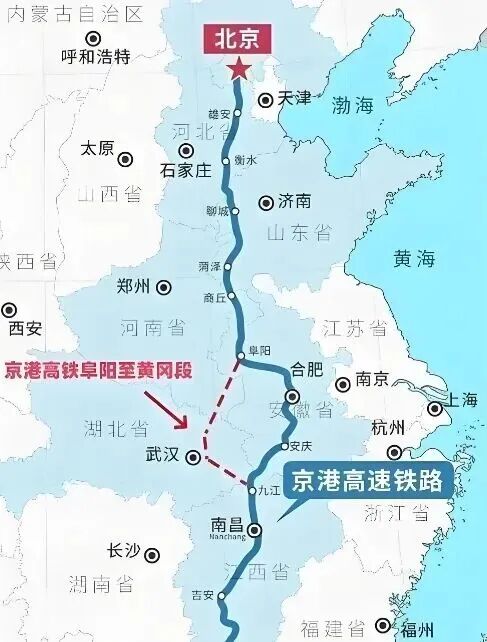
Location of Fuyang-Huanggang high-speed railway in the Beijing-Hong Kong high-speed railway corridor Image source: Henan Official Release
Looking back ten years ago, the construction of the Shangqiu-Hefei-Hangzhou high-speed railway went smoothly, and the east route scheme of the Beijing-Kowloon Railway it represented was once favored by the outside world. Xinyang in Henan and Huanggang in Hubei once jointly proposed the construction of the west route, and contacted the Fuyang side very early. Fuyang also intended to promote this plan. As reported by local media, the west route scheme will bring Funan County, the only region in Fuyang that had no high-speed railway plan, into the high-speed railway era.
According to the article written by Fuyang Municipal Development and Reform Commission, after that, Fuyang actively promoted the planning and construction of the Fuyang-Huanggang high-speed railway, sought support from the national level, started the compilation of the pre-feasibility study report in 2020, and then the line was successfully included in the national "14th Five-Year Plan" modern comprehensive transportation system development plan.
Why does Fuyang attach so much importance to this line? One reason, as reported by local media, is that this line will improve Fuyang's hub pattern, strengthen its transportation radiation capacity, open up the fast channel to Beijing in the north and Hong Kong in the south, deeply integrate into national strategies, and further promote the comprehensive revitalization of northern Anhui.
In fact, before the hub was built, "Northern Anhui" has always been the most prominent label on Fuyang. As early as 20 years ago, Bengbu was positioned by Anhui as the "central city of northern Anhui" and the "growth pole driving the rise of Anhui and Henan". In Anhui's latest territorial space master plan, Fuyang is still a "regional central city". But at the same time, "Northern Anhui" is also regarded as the "depression" of Anhui, and Fuyang, as the "leader", is entrusted with the mission of driving the development of late-developing regions.
The hub happens to be an effective "leverage point".
Looking at this round of prefecture-level cities building "meter-shaped" high-speed rail hubs, such as Xuzhou in Jiangsu, Shangqiu in Henan, and Linyi in Shandong, they are not the second largest economy in their respective provinces, but they have all become or expected to become the second largest high-speed rail hub in their provinces to varying degrees. A greater contrast appears in their provincial internal location: whether it is northern Jiangsu, eastern Henan or southern Shandong, they have little presence in the large economic provinces, and are even labeled as "subsidence zone" and "economic depression".
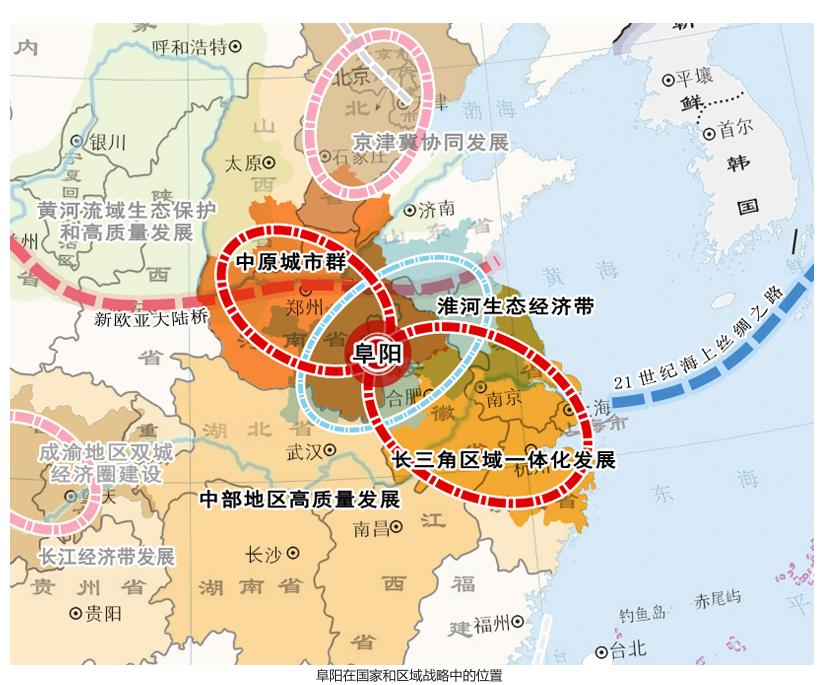
Image source: Fuyang Official Release
Hub economy is becoming the key to bridging the gap. Xuzhou, a traditional transportation hub, has been working hard to transform its position as the central city of the Huaihai Economic Zone into consumption radiation and driving force. Linyi has even built the logistics industry into a model of advantageous industries. Its total logistics volume exceeded the 1-trillion-yuan mark in 2024, and it is building an international trade and logistics hub.
Fuyang is also seeking development with the help of the "hub". The 10th plenary session of the 6th Fuyang Municipal Committee of the Communist Party of China held at the end of last year mentioned that it will systematically build a "four-in-one" modern comprehensive transportation and logistics system integrating railway, highway, airport and water transportation that "supports Fuyang, drives northern Anhui, and echoes Hefei", and take it as an important part of developing the real economy and cultivating new quality productive forces.
Anti-Siphon Effect?
At present, Anhui is elevating the revitalization of northern Anhui to an unprecedented height.
First, the outline of Anhui's 15th Five-Year Plan pointed out that "putting the modernization of northern Anhui as the top priority of the province's modernization"; then, in June this year, Anhui held a mobilization meeting to support the comprehensive revitalization of northern Anhui, emphasizing that it should accelerate the integrated development of new industrialization, urbanization and rural revitalization in northern Anhui to make breakthroughs, "keep up with the pace of high-quality integrated development of the Yangtze River Delta", and the goal is extremely ambitious.
Fuyang is undoubtedly a key piece of the puzzle. Not long ago, after Li Lecheng took office as the Secretary of Anhui Provincial Party Committee, he carried out investigations, and Fuyang became the first stop among all cities in northern Anhui. During the investigation, he emphasized again that "there is no modernization of Anhui without the modernization of northern Anhui", and we should fully integrate into the industrial chain and supply chain of the Yangtze River Delta, and accelerate the quality improvement and efficiency enhancement of the northern Anhui industrial transfer cluster.
With the accelerated formation of the high-speed rail hub, a question that needs to be answered urgently is placed in front of Fuyang: how to really leverage the high-speed railway lines to promote the development of hub economy, not only to attract passenger flow, but also to retain the resources and population brought by the flow.
But when it comes to the relationship between high-speed railways and cities, the siphon effect or radiation effect has always been a lingering problem. A study by Fan Zhaoyuan, an associate professor at the School of Sociology and Population of Nanjing University of Posts and Telecommunications, and others found that the opening of high-speed railways has significantly accelerated the population hollowing out of shrinking cities in China, and the negative impact on population flow in shrinking cities in the central region, far from central cities and dominated by the tertiary industry is particularly obvious.
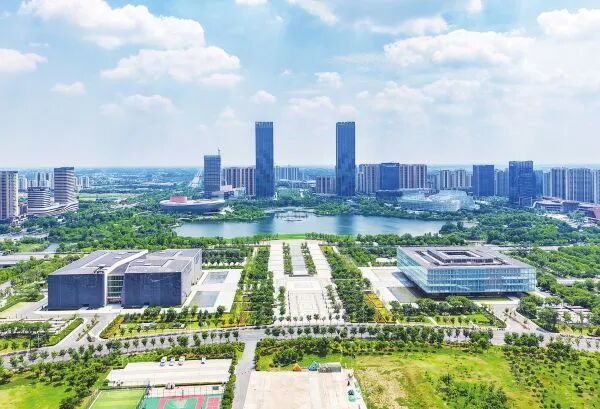
Image source: Fuyang Daily
Fuyang meets many of these conditions. Fuyang has always been a major labor export city. The city's registered population exceeds 10 million, but the permanent resident population is only just over 8 million, and there is a gap of more than 2 million between the two. Since 2021, the permanent resident population of Fuyang has declined for 5 consecutive years, with a total reduction of nearly 200,000 people in 5 years.
There is a saying that high-speed railway is an "amplifier" rather than an "engine". To make high-speed railway bring together resources, it is inseparable from the fundamental reshaping of the city's industrial development model.
In this regard, Fuyang is seeking changes.
As a city closely related to coal, Fuyang first set its sights on the new energy and new materials sectors. One example is photoresist, which was once a "stuck neck" link in China's chip industry. Xinyihua, which mass produces photoresist, and Mituo, which provides photosensitizers and other materials for it, have settled in Fuyang successively, and the city expects to build a complete photoresist industrial chain from this.
It is worth mentioning that Mituo is a company founded in Shanghai. Driven by the "chain leader" Xinyihua, it finally chose to settle in Fuyang, which made the local people see the possibility of "anti-siphon effect".
Looking back decades ago, Fuyang once had a glorious past of ranking first in Anhui in terms of total economic output. But after that, the separation of Bozhou and the lag of industry made Fuyang gradually lose its former glory. By 2019, Fuyang's total economic output was surpassed by Chuzhou, and finally dropped to the fourth place in the province. Now, new opportunities are emerging. Starting from the high-speed rail hub, can Fuyang truly support the "central" position of northern Anhui and return to the rank of "the third largest city in Anhui"?
This article is from the WeChat official account "Urban Evolution", author: Yang Qifei, authorized for release by 36Kr.