He spent 16 days using Opus 5.5 to turn *The Little Prince* into a 3D game, where players can freely visit and explore all the planets that appear in the book.
He spent 16 days turning *The Little Prince* into a playable 3D narrative game.
On October 13, developer Sac shared his work on X.
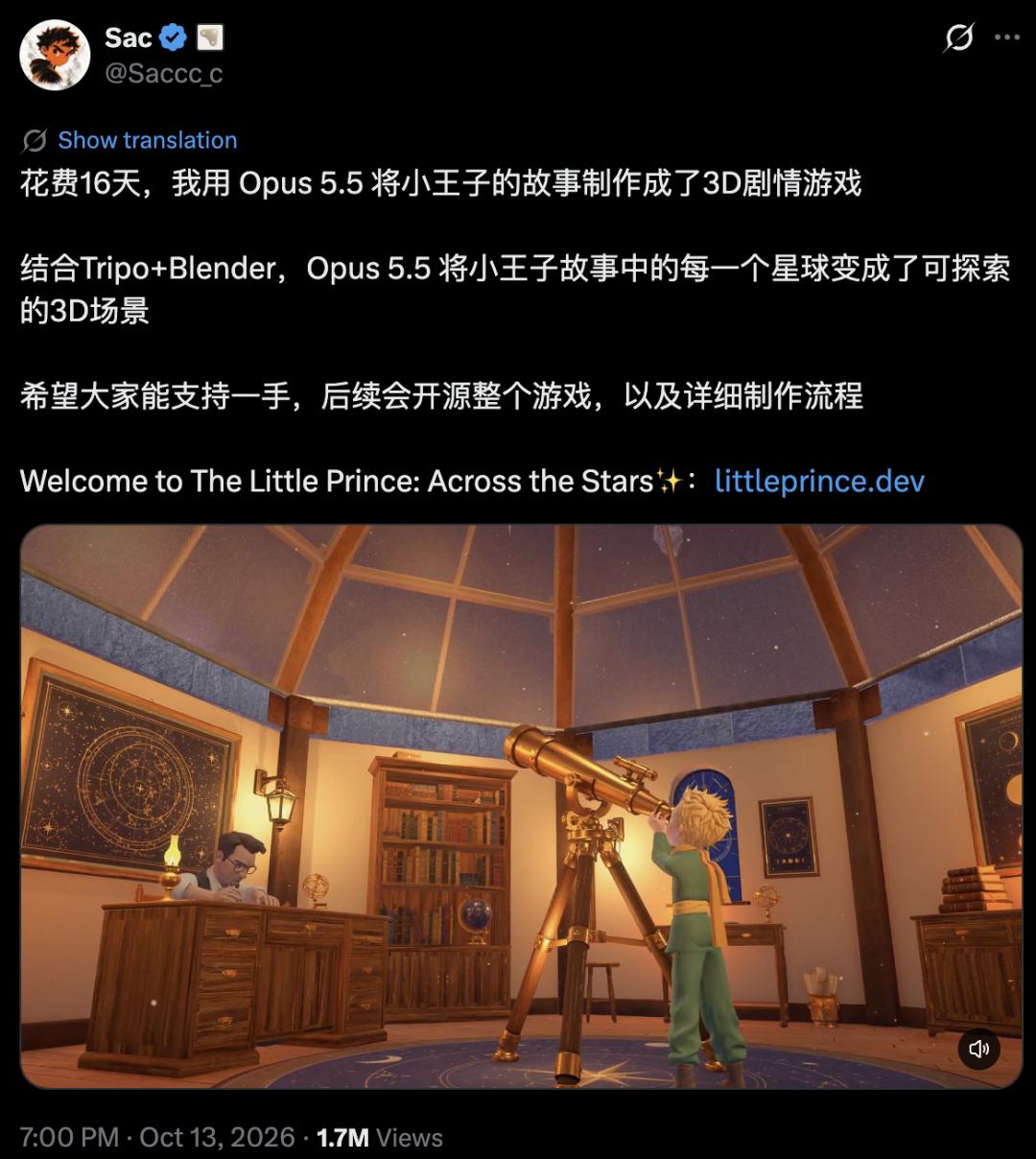
According to Sac, he used Opus 5.5, combined with the 3D model generation tool Tripo and 3D production software Blender, to turn every planet in the story into an explorable 3D scene.
The game is titled *The Little Prince: Across the Stars*, and now has an independent official website entry.
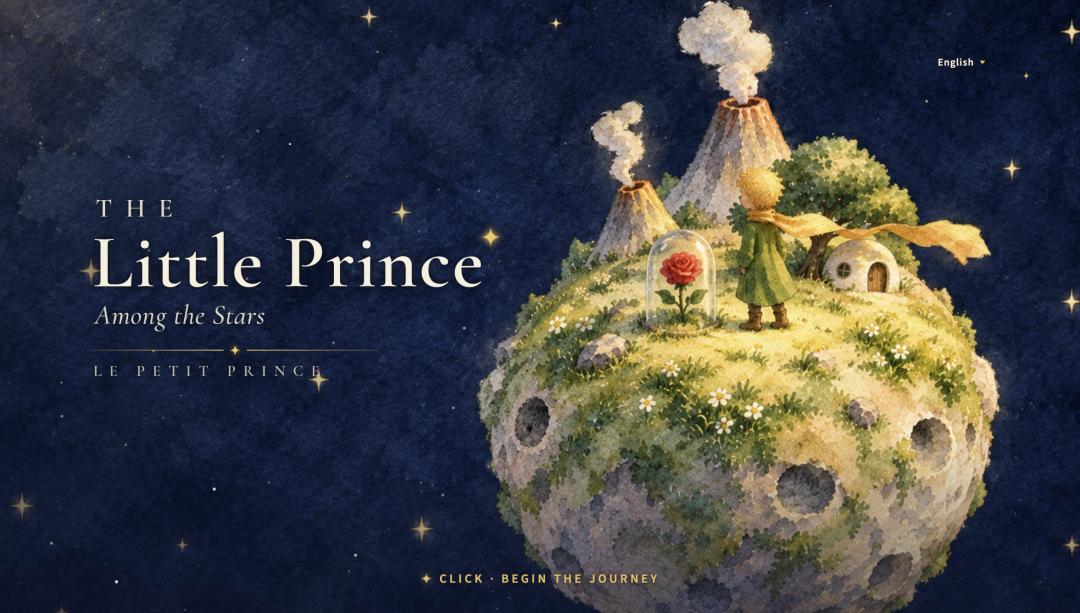
For fans of the book, just being able to step into those places they once imagined in their minds is more than exciting enough.
Visit the Little Prince's planets in person
Let's first look at the demo released by the creator.
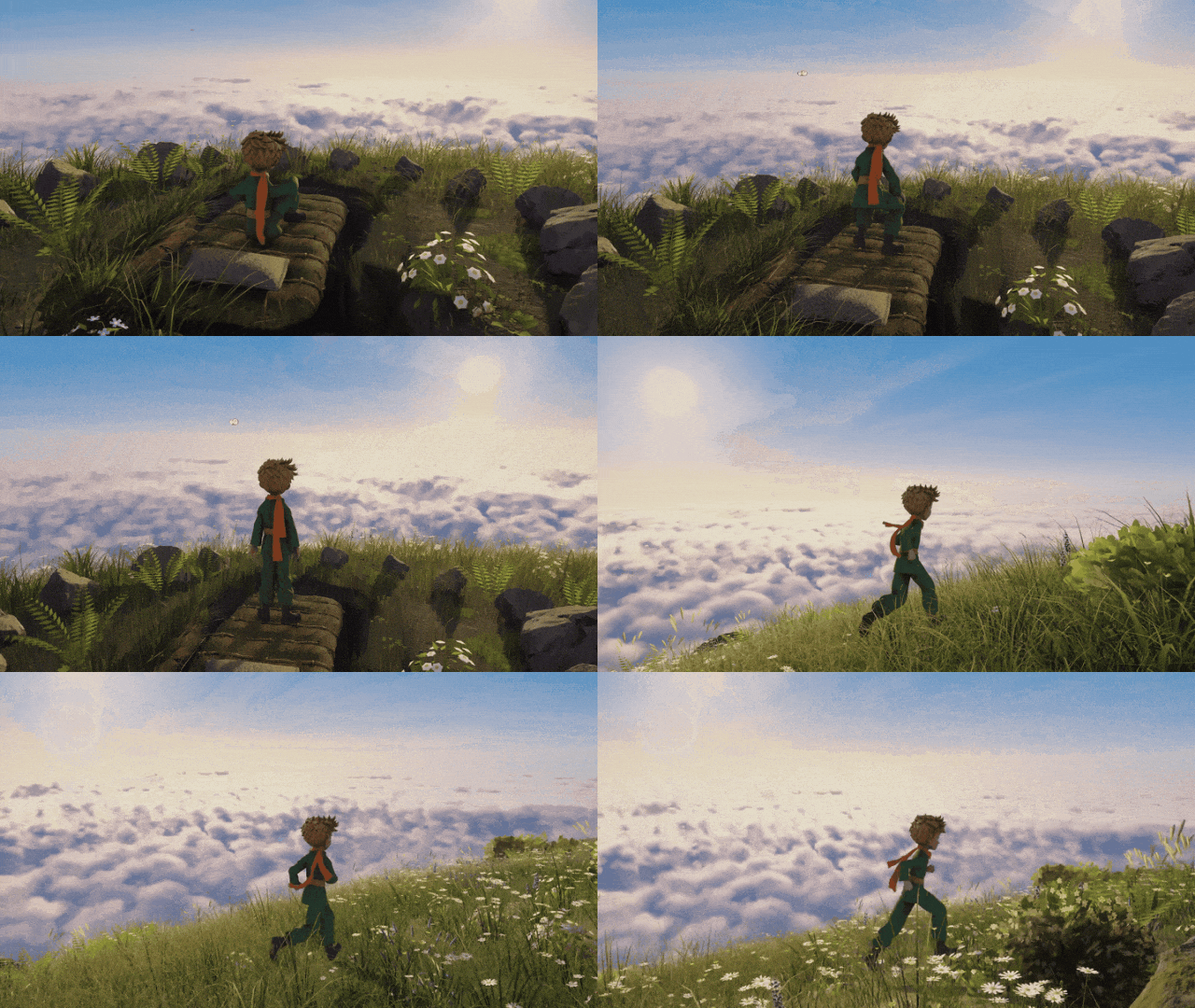
The blond Little Prince stands among plants and rocks, with a vast sea of clouds spreading out in the distance.
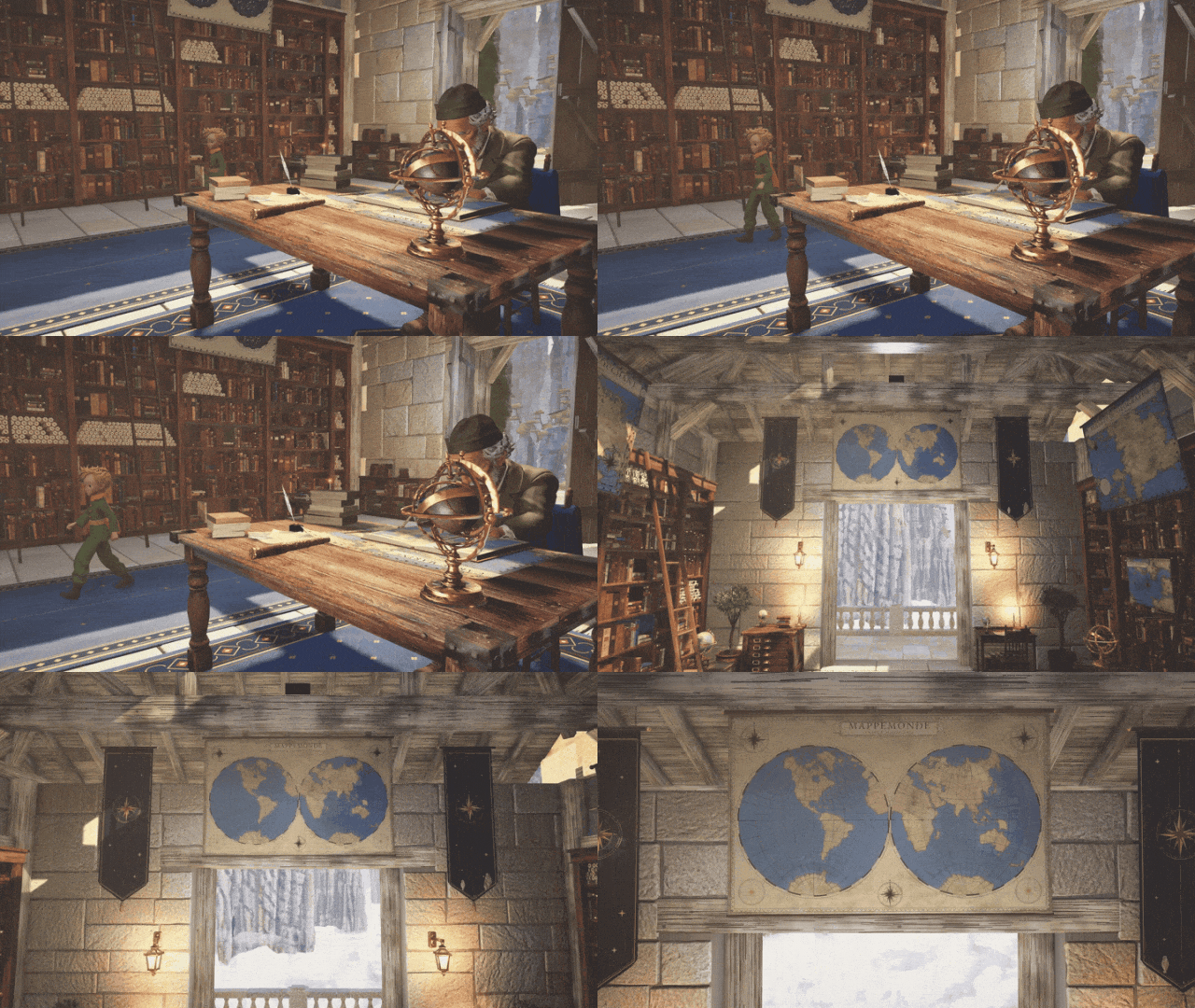
The camera moves indoors. Under the wooden roof, maps hang on the walls, and bookshelves are placed on both sides.
In another clip, the Little Prince runs on the sand, with his shadow moving along with his steps.
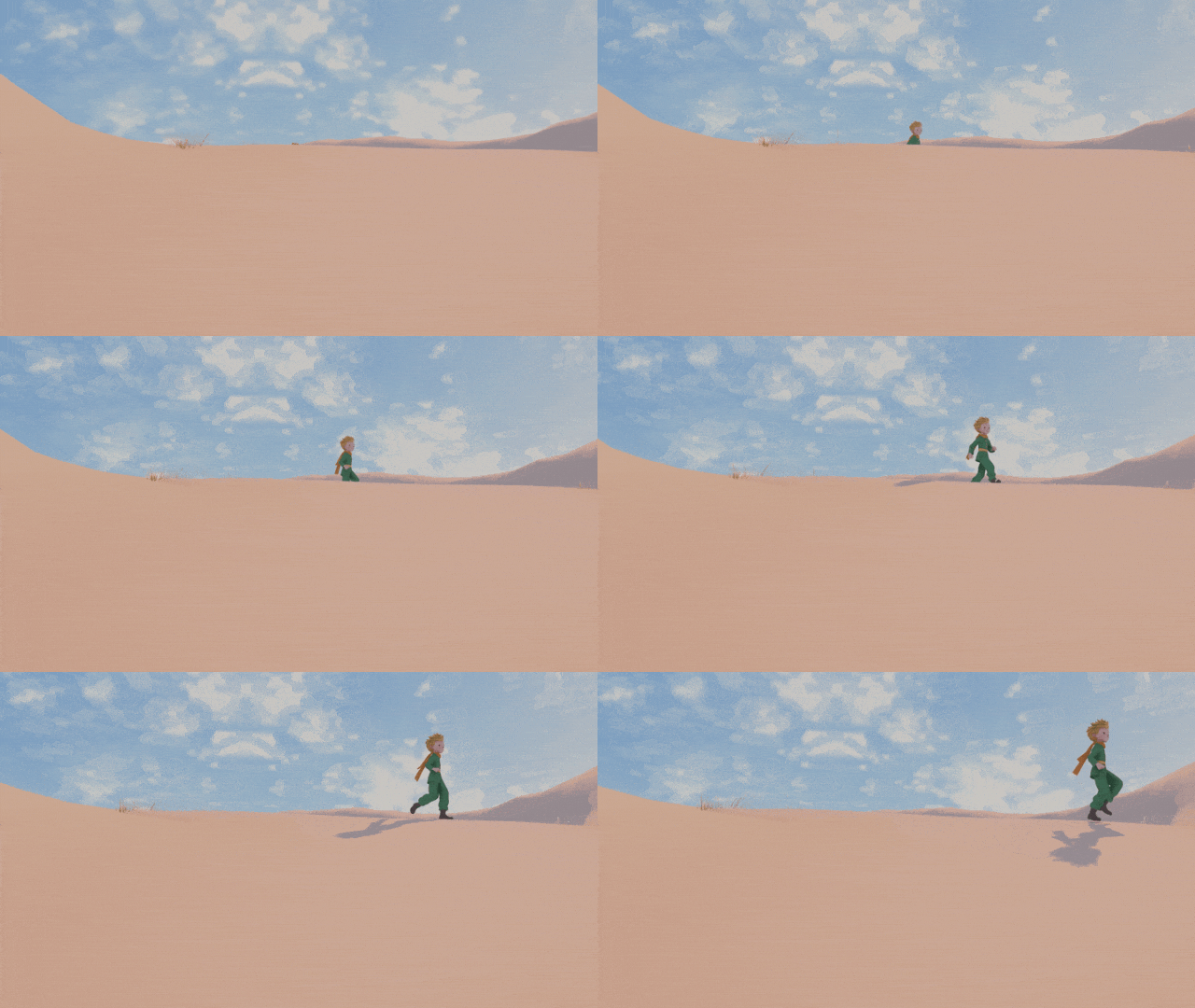
From the sea of clouds to the room, and then to the desert, the characters and environments in the book now have specific shapes, light, shadow and spatial presence.
For people who have read *The Little Prince*, this adaptation easily arouses curiosity:
What would the fairy tale world in our memory look like when turned into a game?
When reading the book, we follow the text to visualize that world in our minds.
After entering the game, we can incarnate as the Little Prince and explore in the 3D scene: where to go, where to stop, and which corner to check first are all up to you.
The familiar story now offers a new way for players to participate in it in person.
However, after building all these scenes, there is a more interesting challenge:
How to turn the unforgettable plots in the book into interactive experiences that can touch players?
One action, one encounter, or even staying in a certain place for a little longer may affect the way the game tells the story.
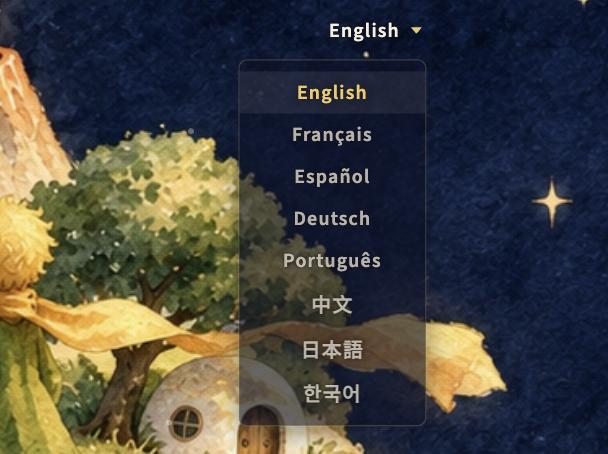
The official website currently lists 8 language options including Chinese, English, and Japanese, giving readers speaking different languages an entrance to approach and explore this world.
The game is developed by one person, with multiple tools working together
The most curious part is: how did he make this 3D game in just 16 days?
Turning a story into a 3D game is far more than just displaying characters and scenes on the screen:
Characters need to be able to move, and the camera needs to follow smoothly;
When the character walks to a specific position, the plot should be triggered;
After the player completes an action, the game should also give corresponding feedback...
The tool combination Sac publicly mentioned includes Opus 5.5, Tripo and Blender.
Among them, Tripo can generate 3D models based on text or images, helping creators turn ideas like characters and objects into 3D assets.
Blender is a set of 3D production software that can be used for modeling, texturing, animation and rendering. After the model is generated, it can be imported into Blender for further adjustment and production.
Sac combined Opus 5.5 with these tools, and finally completed this publicly accessible game project.
In addition, there is an easily overlooked difficulty in game production: after characters, scenes, actions and plots are made separately, they need to cooperate with each other to make the whole game run smoothly.
A character may look great alone, but after being put into the scene, its size and style may not match the environment. A character's action may look natural when viewed separately, but when paired with a following camera, it may make players feel uncomfortable.
These problems need to be repeatedly discovered and adjusted after the work is put into operation.
A complete game is gradually taking shape in the process of solving one specific problem after another.
The biggest inspiration this case gives to individual creators is:
With the help of large models and 3D tools, one person can gradually turn an idea into a work that can be experienced.
Build a scene first, make the character move in it, then connect more scenes and plots.
Split the huge production task into small goals, test and adjust while working, and the work will take shape little by little.
Players have started watering flowers and reporting bugs
After the work was launched, Sac soon received feedback from players.

X user @0xLuo exclaimed after experiencing the game that it is hard to imagine that such a high-completion 3D game was made in only 16 days.
However, he also found a small bug: after completing the flower watering task, the forward and backward directions of the W and S keys, as well as the left and right directions of the A and D keys, are reversed, but he is not sure about the specific trigger condition yet.
As soon as players start playing, problems that were not found during production may emerge. Different exploration routes, key operations and task sequences may expose new bugs.
More importantly, while attractive visuals can draw players in, whether the operation and plot can retain players still needs to be tested by players themselves.
The official website also notes that the current version requires a browser that supports the WebGPU graphics technology. If you want to try it, please first confirm that your browsing environment meets the requirements.
After the game is made public, adapting to different devices and browsers to allow more people to play smoothly is also the work that the creator needs to continue to complete.
After open-sourcing, the 16-day development process is more worth exploring
Sac stated in his original post that he will open-source the entire game later and release the detailed production process.
For people who also want to make 3D games, these materials may provide reference steps:
How to build planets, adjust character models, connect character actions to plots, and troubleshoot bugs.
If it can also explain which links require repeated attempts, which details must be judged by the creator himself, and disclose the cost of tools and the time spent on each link, latecomers can more clearly estimate how much time, energy and funds they need to invest.
The appealing part of this project is that one person, with the help of AI and 3D tools, turned the familiar fairy tale into a game that others can step into and experience in person.
If the subsequent open-source process goes smoothly, the experience accumulated over these 16 days may also help more creators take their first step.
Some people want to make a planet, some want to restore a small town, and some want to turn the story they have written for a long time into a world that people can step into.
If it were you, what kind of game would you most want to make with AI?
References:
https://x.com/Saccc_c/status/2109962425512734739
https://littleprince.dev/
This article is from the WeChat Official Account "New Zhiyuan" (ID: AI_era), written by ASI Revelation, authorized for release by 36Kr.