Just now, the team of Nobel laureate David Baker has once again been featured on *Science*, bringing protein design to the precise atomic level.
What possibilities would it bring to environmental governance and biomedicine if an enzyme could be designed on demand to specifically break down toxic pollutants, or a protease could be created to precisely cleave specific peptides associated with diseases?
For a long time, scientists have mainly relied on discovering and modifying natural proteins to achieve these goals. Creating a truly catalytically active enzyme from scratch is far more difficult than designing its three-dimensional structure: multiple key atoms must cooperate precisely in space to complete the expected chemical reaction.
Previously, the team of David Baker, Nobel laureate in Chemistry, pioneer in the field of artificial protein design and known as the "God's Hand", has used computational methods to design various artificial enzymes such as serine hydrolases and metallohydrolases. However, in the face of complex reactions involving multiple catalytic residues, metal ions and even non-protein components, how to precisely control the arrangement of these atoms and efficiently generate the corresponding molecular structure remains a major challenge in the field of protein design.
Now, Baker's team has published a new study in Science: using the generative AI model RFdiffusion3 (RFD3) to further break through the design constraints of functional sites of complex biomolecules, and achieved two important results in experiments: artificial enzymes capable of hydrolyzing toxic organophosphorus compounds, and proteases capable of selectively cleaving specific peptides.
Moreover, RFD3 outperforms previous methods in multiple computational tests, and extends the atomic-level design capability to RNA and protein-nucleic acid hybrid systems.
Paper link: http://www.science.org/doi/10.1126/science.aeh2982
The researchers predict that this method is expected to be applied to a wider range of biomolecular design tasks in the future.
I. How does RFD3 expand AI design capabilities?
In 2023, RFdiffusion developed by Baker's team was published in Nature, realizing the de novo generation of multiple novel protein structures. RFdiffusion2 further extended the design capability to enzyme active sites, enabling researchers to construct protein backbones based on the spatial positions of a small number of key catalytic atoms.
However, a reasonable overall protein structure does not necessarily mean that it can perform the expected function. Complex enzyme-catalyzed reactions often involve precise cooperation between multiple amino acid side chains, metal ions and small molecule substrates. Even RFD2, which can use key atoms as design conditions, still performs its diffusion process mainly at the residue level, making it difficult to simultaneously construct fine interactions between more side chains, ligands and catalytic residues.
To address this limitation, the research team developed RFD3 with a unified all-atom generation architecture.
Different from previous design methods that mainly take amino acid residues as units, RFD3 incorporates atoms in protein backbones, side chains and nucleic acids into a unified modeling framework. Researchers can directly specify the spatial positions of key atoms, hydrogen bond relationships, substrate orientation and atom burial degree, and then the model generates the molecular backbone that meets these conditions, without the need to determine the specific positions of catalytic residues in the protein sequence in advance.
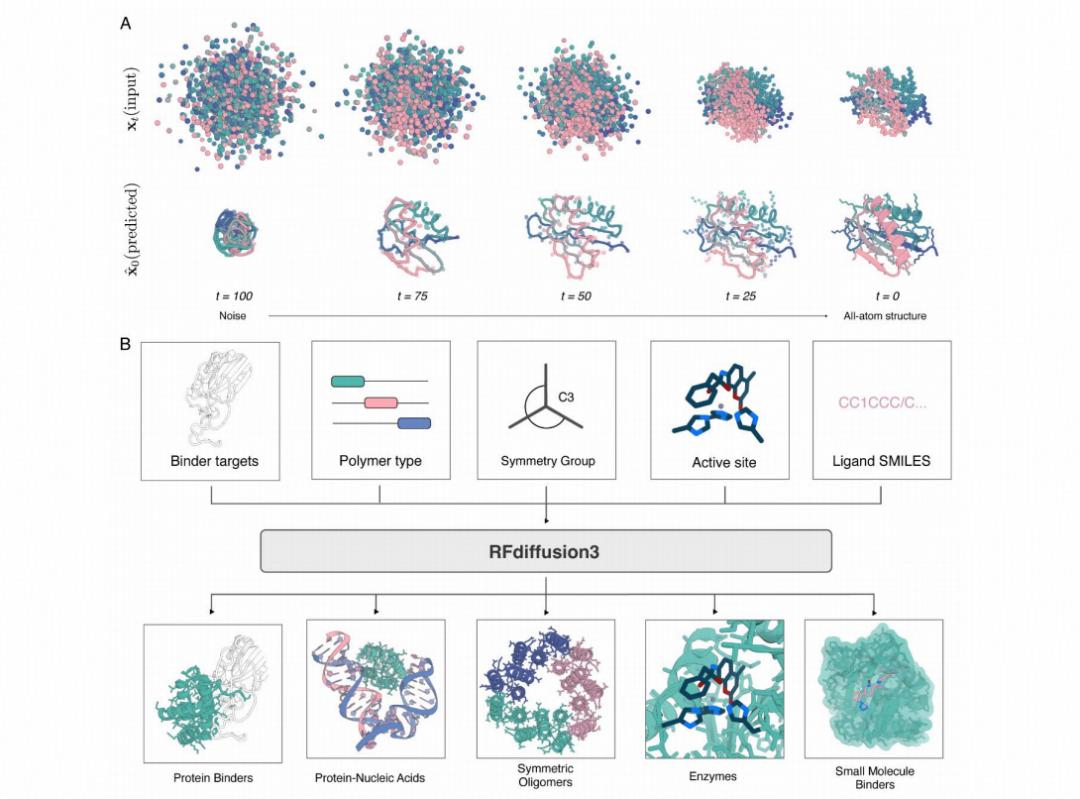
Figure | All-atom diffusion generation process of RFdiffusion3 and examples of biomolecular design under different conditions
In other words, researchers can first determine what kind of atomic arrangement is needed to achieve a specific function, and then let AI find a suitable molecular structure.
Computational tests show that RFD3 has improved in both accuracy and efficiency in design: among 41 enzyme active site design tasks, 37 outperform the previous generation RFD2; for proteins of typical length, its generation speed is more than twice faster than RFD1 and BoltzGen.
The design objects of RFD3 are no longer limited to proteins. In 57 RNA structure design tests, 21 reached the structural consistency standard with LDDT greater than 0.9, while the control model RFDpoly only got 10 such results. The research team also demonstrated the computational design capability of RNA aptamers and RNA-protein hybrid catalytic structures.
RFD3 was publicly published in the form of a preprint as early as 2025. This Science study did not propose the all-atom design method for the first time, but further demonstrated its applicability in complex catalytic sites and different biomolecular systems, and verified more challenging artificial enzyme design results through real experiments.
II. From pollutant degradation to disease research
The most important experimental result of this study is the de novo design of two types of artificial enzymes with catalytic activity.
First, it is a phosphotriesterase capable of hydrolyzing organophosphorus compounds.
Organophosphorus compounds are widely used in pesticides, flame retardants and other products, some of which are highly toxic and difficult to degrade. Enzymes capable of hydrolyzing these compounds have potential value in environmental remediation and medical countermeasures. However, the active site of natural phosphotriesterase involves 6 catalytic residues, two metal ions and a special lysine modification, and the complex spatial constraints make it difficult to design from scratch.
The research team used paraoxon as a model substrate, established a transition state model of the catalytic reaction through quantum chemistry, then generated the protein backbone through RFD3, and carried out sequence design and structure screening with tools such as LigandMPNN and AlphaFold3.
4 of the first 96 candidate designs showed catalytic activity. Among them, the most active ZAPP-1 can carry out multiple rounds of catalysis, and its catalytic rate constant kcat is 0.015 ± 0.003 s⁻¹. The researchers further verified the relationship between the designed active site and the actual catalytic reaction through experiments such as adjusting the conditions of lysine carbamoylation and mutating key catalytic residues.
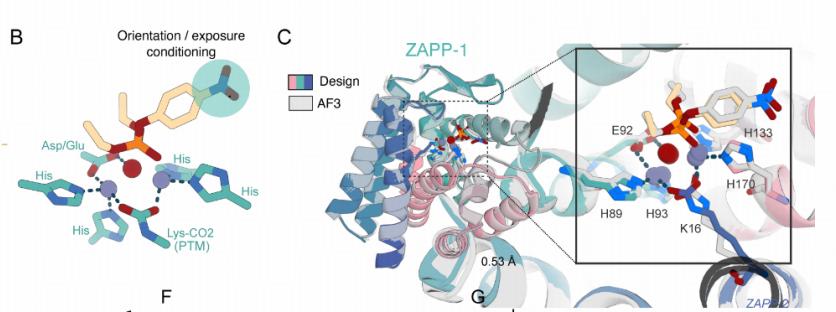
Figure | Active site of phosphotriesterase designed by RFD3 and the molecular structure of ZAPP-1
In the second round of experiments, the team obtained multiple active enzymes from 192 designs, among which the well-characterized excellent designs cover 4 different protein backbones. The catalytic reaction rate of ZAPP-2 is about 500,000 times higher than that under non-catalytic conditions.
This shows that RFD3 can not only design active enzymes for complex chemical reactions, but also find different structural solutions, providing new possibilities for the development of biocatalysts targeting specific chemical substances.
Another experiment focuses on transthyretin (TTR), which is associated with amyloidosis.
Abnormal folding and aggregation of TTR may damage organs such as the heart, nervous system and kidneys. The researchers used RFD3 to design artificial proteases that can recognize and cleave specific TTR-derived peptide sequences.
Among 96 candidate designs, 56 had a cleavage rate of more than 10% in the cis-experiment. Among them, TTRg11 can cleave most of the target reporter substrates within 1 hour, and mass spectrometry analysis confirmed that the cleavage occurred at the predetermined position.
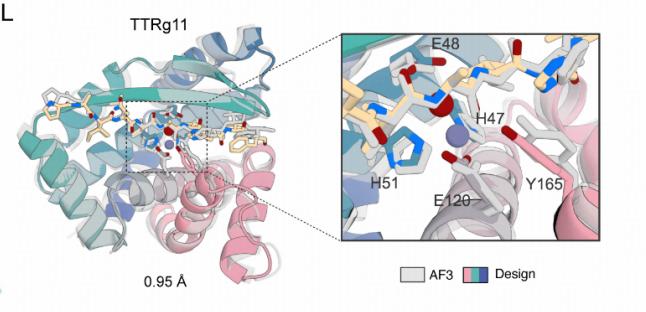
Figure | Molecular structure and active site of artificial protease TTRg11
Compared with the other 6 disease-related protein-derived peptides, TTRg11 has significantly higher activity on the target substrate. Without experimental optimization, its catalytic efficiency kcat/KM reaches 1100 ± 300 M⁻¹ s⁻¹, which is at the lower end of the catalytic efficiency range of some natural proteases (most natural enzymes are in the range of 10⁴–10⁸).
This result demonstrates the potential of designing artificial proteases according to specified substrates, but it cannot yet prove that it can clear TTR amyloid deposits in the human body, let alone mean that a therapeutic drug has been obtained.
In terms of application prospects, the precise design of artificial enzymes is expected to expand the range of reactions that industrial biocatalysis can handle, and provide new tools for the degradation of specific pollutants; artificial proteins with target recognition and cleavage capabilities can be used for disease mechanism research, molecular detection and potential therapeutic strategy development. RFD3's support for RNA and protein-nucleic acid hybrid systems also provides a new path for the design of functional molecules such as RNA aptamers and ribozymes.
However, from obtaining active enzymes in the laboratory to practical applications, it is still necessary to further improve catalytic efficiency, stability and safety. At present, some RNA design results mainly rely on computational prediction, and more experimental verification is still needed.
From AlphaFold's prediction of protein structures, to RFdiffusion's generation of novel proteins, to RFD3's precise design of complex catalytic sites, AI is gradually expanding the capabilities of biomolecular design.
For more technical details, please refer to the original paper.
This article is from the WeChat official account "Academic Headline" (ID: SciTouTiao), the author is Zhang Jiayi, and 36Kr is authorized to release it.