After the computing power network reaches the 4 trillion-yuan milestone, who can truly "put computing power into practical use"?
Demand has surged a thousandfold, yet 60% of computing power remains idle. What will the second half of the computing power network competition revolve around?
In Ulanqab, Inner Mongolia, an abandoned school is being transformed into a data center.
This northern city, hundreds of kilometers away from Beijing, has signed 89 data center projects so far. Alibaba, Huawei, Kuaishou and third-party operators have entered the market one after another, and the local government has accordingly put forward the goal of building a "Token Capital".
At the same time, the China Academy of Information and Communications Technology (CAICT) released another set of figures: in 2025, the national intelligent computing power supply was about 3.8 billion card-hours, while the actual usage was about 1.4 billion card-hours, with a utilization rate of 36.8%.
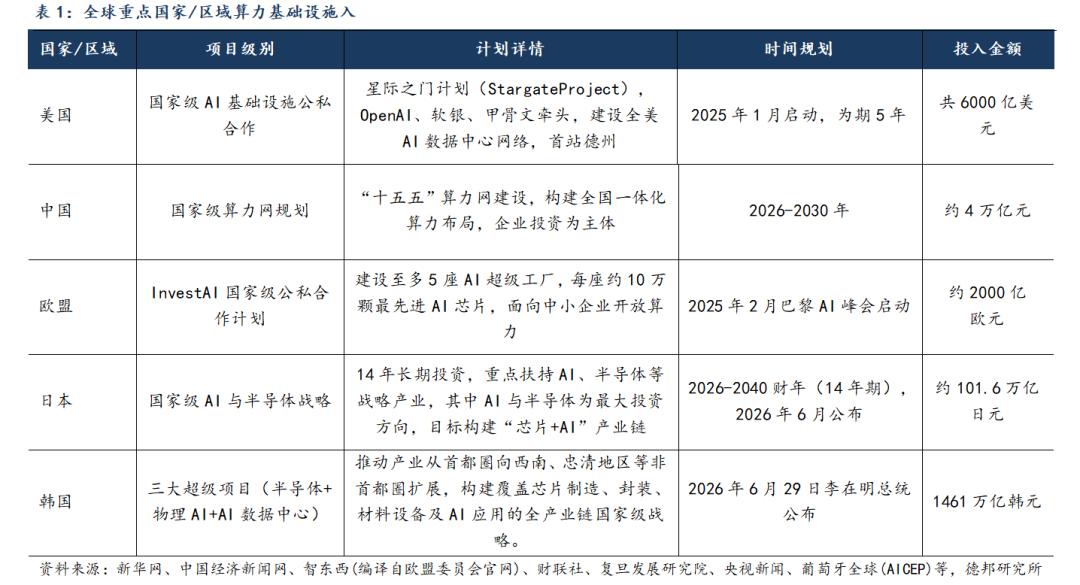
While players are scrambling to expand their territory, 60% of the computing power is left idle. According to estimates from institutions cited by the National Development and Reform Commission, the construction of the computing power network will require an additional direct investment of 4 trillion yuan during the 15th Five-Year Plan period, with a clear requirement to "accelerate the cultivation of an autonomous, controllable and collaboratively operated software and hardware ecosystem".
Substantial funds are still being poured into the supply side, yet a large portion of the built computing power has no tasks to process. Where does the problem lie?
Domestic computing power is in full swing in construction, but cold in actual utilization
At the beginning of 2024, the average daily national Token call volume was about 100 billion; by March 2026, the figure released by the National Data Administration reached 140 trillion, an increase of more than a thousand times in over two years.
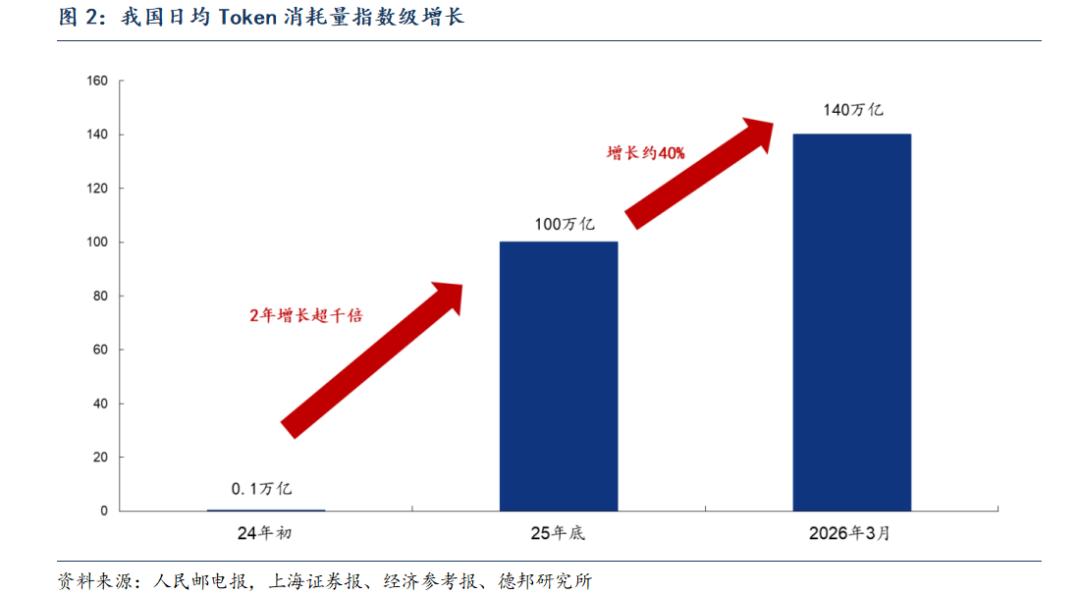
The explosion of demand is also driving a new round of construction of computing power infrastructure. On September 11, the State Council executive meeting studied the construction of the computing power network, and proposed to promote the coordination of computing power and electricity, as well as the integration of computing power and network, forming the "8+10+3" spatial layout.
However, not all computing power centers can benefit from this boom. The COO of ParaTech once revealed to the media that the company's computing power utilization rate was between 90% and 95% in 2025. On the other hand, an intelligent computing park in Inner Mongolia visited by *Economic Observer* is dominated by market-oriented thousand-card general-purpose computing power, with an annual comprehensive utilization rate of less than 50%; the newly built 100,000-card domestic intelligent computing reserved machine room in the park has an even lower shelf rate of less than 20%.
Further research by *Securities Times* reveals the reasons behind this differentiation. The self-built clusters of leading internet giants are supported by internal model training and reasoning services, maintaining high load; the three major operators are backed by their own businesses and information technology innovation orders; the real dilemma lies with the intelligent computing centers invested and built by local urban investment platforms and state-owned assets platforms, which still need to find customers after completion.
They are all intelligent computing centers, so why is there such a big difference?
There are three reasons. First is the investment rhythm: resources are seized rapidly, but the landing of demand follows its own pace. A person from a local state-owned computing power platform told *Economic Observer* that everyone is scrambling for land, electricity and energy consumption indicators, and the current logic is to "occupy the position first".
The construction of computing power infrastructure involves land, electricity, energy consumption indicators and capital investment, and the early layout often requires seizing resources. However, while machine rooms and servers can be put in place successively according to the construction plan, the formation of customer demand and the progress of project procurement have their own respective rhythms. There is a time lag between advance investment and demand landing. Once the early planning does not fully match the real customers, the completed computing power may temporarily find no use.
Second is operational efficiency: the lower the utilization rate, the harder it is to dilute fixed costs. *Science and Technology Daily* once reported that an intelligent computing center with a thousand-card scale in a city in western China has a shelf rate of less than 50%, and the actual utilization rate of the servers on the shelves is less than 30%, with an annual operating cost of more than 30 million yuan.
Electricity bills, depreciation and operation and maintenance costs will not decrease at all even if the business volume shrinks. Every day the servers are idle, these costs are burned for real.
The advantage of Ulanqab lies precisely in its low electricity price. Assuming that the average power of IT equipment in a data center is 10 megawatts, operating all year round with a PUE of 1.2, and the electricity price difference per kilowatt-hour is 0.4 yuan, the annual electricity bill difference is about 42 million yuan, exceeding 200 million yuan in five years.
However, low electricity prices can only reduce operating costs, but cannot eliminate another risk faced by computing power assets: GPUs may lose their cost competitiveness long before they reach the end of their service life. New chips are continuously improving performance, and reasoning technology is also evolving. A few years later, even if old cards can still operate normally, they may have to cut their prices to keep up with new equipment.

(Ulanqab Volcano Grassland, Source: Official website of Ulanqab Municipal Government)
The price of models can drop by three quarters in a month, but the purchased servers cannot be returned at any time. For intelligent computing centers, whether the upfront investment can match the actual demand, whether the daily operation can dilute fixed costs, and they also have to face the risk of asset depreciation brought by technological iteration.
Finally is customer selection: even if the computing power is cheap, customers may not be willing to switch suppliers.
Qidian interviewed the head of an AI application company that provides subscription services for individual users. The domestic computing power they use mainly comes from ByteDance and Alibaba Cloud. When asked whether they considered building their own computing power or trying to connect to smaller computing power service providers or local intelligent computing centers, the other party replied "Not for the time being, the existing ones are enough."
This phrase "enough" actually reveals the key to the mismatch. What application companies buy daily is pay-as-you-go model services, where computing power, models and scheduling have already been packaged by cloud vendors. Switching suppliers means re-deploying models, adapting software and testing stability. No matter how low the quotation is, they have to calculate the time cost of migration and the switching risk first.
Therefore, the real competitors of local intelligent computing centers are those cloud vendors that have encapsulated computing power into mature services.
The financial data disclosed by Alibaba can make the division of labor in this industrial chain clearer. In the quarter ending at the end of June, Alibaba's capital expenditure reached 67.678 billion yuan, a year-on-year increase of 75%; the revenue of the newly consolidated "AI Cloud and Computing Power Services" division (integrated from the Cloud Intelligence Group and T-head) was 48.437 billion yuan, a year-on-year increase of 45%, with an adjusted EBITA of 5.628 billion yuan. The revenue of the newly established "AI Lab and Applications" division (integrated from the AI Model Lab, Qwen 2C Business Unit and Qwen Office) was 3.338 billion yuan, with an adjusted EBITA loss of 13.861 billion yuan.
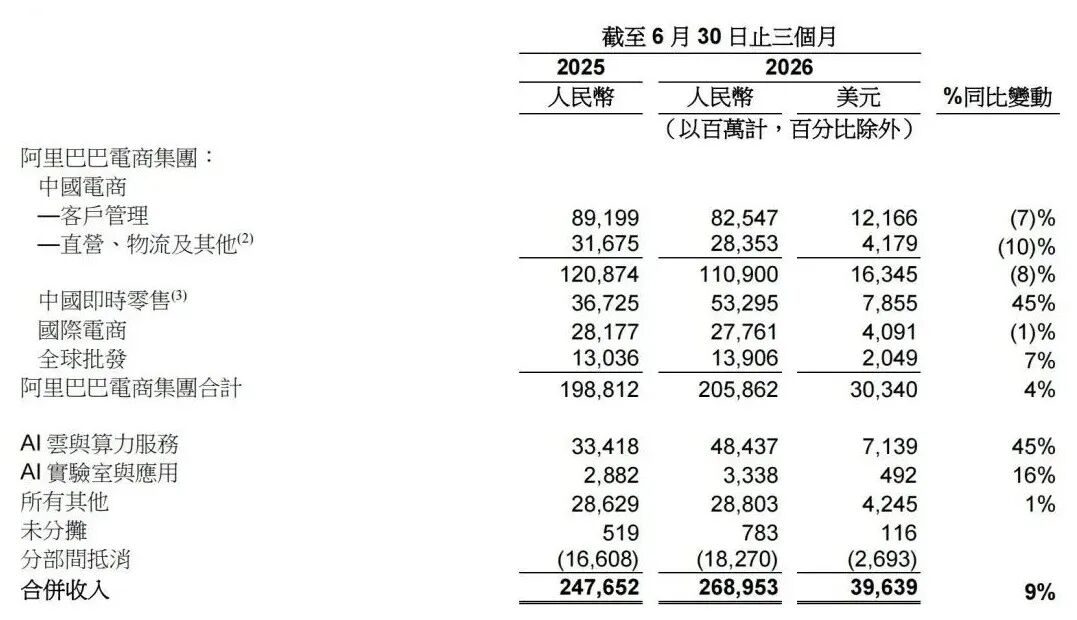
The same computing power expenditure is recorded as revenue in the cloud vendor's statements, but as cost in the model company's statements.
Chip manufacturers, machine room operators, cloud vendors and model companies have all placed heavy bets in this expansion. Even though they are on the same boat, they may not reach the shore at the same time.
In the reasoning era, computing power starts to be accounted for by "tasks"
If idle resources are an old problem of mismatch between supply and demand, the arrival of the reasoning era brings new variables.
It should be known that training and reasoning are two completely different types of loads. Training can be scheduled centrally, with one task running continuously for several weeks to keep the large cluster at high load; reasoning follows user requests, fluctuates with peak and off-peak hours in the morning and evening, and must ensure response speed.
After the popularization of Agent, a single task goes through multiple links including planning, retrieval, tool calling and verification, and the number of calls and context expand together. The total amount of Token consumed by a single task will not decrease as the unit price drops.
Gartner released two sets of figures in its two forecasts in August: global spending on reasoning-related AI infrastructure in 2026 is expected to reach 23.3 billion US dollars, surpassing the 19 billion US dollars related to training for the first time; by 2028, the reasoning cost of a single Agent workflow will rise to more than five times the current level.
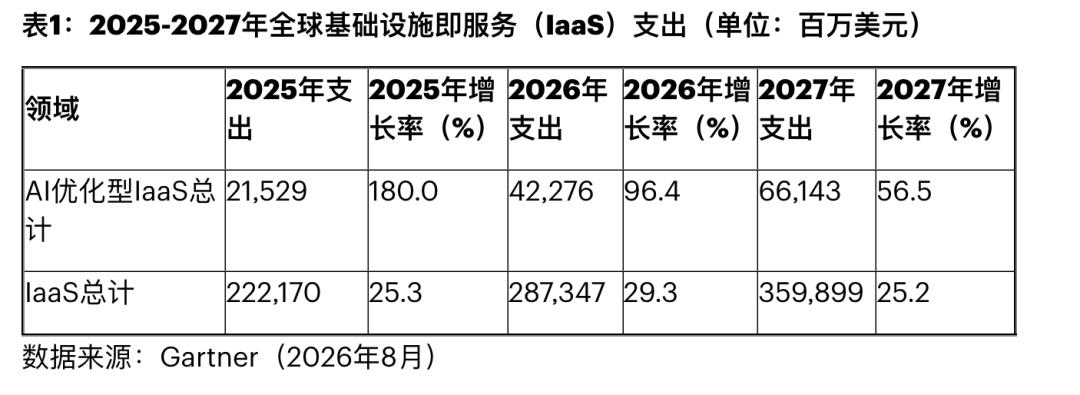
The form of demand has changed. The old method of relying on centralized procurement and building large clusters to achieve high utilization rate is no longer effective in the face of scattered and fluctuating reasoning requests.
DeepSeek's price adjustment in September directly wrote the peak and valley of reasoning into the price list. For the Flash series, during off-peak hours, the input price is 0.02 yuan per million Token for cache hits, 1 yuan for cache misses, and 4 yuan for output, and the prices double during peak hours. The three prices are 60%, about 33% and about 11% lower than the previous off-peak prices respectively.
The subtext of time-sharing pricing is that price itself has become a scheduling tool, guiding users to move tasks that can wait to off-peak hours. The peak-valley difference of computing power is directly reflected in the API quotation for the first time.
The entire market is also cutting prices. Silicon Data's LLM Token Expenditure Index shows that the industry's average payment price per million Token has dropped from a high of more than 2 US dollars in May to 0.97 US dollars at the end of August, a drop of more than 52% from the May high. However, the differentiation is obvious: mid-range general models are replaced by open-source models with the most fierce price wars, while top flagship models still maintain premium capabilities.
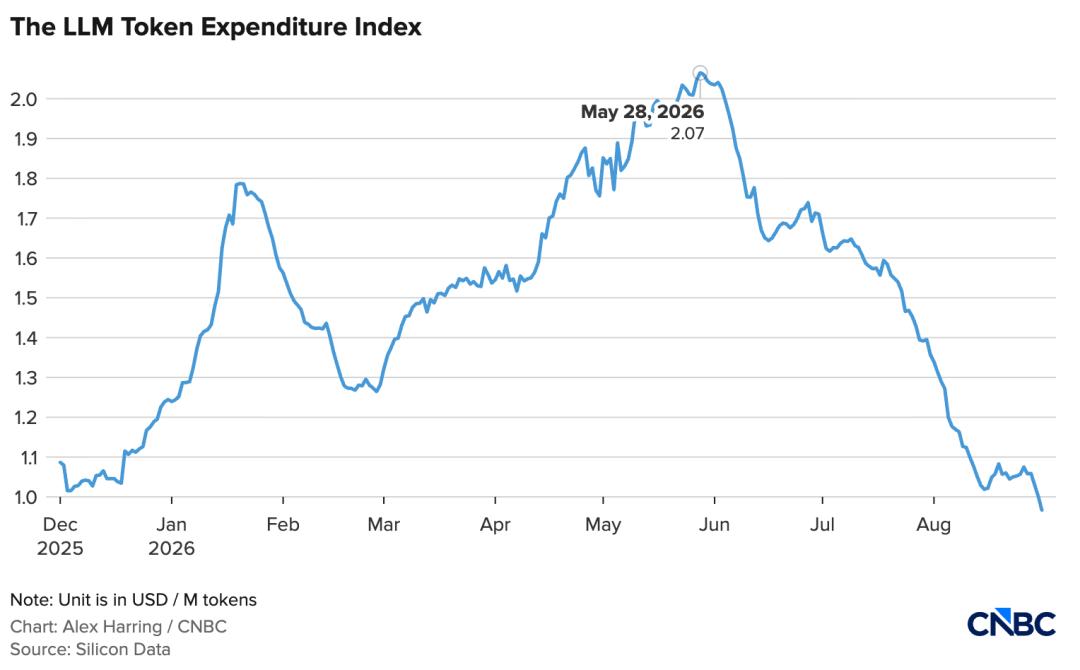
This shows that the procurement methods of enterprises have also changed: simple tasks are assigned to cheap and sufficient models, and complex reasoning is left to flagship models. The cost saved by model companies through technical optimization is being passed on to customers through price wars.
However, the drop in model prices does not mean that the total cost of completing a task will drop proportionally. The unit price of Token is only part of the cost. Completing a task also needs to take into account the model effect, number of calls, response time, failed retries and manual review. A cheap model may require several more rounds of attempts, while an expensive model may get it done at one time. Which one is more cost-effective has to be calculated together with the task completion quality.
The accounting of subscription-based products is the most intuitive: the user's monthly fee is fixed, and the call cost follows the usage volume. The drop in Token price is good for gross profit, but as functions become more and more complex, a single task consumes more resources, and the total cost will still rise.
The ruler for evaluating computing power has changed from the peak parameters of chips and the unit price of Token to whether tasks can be stably delivered under real load and how much it costs to deliver one task.
An industrial-level evidence is that domestic chips are currently mainly used for reasoning. In its prospectus, MetaX clearly states that internet companies purchase domestic chips mainly for the reasoning side; the pre-training of DeepSeek V4 is still completed on the NVIDIA H800 and H100 clusters, while Ascend undertakes reasoning deployment and part of post-training; Alibaba claims that its self-developed PPU is superior to H20 on the reasoning side, although the test scope covers models with 20 billion to 100 billion parameters.
Reasoning lands first, half out of active choice and half out of capability boundary. Training is a task of global synchronization. Each step of gradient update has to wait for the slowest card. The larger the scale, the easier the waiting becomes a black hole that devours computing power; reasoning can be divided and scheduled, and the capabilities of domestic computing power can be directly realized.
From "available cards" to "tasks running smoothly", domestic computing power still needs to "pass three levels"
Even with supply and demand, business operations may not necessarily go smoothly. To truly enter application production, computing power still needs to "pass three levels".
First, the built resources must be fully utilized.
Sugon shared a sample: after the national supercomputing internet core node in Zhengzhou was connected to the national integrated computing network scheduling system, the system resource utilization rate was raised from less than 50% to full load through cross-center optimization and peak shaving and valley filling.
A lot of idle resources come from the mismatch between tasks and resources. Putting tasks into a larger pool for scheduling can fill the idle time slots.
Computing-power-electricity coordination is also solving similar problems. Gao Wen, an academician of the Chinese Academy of Engineering, revealed at WAIC that the first phase of China's computing power network has been completed by about 70%, and full implementation may take 20 years. His team is researching to transform computing power