A central state-owned hydropower enterprise has been fined 1.26 million yuan, energy storage enterprises have been arranged for collective regulatory interviews, and Zhejiang has not even spared projects that "have not completed all required formalities", which marks a shift in the working approach of energy regulation.
The extended scope of energy regulation in three domestic regions is shifting to ex-ante process supervision.
Energy Foresight notes that the energy regulatory offices of the three regions have taken intensive actions recently. Among the four penalty notices issued in Gansu, Sinohydro 14th Bureau Co., Ltd. was fined 1.2657 million yuan for three overlapping violations: working without valid certificates, absence of risk control, and construction not in accordance with drawings. In Xinjiang, 12 energy storage enterprises were summoned together on the grounds of "disobeying dispatching orders and over-planned charging and discharging". The two penalty notices in Zhejiang have the same amount of 350,000 yuan, pointing to the same reason - failure to go through the project quality supervision procedures.
The common feature of the actions in the three regions does not lie in what penalties are imposed, but in what is inspected. Gansu inspects the behavioral deficiencies in the construction process, Xinjiang inspects the dispatch discipline after commissioning, and Zhejiang inspects the compliance of procedures at the front end of construction. The entry point of regulation is extending to the front end and daily operation, and the past response mode of "rectification after accidents" is losing its space.
1.2657 million yuan is not the end, the safety ledger of hydropower central SOEs cannot withstand close inspection
The amount of this penalty in Gansu is worth breaking down. 1.2657 million yuan is more than 25 times of the single penalty imposed on Sinohydro 4th Bureau in the same period. The reason why Sinohydro 4th Bureau was fined was that "failing to take corresponding control measures according to risk classification", with a fine of 50,000 yuan.
As central SOE construction units also punished in Gansu, the fine gap is so huge, the key lies in the superposition of illegal facts, the problems of Sinohydro 14th Bureau are not one, but three at the same time.
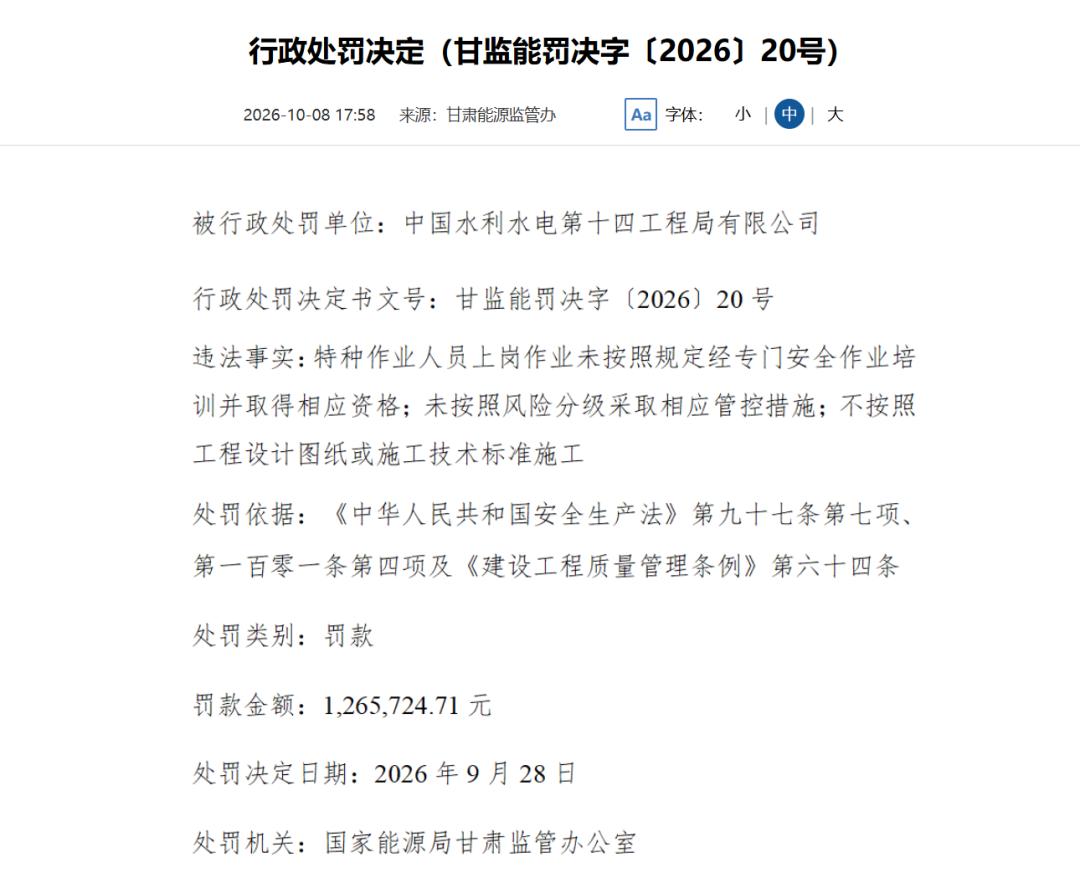
(Screenshot from the official website of National Energy Administration)
Working without valid certificates, absence of risk control, and construction not in accordance with drawings, these three points point to three different links in the construction management chain: personnel qualification, system implementation, and technical compliance. A project has problems in these three links at the same time, which does not indicate the accidental negligence of a certain team, but the simultaneous failure of the project-level management system at multiple nodes.
Looking through the punishment records of Sinohydro 14th Bureau in the past two years, this kind of "multi-point failure" is not an isolated case. It is reported that in May 2026, the company was given a red warning for three months by the Shenzhen Municipal Housing and Urban-rural Development Bureau due to its involvement in a safety accident. In September, its subsidiary Sinohydro 14th Bureau Shenzhen Co., Ltd. was fined 550,000 yuan for a lifting injury accident that caused one death.
From Gansu to Shenzhen, from energy regulation to housing and urban-rural development regulation, the punished subjects are changing and the types of problems are changing, but the judgment that "there are systematic weaknesses in the safety management system" has been repeatedly confirmed under different regulatory calibers.
The safety management of hydropower construction enterprises has a structural problem, that is, the projects are widely distributed, the operation surfaces are scattered, and the personnel have high mobility. The two systems of hierarchical risk control and special operation with valid certificates are the most likely to become "paper-based". The ledgers are complete during the inspection, but the construction site may not match. The problems found by the Gansu Regulatory Office essentially tear a hole in this kind of "paper compliance".
The scale of energy engineering construction is still expanding, but the granularity of safety management has not kept up with the expansion speed. A fine of 1.26 million yuan is not fatal to a central SOE, what really needs attention is what kind of constraints the credit traces accumulated by this enterprise being repeatedly punished in different regions will form in future bidding and qualification review.
12 energy storage enterprises were summoned together, dispatch discipline is no longer a "suggestion"
The most thought-provoking part of this Xinjiang's interview is that it focuses not on "whether it is built" but on "whether it is used correctly".
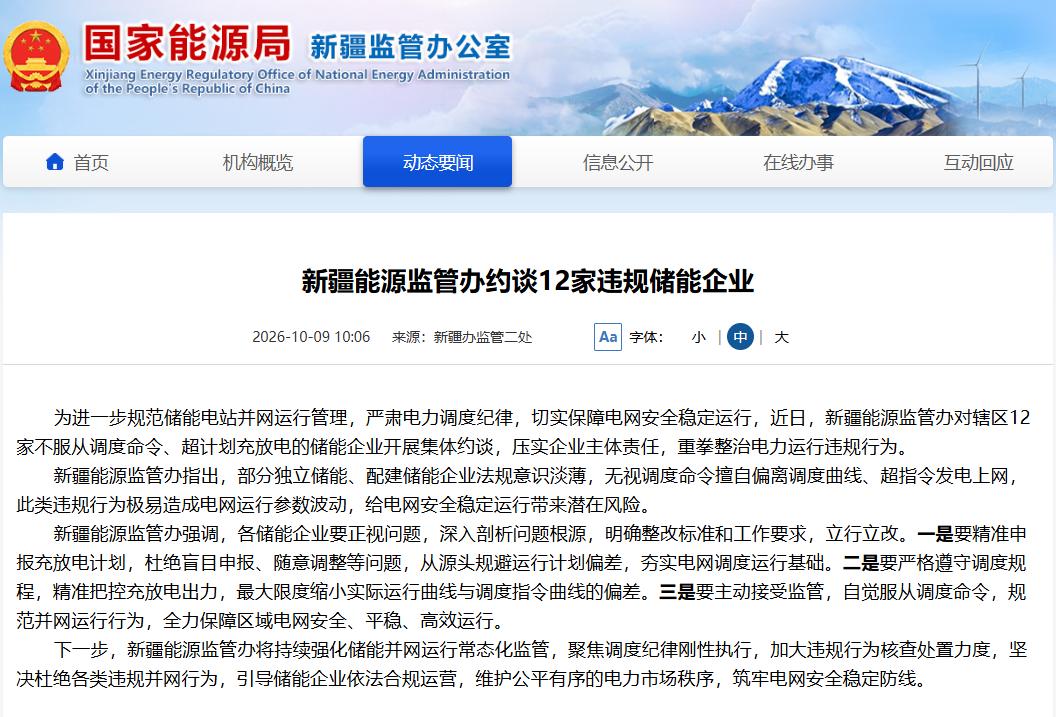
(Screenshot from the official website of National Energy Administration)
In the past few years, the main policy line of the energy storage industry has been pushing enterprises to launch projects. Various policy tools such as energy storage allocation ratio, grid connection priority, and capacity compensation are trying to build energy storage stations first. Now that the projects are completed and the scale is up, the regulatory attention naturally shifts to the operation link.
This interview in Xinjiang is a clear action of this shift.
The impulse of energy storage enterprises to over-plan charging and discharging is rooted in the revenue structure. The income of energy storage stations is directly linked to the charging and discharging volume. In the face of the price difference in the spot electricity market, more charging and discharging means more profits. However, the grid dispatch is a real-time balance account. If the energy storage station deviates from the dispatch curve without permission, it will at least cause the fluctuation of operation parameters, and at worst affect the regional power supply safety.
An easily overlooked point here is that Xinjiang's constraints on energy storage dispatch discipline actually have ready-made assessment tools, but the rigidity of implementation was not enough before. The draft for comments on the "Two Detailed Rules" in North China has clearly stated that if the energy storage station causes the actual curve to deviate from the dispatch plan curve due to its own reasons, the deviation power assessment will be carried out every 5 minutes, and the allowable deviation is only ±2%.
Shandong, Shanxi and the five southern provinces have also included independent energy storage and supporting energy storage into the dispatch discipline assessment system. The rules have always been there, and the significance of this interview in Xinjiang is to turn "assessment is allowed" into "assessment must be carried out".
For energy storage enterprises, this means a fundamental shift, that is, the competitiveness of power stations shifts from "whether it can be built" to "whether it can be managed". The rigid implementation of dispatch instructions will eliminate enterprises that only rely on seizing power and lack refined operation capabilities. At present, the average daily available hours of independent energy storage is 3.28 hours, and that of new energy supporting energy storage is only 2.25 hours. The gap in operation efficiency itself illustrates the problem. After the dispatch discipline is tightened, this gap will only widen.
The weight of the 350,000-yuan penalty in Zhejiang goes beyond the "procedures"
The two punished enterprises in Zhejiang, Zhejiang Shengfan Agricultural Development Co., Ltd. and Haining Yueyuhai New Energy Co., Ltd., have "agriculture" and "new energy" in their names, were established not long ago, and belong to small and medium-sized market entities in the industry.
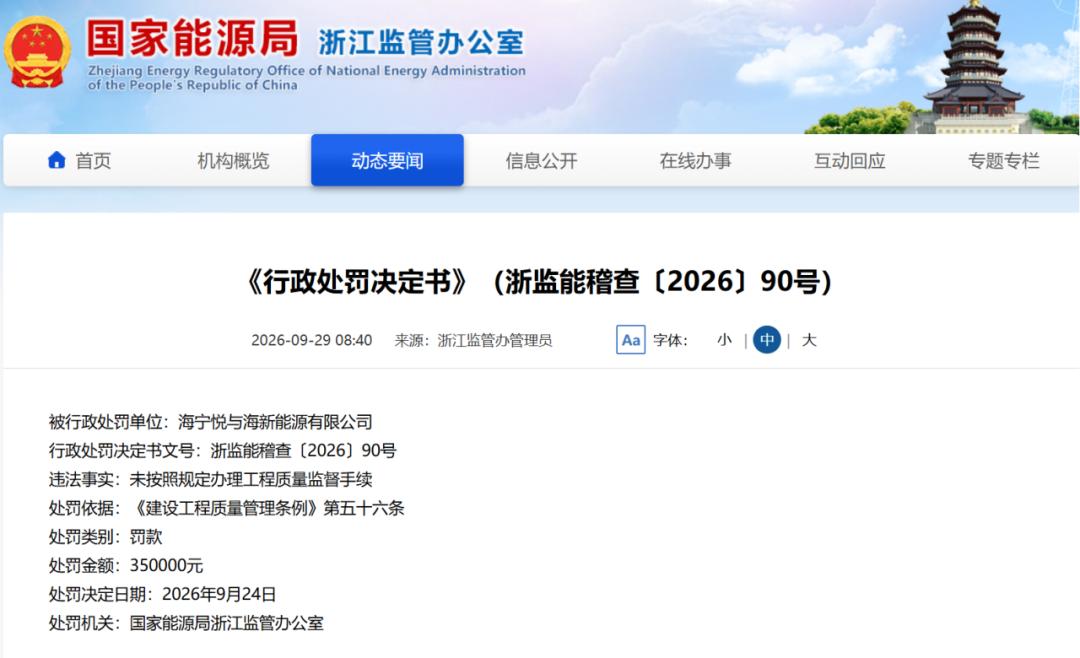
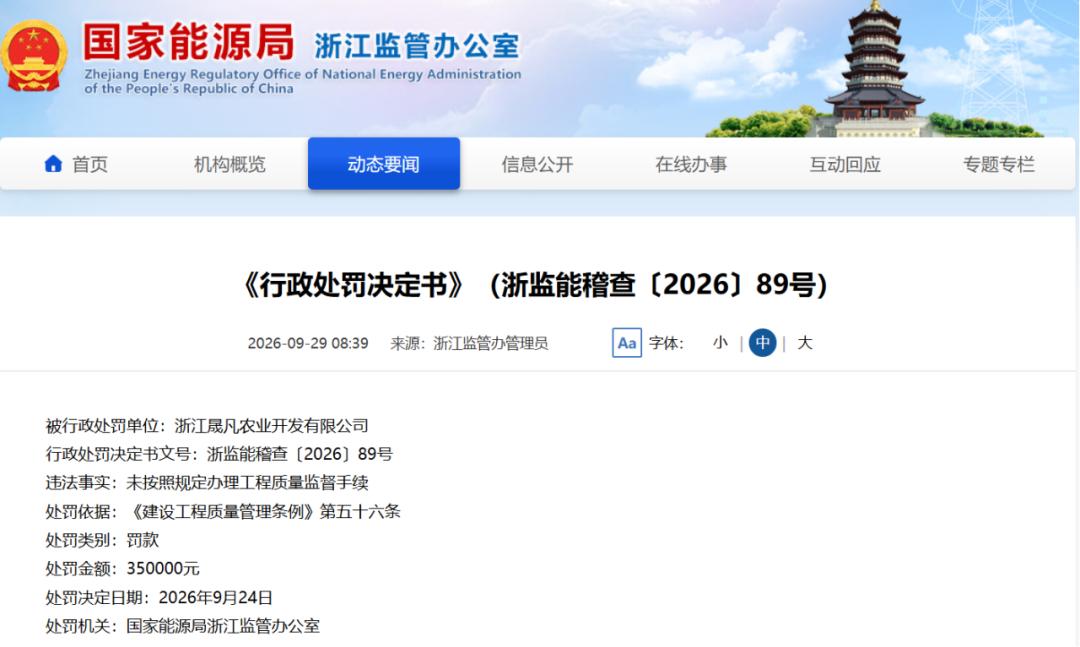
(Screenshot from the official website of National Energy Administration)
According to the observation of Energy Foresight, the failure to go through the project quality supervision procedures rarely appears as a separate cause of punishment in the past energy regulation practice. The project quality supervision procedure is the "entry link" of power construction project quality control. Failure to go through the procedure means that the subsequent quality supervision process cannot be started, and the compliance of project quality is discounted from the source.
This time, the Zhejiang Regulatory Office directly imposed a fine of 350,000 yuan in accordance with Article 56 of the Regulation on the Administration of Construction Project Quality, sending a clear signal that procedures are not matters that "can be supplemented later".
Another piece of information contained in the two penalty notices lies in the identity of the punished subjects. In the past, the punished objects of energy regulation were mainly large power generation groups, power grid enterprises and central SOE construction units, while small and medium-sized market entities were more constrained in the project approval and grid connection links. Zhejiang directly issued a 350,000-yuan penalty notice to two small and medium-sized enterprises this time, indicating that the coverage of regulation is extending to small and medium-sized entities along with the distribution of projects.
From Gansu to Xinjiang and then to Zhejiang, the three regional regulatory offices have different entry points, but the restrictive logic they point to is consistent: The objects of regulation are changing from "accidents" to "behaviors", and from "results" to "processes". Gansu punishes the behavioral deficiencies in the safety management process, Xinjiang focuses on the dispatch discipline in the operation process, and Zhejiang manages the compliance procedures at the front end of construction. For energy enterprises, the focus of compliance needs to move forward from "no accidents" to "every step can withstand inspection".