Liang Wenfeng has set his sights on robots. Will large models replace embodied models?
Finally, DeepSeek is about to step into embodied intelligence.
Recently, sources say Liang Wenfeng is in talks with multiple embodied intelligence startups, considering entering this field.
Since 2026, it has almost become a trend for large model companies to get involved in embodied intelligence. Not to mention OpenAI, Google's recently updated new model Gemini 4 Argon also focuses on robot manipulation.
It has almost become the industry consensus that embodied intelligence is the next stop for large models, and DeepSeek obviously holds the same view.
Liang Wenfeng once described his envisioned AGI technology roadmap in an investor exchange record circulated in May 2026: from language models, Chain of Thought (CoT), Agent, to continuous learning, AI self-iteration, and finally embodied intelligence.
At the end of this roadmap, AI will no longer be just a chat assistant on the screen, but truly step into people's daily lives. "After reaching the stage of embodied intelligence, it will enter the real world, help you with housework, and even take care of you in your old age."
But Liang Wenfeng is also clearly aware that it is not easy to get to this point. He particularly emphasized the priority of the technical route: if you reverse the order and start with embodied intelligence first, "you will end up working extremely hard on your own, it is a very tough task."
Now, only a few months after this statement, Liang Wenfeng has been reported to start contacting robotics companies. The direction he once placed at the very end of the AGI roadmap seems to be moved to the agenda ahead of schedule.
Where exactly did the change happen? For general large model companies like DeepSeek, is there a different path to enter the physical world from the previous ones?
General Large Models, Stepping into the Physical World
Almost at the same time when Liang Wenfeng was exposed to be in contact with robotics companies, Wang Xingxing gave an optimistic judgment on the general large models moving towards the physical world.
On October 12, Wang Xingxing revealed at the 26th China International Industry Fair that Unitree has tested multiple robots with GPT-6, "the performance is actually very good". He judged that the critical point of embodied intelligence will come in as fast as one or two years, and next year's GPT-7 may even "directly break through all problems of embodied intelligence".
In the past few years, the robotics industry has been trying to train dedicated embodied models, and there are mainly two technical ideas: one is the "separation of cerebrum and cerebellum", where the large model is responsible for perception and decision-making, and the underlying control system is responsible for movement; the other is the end-to-end model represented by VLA, which tries to integrate vision, language and movement into a unified model.
Nowadays, general foundational large model-driven Agent is becoming another exploration approach: the model understands tasks and formulates plans based on environmental information, then calls the robot's motion tools to execute, and adjusts operations according to feedback.
"In fact, this is not even a technological or paradigm innovation." An industry insider compared it to the Harness in the embodied intelligence field, which is a task execution and tool calling mechanism built around the model, and VLA can also become a Skill called by the robot Agent.
This route is not brand new, but it may provide another solution to the long-standing data problem faced by embodied intelligence.
"I think this is a very good entrepreneurial direction." An engineer from the embodied intelligence department of a large tech company said that current embodied models face two major data bottlenecks: the first is scaling. End-to-end VLA and other models have invested a lot of costs in collecting real machine data, but still have not verified the Scaling effect similar to that of language models; the second is data alignment. Data collected by different robots varies greatly, making it difficult to reuse directly.
General large models already have strong capabilities of understanding, reasoning and planning. If these capabilities are used for robot tasks through the Agent framework, the dependence on task-specific training data can be reduced.
He believes that "the no-training route where general LLM generates control logic may have Scaling potential".
In September, RoboCurve released a set of real machine tests: connecting GPT-6 Astra to the robot Agent system, allowing the model to generate the motion target of the robotic arm through tool calls based on the camera picture and robot status, and then executed by the underlying control system.
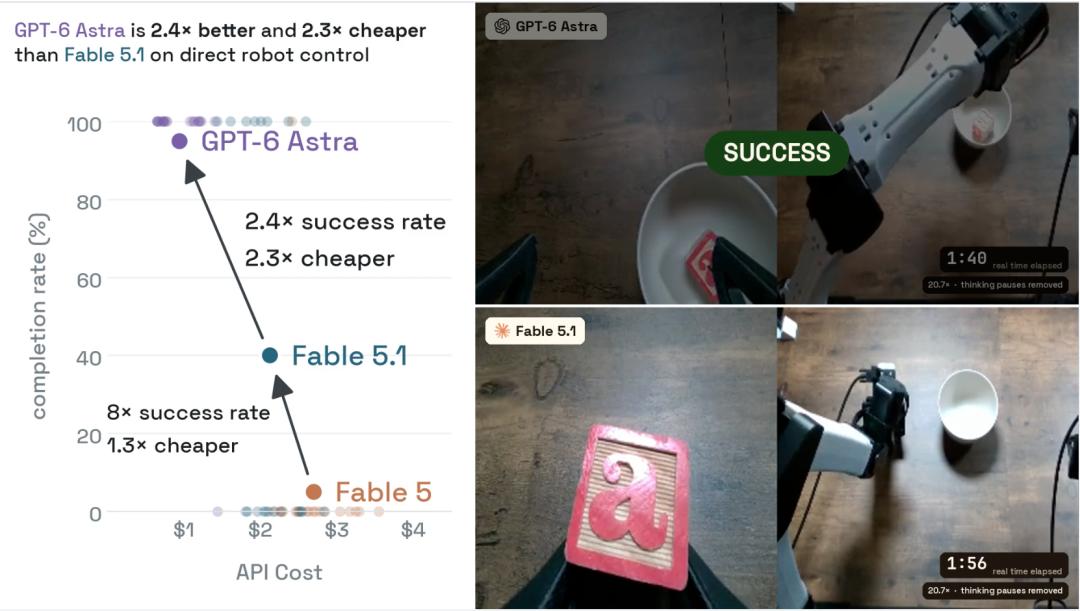
Comparison of the best performance of different models in completing the task of "putting the building block into the bowl"
In 20 tests of "putting the building block into the bowl", GPT-6 Astra succeeded 19 times with a success rate of 95%, and the average time consumed was significantly shorter than that of the control model.
This set of tests is not enough to prove that general large models are competent for complex robot operations, but it demonstrates a possibility: there is no need to train a dedicated embodied model from scratch for each task, and general large models can also participate in operations in the physical world with the help of tools.
For general large model companies like DeepSeek, this may mean that entering the embodied intelligence field does not necessarily require building a complete embodied model system from scratch.
Two Sides of the New Route: Capabilities and Costs
Around this route, the research teams are carrying out different explorations, which are roughly divided into two directions: one is to let general large models command robots to complete tasks, and the other is to let them participate in the R&D and improvement of robot control methods.
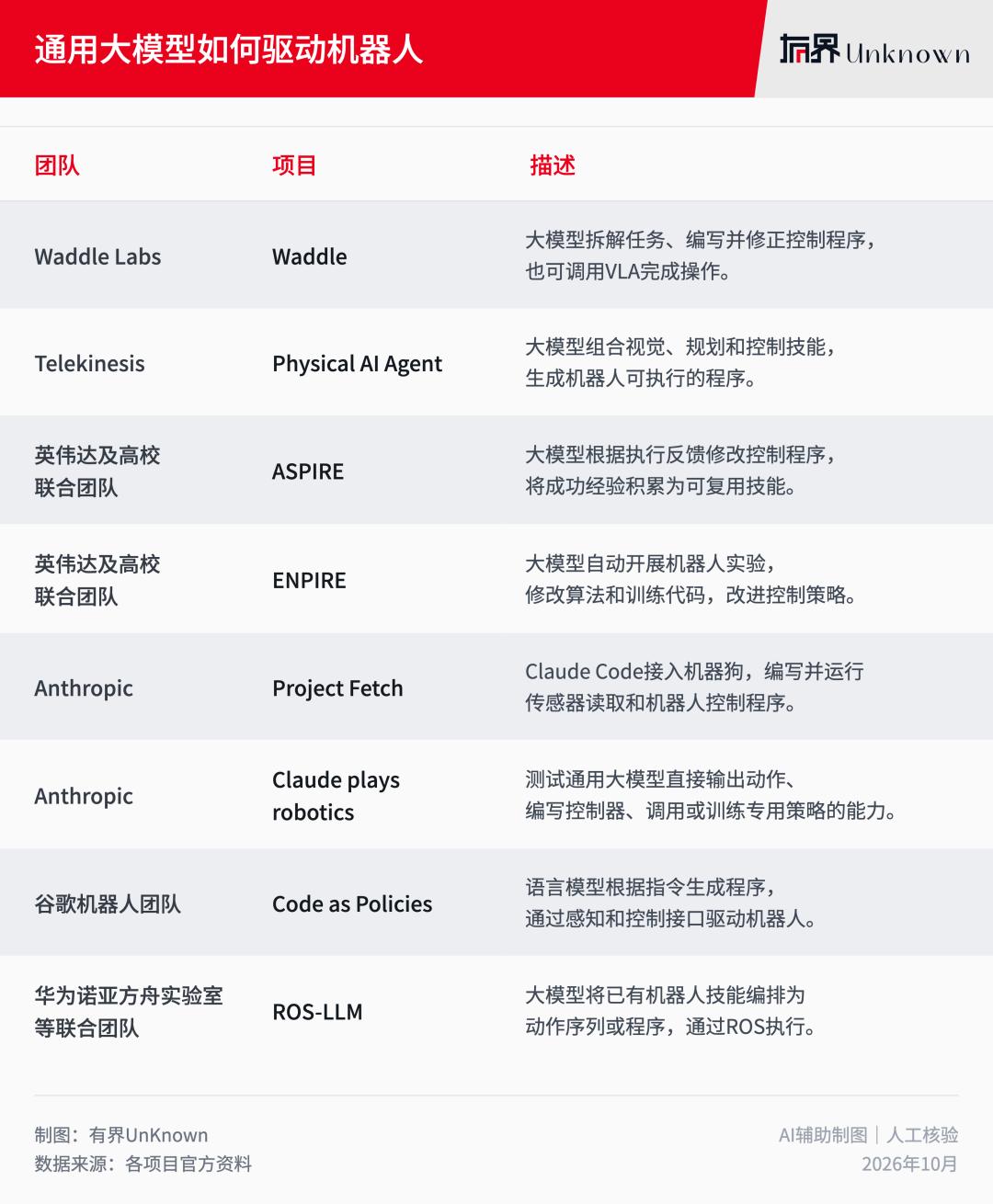
Overview of general large model-driven robotics research projects
Waddle is the representative of the former direction. It allows the large model to understand tasks, write control codes based on camera images, and call tools such as VLA to perform operations. The general large model is responsible for planning and handling exceptions, and the dedicated model is responsible for specific movements, and the two cooperate to complete complex tasks.
ENPIRE introduces Agent into the R&D process. The robot conducts experiments repeatedly, the coding Agent analyzes execution records, finds the cause of failure, modifies algorithms and training codes, and then verifies the effect through the next round of experiments. The work that used to require researchers to debug repeatedly is now being attempted to be completed by AI.
However, from technical exploration in the laboratory to robots truly entering factories and homes, there are still many practical problems on this route.
"The first problem is cost." The above engineer believes that if the robot needs to call OpenAI's API every time it performs a task, customers will have to pay continuous model calling fees after purchasing the hardware. "It's equivalent to that we only sell the customer a piece of hardware, and the customer has to pay an additional subscription fee."
Then, can the cost of calling the model offset the original cost of collecting data and training the model?
He believes that the two can indeed offset part of each other, but the business models are different. Independently collecting data and training models, although with high upfront investment, the models are in your own hands; relying on external APIs means that additional costs may be incurred every time the robot works.
"The second problem is real-time performance." He once tried to call GPT models through different services, and a single response took several seconds. For robots that require continuous perception and rapid response, this is obviously not ideal.
However, he believes that the real-time performance problem is expected to be improved in the future.
This also means that whether general large models can enter the physical world is no longer just a question of whether the model has the capabilities, but also depends on whether it can complete tasks stably at a sufficiently low cost and at a sufficiently fast speed.
Can Players Like DeepSeek Catch Up Later?
In addition to OpenAI, many domestic large model companies are already trying to develop embodied intelligence. "I think Xiaomi is very suitable for this, they have the Mimo large model and their own robot ontology CyberOne", an industry insider believes that besides Xiaomi, "DeepSeek and Kimi are also very suitable for carrying out similar explorations".
For them, "an important threshold for entering embodied intelligence is to obtain interactive data of real robots", that is, the lack of physical data.
Looking back at OpenAI's research in the past nearly a decade, you will find that OpenAI has never completely left the physical world over the years.
In 2017, OpenAI launched the dexterous hand research. In 2018, the robotic hand could only rotate the block in the palm; in 2019, it was able to restore the Rubik's Cube with one hand, but the success rate under ordinary random scrambling was 60%, and only 20% in the most complex cases. Researchers constantly changed conditions such as mass and friction in simulation, and used rubber gloves and plush toys to create interference in real machine tests to verify its adaptability.
This set of control technology did not directly evolve into GPT. After that, OpenAI explored to let general models understand the real world through multimodal data. The GPT-4o system card disclosed that its pre-training data includes videos, but videos cannot replace robot movements and contact feedback. In 2026, OpenAI was also reported to have established a robot data collection laboratory to record real operations through remote-controlled robotic arms.
From simulation training, multimodal learning to real machine data collection, OpenAI has been continuously trying to let AI accumulate physical experience.
In comparison, domestic large model companies also have related actions.
DeepSeek's exploration into the physical world is first reflected in its visual capabilities. In 2024, it launched the Janus series that balances image understanding and generation; on January 27, 2025, it released Janus-Pro. In the official demonstration, the model can read formulas in pictures and convert them into codes, and also generate images according to text descriptions. However, these capabilities are mainly built on image and text data.
On the evening of August 6, 2026, DeepSeek appeared in the IPO strategic placement list of Unitree disclosed by Unitree Robotics. Wang Xingxing said during the roadshow that according to the strategic cooperation memorandum signed by the two parties, the two companies will carry out cooperation around AGI, high-performance general robots and AI large models.
But these explorations still stay at the level of the two-dimensional world.
Looking at the published technical papers, DeepSeek has not yet demonstrated the physical interaction training results similar to OpenAI's dexterous hand project, nor has it clearly disclosed large-scale 3D scenes, robot motion trajectories and the corresponding training system.
This puts DeepSeek in a competition different from that of language models. In the past, it achieved competitive model performance with relatively limited investment through the mixture-of-experts architecture, training optimization and reinforcement learning.
Conclusion
Compared with forming a robotics team on its own, Liang Wenfeng's more specific actions in the embodied intelligence field are currently reflected in investment.
In August 2026, DeepSeek participated in the IPO strategic placement of Unitree Robotics, contributing about 141 million yuan. By October, DeepSeek was reported to plan to lead the investment in robotics AI startup Winverse AI. From robot ontology to robot AI, Liang Wenfeng has begun to find partners for DeepSeek to enter the physical world.
This also leaves a suspense: according to the order he envisioned earlier, embodied intelligence will not be developed until the model can achieve continuous learning and self-iteration. Now that he is contacting and investing in robotics companies in advance, is he preparing for that day, or have new advances in the robotics field led him to make a new judgment?
The answer may lie in the next move. After all, there is still a long way to go between investing in a robotics company and letting your own model truly control the robot.
This article is from the WeChat official account "UnBound Unknown", author: Qian Jiang, editor: Shan Cha, authorized by 36Kr for release.