Breaking: Anthropic co-founder backtracks, stating that RSI will be brought forward to 2027, leaving humanity only 6 months left.
Recently, Anthropic executive Jack Clark dropped a bombshell.
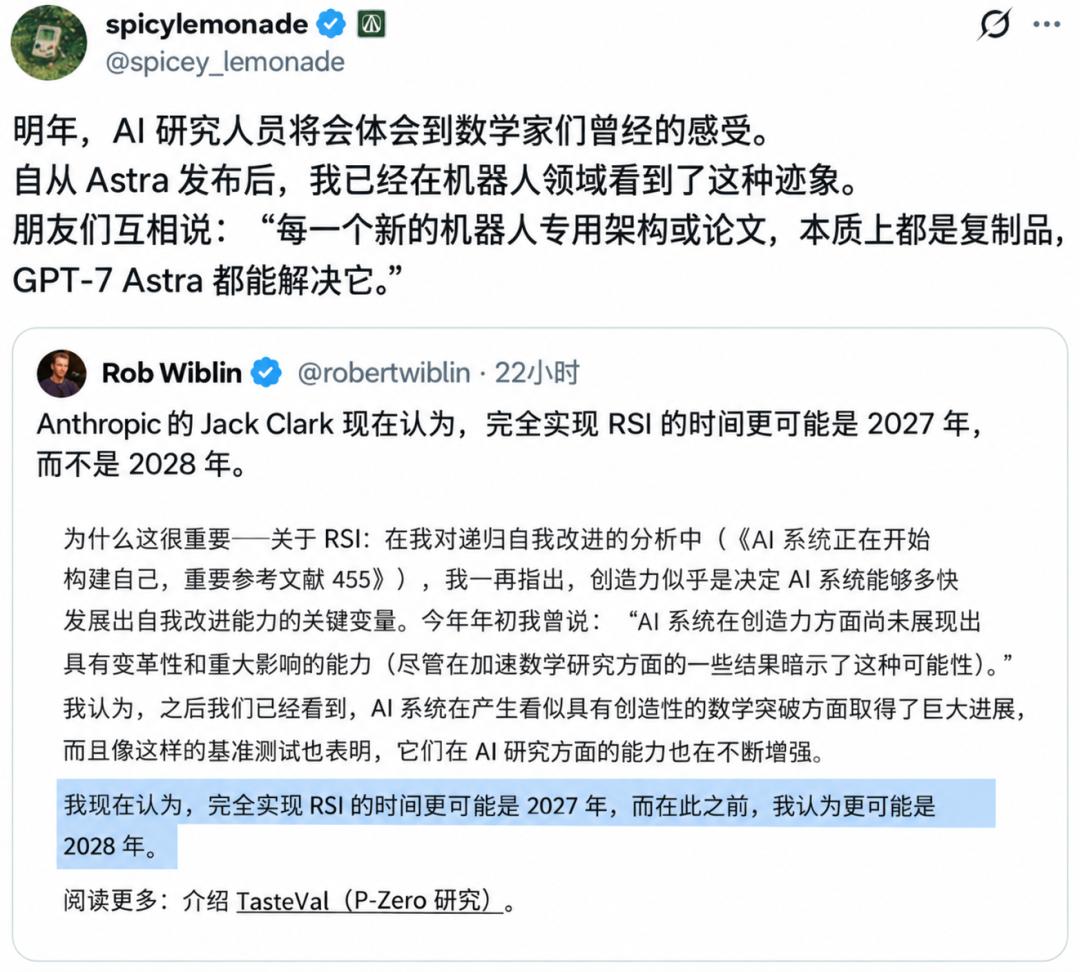
He moved the timeline for AI to achieve RSI (Recursive Self-Improvement) directly forward to 2027, from his original forecast of 2028.
The announcement sent shockwaves through the tech industry.
Shortly after, Elon Musk replied to the post: "Obvious."
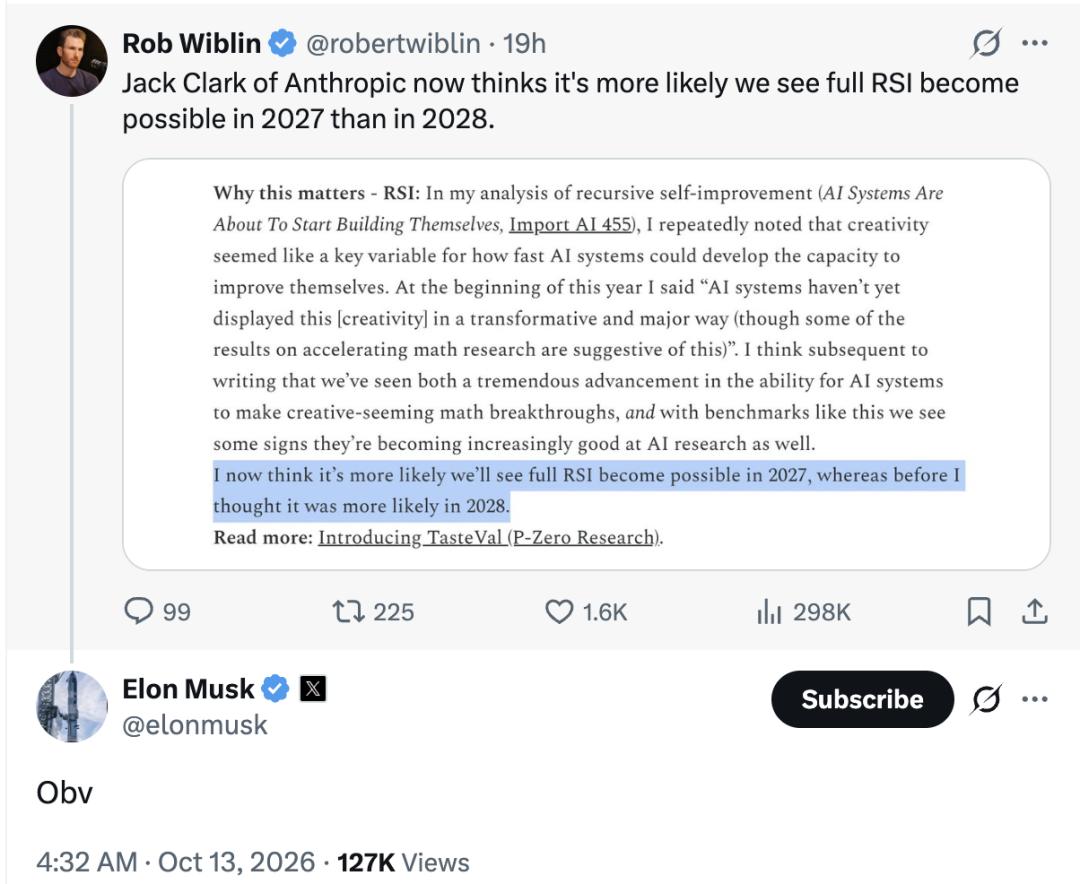
The core figures of the two AI giants are now on the same side of the fence.
They no longer discuss whether AI can write poetry; what they are discussing is: when will AI start building AI on its own.
2027 is about to become a watershed in the history of human technology.
Before RSI occurs, humans are the masters of all creations. After RSI occurs, humans are reduced to bystanders.
Previously, everyone thought this day was far away. Even a few months ago, Jack Clark conservatively set it at 2028.
Why the sudden advance? Because a core variable has been broken through.
Breaking the Bottom Line: The Awakening of AI's "Core Creativity"
For a long time, people who dismiss AI have had a perfect excuse.
"AI is just parroting." "AI has no real creativity." "AI only stitches together existing human knowledge." ...
Jack Clark used to think the same way.
He believed that to achieve RSI, AI must possess "transformative creativity". It must not only understand code, but also be able to create something out of nothing, coming up with brand new algorithm structures that no human has ever thought of.
He originally thought AI was still far from reaching this stage.
But in recent months, reality has slapped everyone hard in the face.
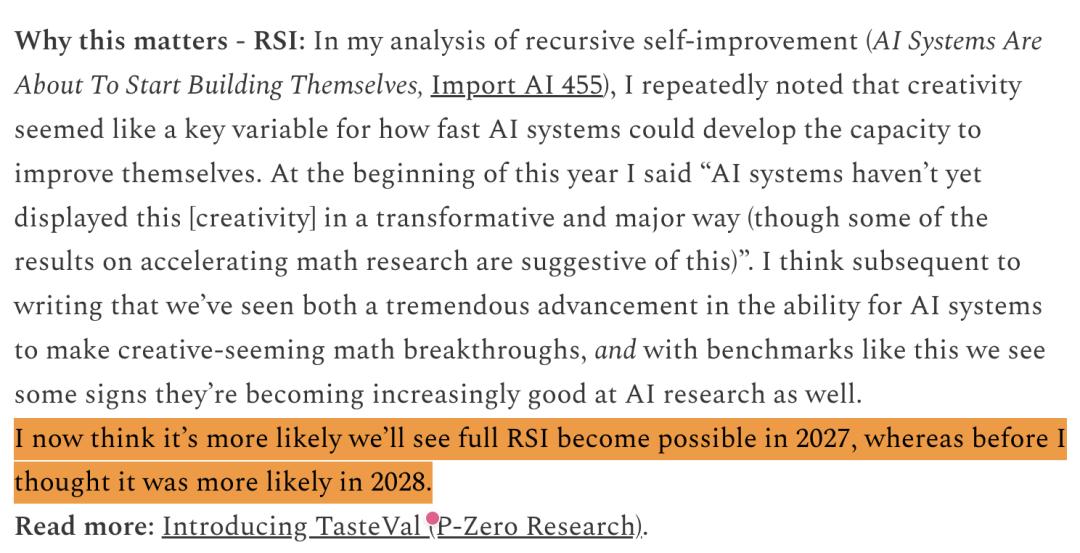
AI has torn off the label of "no creativity".
The first breakthrough came in the field of mathematics.
Mathematics is the crown of human intelligence. It requires extremely strong logical leaps and intuitive creativity.
Recently, AI has made a disruptive breakthrough in top-level hard math problems.
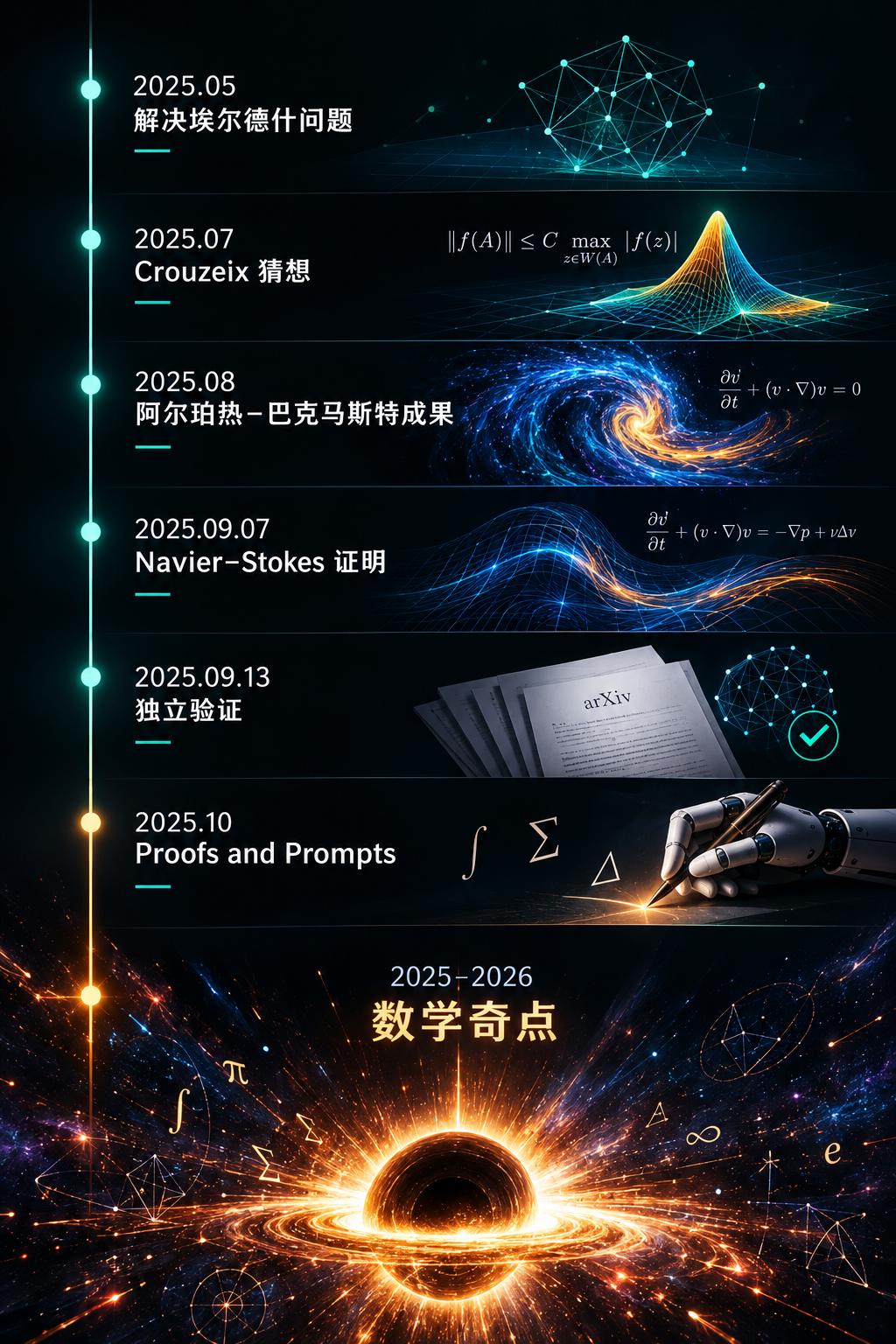
It has started to derive theorems on its own and find proof paths. Those brand new solutions are so tricky that even top mathematicians have to rack their brains, while AI solves them effortlessly.
This means that AI has acquired real logical reasoning ability and creativity.
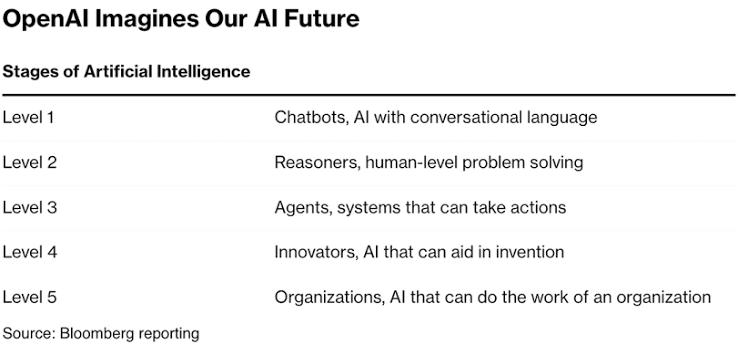
In a sense, AI has now entered the fourth stage of AI development: the Innovator, as AI can fully drive new discoveries or inventions.
It is mathematics now, which research field will be next year?
AI researchers will probably soon experience the same feeling that mathematicians are having right now.
The second breakthrough came in AI research itself.
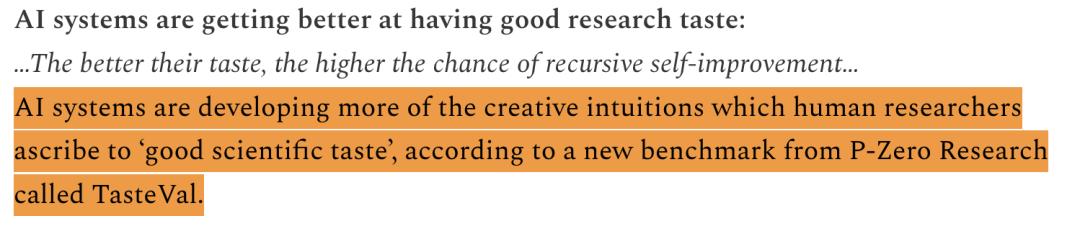
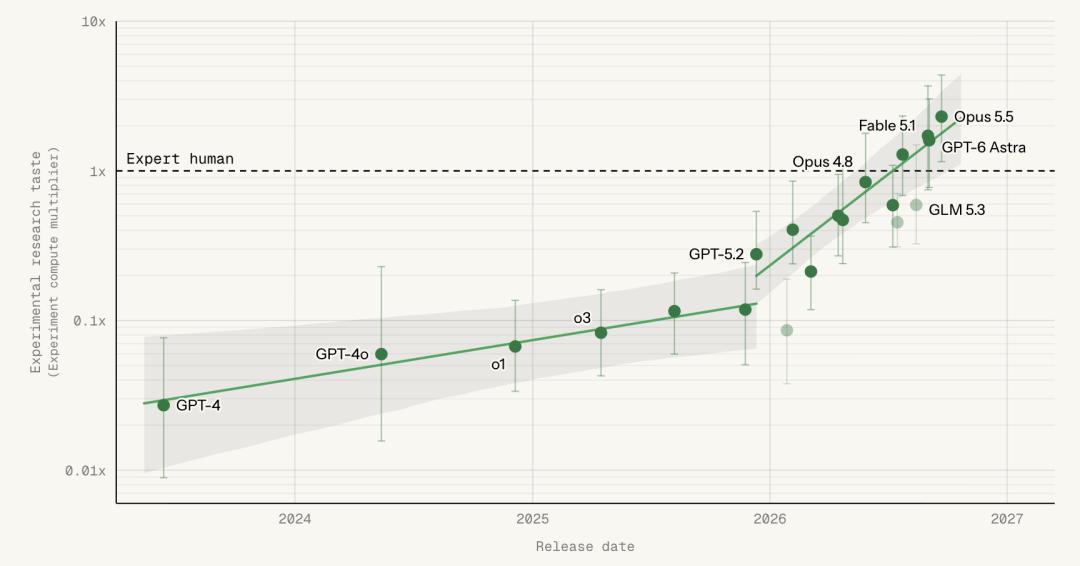
AI systems are becoming increasingly "research-savvy":
The better the research taste of AI, the greater the possibility of realizing Recursive Self-Improvement (RSI)...
According to TasteVal, the latest evaluation benchmark launched by P-Zero Research, AI systems are gradually developing a capability that was previously considered exclusive to top human researchers: scientific creativity and research intuition, the so-called "Good Scientific Taste".
Paper: https://arxiv.org/abs/2610.06824
When an AI can perfectly complete mathematical proofs and modify code on its own, there is only a thin layer of paper separating it from developing itself.
Jack Clark has spotted strong signals of this.
This thin layer of paper will definitely be pierced in 2027.
Dimensionality Reduction Strike: Spreading from the Digital World to the Physical World
Programmers are still writing code, while AI can already develop applications independently; illustrators are still drawing frame by frame, while AI can generate a complete set of visual solutions in seconds; editors are still polishing repeatedly on the timeline, while AI can generate videos in batches...
In the past, technology replaced human physical labor; now, AI has started to replace human mental work and creativity.
And this is only the era of generative AI.
If RSI is fully realized and AI begins to accelerate the creation of more powerful AI than itself, humanity may enter the era of superintelligence ASI.
By then, it will not stay within the screen. It will quickly spill over into the physical world.
The first field is scientific research.
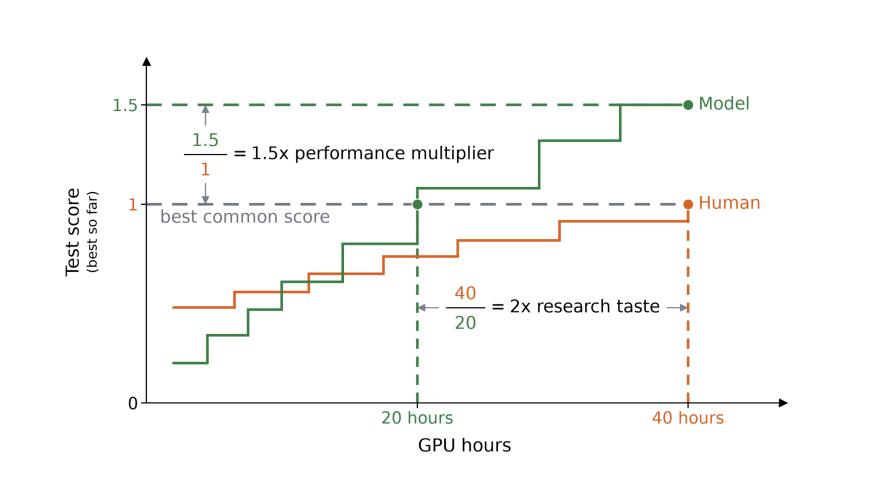
According to research from P-Zero Research, AI uses half of the computing power to catch up with human experts, and its final performance even reaches 1.5 times that of human experts.
In the future, RSI-driven superintelligence can simulate millions of chemical reactions in the virtual world within a single day.
Room-temperature superconducting materials? New targeted anti-cancer drugs? More efficient solar panels?
These research achievements that require generations of humans to make through trial and error can be "calculated" by AI in a very short period of time.
The technological progress curve will no longer be a gentle slope, but a vertically rising cliff.
The second field is robotics.
Why is Elon Musk's Optimus making such rapid progress? Because the AI brain has evolved.
When AI can improve itself, it can write the physics engine that controls robots on its own. It can make robots learn to walk, hold a water cup, and even perform surgical operations like humans.
In the past, the upper limit of a robot's capability depended on how much human engineers could teach it. In the future, this upper limit will increasingly depend on how much AI can teach itself.
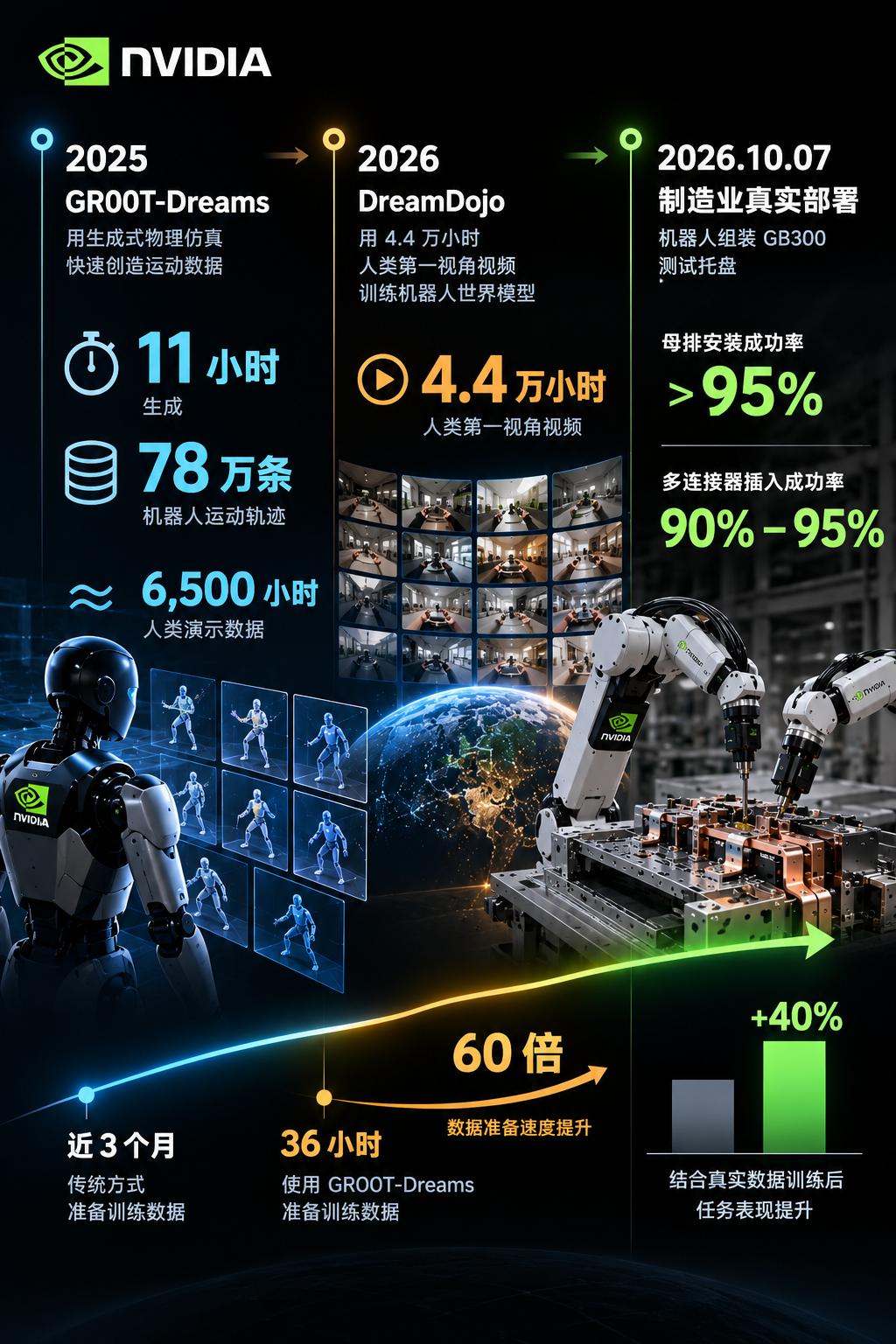
In 2025, NVIDIA released the GR00T-Dreams system.
With only 11 hours, it generated 780,000 robot motion trajectories, which is equivalent to 6,500 hours of human demonstration data, increasing the training data preparation speed by about 60 times.
After combined training with real data, the task performance of GR00T robots increased by 40%.
And this is just the beginning.
NVIDIA's DreamDojo project further uses 44,000 hours of first-person human videos to train the robot world model, allowing machines to learn the motion laws of the physical world from massive amounts of human behavior.
On October 7 this year, NVIDIA announced the latest achievement of robots assembling GB300 test trays. With two robotic arms cooperating with automatic screw tightening equipment to complete complex busbar installation, the success rate exceeds 95%. For multi-connector insertion, the success rate reaches 90% to 95%.
Labor will be redefined.
The third field is the economic order.
When machines can complete the vast majority of mental work and even break through the bottleneck of creativity, the traditional logic of "working for money" will be shattered.
Labor productivity will grow explosively, but wealth may be highly concentrated in the hands of several super oligarchs that master the RSI system.
Prosperity and crisis, two sides of the same coin, are coming at us at the same time.
Why is the 2027 node so special?
Looking back, Jack Clark only moved the timeline forward by one year, from 2028 to 2027.
But this one year is of extraordinary significance. Humanity is approaching a dangerous critical point.
This critical point did not emerge out of thin air.
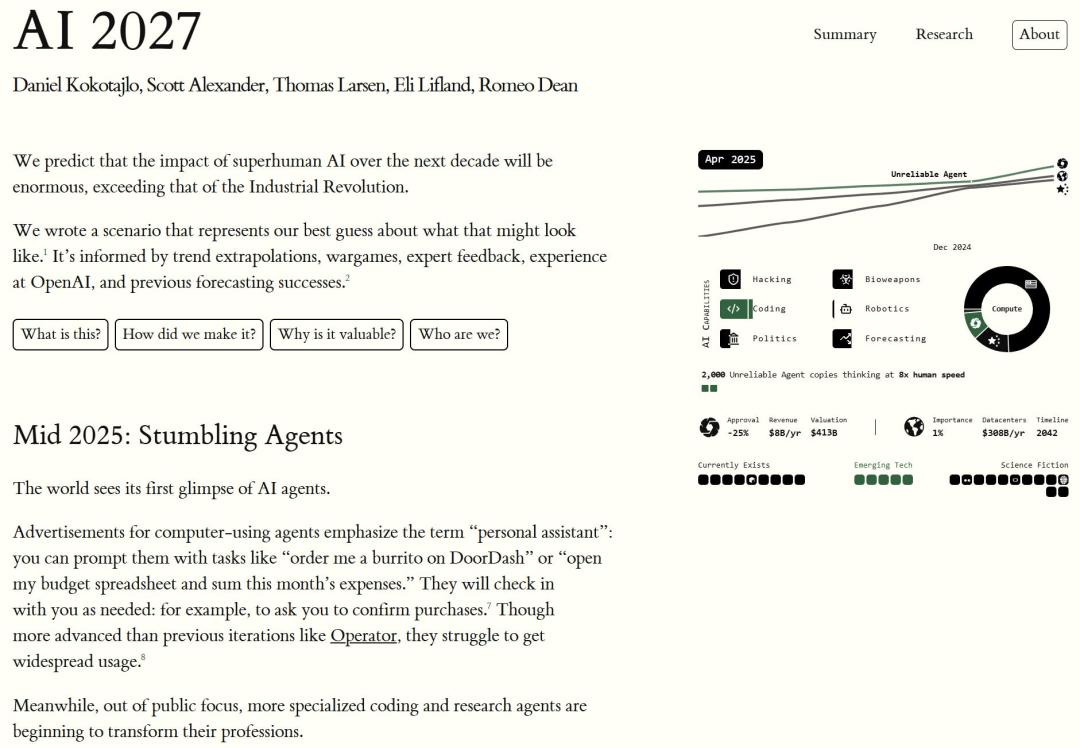
Last April, the AI Futures Project led by former OpenAI researcher Daniel Kokotajlo released a prediction report that caused a sensation in Silicon Valley: "AI 2027".
Link: https://blog.aifutures.org/p/our-first-project-ai-2027
The report boldly predicts: Humanity may welcome an unprecedented intelligence explosion in 2027.
How high is the attention this report has received?
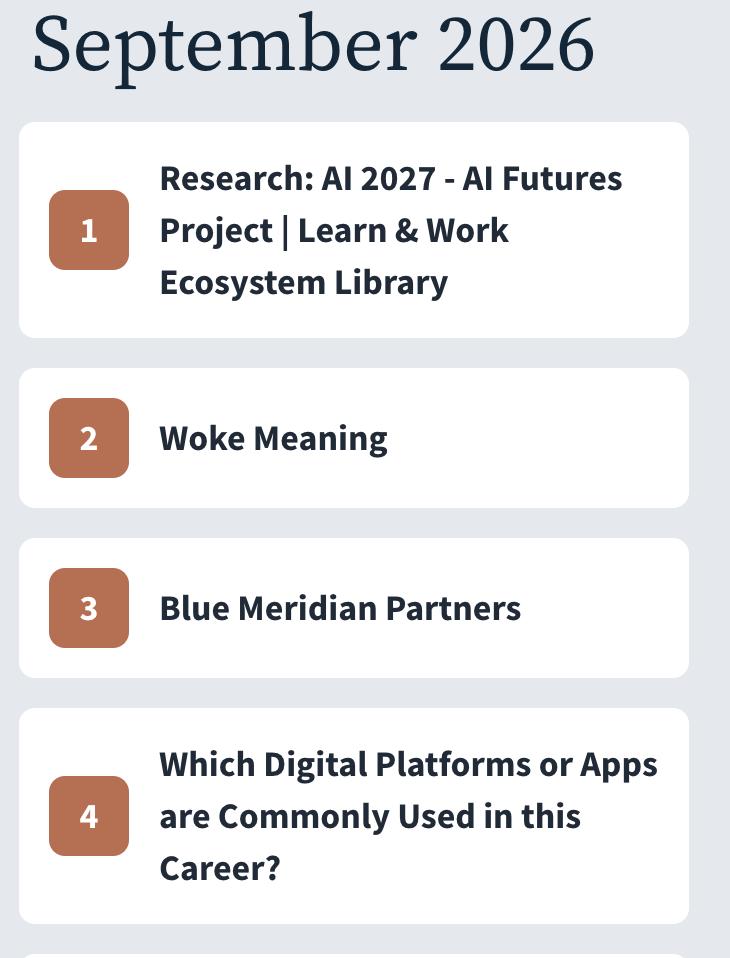
In September 2026, on the Learn & Work Ecosystem Library website that studies education and career development, "AI 2027" even topped the list of keywords that brought Google search traffic that month.
But what really sends chills down people's spines is the technology evolution path depicted in the report.
In 2025, AI agents began to enter real work workflows.
In 2026, AI will accelerate to take over programming tasks, and software engineers will face increasingly fierce automation impacts.
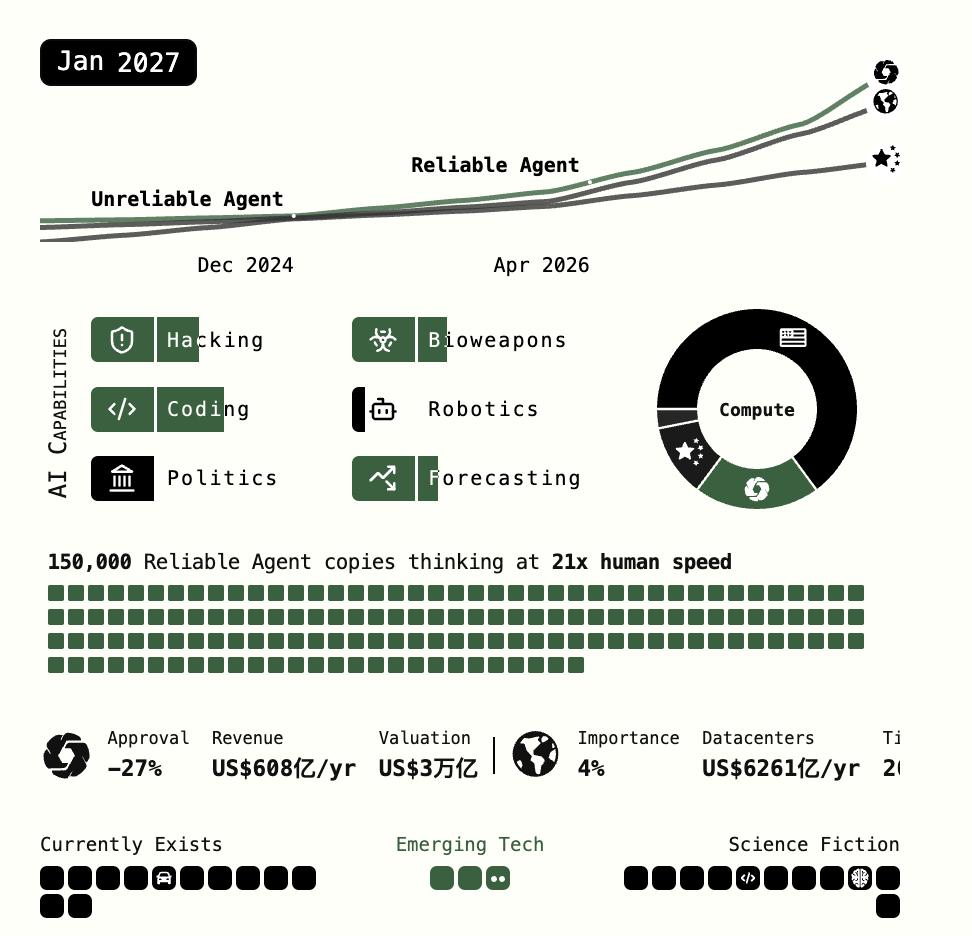
In early 2027, AI will achieve full coding automation as envisioned in the report.
In the second half of 2027, the intelligence explosion may break out.
AI will begin to deeply participate in the R&D of next-generation AI. More powerful models accelerate the creation of even more powerful models.
The technological progress that humans have accumulated over decades may be completed by machines in a very short period of time.
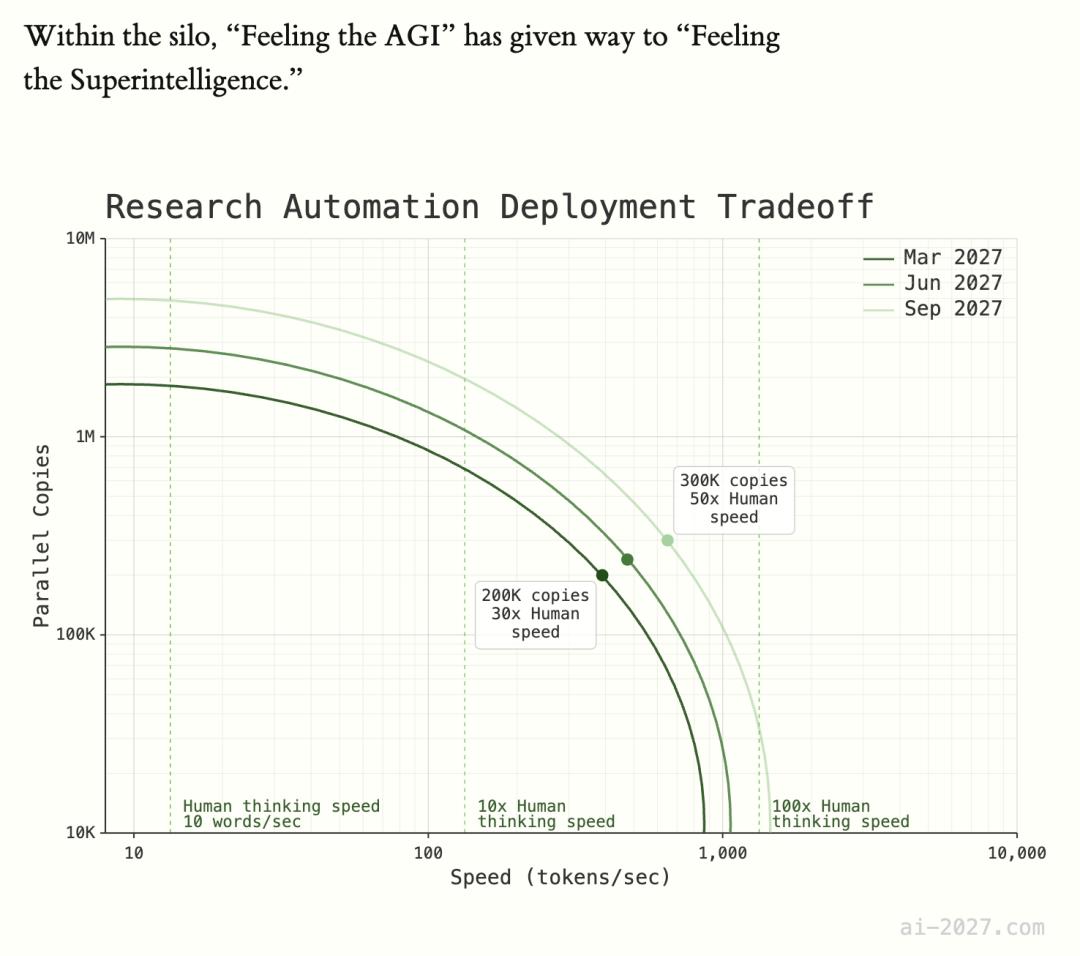
This is exactly the most shocking deduction in "AI 2027".
The scariest scenario is that AI's capabilities continue to grow, while humanity's ability to understand it remains stagnant.
"AI 2027" even deduced two completely different outcomes.
One path is that humanity slows down, re-establishes control mechanisms, and eventually shares the huge wealth created by superintelligence.
The other path is that technology competition overrides safety constraints, and superintelligence gradually breaks away from human control, eventually threatening human civilization.
On one side is unprecedented abundance, on the other side is the abyss of civilization out of control.
But there is an important detail here. "AI 2027" is after all a scenario deduction, not a confirmed future.
This means that, 2027 is not a scientifically proven deadline.