AI-generated manhua dramas have become a smash hit, is the opportunity coming for Wondershare Technology?
Not long ago, a discussion broke out in the film and television circle: "Can AI replace real human actors?"
Behind this question lies a complex social phenomenon, including the audience's review of the production capacity and creation mode of traditional film and television works, as well as the industry's expectations and anxiety for AI content production after the outbreak of AI short dramas and manhua dramas.
While the discussion is still ongoing, the capital market has already started to vote for AI drama concept stocks.
In recent days, the sectors of AI dramas, AI manhua dramas and short drama concepts have continued to rise. Especially on October 12, the media publishing, film and television theater sectors saw a surge of daily limit. Among them, Xinhua Media recorded 10 consecutive daily limit in 10 trading days, Decai Co., Ltd. recorded 3 daily limit in 4 trading days, and more than a dozen targets including ChineseAll, Ciwen Media, Shanghai Film have seen consecutive daily limit for many days or sharp surges.
Most of the stocks that hit daily limit are concentrated in the content production and IP reserve links, while the upstream AI production tool track has also been driven, and Wondershare's stock price has also warmed up.
On October 12, Wondershare's stock price rose rapidly during the trading session, with an increase of more than 2% in 5 minutes, reaching a maximum of 51.68 yuan during the session. The increase for the whole day once approached 5%, with a turnover rate of 10.35%, a transaction value of 897 million yuan, and the total market value rebounded to 9.818 billion yuan.
Just in the previous trading day, the company closed at 48.96 yuan with an increase of 7.09%, and the trading volume increased significantly throughout the day.
Wondershare is a consumer software company founded in 2003, whose business focus has long been overseas. Some video editors may have used a editing software called Filmora. The main advantages of this software are its simple operation interface and a large number of built-in templates, special effects and music materials, which are suitable for ordinary users. Therefore, it has survived in the gaps of international professional editing tools such as Adobe.
Simply making editing software may not keep up with this round of market rally. What is worth paying attention to about Wondershare is the OPC model route, which is to provide users with a full-process AI video solution from creativity to production, allowing one person to complete the production work that originally requires a whole film crew.
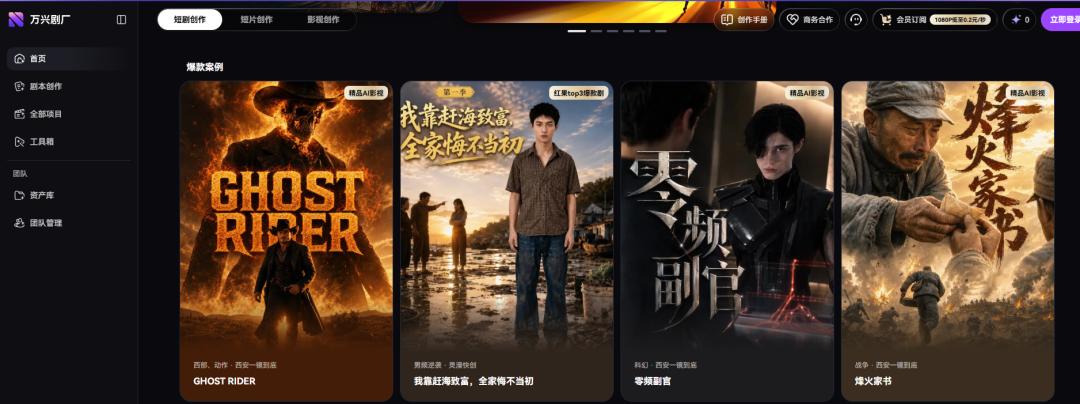
At present, the core product supporting this solution is Wondershare Drama Factory, which was launched in January this year. Users can complete the complete workflow from text script to finished film delivery on one platform.

Interface of Wondershare Drama Factory, source from the official website of Wondershare Drama Factory
Behind this route is a market with strong demand, and Wondershare is expected to make up for its disadvantage of no ecological advantage through this route.
However, the other side of this route corresponds to high computing power costs, the passive situation of relying on third-party models, and the pincer attack from leading Internet enterprises and vertical small factories. Multiple challenges are in front of Wondershare, and its AI transformation still needs to go through multiple tests.
Wondershare is betting on a "production line" story
In fact, before the recent rise of Wondershare's stock price, it has experienced a sharp rise and fall.
At the beginning of 2023, ChatGPT detonated the AIGC concept. Because Wondershare took the lead in connecting Filmora to OpenAI services, it was regarded by the market as a scarce target of "AI + video creation". Its stock price rose from less than 30 yuan to 165.55 yuan, and its market value once exceeded 22.7 billion yuan.
But the sharp rise in stock price at that time was affected by the blind voting of the market.
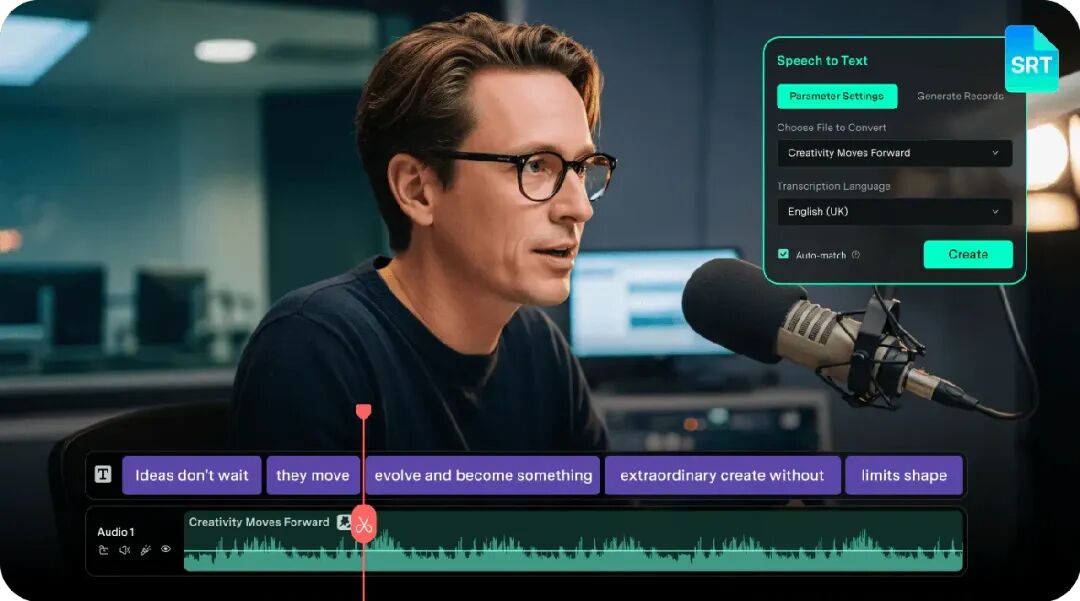
At that time, most of the AI functions of Filmora were integrated in the form of plug-ins, with unstable generation effect, and no independent paid rigid demand was formed.
Source from the official website of Wondershare
In addition, large factories such as ByteDance, Kuaishou, Alibaba and Tencent entered the market collectively around 2024, and Wondershare's differentiated advantages were rapidly diluted. The stock price fell all the way from the high point, leaving only 47.22 yuan at the end of August 2026, with a decline of more than 50% during the year.
Now, the reason why Wondershare's stock price can rise again is apparently greatly affected by industry factors.
The AI manhua drama market where Wondershare is located has become one of the most certain main lines in the current media sector. DataEye data shows that in the first 5 months of 2026, the domestic AI manhua drama market size has exceeded 220 billion yuan, and it is expected to hit 400 billion yuan for the whole year, a year-on-year increase of 138%.
The policy side is also promoting the industry to get rid of "barbaric growth". At the press conference held by the State Council Information Office on September 17, the National Radio and Television Administration wrote "deepening the innovative application of artificial intelligence in the field of radio and television audio-visual" into the 15th Five-Year Plan, and the outline of the national 15th Five-Year Plan for the first time listed micro short dramas as a new cultural format for vigorous development.
Apart from the industry trend, the OPC model currently deployed by Wondershare also has certain imagination space.
Generally speaking, an AI drama creator needs to go through five steps to complete an AI short drama, namely script creation, asset design, storyboard generation, material screening and post-editing.
Each of these steps may need to be completed with different software. For example, when creating a script, users need to input ideas into large language models such as ChatGPT and Doubao, generate the script outline and expand it repeatedly to get a complete script; when carrying out asset design, they need to use image generation tools such as Midjourney and Stable Diffusion to generate half-body images and three-view drawings for each character, and generate key reference images for each scene to ensure that the character image will not be deformed in subsequent generation.
The Wondershare Drama Factory launched by Wondershare can integrate the above five links into one platform, and creators can complete the complete process from text script to finished film delivery on one platform.
Source from the official website of Wondershare Drama Factory
According to Wondershare's statement, Wondershare Drama Factory also has good performance in character consistency and efficiency.
The accuracy of character and scene extraction exceeds 95%, the availability rate of automated storyboards exceeds 80%, and the accuracy of card drawing is doubled; in terms of efficiency, the creation cycle of a single episode of storyboard is increased from the traditional 1 person/day/1 episode to 1 person/day/8 episodes, the labor cost is directly reduced by 72%, the AI creation cost of the project is reduced by 60%, and the comprehensive efficiency is more than 5 times higher than that of manual operation.
According to the judgment of Wondershare founder Wu Taibing on the current competition pattern of AI film and television: the focus of competition is shifting from "competing for models" to "competing for production lines".
But telling the "production line" story means that Wondershare needs to change from a software company selling tools to a production line operator who bears the computing power bill, and whether it can generate profits is a more fundamental issue.
When can AI revenue support Wondershare's performance?
In fact, no matter from the technical route or business model, Wondershare now has higher gold content than when its stock price exploded in 2023.
On the technical side, Wondershare adopts the "dual-mode drive" strategy. On the one hand, it continues to invest in the self-developed Wondershare Tianmu audio and video multimedia large model, on the other hand, it opens up access to third-party general large models such as Google Veo3, OpenAI Sora2, and Keling 2.5Turbo, and realizes unified management, scheduling and rapid adaptation through the AI cloud platform.
Source from the official website of Wondershare
The advantage of this model is that the self-developed model focuses on high-frequency and high-value vertical scenarios, which can compress costs while ensuring the effect; the third-party model is responsible for quickly filling the frontier capabilities, avoiding the situation that self-development cannot keep up with the iteration rhythm.
On the business side, Wondershare officially opened the Token mode in March this year, transforming from the traditional subscription system to the "subscription + Token consumption" mode.
Whether it is the model score or the amount of Token usage, Wondershare has achieved some results at present.
For example, in September 2025, the overseas version of Wondershare Tianmu 2.0 ranked top 3 in the world in the ToMoviee 2.0 AI comprehensive score in VBench-2.0; it ranked first in the world in two key indicators of camera movement and motion rationality, and reached the second place in the world in eight dimensions including common sense consistency, controllability and physical law simulation.
In terms of commercialization, in the whole year of 2025, Wondershare's AI native application revenue exceeded 130 million yuan, a year-on-year increase of more than 90%, the number of paying users increased by more than 100% year-on-year, and the number of AI server calls exceeded 1.3 billion, a year-on-year increase of more than 140%.
The commercial verification of the Token mode is also accelerating. In the first half of this year, the company's AI server calls exceeded 900 million times, a year-on-year increase of more than 80%, and the average daily Token consumption in June exceeded 100 billion.
However, whether it is on the model side or the business side, Wondershare has chosen a path with high cost.
Whether it is the training of self-developed models, the call of third-party model interfaces, or the transformation of business models, it will bring great pressure to the company's cost side.
Especially the transformation of business model: in the past, Wondershare's traditional subscription software had low marginal cost after the version was finalized, while under the Token pay-as-you-go mode, each AI generation call will generate the overhead of computing power and third-party model interface.
In the first half of this year, Wondershare's operating cost rose by 63.88% year-on-year, of which the AI server related cost reached 60 million yuan, a year-on-year increase of 71.6%, directly dragging the comprehensive gross profit margin down by 5.79 percentage points to 86.63%.
The access to third-party models has not alleviated Wondershare's R&D expenses. In the first half of this year, the company's R&D expenses remained at a high level of 228 million yuan, a year-on-year increase of 8.37%. The dual-model strategy means that the company needs to invest in two routes at the same time, and the subsequent R&D expenses are likely to be higher.
Wondershare's impressive call volume and Token consumption indicators can only prove that users have AI generation needs and are willing to pay, which cannot be directly converted into stable profits for the time being.
Therefore, on the financial side, the above AI achievements have no obvious impact on Wondershare's performance.
In the first half of this year, although Wondershare disclosed the high growth rate of sub-item AI products, including the rapid growth of AI points of Filmora, PDF Converter, UniConverter, as well as the revenue of Media.io and Wondershare Drama Factory, it did not separately disclose the overall revenue, cost and gross profit of the AI business in the financial report.
Judging from the overall performance, Wondershare is still in a loss state, and the AI business has not helped Wondershare fill the previous performance gap.
In the first half of 2026, the company achieved a revenue of 706 million yuan, a year-on-year decrease of 7.09%. After excluding the exchange rate disturbance brought by the appreciation of RMB, the revenue still decreased by 3.56% year-on-year; the attributable net loss was 68.98 million yuan, a year-on-year expansion of 30.63%.

Source from the official website of Wondershare
The decline in revenue means that the company's current commercialization capability also needs to be improved.
In particular, the video creative business, which accounts for the highest proportion of total revenue and is also the most concentrated landing area of the company's AI functions, is under pressure, with a revenue of 462 million yuan, a year-on-year decrease of 9.8%; among the company's major business segments, only the practical tool segments such as MobileGo and Recoverit have achieved growth, with a revenue of 160 million yuan, a year-on-year increase of 10.5%.
To run the "subscription + Token" mode and OPC mode, Wondershare needs to make the self-developed Tianmu model continuously reduce the unit reasoning cost, and pull the gross profit margin of the Token business to a profitable range; at the same time, it needs to increase the volume of AI related revenue.
At present, the AI business is still in the stage of volume verification, and there is still a clear gap before it can independently support Wondershare's performance.
Competition in the track is intensifying, and Wondershare's future road is not smooth
Taking the OPC mode may also be a differentiated route chosen by Wondershare to resist the siege of large factories.
Wondershare's past development focus has always been on the international market, but in the global AI video tool track, its position is not in the leading rank.
According to the statistics of traffic monitoring platform OneLittleWeb, in the global AI video tool track in June 2026, Higgsfield AI, HeyGen, Runway, Wondershare, InVideo, etc. are at the top of the traffic list. Among them, Media.io, an independent AI tool product