If the key to early-stage investment is "betting on people", then what do we make of Tian Keyu?
Before working as a content creator, I worked as an institutional PR specialist and journalist for many years, and had the honor to interview a number of investors. After countless conversations, you will find that there are certain fixed patterns in their answers.
For example, the core of early-stage investment is "invest in people".
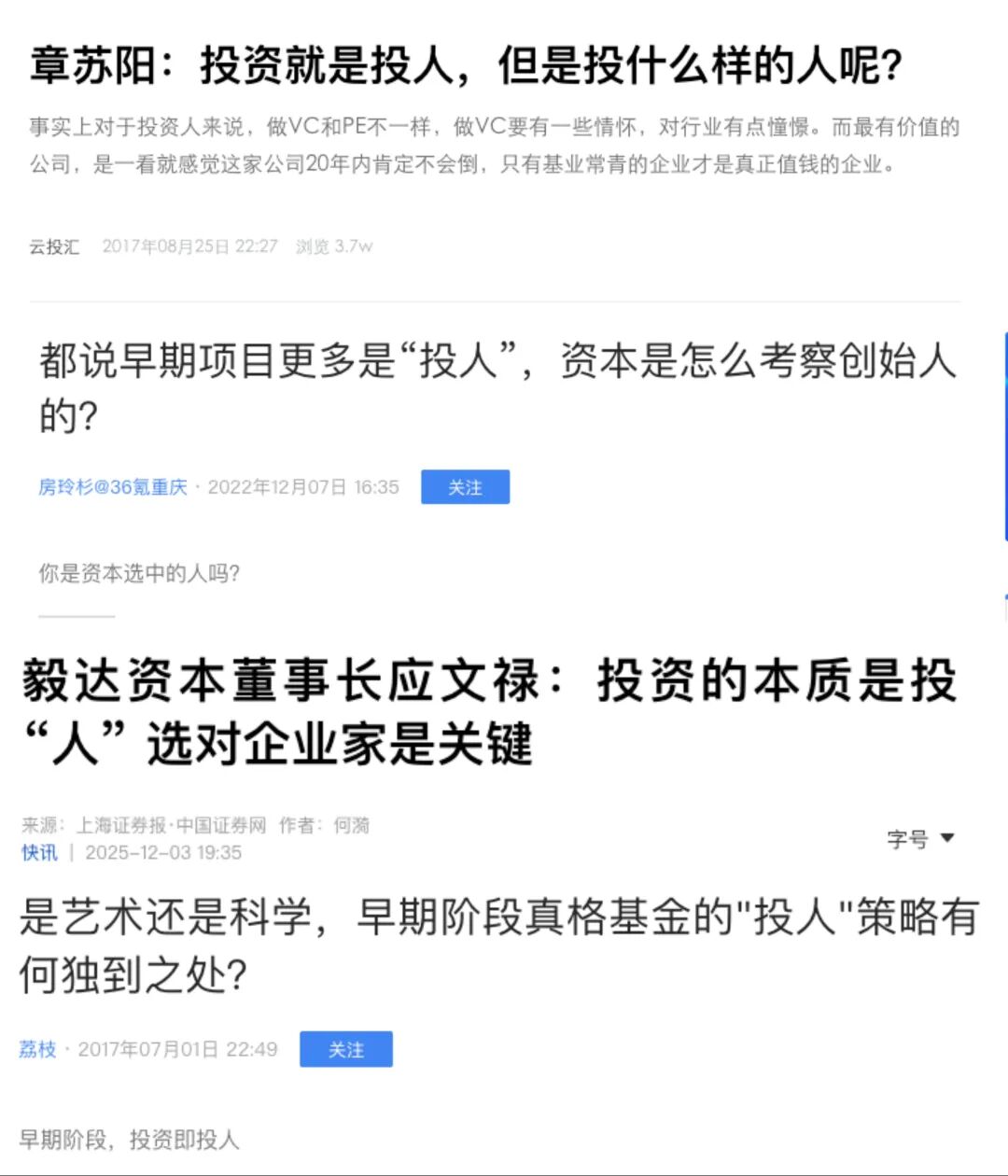
This assertion is so widely spread because it is almost universal in the investment field. When a project is in its initial stage, or even has not really entered the market, there are not enough financial indicators and original data to build a model of potential future returns — in this case, the founder and core team become the most critical variable that determines the success or failure of the project.
So what kind of people should we invest in? Zhang Suyang, Founding Partner of Volcanics Capital, once listed several criteria in an interview: 1. Business ethics 2. Sense of responsibility 3. Long-termism 4. Good physical health
If all these are "consensus", a recent financing news seems to have become a "paradox".
In October 2026, the AI lab founded by Tian Keyu, a former intern at ByteDance, secured nearly $30 million in financing from 5Y Capital and IDG Capital, with a post-money valuation of $200 million. At that time, the team did not even have a product or an official name.
The controversy goes far beyond that, and even more so to Tian Keyu himself. He is the protagonist of the much-discussed "ByteDance poisoning incident" two years ago.
Recently, "Elsewhere", a top self-media account in the investment field, interviewed Tian Keyu, pushing the controversy to a new climax.
01. The "Rashomon" of the Poisoning Incident
Let's review the whole story of Tian Keyu's "ByteDance poisoning incident".
The public account says: In 2024, Tian Keyu, a PhD student at Peking University, was interning at the commercial technology team of ByteDance. Dissatisfied with the allocation of computing power resources in the team, he used technical means to sabotage the internal large model training, resulting in abnormal training of multiple core research projects in the team and all the previous achievements going down the drain. After being discovered, ByteDance terminated his internship agreement on the grounds of serious violation of discipline and malicious sabotage.
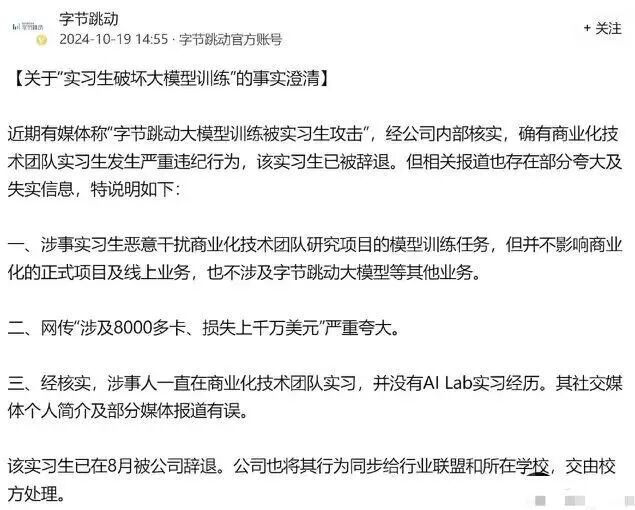
The official public notice issued by ByteDance at that time
In November 2024, ByteDance filed a civil lawsuit, claiming 8 million yuan in compensation from Tian Keyu and demanding a public apology. The court of first instance ruled that Tian Keyu should pay 500,000 yuan in compensation to the company. ByteDance subsequently filed an appeal, and the second instance is still ongoing.
In an interview in October 2026, Tian Keyu described the incident as an act of "naive justice" out of "standing up for what's right": he found that a new intern had occupied the cluster resources of other team members, and got no response after reporting to the leader, so he entered the other party's program to freeze or shut it down. In this way, "the excess resources he occupied would be reclaimed, and others could use them normally".
For his description, the podcast host asked him to swear, and Tian Keyu swore that if he told a lie, he would "face setbacks in all his research for the rest of his life".
However, less than a day after he swore, a 10,000-word report published in real name by his former colleague on GitHub presented a completely different version of the story.
The report states that Tian Keyu's interference in the team's projects lasted for nearly 5 months, instead of the "five times in ten days" he claimed, nor was it a simple "program shutdown". Instead, he used sophisticated means such as tampering with the underlying source code and mixing noise into the T5 weights to disguise the malicious sabotage as occasional failures, resulting in abnormal training of multiple core projects including LlamaGen and Goku, which took the team months of effort to troubleshoot.
Before being discovered, Tian Keyu even attended the team's troubleshooting meeting. He learned about the progress of his colleagues' investigation during the meeting, and then adjusted his attack code in a targeted manner after the meeting.
The whole incident has different descriptions from different people, just like the movie "Rashomon": everyone considers themselves a just person, and everyone has their own reasons for doing what they did.
But no matter whether Tian Keyu is a person who "roars out for justice" or a "reckless genius" who ignores the rules with his outstanding technical skills, one thing is certain: he did sabotage the company's project training and violated the basic contractual spirit of a professional, which has been ruled by the court. From a business perspective, he is a founder with moral flaws.
02. Why is the investment a must?
Under normal circumstances, capital is absolutely rational. Why invest in a founder with moral flaws? For early-stage investment, isn't this planting a huge hidden danger?
The most dramatic follow-up of the "poisoning incident" is that in December of the same year, Tian Keyu, as the first author, completed the VAR paper and won the Best Paper Award at NeurIPS, a top AI conference.
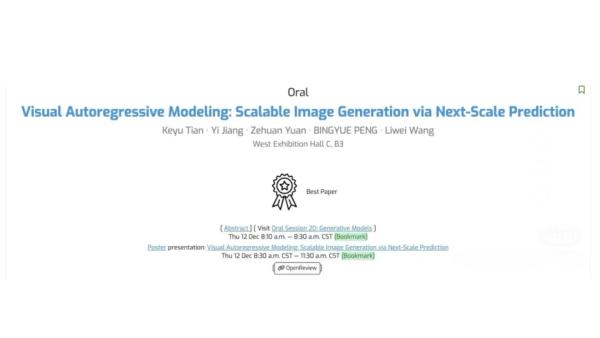
The NeurIPS Best Paper Award is extremely prestigious, known as the "Nobel Prize in the field of artificial intelligence". Its admission threshold is extremely strict. Take 2023 as an example, the conference received 12,343 submissions, and the final acceptance rate was only 26.1%. Among the accepted papers, those that can win the "Best Paper" are one in a million.
The VAR paper completed by Tian Keyu as the first author was not only selected for the highly competitive Oral session, but also won the Best Paper with an almost perfect review score (7,8,8,8).
In the AI field, academic ability is often directly equivalent to commercial value. The "world model" studied by Tian Keyu is the underlying paradigm for embodied intelligence, autonomous driving and 3D content generation, which belongs to infrastructure-level technology. Similar to the academic breakthrough in the field of computer vision by Li Feifei in the past, it directly gave birth to the emergence of companies with a valuation of tens of billions such as Waymo.
In the era of AI's rapid development, a best paper at a top conference is no different from a direct admission ticket to the capital circle.
03. Taking risks for scarcity
So here comes the question: a founder with moral flaws, but with extremely high potential commercial value. If you don't invest, you are afraid of missing the opportunity; if you invest, you have to take risks. How to choose?
This reminds me of the largest "early-stage investment" in Chinese history.
More than 2,000 years ago, Liu Bang, a grassroots pavilion chief in Pei County, raised a troop in the chaotic war times. Judging by today's "due diligence" standards, his core team can be described as a "moral lowland": Fan Kuai was a dog butcher, Chen Ping was accused of "incest with his sister-in-law and accepting bribes", and Liu Bang himself was famously known for "disowning his relatives". When Xiang Yu captured Liu Bang's father Liu Taigong and threatened to boil him to death, Liu Bang even responded:
"My father is your father. If you insist on boiling your father, please share a cup of the soup with me."
However, Liu Bang's angel investors, whether his father-in-law Lord Lü or Xiao He, firmly bet on him, and in the end, this investment was a huge success.
Later generations summed up Liu Bang's philosophy with four core words: "pragmatism". In his view, in the chaotic world of life and death, face and morality are illusory, and being able to solve problems is the real thing.
Is this what capital thinks now? They bet that Tian Keyu's technical talent can be transformed into the cornerstone of a business empire, and are willing to take risks for this kind of "scarcity", betting that this "flawed genius" can lead the team to go through cycles.
History is always written by the victors. When he succeeds and reaches the top, there will naturally be great Confucian scholars to justify his deeds.
However, as a former "honest person" in the workplace, I always feel a little lost: if the contract can be torn up, then the employment contract in the past can be torn up, will the investment agreement in the future also be torn up?
Disclaimer: This article is written based on public reports, the parties' own accounts and third-party published technical reports, aiming to discuss the business model and contractual spirit of the AI venture capital circle. The relevant case is still under the second instance trial. Please refer to the effective judgment of the court for the final fact and responsibility determination.
This article is from the WeChat Official Account "Li Guan Lab", written by Xiao Dao Lai Qi, and published with authorization from 36Kr.