For the first time worldwide, AI can directly prescribe medications without doctors' oversight. Is this a good thing or a bad thing?
In September this year, the U.S. state of Utah approved a new program where an AI system will diagnose patients and issue them prescriptions.For the first time, patients can get medication prescribed by AI without any human doctor's oversight.
Prior to this, Utah had already launched a pilot program for AI prescription refills. That is, when a chronic disease is confirmed and the patient's condition is stable, AI can renew the "long-term medication" that the patient has been taking, but cannot make new diagnoses, adjust the dosage of existing drugs, or add new medications. All "changes" must be reviewed by a human doctor.
This new program, however, will for the first time use AI to provide patients with "new diagnoses" and "initial prescriptions".
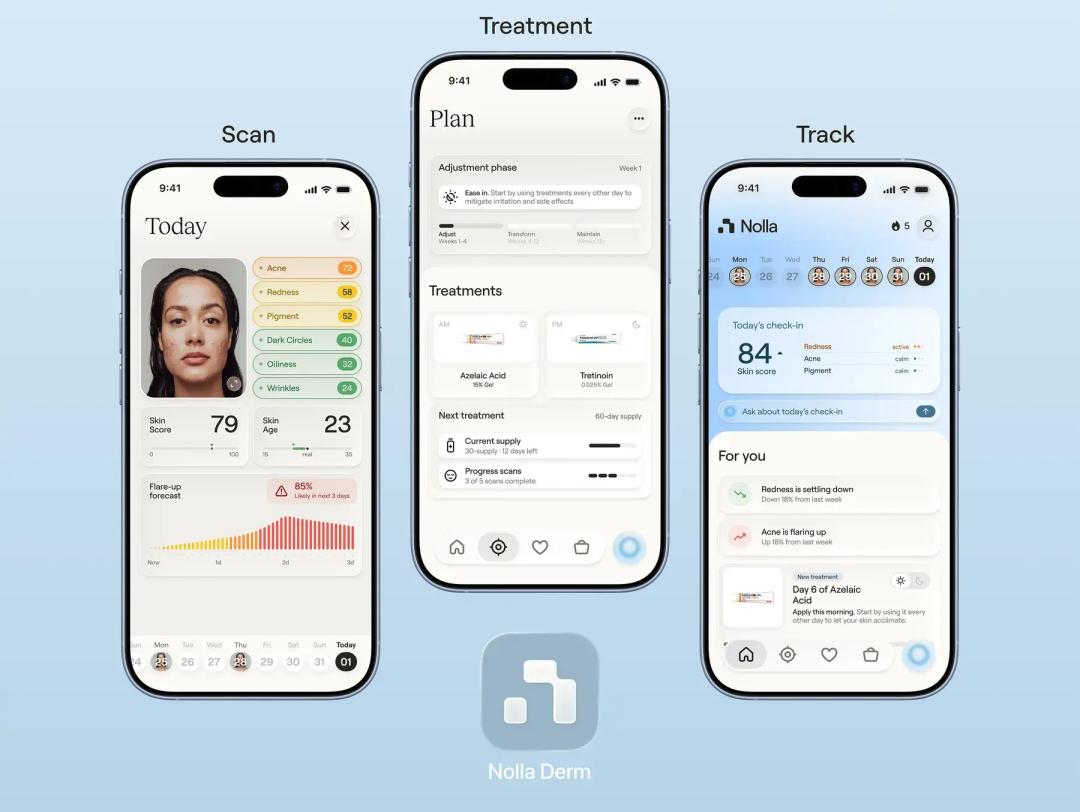
Figure | Nolla Derm
$4.99 per month, get medication delivered to your door with just a selfie
This pilot is initiated by medical startup Nolla Health. The entire trial lasts for one year and is currently only conducted in Utah,exclusively for adult patients with mild to moderate acne.
The whole process goes like this: users pay $4.99 per month to subscribe to the Nolla Derm app, complete identity verification, fill in personal health information, and follow the instructions to take photos of their faces from 5 different angles.
After that, the AI identifies acne issues, evaluates the sebum secretion of the skin, and calculates an acne severity score (maximum 5 points). Once the score exceeds 3.5, or the user is pregnant, breastfeeding, suffering from severe liver and kidney diseases, etc., the autonomous AI prescribing process will be terminated and the case will be transferred to a human doctor for assessment.
Finally, the screened users enter the prescribing stage,where the AI combines all kinds of information to recommend a treatment plan from a designated list containing 8 types of medications. Users can choose to have the medication delivered to their home, or take the prescription to a local pharmacy to buy the drugs.
All medications on this list are creams and gels, specifically including tretinoin, adapalene, benzoyl peroxide, azelaic acid, the compound formulation of clindamycin combined with benzoyl peroxide, as well as several "customized versions" formulated on demand, which are added with niacinamide or topical spironolactone (the latter has two formulations).Oral medications, isotretinoin and severe acne are not covered in the pilot, and the AI cannot recommend any treatment beyond the scope of the list.
After the initial consultation, users can also follow up and adjust their prescriptions within the app.
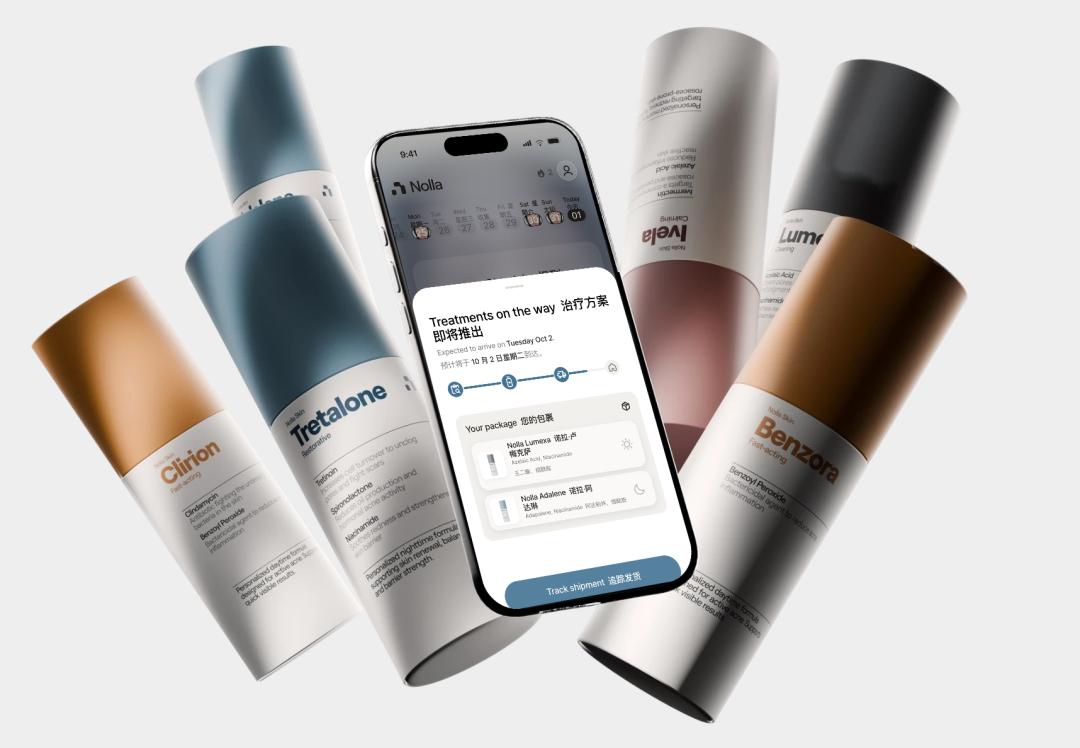
Figure | Nolla Derm
To reduce the risks of the pilot program, the company divided the implementation process into three stages:
Stage 1 (at least 4 weeks): For the first 100 users, every prescription generated by AI must be independently reviewed and approved by two licensed human doctors before being provided to users;
Stage 2 (at least 8 weeks): For the next 400 users, the AI generates prescriptions directly, but doctors will conduct a review once a week;
Stage 3: The program will gradually enter the autonomous mode, where doctors will randomly sample at least 10% of the prescriptions every month, and review cases with aggravated conditions or adverse reactions.
During the implementation process, once any serious adverse event occurs, the program will be suspended immediately. Before entering the next stage, the program must achieve certain goals and obtain approval from the state government. The goals include that the consistency between AI diagnosis and treatment and doctors' opinions reaches at least 95%, no serious conditions missed by AI are found in doctors' sampling inspections, and no serious adverse events occur.
The company's slogan is "Private doctors accessible to everyone"
Nolla Health was founded in 2024 in Norway by three co-founders. In September 2025, the company secured $4.5 million in seed financing and set up its headquarters in New York City, New York State, the United States.
The three co-founders have complementary backgrounds. Luis Wenus used to be an engineer who helped the digital identity system World ID acquire its first 2 million users; Luis Soenksen holds a doctorate from the Massachusetts Institute of Technology and is a researcher at Johns Hopkins University, with about a decade of in-depth experience in the field of artificial intelligence modeling for dermatology; Sean Geiger once served as a senior software engineer at Apple.
Judging from the team configuration, the three represent a growth-focused product manager, a research-oriented scientist, and an engineering-focused developer respectively. The company's ambition is to integrate "technology" and "doctors" into one single system.
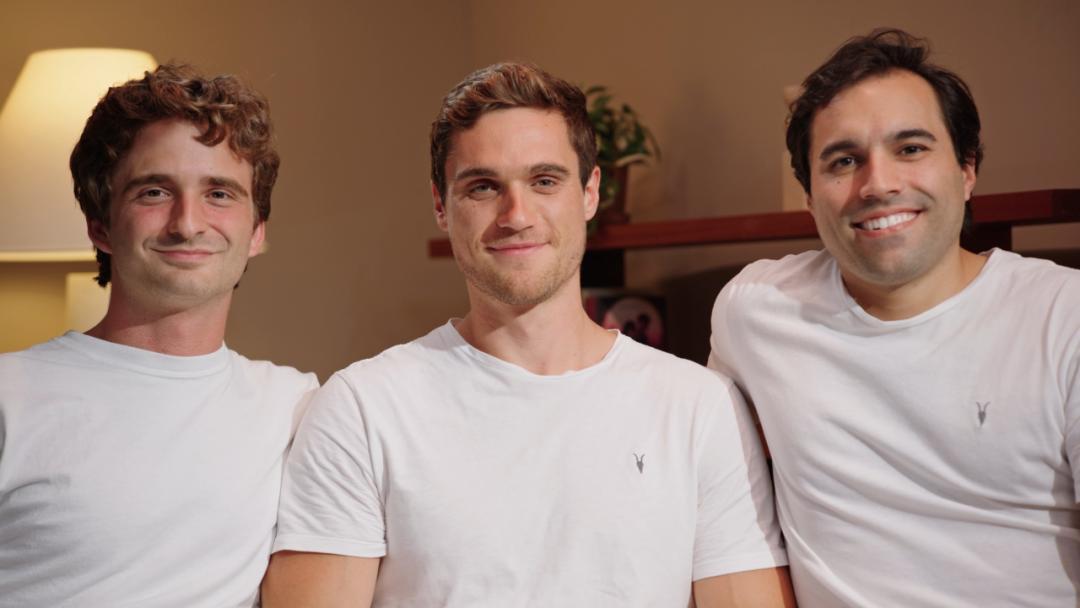
Nolla Health co-founders Sean Geiger, Luis Wenus and Luis Soenksen | beautyindependent.com
Nolla Health's slogan is "Private doctors accessible to everyone". Founder and CEO Wenus mentioned in an early interview that he grew up in a family with a father who was a doctor and a mother who was a nutritionist, and was always accompanied by health professionals. It was not until he grew up that he realized that this convenience of being able to consult a doctor at any time is actually very rare. Therefore, he hopes to turn it into a norm rather than a luxury.
Unlike many companies that only apply chatbots to old systems, Nolla chose to build its entire "full-stack" capability independently: from identifying conditions, tracking changes, to issuing prescriptions and making referrals, all processes are completed in-house. Underpinning this platform systemare large multimodal models (LMM), Vision Transformers (ViT) and other machine learning systems, which in layman's terms are AI that can understand both images and text. Every facial photo uploaded by users is a set of analyzable data for the model.
According to the company's official website, its platform is trained on more than 3 million annotated clinical cases to find patterns from images and user data; some media reports also state that it is "over 1 million dermatology cases covering 1,600 types of conditions".

The company's official website states that such models are trained on more than 3 million annotated clinical cases | Nolla Health official website
This acne treatment-focused app is exactly one of the company's launched products. The reason for choosing acne as the entry point is that it is extremely difficult to book an appointment with a dermatologist in the United States. In the U.S., patients have to wait an average of 36 days to see a dermatologist, while problems like acne affect as many as 50 million Americans every year. The waiting itself is not life-threatening, but it will delay treatment and wear out patients' patience. Therefore, Nolla Health's idea is: since the skin is visible, can be clearly photographed, and diagnosis is highly dependent on image judgment, it is better to let AI take over this task first.
The company repeatedly emphasizes that this is not intended to replace doctors, "but to let AI take over diagnosis and treatment work with high repeatability and relatively low risk", so as to free up dermatologists to treat more complex and higher-risk patients; once the AI cannot "select a treatment plan with confidence", it will refer the user to a doctor.
However, giving the right to issue prescriptions to algorithms inevitably raises questions.
Convenient and cost-saving, but accompanied by uncertain risks
The original intention of the company to provide this service is to let AI safely handle routine, mild, non-urgent cases, saving patients the waiting time for appointment registration, as well as the time and cost of visiting hospitals.This may help patients seek medical attention in a timely manner and receive regular treatment.
Moreover, delegating the low-risk routine part of the work to AI can also help doctors get rid of repetitive tasks and focus their energy on cases with complex conditions and high risks.
However, the lack of prior review by doctors has drawn attention and concerns from the medical community. In the health field, excessive trust in AI has caused many accidents. For example, in 2025, a 60-year-old man followed ChatGPT's advice to replace common salt (sodium chloride) with sodium bromide to reduce sodium intake, resulting in bromine poisoning, which caused severe hallucinations and aggressive behaviors.
In fact, when Utah opened up AI prescription refills, it faced strong opposition from doctors. Doctors are worried that AI cannot replace the all-round observation and comprehensive judgment of human doctors during face-to-face consultations, and may ignore changes in patients' lives or conditions, potential adverse drug reactions or improper medication use.
On the other hand, the expansion of AI diagnosis and treatment has also brought a legal and ethical dilemma to the table:If the AI prescribes the wrong medication and the patient has problems after taking it, who is responsible? Is it the company that developed the app, the government department that approved the trial, the doctors who participated in the sampling inspection and supervision, or the patient themselves? At present, there are no judicial precedents in this regard.
There are divergences in regulatory approaches, making Utah's unique case particularly notable
This trial in Utah is like a signal flare, indicating that the role of AI in medical decision-making will expand rapidly. And this kind of expansion is no longer a sporadic phenomenon.
The number is the most telling evidence. There were only 6 AI medical devices authorized by the U.S. FDA in 2015, more than 300 new ones were added in 2025 alone, and the total number exceeded 1,600 by September 2026. The proportion of U.S. doctors using AI in clinical practice also rose from 47% in March-April 2025 to 63% in November 2025-January 2026.
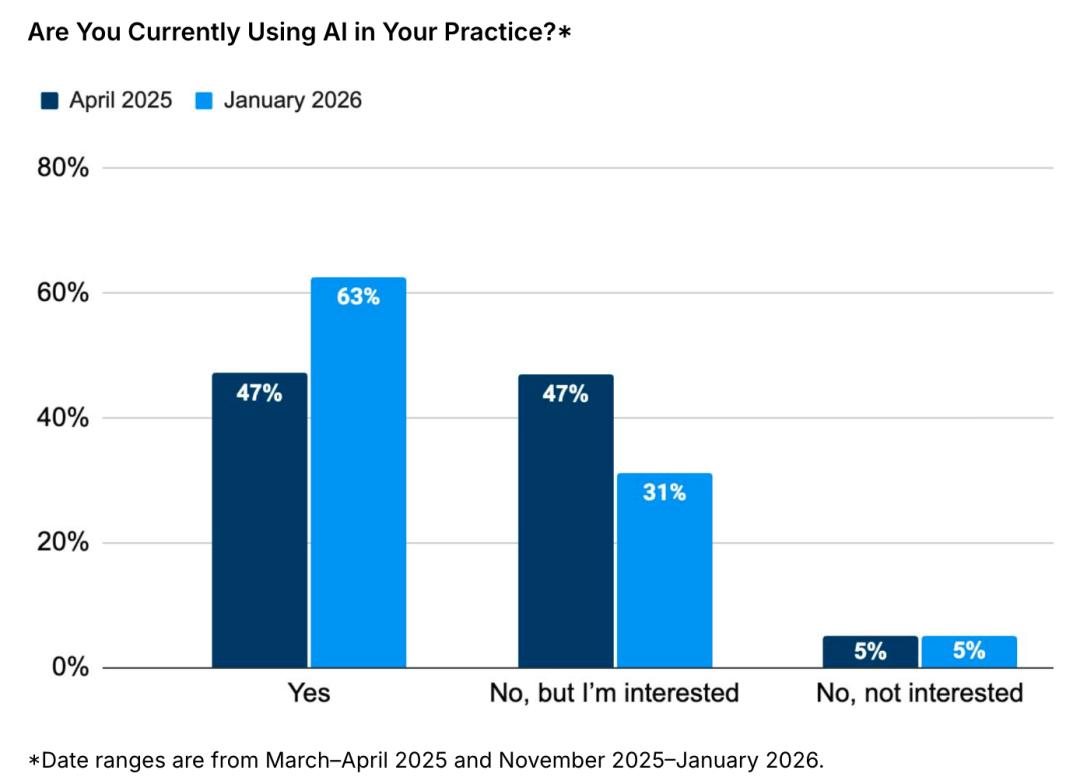
A Doximity survey shows that the proportion of U.S. doctors using AI in clinical practice rose from 47% in March-April 2025 to 63% in November 2025-January 2026; Doximity is the leading digital platform for medical professionals in the U.S., with more than 3 million members including over 85% of all practicing doctors | doximity.com
But the real watershed is not whether to use AI or not, but how far AI is allowed to go. This tiny difference is a test for developers, medical institutions and regulators, and the most concentrated divergence lies in regulation.
The U.S. federal government has not introduced major legislation so far, so each state acts on its own. In 2025, 21 U.S. states passed 34 AI healthcare-related laws, and about 14 more were added in the first half of 2026. For example, Texas requires that patients must be given written disclosure when AI is involved in diagnosis and treatment; Iowa has set rules for medical insurance claims, where AI can do the initial review, but reimbursement cannot be rejected solely based on AI's decision.
In contrast,the EU AI Act classifies all medical AI as "high-risk" and regulates them according to the strictest standards, with the implementation deadline being December 2027 (for independent systems) and August 2028 (for embedded devices).Current rules in China are more straightforward, explicitly prohibiting AI from replacing doctors to issue prescriptions. The World Health Organization's 2024 governance guidelines pointed out the core risks of such systems: hallucinations, data bias, and "black box" opacity.
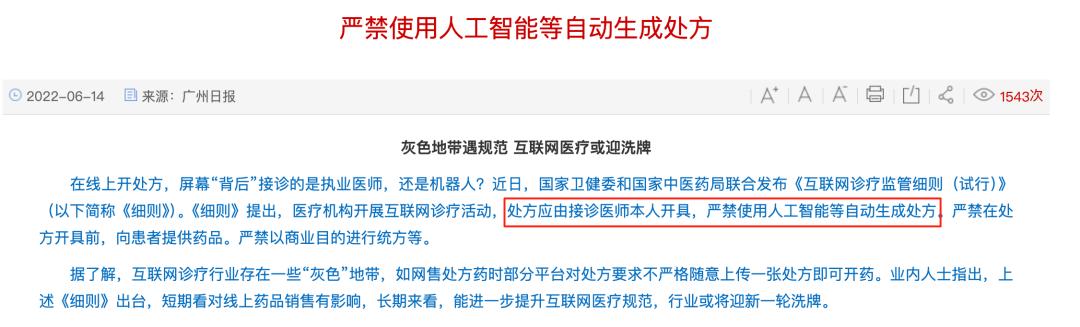
China's "Internet Diagnosis and Treatment Supervision Rules (Trial)" stipulates that prescriptions must be issued by the attending physician themselves, and it is strictly prohibited to use artificial intelligence and other means to automatically generate prescriptions | Screenshot
It is precisely because there are divergences in global regulatory paths and most regions still draw red lines that Utah's unique case of "allowing AI to issue prescriptions" is particularly worthy of attention. This small app has truly crossed the threshold of "prior manual approval" for the first time, which may become the first step for AI to replace doctors, and also a key step for AI to take over daily primary medical care in the future. Its success or failure will become an important reference case for the development of global medical AI.
References
[1]https://www.techspot.com/news/114111-utah-become-first-state-ai-examine-patients-prescribe.html
[2]https://www.healthcaredive.com/news/utah-approves-health-ai-pilots-drug-management-womens-health/832318/
[3]https://commerce.utah.gov/ai/regulatory-relief-4/authorized-pilots/doctronic/?_sp=d269e82e-b76b-483e-ab05-e16b6a9fb767.1791791665799
[4]https://abcnews.com/US/utah-medical-company-announces-ai-powered-prescriptions/story?id=137043840
[5]https://www.chiefhealthcareexecutive.com/view/ai-prescribing-gets-a-state-supervised-test-in-utah
[6]https://www.unite.ai/nolla-health-launches-ai-issued-initial-acne-prescriptions-in-utah/
[7]https://pitchbook.com/profiles/company/1020005-65#investors
[8]https://www.beautyindependent.com/4-5m-raise-nolla-health-ai-startup-offers-acne-care/
[9]https://www.nollahealth.com/about
[10]https://www.fda.gov/medical-devices/digital-health-center-excellence/artificial-intelligence-enabled-medical-devices
[11]https://intuitionlabs.ai/articles/fda-approved-ai-medical-devices-list
[12]https://www.doximity.com/reports