TSMC's performance has hit a new all-time high. C.C. Wei says the company will seize every possible business opportunity.
The surging AI demand has driven TSMC to post another record-breaking performance.
On October 15, TSMC released its financial results for the third quarter of 2026, with quarterly revenue, net profit and earnings per share all hitting new all-time highs. Its net profit jumped 68.7% year-on-year, marking the sixth consecutive quarter that it refreshed its single-quarter profit record.
Faced with the long-term demand brought by AI, TSMC is accelerating the expansion of advanced processes, advanced packaging and global manufacturing bases. C.C. Wei, Chairman and President of TSMC, said that the company expects its full-year revenue denominated in US dollars in 2026 to increase by about 44% year-on-year, and the full-year production capacity of its 2nm family of technologies in 2027 will more than double. Meanwhile, TSMC has decided to build an additional 3nm fab in Tainan, Taiwan, China, and continue to advance the layout of advanced processes in the United States and Japan.
Wei emphasized: "We have no intention to leave food on the table for others, we want to capture every possible business opportunity!"
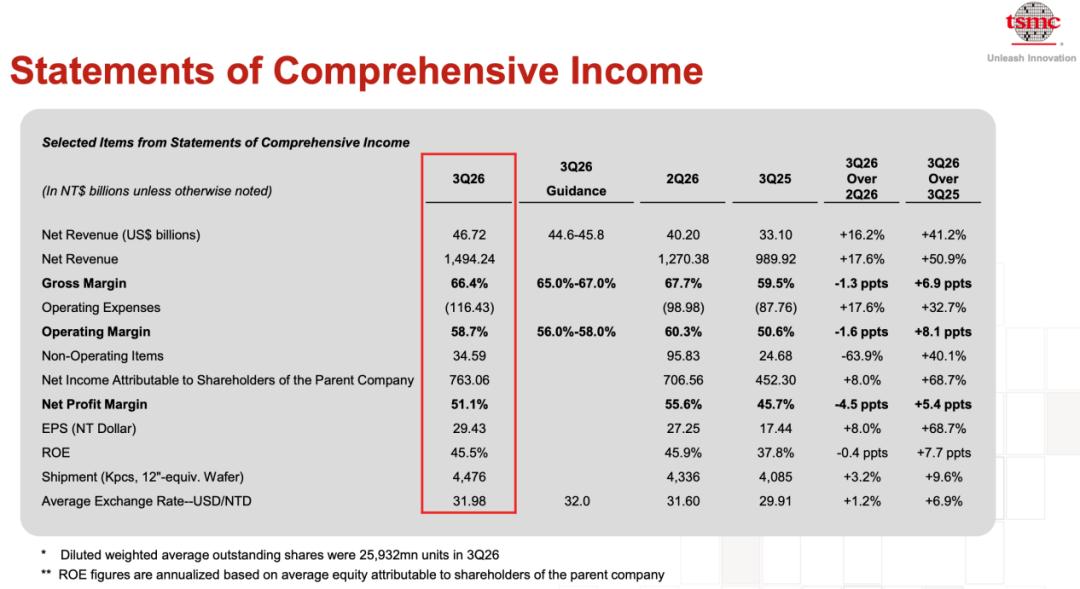
Net profit up 68.7%, AI demand extends to CPUs and networking chips
According to the financial report, TSMC's consolidated revenue in the third quarter of 2026 reached NT$1.49424 trillion, up 50.9% year-on-year and 17.6% quarter-on-quarter; its after-tax net profit was NT$763.06 billion, up 68.7% year-on-year and 8% quarter-on-quarter; its earnings per share (EPS) reached NT$29.43, higher than the NT$27.25 recorded in the second quarter.
Denominated in US dollars, TSMC's revenue in the third quarter was US$46.72 billion, up 41.2% year-on-year and 16.2% quarter-on-quarter, exceeding the company's previous financial forecast range of US$44.6 billion to US$45.8 billion.
In terms of profitability, TSMC's gross margin in the third quarter was 66.4%, operating margin was 58.7%, net margin was 51.1%, and return on equity (ROE) reached 45.5%.
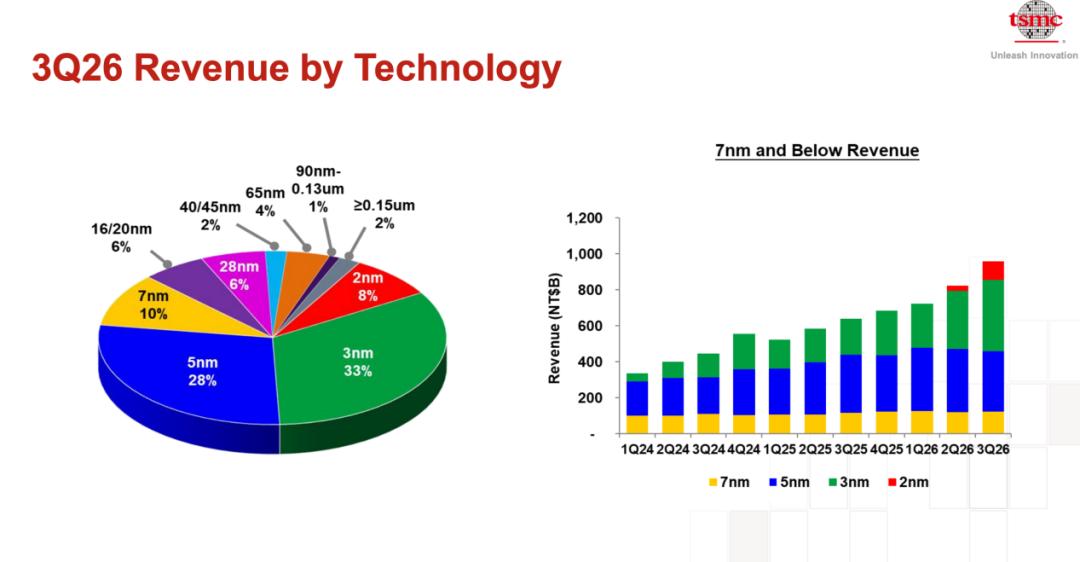
In terms of process structure, 2nm process accounted for 8% of wafer sales value in the third quarter, while 3nm, 5nm and 7nm processes accounted for 33%, 28% and 10% respectively. 7nm and more advanced processes together accounted for 79% of wafer sales value.
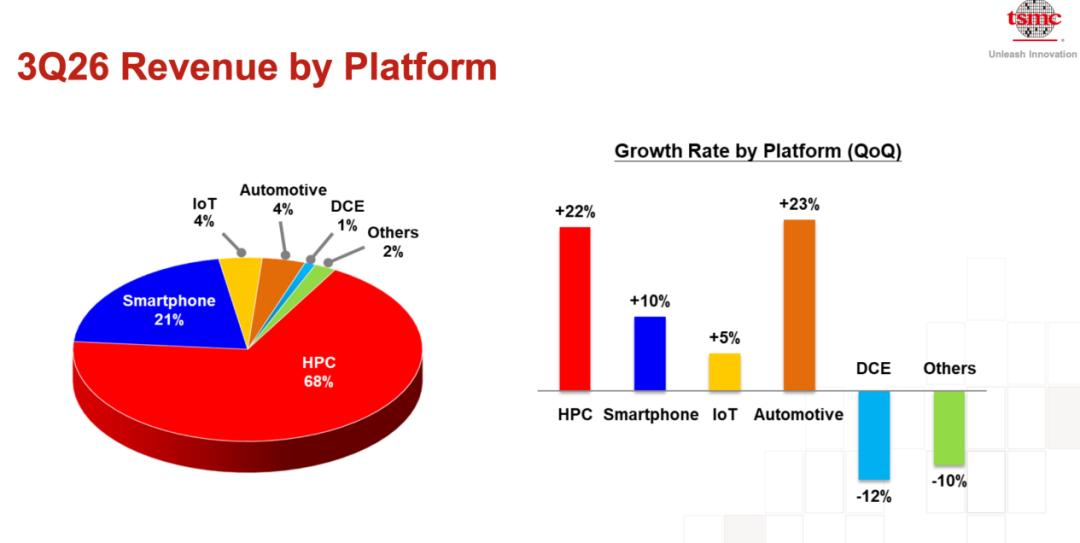
In terms of application platforms, high-performance computing (HPC) is TSMC's largest source of revenue. HPC revenue in the third quarter increased by 22% quarter-on-quarter, accounting for 68% of total revenue; smartphone revenue increased by 10% quarter-on-quarter, accounting for 21%; automotive electronics revenue increased by 23% quarter-on-quarter, accounting for 4%; IoT revenue increased by 5% quarter-on-quarter, accounting for 4%. Consumer electronics revenue fell 12% quarter-on-quarter, accounting for 1%.
Looking ahead to the fourth quarter, TSMC expects revenue to be between US$52.3 billion and US$54.3 billion, with a midpoint of US$53.3 billion. Calculated based on the midpoint, revenue will increase by about 14% quarter-on-quarter and about 58% year-on-year. The company expects gross margin in the fourth quarter to be 65% to 67%, and operating margin to be 56.5% to 58.5%.
Regarding the full-year performance for 2026, Wei said that supported by strong demand for advanced processes, TSMC expects its full-year revenue denominated in US dollars to grow by about 44% year-on-year.
AI is an important source of demand that the company continues to be optimistic about. Wei pointed out that the industry is gradually moving from chatbots to the deployment of AI assistants, namely Agentic AI. With the rapid popularization of generative AI and the wide adoption of open-source AI models, the efficiency of AI applications has been improved and the threshold for use has been lowered, further driving demand for chips built on advanced processes.
At the same time, AI demand is not limited to GPUs and AI accelerators. Wei said that the emergence of Agentic AI CPUs and the continuous growth of demand for networking chips have also further boosted wafer demand.
He emphasized: "No matter what technological path AI takes in the future, it needs the support of the most advanced semiconductor processes." Relying on technological leadership, manufacturing capabilities, global layout and customer trust, currently "all AI customers are cooperating with TSMC".
However, TSMC remains cautious about its business planning for 2027. Wei pointed out that consumer electronics and end markets with high price sensitivity are facing challenges such as rising component prices and macroeconomic uncertainty. Nevertheless, demand for advanced processes remains extremely strong, including the rapid ramp-up of 2nm, which is expected to support the business performance in the first quarter of 2027.
2nm production capacity to double next year, TSMC ramps up global capacity expansion
In terms of advanced processes, TSMC is accelerating the mass production preparation for 2nm and subsequent technologies. Wei said that the N2 technology has entered the high-volume production stage with good yield in the fourth quarter of 2025, and multi-stage production ramp-up is continuing at the Hsinchu and Kaohsiung plants. Benefiting from strong demand for smartphones, high-performance computing and AI applications, the company expects the full-year production capacity of the N2 family of technologies in 2027 to more than double.
In terms of next-generation processes, TSMC has begun to prepare production capacity for A14 technology, with risk production expected to start as scheduled in 2027 and mass production to kick off in 2028. Wei also revealed that the market demand for the A16 (1.6nm) process is very high, and customers have strong willingness to adopt it.
3nm is also a key focus of this capacity expansion. TSMC previously planned to build three new fabs worldwide to meet the strong demand for 3nm processes that will last for several years. With the further increase in customer demand, the company has decided to build an additional 3nm fab in the Tainan Science Park in Taiwan, China, which is expected to enter mass production in the first half of 2028; the original new 3nm fab in Tainan is expected to enter mass production in the first half of 2027.
Overseas layout is also advancing simultaneously. The second fab in Arizona, United States, has completed construction and is currently in the stage of equipment move-in and installation, and is expected to start mass production in the third quarter of 2027, slightly earlier than the original schedule. The second fab in Japan is proceeding as planned and will adopt the 3nm process, with mass production expected in 2028.
Wei said that nearly 25 fabs are currently under construction around the world. In the next few years, TSMC will build 13 advanced process and advanced packaging plants in Taiwan, China, and 5 to 6 fabs overseas.
In addition to wafer manufacturing, advanced packaging is also an important part of TSMC's capacity expansion. Wei pointed out that the current demand for CoWoS advanced packaging is very strong and continues to grow. Even though TSMC has significantly expanded its production capacity every year, supply still falls short of demand at present, and the company is going all out to increase production capacity to meet customer demand.
For forward-looking technologies such as panel-level packaging (FPLP), silicon photonics and co-packaged optics (CPO), TSMC is actively developing larger panel-level packaging solutions to reduce future costs. Wei emphasized that the company remains the industry leader in related technologies and mass production maturity.
In terms of its US layout, Wei said that the construction and capacity expansion in Arizona is mainly in response to the demands of a large number of US customers. In addition to wafer manufacturing lines, TSMC is also actively evaluating and planning to build advanced packaging capacity in the United States, and continues to communicate with customers on specific specifications and requirements.
To increase existing output, TSMC is also carrying out equipment conversion and capacity optimization. Wei said that the company continues to convert part of the 5nm equipment in Taiwan, China to support 3nm production capacity, and increase productivity at each production site to produce more wafers. At the same time, the company also provides more flexible capacity support across the N7, N5 and N3 nodes.
In terms of customer demand planning, TSMC has dispatched teams to conduct on-site inspections of the construction progress and power supply status of US data centers. Wei said that all cloud service providers (CSPs) are fully prepared and the relevant feedback is positive. TSMC systematically grasps the product roadmaps of customers for many years to come through a combination of top-down and bottom-up approaches to arrange production capacity in advance.
Capital expenditure will increase significantly in the next three years, overseas capacity expansion brings cost pressure
Continuously expanding advanced processes and related production capacity also means that TSMC will maintain high capital investment in the future.
TSMC reiterated that its full-year capital expenditure for 2026 is expected to be between US$60 billion and US$64 billion, and the scale of capital expenditure from 2026 to 2028 is expected to be significantly higher than that of the previous three years.
Wendell Huang, CFO of TSMC, said that although the supply of some equipment is still tight at present, the company continues to cooperate with equipment suppliers in advance to plan production capacity to meet the future demand of customers.
However, the rapid ramp-up of advanced processes and the expansion of overseas fabs will also have an impact on gross margin. Huang pointed out that the midpoint of gross margin in the fourth quarter is expected to decrease by about 0.4 percentage points compared with the third quarter, mainly due to the dual impact of the rapid ramp-up of 2nm and the higher cost of overseas fabs. Productivity improvement, cost reduction and capacity optimization across process nodes are expected to partially offset these unfavorable factors.
TSMC expects that the dilution effect of overseas fab mass production on the full-year gross margin in 2026 will be closer to 2 percentage points; with the continuous advancement of US capacity expansion in the next few years, the dilution of gross margin by overseas fabs may expand to 3 to 4 percentage points.
In response, the company plans to take advantage of the expanded production capacity in Arizona to improve the cost structure through operational optimization, and cooperate with customers and suppliers to manage cost impacts, so as to maintain cost competitiveness in all production regions.
In terms of equipment investment, for High-NA EUV (High Numerical Aperture Extreme Ultraviolet Lithography) equipment, Wei emphasized that TSMC attaches great importance to technology maturity and return on investment (ROI), and will not blindly chase new equipment. It will only consider introducing the equipment into mass production when the equipment is mature and cost-effective.
Regarding market competition, Wei said that whether customers are fabless semiconductor companies or integrated device manufacturers (IDMs), TSMC will treat them equally, and will take the internal production capacity of competitors into overall evaluation.
From the third-quarter performance to the capital investment in the next three years, the key points disclosed at TSMC's recent earnings conference focus on the continuously growing demand for advanced processes and the corresponding global capacity expansion plan. Faced with the demand brought by AI, the company is simultaneously advancing 2nm, 3nm and subsequent processes, expanding the production capacity of advanced packaging such as CoWoS, and increasing output through equipment conversion and cross-process capacity optimization.
Wei said that TSMC will do everything possible to maximize support for customers at the fastest possible speed under feasible conditions. For the company, how to control overseas manufacturing costs and maintain profitability while expanding production capacity will receive the same level of attention as the mass production progress of advanced processes.
*Disclaimer: This article is originally written by the author. The content of the article represents the personal view of the author only. Semiconductor Industry Watch reprints it to convey a different perspective, which does not mean that Semiconductor Industry Watch endorses or supports this view. If you have any objections, please contact Semiconductor Industry Watch.
This article is from the WeChat official account "Semiconductor Industry Watch" (ID: icbank), written by the editorial department, and is authorized for release by 36Kr.