Tencent, ByteDance and Alibaba are vying for the next AI entry point.
Over the past year, Agent has repeatedly become a major industry hotspot.
Last year, Manus enabled users to assign a complete task to AI. At the beginning of this year, OpenClaw allowed Agent to work continuously on computers or servers. By September, Meta launched Muse, further integrating long-term memory, cloud operation and task execution, striving to make AI an assistant that can handle personal affairs for a long time.
The competition among Agents is shifting from performing specific tasks to continuously providing personal services. Major domestic tech giants have also begun to speed up their layout.
At the end of September, ByteDance was exposed to be accelerating the advancement of its personal agent project Spell, and Tencent's Yuanbao also spread news that it will launch similar products. Entering October, Lingguang under Ant Group launched a new version of internal beta test. Alibaba's Tongyi Qianwen previously announced that it would accelerate the development of Personal Agent.
For companies such as Tencent, ByteDance and Alibaba, this competition affects not only the AI assistant market, but also their internet businesses that they have operated for many years.
In the past, users needed to enter different Apps to find goods and services, and platforms competed for traffic through search, recommendation and advertising. Now, personal agents try to undertake these demands in advance, with AI completing screening, price comparison and even transactions. If this model works, part of the traffic distribution right may be transferred from the original platforms to Agents.
The subtlety of this competition is that major giants hope their own Agents will become the entry for users to access other platforms, but they are not necessarily willing to let competitors' Agents enter their own ecosystems.
I. Major domestic tech giants are collectively betting on personal agents
In fact, many personal agent projects of domestic giants were launched earlier than Muse.
ByteDance's Spell project was launched as early as April this year, led by the Doubao mobile assistant team. The product is named "Xiaodou", and it is planned to be launched as an independent App. At the end of last year, the technical preview version of Doubao mobile assistant was unveiled, which could already complete cross-application operations for users by identifying screens and simulating clicks.
However, part of the capabilities of the mobile assistant requires system-level support from mobile phone manufacturers, so it is limited by device adaptation and third-party application permissions. Spell tries to further extend the Agent capabilities accumulated by ByteDance on the mobile end to independent applications, so that more users can use them.
The pace of project advancement changed in September.
With the popularity of Meta Muse, ByteDance accelerated the R&D of Spell, and the Doubao conversation team also participated in it, planning to combine personal agent capabilities with Doubao products. As for whether to launch an independent App or upgrade existing products in the end, it has not been determined yet.
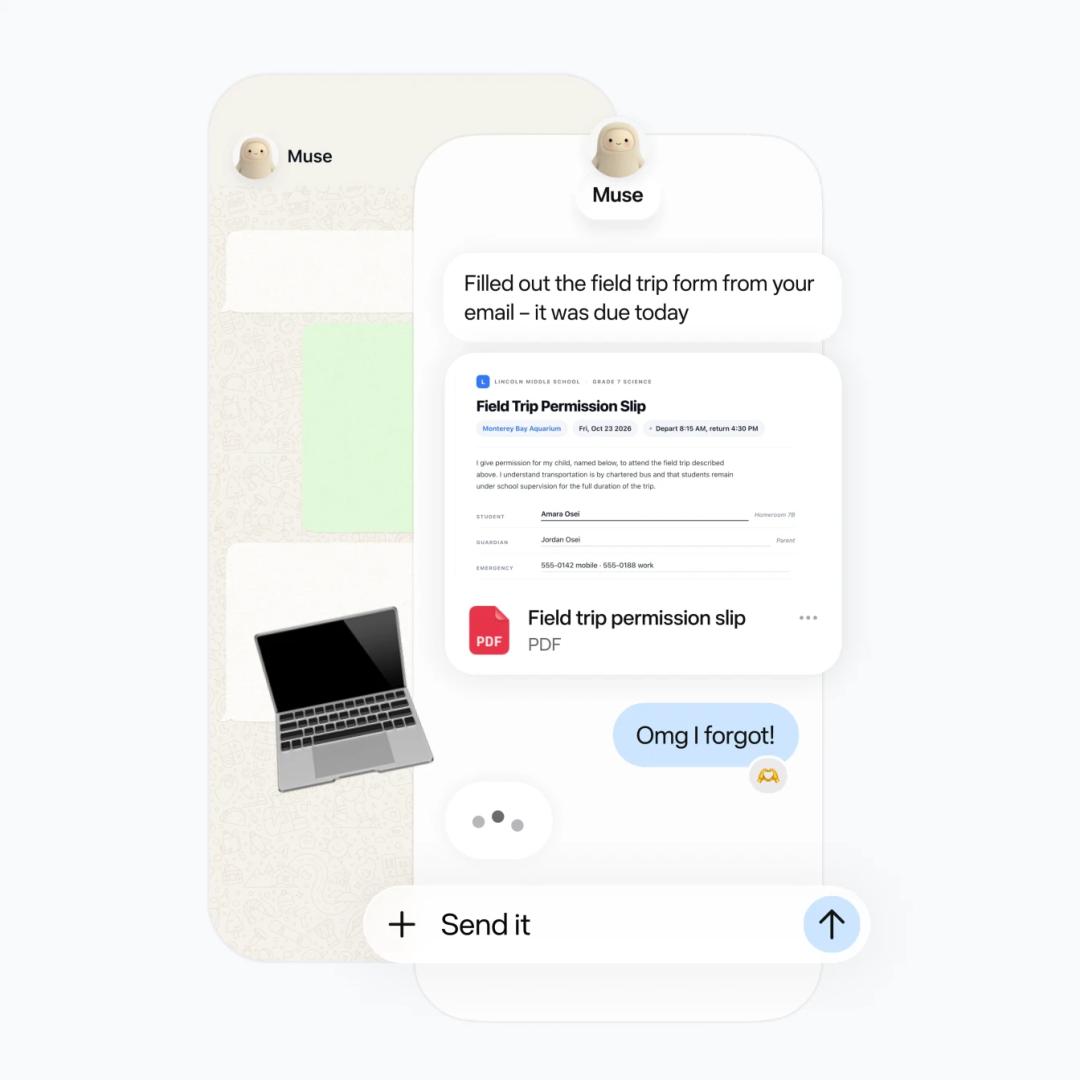
The market performance of Muse has shown major giants the potential of personal agents in the consumer market. According to The Information, about three weeks after Muse was launched, more than 3 million users actively sent instructions at least once a week, and more than 1 million users sent instructions at least once a day.
Before that, although Agent products such as Manus and OpenClaw have attracted widespread attention, their main users are still concentrated in the group of technology enthusiasts and developers. Muse tries to lower the threshold of use, so that ordinary users can also assign daily tasks such as shopping, scheduling and information tracking to AI.
Tencent has also started relevant exploration long ago.
In April this year, Tencent's lightweight cloud team launched LightVela, which entered paid public beta in August. Users can deploy exclusive Agents in the cloud, which support long-term memory, scheduled tasks, and send instructions through tools such as WeChat and QQ. Compared with open-source Agents that require users to build environments on their own, LightVela saves steps such as server deployment and maintenance.
However, LightVela is more similar to a cloud Agent hosting tool. Users still need to configure models, skills, etc., and there is still a certain threshold for ordinary consumers.
Therefore, Yuanbao is also synchronously planning to launch a personal agent. Different from LightVela, Yuanbao already has an existing consumer-level user base, so it does not need to find users from scratch. But how to make users get used to assigning long-term tasks to AI in addition to the original chat functions still needs new products to verify.
Different from ByteDance and Tencent, Alibaba chose to directly transform its existing AI assistant.
On October 11, Lingguang under Ant Group launched a new version of small-scale internal beta test, and the relevant direction has been prepared about half a year ago.
Previously, Lingguang mainly provided functions such as chat and application generation, and the new version began to try to handle tasks that require continuous follow-up. For example, re-plan the trip when the flight is delayed or the scenic spot has flow restriction, or track market changes for a long time, and call external services such as DingTalk and smart home through Skill and MCP.
Alibaba's Tongyi Qianwen focuses on personal data and service ecosystem. At the Yunqi Conference on September 22, Qianwen announced that it would accelerate the creation of Personal Agent, and began to access data such as health, sports, and personal positions under user authorization. As of that time, its open platform has covered more than 20 fields, with more than 1000 partners applying for settlement.
The capabilities previously scattered in mobile assistants, chatbots and cloud Agents are being integrated into personal agent products. The popularity of Muse is rapidly accelerating this process.
II. Why do major giants start competing for Agents again?
This is not the first time that Agent has become an industry hotspot.
In March 2025, Manus launched a general AI Agent. Users only need to give the target, and AI can independently decompose tasks, call tools, and complete work such as data collection, data analysis, and webpage production. At that time, Manus's invitation code was once speculated to tens of thousands of yuan on second-hand trading platforms.
Manus soon proved the commercial value of Agent. In December 2025, Manus disclosed that its annual recurring revenue (ARR) reached 100 million US dollars, and the annual revenue run rate reached 125 million US dollars.
At the beginning of this year, OpenClaw set off another Agent boom.
Different from Manus, which mainly performs tasks assigned by users on the cloud, OpenClaw allows users to deploy Agents on their own computers or servers, enabling AI to read files, operate browsers, call applications, and even work continuously through scheduled tasks. It can also access communication software, so that users can remotely assign tasks through chat messages.
However, the stronger the capabilities of Agent, the higher the usage threshold and security risks. Deploying environments, configuring models, and managing permissions all require users to have certain technical knowledge. Once Agent obtains permissions related to files, emails and even payments, wrong execution may also cause actual losses.
Manus and OpenClaw verified two things: first, users are willing to pay for AI to perform tasks, and second, AI can work without continuous human operation. But how to turn these capabilities into services that ordinary people can use for a long time is still a difficult problem to solve.
The emergence of Muse solved this problem.
Meta configured an independent cloud virtual machine for each Muse, which can save personal data accessed under user authorization and continuously perform tasks in the background. For example, if a user asks Muse to arrange a trip, it can filter flights and hotels according to the user's preferences, and continue to follow up when the itinerary changes, without requiring the user to re-explain the background every time.
From Manus to Muse, Agent has begun to extend from a tool for completing specific tasks to a product that serves individuals for a long time.
This change is particularly important for major giants that already have a huge user base.
In the past two years, products such as Doubao, Qianwen and Yuanbao have competed around chat, search and content generation. With the continuous improvement of model capabilities, the functional differences between mainstream products are narrowing. Users can use Doubao to write copywriting, or use Qianwen to search for information, and the cost of switching products is not high.
Personal agents may increase the migration cost of users.
An Agent that has been used for a long time can gradually accumulate the user's work habits, consumption preferences, schedule and historical tasks. The longer the user uses it, the less information they may need to provide repeatedly. When replacing the Agent, users may need to re-authorize applications, migrate personal data and establish workflows.
For major giants, this means that AI products have the opportunity to form stronger user stickiness. When users begin to get used to assigning daily affairs to the same Agent, the long-term accumulated personal data and workflows may also become new competitive barriers.
A larger imagination space lies in the internet entry.
In the past, users needed to open Ctrip to book flights, enter Taobao to shop, and order takeout through Meituan. Personal agents may centralize these operations into one entry. Users only need to put forward demands, and the Agent is responsible for finding goods, comparing prices, calling services, and then the user confirms the transaction.
If this model works, users' consumption demands may first be undertaken by the Agent and then distributed to different service platforms.
III. Can personal agents break the App ecosystem?
If personal agents want to become the new internet entry, the first thing they have to face is the resistance from existing internet platforms.
On September 20, Amazon began to block Meta Muse from accessing its shopping website. According to the original design of Muse, users can ask it to search for goods, compare prices, and even complete purchases directly. But after Amazon took restrictive measures, Muse can no longer perform tasks normally.
Amazon's reason is that Meta allowed Muse to access its website without permission, and the Agent did not clearly identify itself when browsing, which may bring account security and privacy risks.
This is not the first time that Amazon has restricted external AI tools. Previously, it restricted Google and OpenAI's shopping robots from accessing the website, and also sued Perplexity, trying to prevent its Agent from operating Amazon's shopping services without authorization.
Similar conflicts have already emerged in China.
In December last year, shortly after the technical preview version of Doubao mobile assistant was released, some users found that using AI to operate WeChat would trigger abnormal account exit. Subsequently, Doubao removed the function of automatically operating WeChat. Restrictions also appeared on Taobao, Alipay, Pinduoduo and some banking Apps one after another.
Subsequently, Doubao mobile assistant announced that it would adjust product capabilities, temporarily remove the operation of financial payment Apps, restrict some scenarios such as games and point incentives, and stated that it hopes to formulate AI operation rules together with application manufacturers.
These restrictions are considered for security and compliance, but they also involve the distribution of benefits between platforms.
Over the past decade, internet platforms have established a mature business model around search, recommendation and transaction. After users enter platforms such as Taobao and Amazon, platforms decide how goods are sorted, which merchants get exposure, and where advertisements are displayed.
Personal agents may change this process.
If users directly tell the Agent what to buy, and the Agent compares prices across platforms, filters goods, and then completes the order, users do not need to browse a large number of product pages. Part of the search and recommendation links originally controlled by the platform may be transferred to the Agent.
For platforms that rely on advertising, merchant promotion and transaction commissions to obtain revenue, this change will impact the existing business model.
Amazon's attitude is quite representative. It does not reject AI shopping, and it is also developing shopping assistants such as Rufus, but it has taken restrictive measures against external Agents that enter its platform without authorization.
For domestic giants that operate both AI products and internet platforms, this contradiction is more obvious.
Alibaba hopes that Qianwen will become the entry for users to handle consumption demands, but at the same time it needs to maintain the existing merchant operation system of Taobao. Tencent also faces similar problems. WeChat has a huge mini-program ecosystem. If personal agents directly complete tasks such as ordering food, shopping, and traveling for users, users may no longer need to actively search and enter mini-programs, and part of the existing traffic entries of WeChat may also be weakened.
For these giants, personal agents are not only an opportunity to compete for new entries, but also may impact the internet ecosystems they have operated for many years. They hope their own Agents can call more external services, but whether they are willing to open the same capabilities to competitors is still a problem.
More importantly, whether users are willing to trust AI with their personal affairs.
On September 25, foreign media reported that an external security researcher found a security vulnerability in Muse, which may allow attackers to access sensitive information such as emails and files in the user's exclusive virtual machine. Meta subsequently strengthened relevant security warnings.
For chatbots, wrong answers usually mean that users need to re-verify the information. But once a personal agent obtains operation permissions such as emails, files, and shopping, wrong execution or security vulnerabilities may bring actual losses.
The early growth of Muse has not yet been fully converted into stable user retention. According to The Wall Street Journal, the global download volume of Muse has approached 9 million times, but the download growth has begun to slow down. Sensor Tower data shows that its 14-day retention rate is 22.5%, lower than ChatGPT's 26.8%.
Personal agents have attracted a large number of users to try, but there is still a long way to go before they become indispensable tools in daily life.
For giants such as Tencent, ByteDance and Alibaba, launching products in advance is only the first step. The real competition lies in who can take the lead in opening up the application ecosystem, stably complete tasks at a controllable cost, and make users feel relieved to assign more affairs to AI.
This article is from the WeChat official account "Market Value List" (ID: shizhibang2021), written by Xiang Qing; edited by Zhao Yuan, and published with authorization from 36Kr.