Hesai is eager to shake off the "LiDAR" label.
The anxious Hesai is trying to shake off the "lidar company" label that has accompanied it for years.
On October 14, Hesai Technology released its spatial intelligence product Kosmo. Through a device integrating lidar and camera, users can scan the real environment, reconstruct it into a browsable and editable digital space, which can then be used for robot training, film and television production or commercial display.
"We are evolving from a component provider to a full-scale infrastructure provider," said Li Yifan, co-founder and CEO of Hesai. He divides physical AI into three layers: whole-machine applications, models and infrastructure, noting that the industry cannot solve problems solely by relying on models, and the underlying hardware, computing and data all need to be improved.
Following this logic, Hesai hopes to extend from lidar perception to the spatial data of Kosmo, and then move into the execution link represented by power modules, to become a "physical AI infrastructure company".
This new identity carries greater commercial ambitions, but it also emerges against a very realistic backdrop: there is no sign of an imminent end to the painful period of Hesai's most mature business.
Automotive lidar has undergone a drastic price collapse in the past decade. In 2016, a 64-line mechanical lidar from Velodyne was priced at around $80,000; in the past two years, the MX released by RoboSense and the ATX from Hesai have both pushed the price below $200.
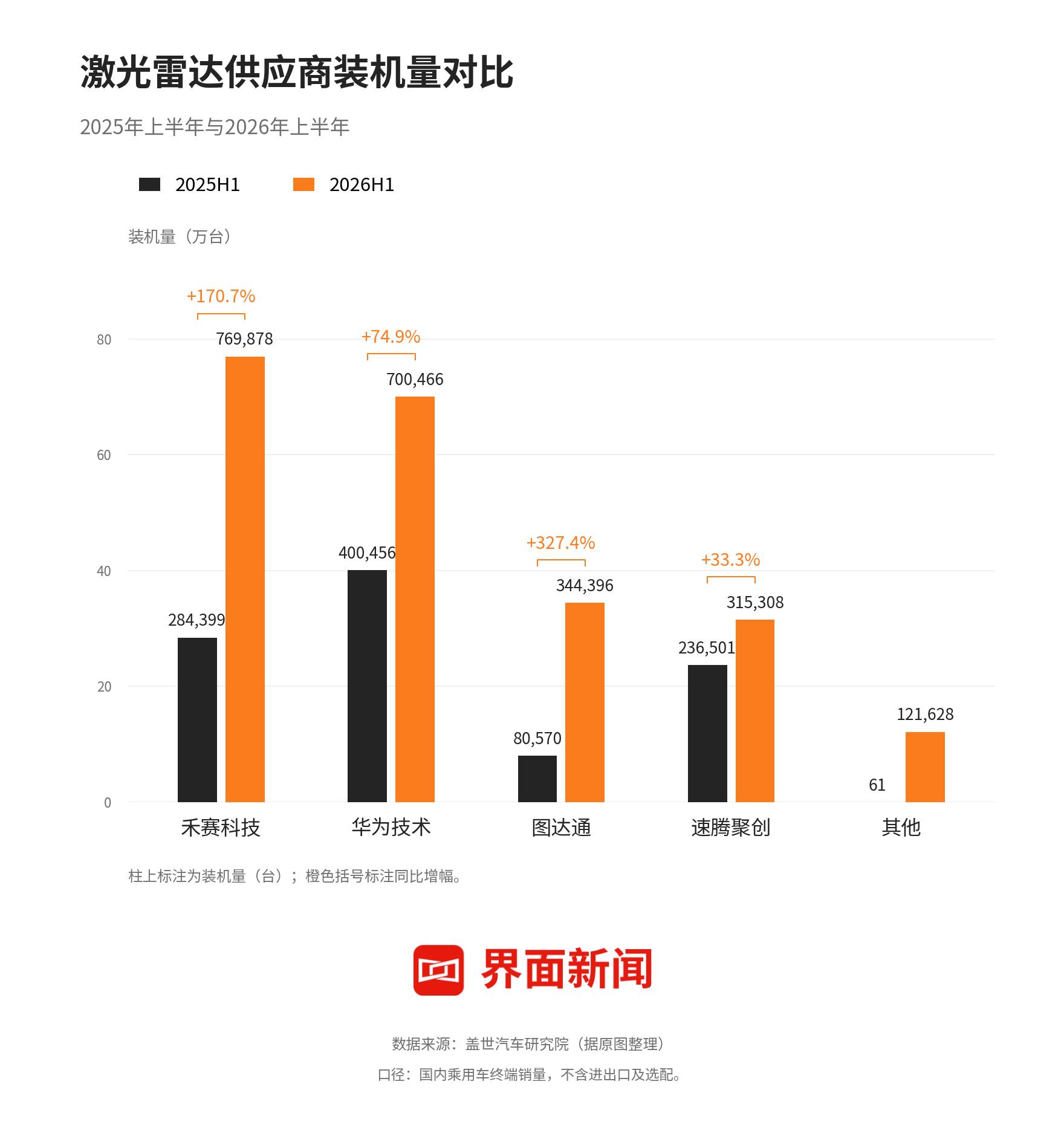
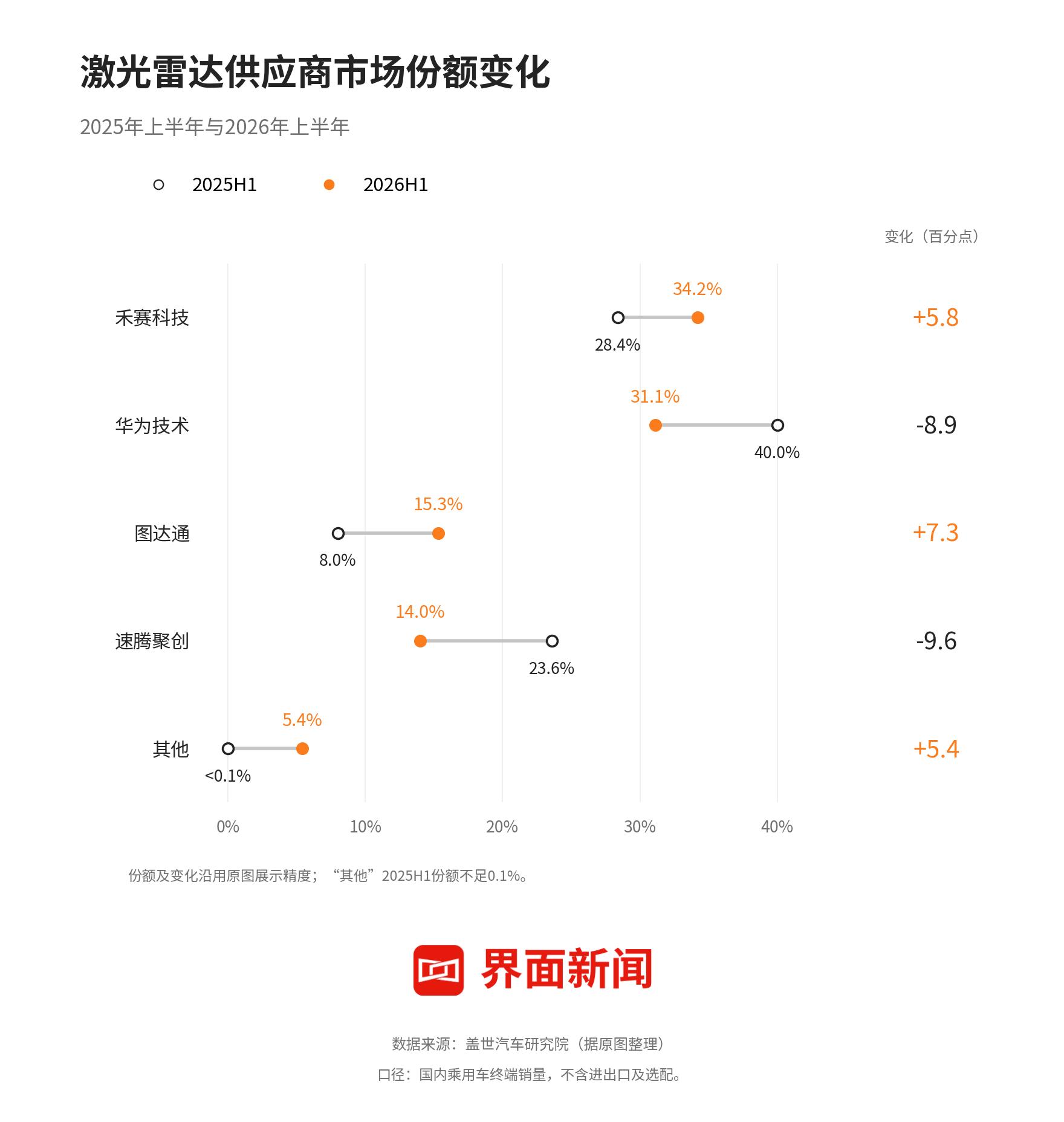
Moreover, there is no sign that the price reduction is over. In the second quarter of 2026, the comprehensive average selling price of Hesai's lidar dropped to 1,297 yuan, down 35% year-on-year, lower than the previous market expectation of 1,350 yuan. In the same period, the company shipped 628,000 units, which was not only lower than the company's guidance of 650,000 units, but also slightly lower than market expectations; among them, ADAS lidar shipments reached 486,000 units, which also failed to meet the expected 504,000 units.
This means that Hesai is not only facing the situation of "trading price for volume", but also that when the price is still falling rapidly, the volume may not always grow as expected.
Entering the large-scale automotive supply chain means larger orders, as well as more powerful automakers, stricter cost requirements and continuous annual price reduction pressure. Hesai can of course still rely on higher sales to do business. But when ASP is still declining at a double-digit rate every year, "selling more lidar units" itself has increasingly become insufficient to form a complete growth story for a listed technology company.
The booming embodied intelligence is therefore particularly attractive. In the second quarter of this year, Hesai's robot lidar shipments reached 142,400 units, and the cumulative figure in the first half of the year reached 260,700 units. At the same time, the company no longer only provides "eyes" for robots. The cumulative delivery volume of Hesai's robot power modules has exceeded 10,000 sets, and the company expects shipments to reach six-digit scale in 2027.
But the robot market is not another mature automotive market.
Previous interviews by Jiemian News with multiple R&D personnel in the embodied intelligence industry found that for lawn mowers, delivery robots, AMRs and high-speed mobile robots, the use of lidar for positioning, navigation and obstacle avoidance is a relatively clear demand; when it comes to humanoid robots, especially desktop operation scenarios, the industry is still looking for solutions among different combinations of cameras, depth cameras, lidar, tactile sensors and other technologies. Different motion capabilities, operation capabilities and robot forms require different types of "eyes".
Robot power modules are another key focus. Li Yifan said that a humanoid robot may have more than 100 drive units, which account for more than half of the bill of materials cost of the whole machine; the company's current power module products hope to leverage its past accumulation in precision machinery, chips, manufacturing and mass production to enter this higher-value market.
In contrast, what Kosmo needs to prove is another kind of procurement value: why robot companies need to buy spatial data from Hesai, and why they need to keep purchasing it.
Kosmo consists of the AI spatial camera Kosmo One and the cloud platform Kosmo World. The former integrates a customized lidar, an 8K imaging system and a high-precision inertial measurement unit, while the latter is responsible for 3D reconstruction, editing and asset management. After the collected data is imported into the software, it can generate 3DGS, Mesh and depth maps, segment and edit objects, and use AI to complement the areas that are not actually scanned.
Xiang Shaoqing, co-founder of Hesai, introduced at the press conference that for a scene of about 100 square meters, traditional manual modeling may take about 300 hours, while on-site scanning using Kosmo only takes 15 minutes. The company hopes to further use these scanning results to generate different layouts, such as changing the position of furniture, and derive multiple virtual training scenarios from the same real scene.
Hesai has designed more than one source of revenue for this business. At present, the company on the one hand sells integrated software and hardware products, and on the other hand hopes to provide real spatial data production services for world model and physical AI companies; the management previously also proposed that Kosmo's future revenue will gradually extend to cloud processing, subscription and 3D spatial asset licensing.
However, what robots ultimately need is not a sufficiently realistic 3D map, but whether these data can make the model learn faster, have higher task success rate, and truly reduce expensive data collection.
The capital market has already seen similar "spatial intelligence" stories. When Kujiale Technology went public, it also tried to transform from a design SaaS like Kujiale to a spatial intelligence company. But as of 2025, its spatial intelligence platform only had 16 customers, with revenue of about 5.2 million yuan, accounting for less than 1% of the company's total revenue. About three months after listing, the share price of Kujiale once fell back to near the issue price.
Kujiale's experience does not prove that Kosmo will follow the same path, but it shows that there is still a long commercial chain between 3D spatial technology and a large-scale infrastructure business. Digitizing real space is getting easier and easier, but getting customers to keep paying for these digital spaces is another matter.
At present, the important partner Hesai uses to verify this system is the embodied intelligence company Sharpa.
This embodied intelligence company is also co-founded by Hesai's three founders Li Yifan, Xiang Shaoqing and Sun Kai. According to Hesai's announcement, the three collectively hold the majority of voting rights in Sharpa indirectly. Therefore, in accordance with the Listing Rules of the Hong Kong Stock Exchange, Sharpa constitutes a connected person of Hesai, and the relevant transactions between the two parties are continuing connected transactions.
Since March this year, Hesai has supplied lidar and robot power modules to Sharpa, and provided related manufacturing and support services. As of the end of June, the transaction amount between the two parties was about 42 million yuan. After that, Hesai raised the annual cap of the relevant 2026 transactions from 100 million yuan to 300 million yuan, and this adjustment was approved by the general meeting of shareholders on August 28.
At the Q2 earnings call, Hesai's management disclosed that Sharpa's demand is the main source of revenue for its robot power modules. Li Yifan also explained that Sharpa can provide Hesai with feedback in real usage scenarios, help the company understand the actual performance, reliability and cost requirements of robots, and then promote the products to a broader market.
But when Hesai hopes to evolve from an in-depth supplier of Sharpa to an infrastructure supplier for the entire robot industry, this advantage naturally raises another question: how to make Sharpa's competitors also willing to integrate Hesai into their underlying technology stack.
For the ordinary lidar business, suppliers mainly deliver a standard component; Kosmo and power modules bring Hesai further into customers' training environments, product definitions and robot architectures. The deeper the relationship, the more infrastructure suppliers need to establish clear information boundaries and customer trust.
Hesai is using more third-party customers to prove that this model can be replicated externally. Its robot lidar has been adopted by more than 50 enterprises, and Kosmo has obtained orders from Galaxy Universal and other clients; at the press conference on October 14, the company announced new Kosmo cooperation with Galaxy Universal and Forcelink Robotics.
This is also the real test that Hesai's new identity as a "physical AI infrastructure company" needs to undergo. It is easy to understand that the company develops more components, and the migration of technical capabilities from lidar to drivers and spatial data also follows a logical path. But infrastructure is ultimately not a company's self-definition, but determined by customer relationships: whether robot companies with different technical routes, even competing with each other, are willing to build some of their key capabilities on top of Hesai.
This article is from "Jiemian News", written by Zhou Mo, authorized for release by 36Kr.