AI Giants: Earnings Reports Released, Stock Prices Skyrocket
Just now, TSMC released its Q3 financial report, with multiple indicators exceeding expectations.
First, look at the performance:
Q3 revenue reached NT$1.494243 trillion, up 50.9% year on year, higher than the market expectation of NT$1.46332 trillion;
Net profit was NT$763.064 billion, up 68.7% year on year, higher than the expected NT$739.49 billion;
Operating profit was NT$876.445 billion, higher than the expected NT$854.35 billion.
Gross margin was 66.4%, in the upper-middle part of the company's previous guidance range of 65%-67%, indicating that the cost pressure brought by 2nm ramp-up and overseas capacity expansion has not gotten out of control for the time being.
The process structure is the most noteworthy part of this financial report.
In Q3, 2nm accounted for 8% of wafer revenue, 3nm for 33%, 5nm for 28%, 7nm for 10%, and advanced technologies of 7nm and above accounted for 79% in total.
Compared with the 3%, 30%, 33%, 11% and 77% in Q2, the proportion of 2nm has increased significantly, the proportion of 3nm has continued to expand, and the proportion of 5nm has decreased, indicating that the demand for AI and high-performance computing is pushing customers to migrate to more advanced nodes.
However, the current proportion of 2nm is still only 8%, and the real mass production will not come until next year, which is not enough to fully offset the drag on profit margin caused by the ramp-up of advanced processes in the short term.
In terms of guidance, the company previously gave Q4 gross margin guidance of 65%-67% and operating profit margin guidance of 56%-58%; for the full year, TSMC raised its 2026 dollar revenue growth guidance to "slightly above 40%" at its July investor conference, and raised the full-year capital expenditure range to $60 billion - $64 billion.
The focus of this Q3 earnings call is to see whether the management will continue to confirm this full-year guidance and whether it will further raise the Q4 revenue outlook.
More crucially, it is 2027.
TSMC has not yet explicitly disclosed the specific values of 2027 revenue, gross margin or capital expenditure in its official statements, but the management has repeatedly emphasized that the visibility of AI demand has extended to 2030, and capital expenditure in the next three years will be significantly higher than that in the past three years.
After the financial report was released, US stocks rose after an initial fall in the overnight session.
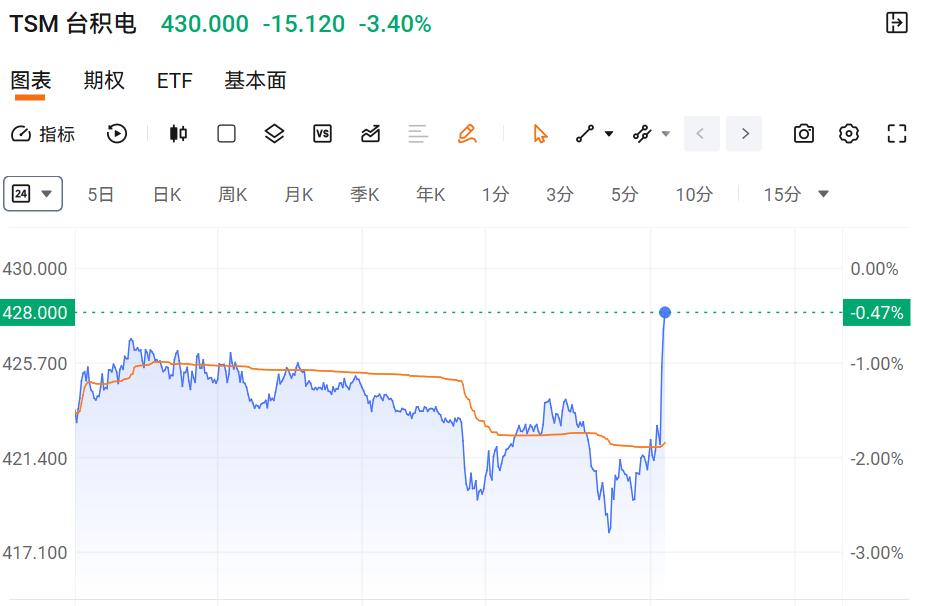
Overall, TSMC's performance remains excellent.
It proves that the demand for AI computing power has not stalled, orders for advanced processes are still full, and the 2nm ramp-up is proceeding as planned.
TSMC also mentioned that revenue growth has continued to accelerate over the past two quarters, and the company has also accelerated the pace of capacity expansion.
TSMC previously said that this year's capital expenditure will reach a record high of $64 billion. At the same time, the market's expectation for TSMC's 2027 capital expenditure continues to rise, and this indicator is an important vane to measure the development prospect of the entire industry.
Goldman Sachs currently expects TSMC's capital expenditure in 2027 to reach $85 billion, while UBS expects it to be $90 billion, both higher than the average institutional survey expectation of $75 billion.
Of course, in the short term, global AI tech stocks are currently in the stage of valuation repricing, and a single quarter's outperformance is no longer enough. The market is more concerned about: whether demand in Q4 and 2027 will remain strong, whether capital expenditure will continue to expand, whether gross margin can be maintained, whether 2nm yield and pricing can be successfully fulfilled, and whether overseas capacity expansion will further compress profits.
In terms of valuation, after the release of the new performance, TSMC's valuation cannot be simply described as cheap.
More accurately, the fundamentals remain strong, the valuation is not extreme, but it already includes high growth expectations, and the safety margin depends on whether the Q4 guidance and 2027 capital expenditure can continue to be fulfilled.
Calculated based on the closing price of $430 on October 14, TSMC's total market value is about $2.23 trillion, TTM price-to-earnings ratio is about 31 times, and price-to-book ratio is about 11 times.
Looking at TTM alone, 31 times is not low for a mature manufacturing enterprise; but TSMC is now more like a "core asset of AI computing power infrastructure", and the market will also look at the forward PE at the same time.
According to the 2027 earnings forecast, the widely accepted forward PE given by the market is in the range of 16-20 times, which is near the middle of TSMC's historical valuation range.
In other words, the forward valuation is acceptable.
In the AI hardware chain, TSMC is still one of the targets with the highest certainty, but its valuation is not significantly undervalued, and the stock price will still be suppressed by US stock sentiment, selling pressure in the semiconductor sector and interest rate expectations in the short term.
What can really repair the valuation in the future is not another outperformance itself, but the management giving stronger medium and long-term guidance, proving that 2nm and advanced packaging can continue to bring sustainable profit margins, and the marginal improvement of macro negative factors, including inflation, currency, risk-free rate of return and so on.
This article is from the WeChat official account "Gelonghui APP" (ID: hkguruclub), written by Max, authorized for release by 36Kr.