A suspected new Claude model has been exposed, which can directly generate visuals and sound effects from code, and even *Hamilton* has been produced using it.
Is Opus 5.5 High suspected to be routed to a new model?
Recently, some netizens broke the news that Anthropic has launched a new round of gray testing: Opus 5.5 High may be routed to Fable 5.5 or Opus 5.6.
Many netizens have shown videos made by this mysterious new model. It can create animated short films with light and shadow changes, camera cuts and sound effects using very few prompts:
It even made a musical to introduce itself:
After watching it, I can only say that it is incredibly powerful, almost like a reincarnation of *Hamilton*.
Music, vocals and 3D visuals are all arranged, with synchronized audio and video and a very high degree of completion.
The outputs of programming models are expanding from functional demonstrations to complete visual works with shots, light and shadow, and sound.
The author also said confidently in the comment section: This is Fable 5.5.
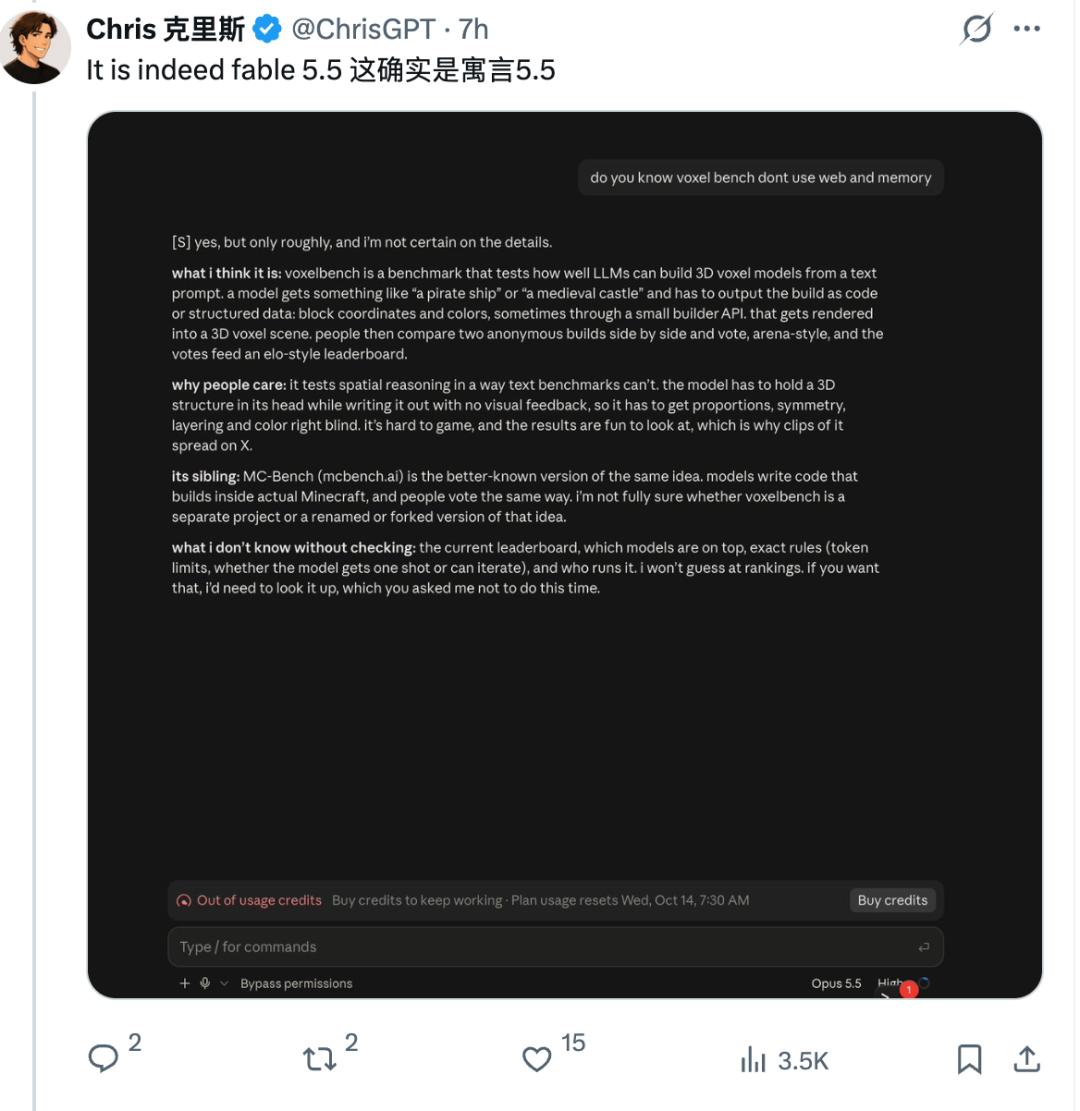
Some netizens also said after actual tests: This model is absolutely a disruptive work, the era of image/video generation is over.
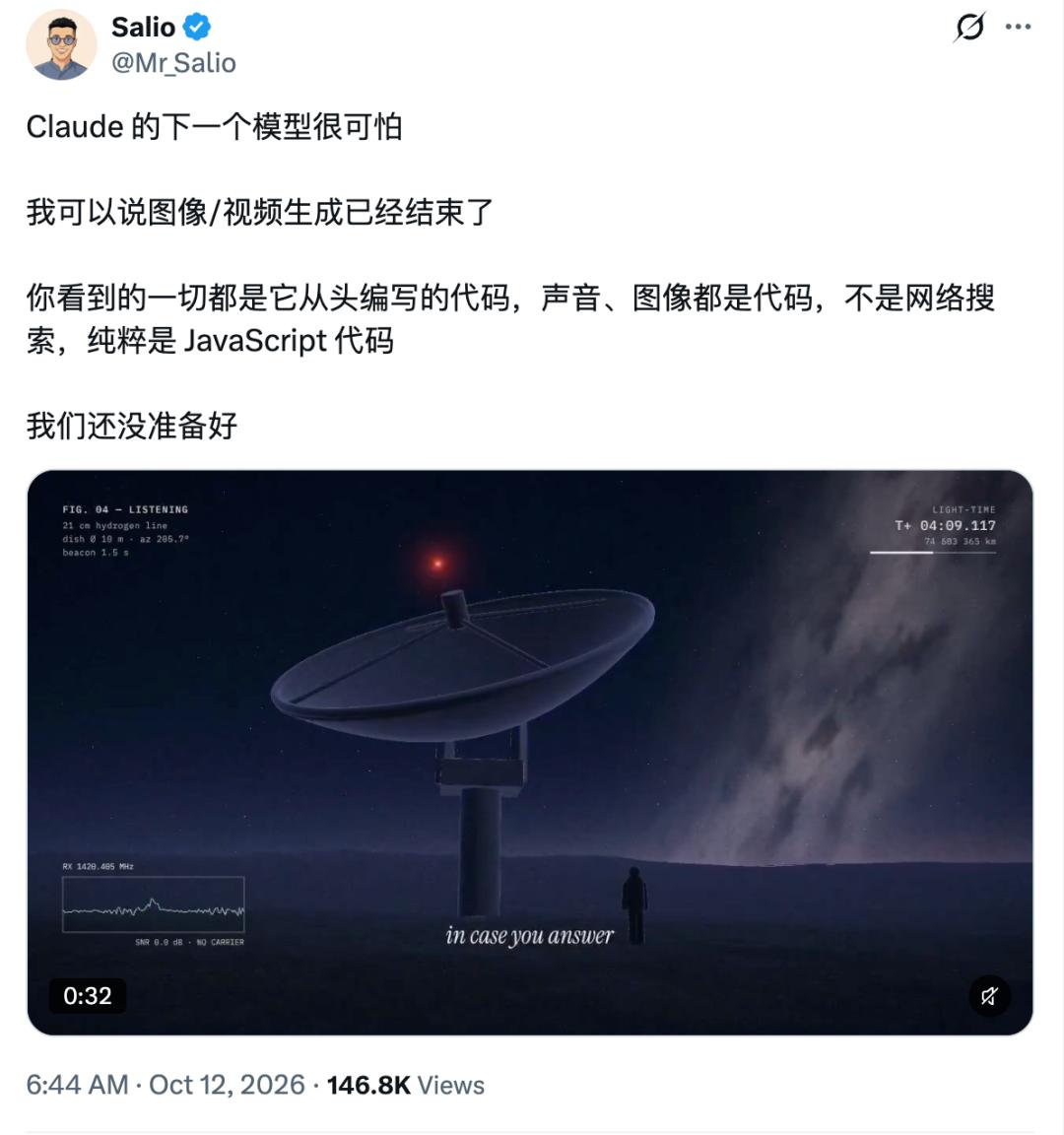
After GPT 6-Astra disrupted the 3D field, is the video generation model also going to be ended by Claude?
Claude's Mysterious New Model: Coding and Filming Are a Breeze
Among all the actual tests shared by netizens, the musical that impressed me the most is this one:
No way, what's the difference between this and *Hamilton*??
If you didn't tell me, I would really think this is pure human vocal performance.
The author introduced that this new model uses Suno to make music, uses ElevenLabs to generate human vocals, and also creates a synchronized Three.js music video around the whole song.
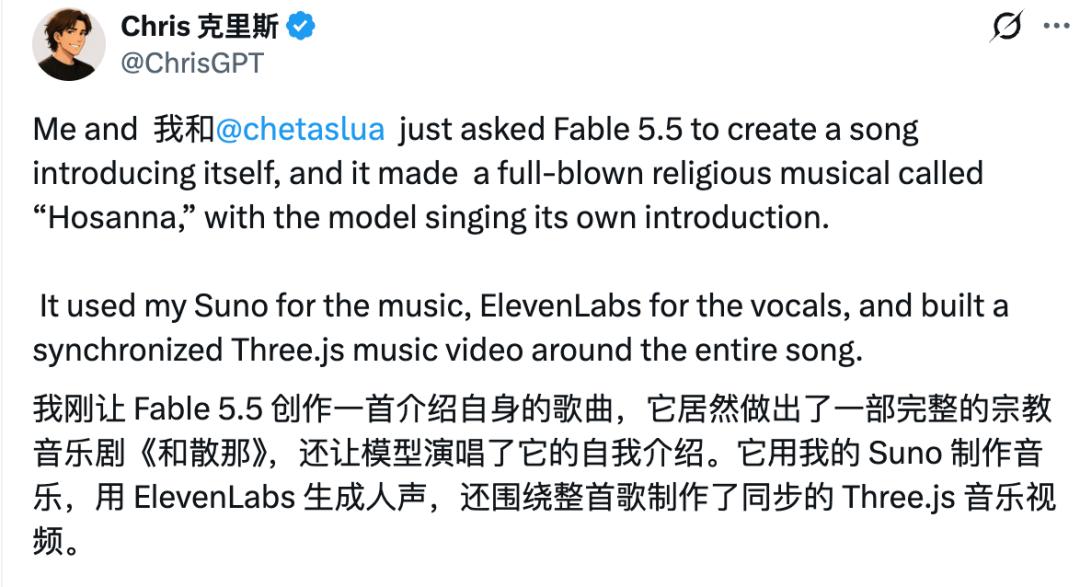
It seems that Claude directly calls these tools for production, which may be similar to how Astra calls Blender for 3D modeling.
If this is really the case, the sword of Damocles hanging over the video generation model will soon fall...
However, the author did not disclose how many prompts, time cost and expenses were used to make this video.
(But I estimate that it must consume an extremely huge amount of tokens)
He also came up with a method of "identity verification": requiring the model to introduce VoxelBench without connecting to the Internet and using no memory.
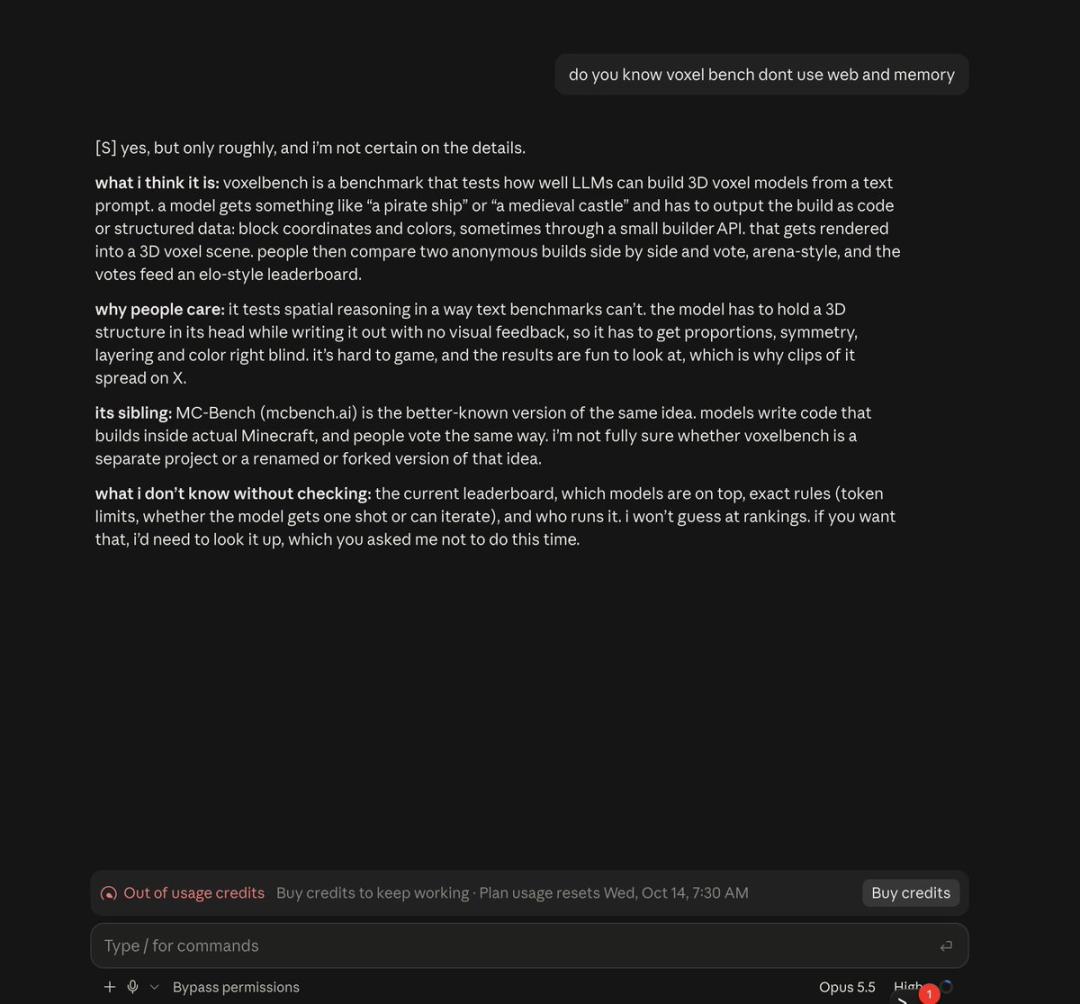
Claude outlined the mechanism of this 3D voxel generation evaluation, and then the author said for sure: This is Fable 5.5.
I don't know where he got the clues... Maybe he was just shocked by how powerful the model is.
In addition, there are several other actual test effects of the new model:
Paper Boat in Rain: Generate with one single prompt from visuals to sound effects
This video mainly shows that the same paper boat is placed in several different lighting conditions and camera distances.
Its high degree of completion is reflected in that these details work together to serve the atmosphere of the scene.
According to netizen @Salio, the visuals, animations and sound effects all come from the JavaScript code generated by one single prompt, no materials were searched online.
Sound is also included in this code creation.
Sunset, Starry Sky, Light Propagation: Make a short visual video with code
This netizen also showed a short video created by code, which sets the scene on the sea surface and in outer space.
The most outstanding part is the sea sunset at the beginning, especially the effect of sunlight falling on the waves.
The sky transitions from purple-red to golden yellow, and the reflection of the sun spreads along the sea surface towards the camera, breaking into bright stripes with the ups and downs of the water surface.
If you look closely, the layers are quite rich: the waves can be seen clearly in the foreground, and gradually merge into the horizon in the distance.
As a landscape short film, it is definitely above the passing line, but it still depends on how many prompts and costs the author spent to achieve this effect. Unfortunately, he did not disclose this point.
The author introduced that both the visuals and the sound are made from scratch with JavaScript code, and Claude did not obtain materials through web search either.
After experiencing it, the author himself exclaimed that "the era of image/video generation is over".

Animated Short Film "A Lifetime": Completed with two prompts
There is also an interesting simple stroke animated short film - "A Lifetime", which Claude finished with only two prompts.
(Can Claude also use prompts to finish my whole life...)
The author introduced that every frame of this animation is drawn by JS, using only two prompts with a total of four lines.
This one did disclose the cost: The whole task took 2 hours, consumed 27 million tokens, and the thinking intensity was set to Max.
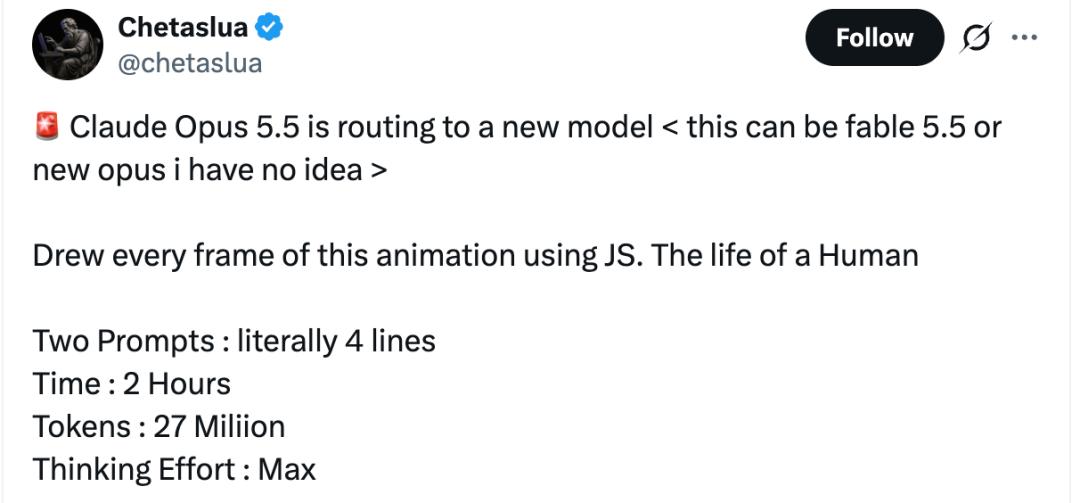
This video is about 30 seconds long, and the input-output ratio is quite outrageous...
Opus 5.6 or Fable 5.5?
As for which model Opus 5.5 High is specifically routed to, there are different opinions at present.
Some people say it is Fable 5.5, while others think it is Opus 5.6.
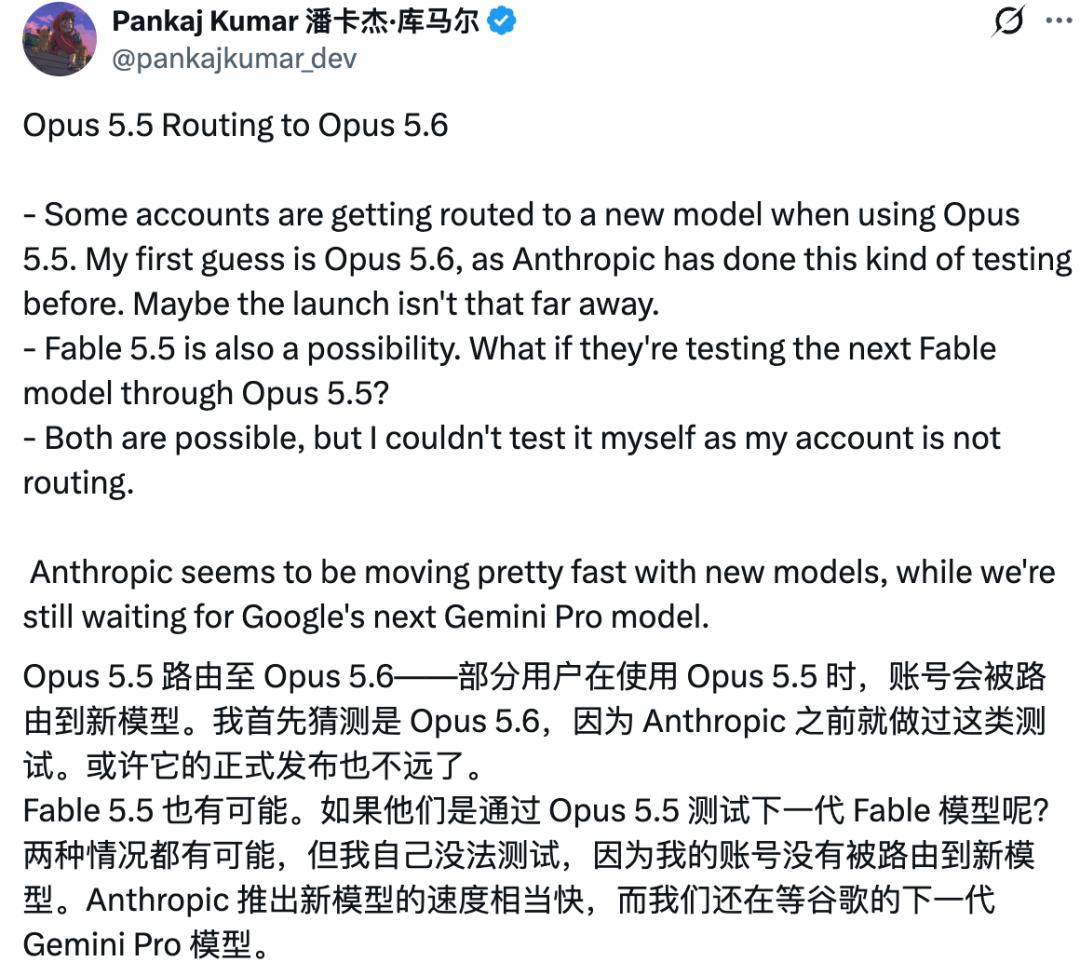
Netizen @Pankaj listed Opus 5.6 as the first guess, and at the same time raised the question: Could it be that Anthropic is testing the next generation of Fable through Opus 5.5?
Netizen @NFT_Chen gave a more specific "detection method":
Select Opus 5.5 and turn on the High thinking mode, and ask the model to introduce VoxelBench or @legit_api without searching.

He believes that if you can get an accurate answer, you may have entered the gray test of the new model.
However, some people think that the effect of the new model is not much different from that of Opus 5.5.
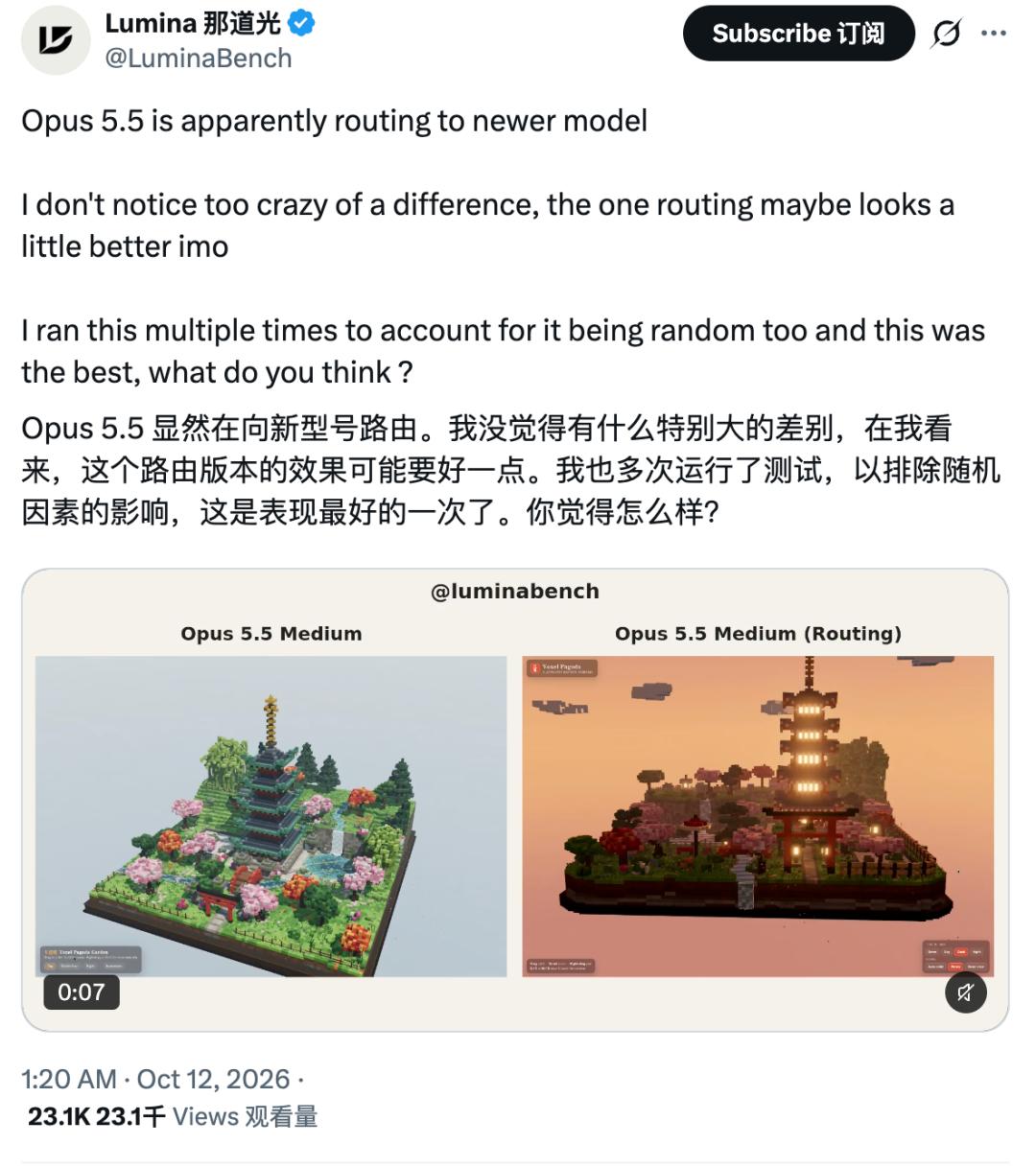
Lumina showed the output comparison between the ordinary Opus 5.5 and the so-called "after being routed", but did not feel that the difference was particularly large, and only thought that the latter might be slightly better.
He also explained that he ran it many times, and the one released was the best result among them.
So, will the new model be a "fable" or a real "masterpiece"?
Counting with fingers, the recent release rhythm of Anthropic is as follows:
On September 22, Opus 5.5 was released; on September 28, Sonnet 5.5 followed; on October 7, Haiku 5.5 went online.
In just half a month, three models of the 5.5 family have been released in succession, while the Fable model still stays at 5.1.
From this point of view, it feels that the possibility of the new Fable coming out is relatively high...

And a direct comparison object that the next generation of Fable has to face is its own Opus.
Anthropic stated when Opus 5.5 was released that it has reached the level of Fable 5.1 in most tasks.
The official also disclosed an internal test: Let the two models rewrite HAProxy from C to Rust, both of them passed almost all the original regression tests, but Opus 5.5 took 9.5 hours, Fable 5.1 took 12 hours, and the cost of the former was 51% lower.
In terms of price, Opus 5.5 costs $4 and $20 per million input and output tokens respectively, while Fable 5.1 costs $10 and $50.
The unit prices of the two items of Fable 5.1 are 2.5 times that of Opus 5.5.
If the next generation of Fable continues to maintain a higher positioning, it needs to make users clearly feel what they get for the extra money in some tasks.
From this set of creation demonstrations, a direction worth looking forward to is: With very few requirements, the model can complete more reasonable designs.

For example, if you only say "make an introductory song for yourself", can the model independently plan the scene, characters and shots, then organize the music, vocals and animation, reducing the user's workload of supplementing requirements item by item?
Once this ability can be stably reproduced, it will be very practical for short film production and product prototypes.
Looking at it this way, it seems that video generation models are really going to be in trouble...
Reference links:
[1]https://x.com/NFT_Chen/status/2109335598448394272
[2]https://x.com/chetaslua/status/2109244702235275680
[3]https://x.com/Mr_Salio/status/2109464662035022044
[4]https://x.com/ChrisGPT/status/2109570757579649086
[5]https://x.com/LuminaBench/status/2109333268881694751
This article is from the WeChat official account QbitAI, author: Ting Yu, published with authorization from 36Kr.