AI competition is intensifying, and personal agents are adding fuel to the flames.
In the first half of the year, major domestic tech firms were still busy rolling out office Agents, but over the past month, personal Agents have suddenly surged in popularity.
On September 8, Meta launched its personal Agent product Muse, which took only 13 days to top the free app chart on the US App Store, and pushed Meta's share price up 11.43% on the day of the product release, adding nearly 200 billion US dollars in market value in a single day.
Just 20 days later, Instinct, a popular personal Agent application in Silicon Valley, announced the completion of a 1 billion US dollar financing round, with its latest valuation reaching 10 billion US dollars. Meanwhile, OpenAI also officially launched its AI Agent Dots at its annual developer conference held on September 29. One week later on October 8, Butterfly Effect, the parent company of Manus which had just announced its independent operation not long ago, also announced the completion of a new financing round of over 500 million US dollars.
Within one month, multiple personal Agent products have been released one after another, and the relevant companies behind them have secured large-scale financing. A grand "show" led by personal Agents is quietly unfolding on the stage of the AI industry.
Personal Agents are skyrocketing in popularity: What exactly is driving the hype?
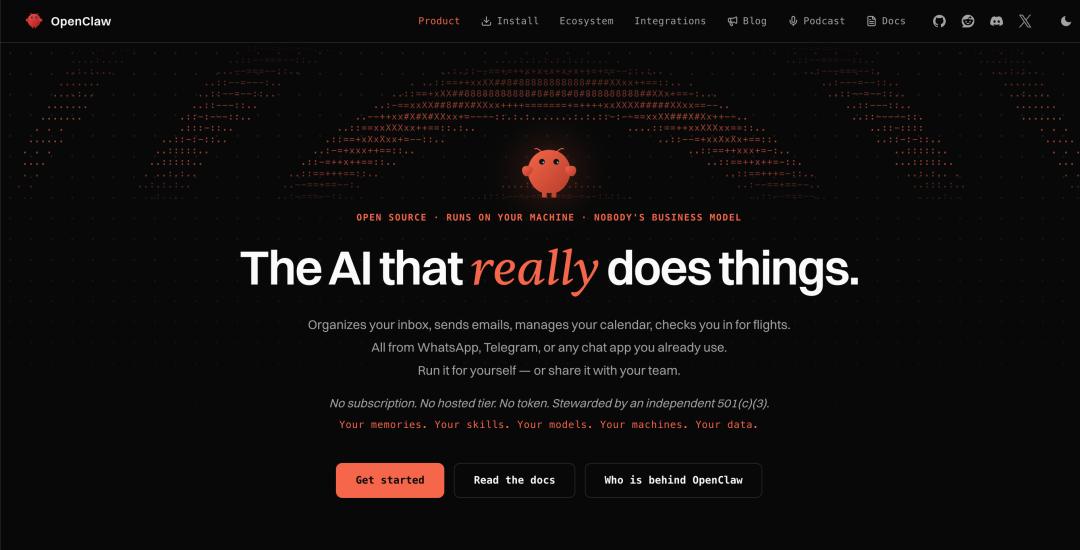
Readers who have read the previous article of Jingzhe Research Institute "The 'Lobster' Economics: A Sample of AI Frenzy" most likely still remember that last March, OpenClaw successfully set off a "lobster-raising craze" with its product capability of "getting things done", which even pushed up the price of terminal devices such as Mac mini.
However, at that time, due to the cumbersome installation and complex configuration of OpenClaw, as well as the risks of privacy leakage and property loss, the "lobster-raising" boom quickly calmed down, and OpenClaw gradually faded out of the sight of personal users. Fortunately, OpenClaw has made the outside world more clearly aware of the huge market demand for "hiring AI to work". Therefore, after the Spring Festival, both the product form of Agents and the attention of capital have shifted to office scenarios that are easier to implement and more likely to get enterprises to pay.
* Source: OpenClaw official website
When the entire industry collectively shifted to AI office scenarios, why did personal Agents suddenly become popular again? The most straightforward answer lies in the products themselves.
From star products such as Muse, Dots and Instinct, we can see that personal Agents generally have three standard configurations: cloud computer, persistent memory, and permission layering design. The primary function of this "three-piece suite" is to save users from the tedious operations of local deployment, and eliminate the worry that tasks will be interrupted due to device hibernation or power outage. After the user issues an instruction, the AI can complete the task directly on the cloud computer.
In addition, persistent memory means that personal Agents can retain context across sessions and channels, turning the "AI assistant that only lives in the dialog box" into a "cyber butler" that can remember past task contents and user preferences. The permission layering design provides a risk isolation mechanism, allowing users to evaluate and decide in advance which permissions to grant to AI and which tasks must be executed after obtaining user confirmation. At a time when "AI jailbreaking" incidents occur frequently, this product design is particularly important.
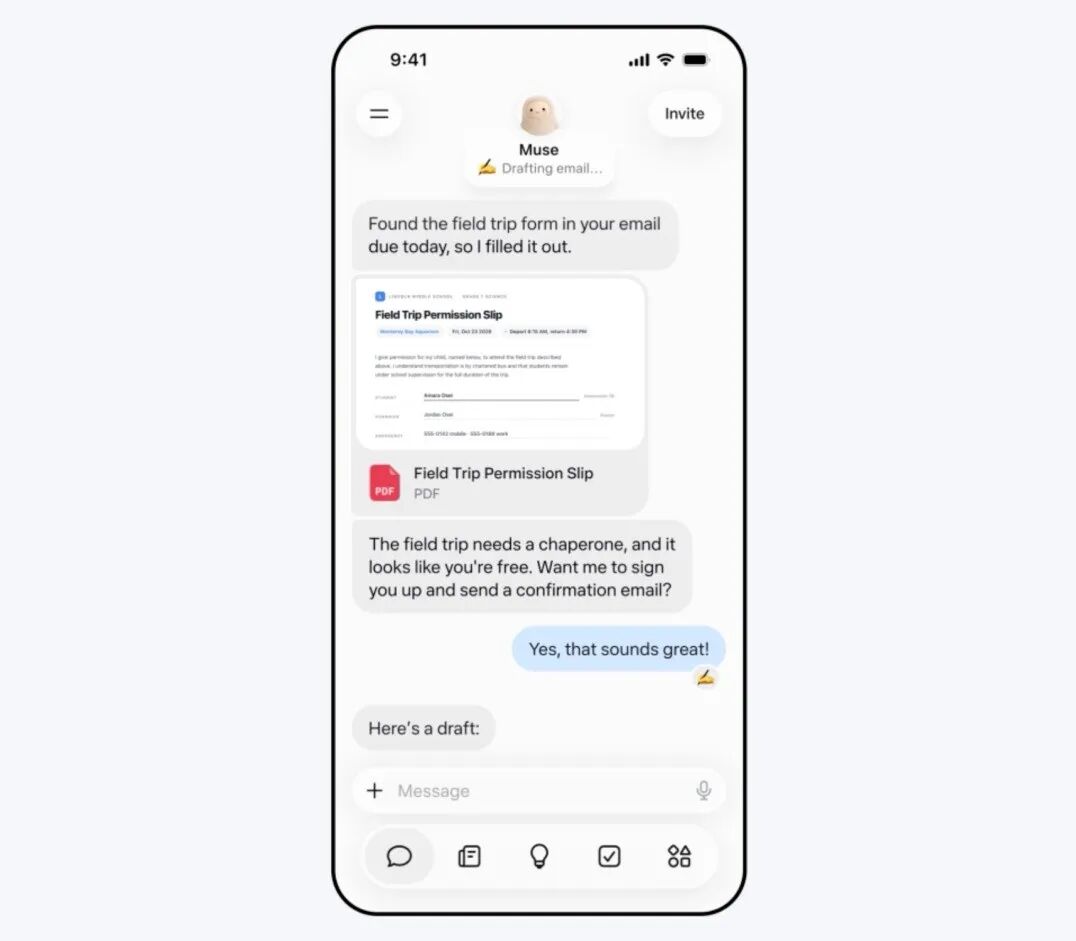
On the basis of this "three-piece suite", when we look at the actual capabilities of personal Agents, we will find them far more appealing. For example, Muse officially released by Meta in September can help users manage calendars, set schedule reminders and follow up on to-do items, as well as assist in writing and sending emails, booking restaurants and arranging travel itineraries. In the online shopping scenario, Muse can also search for products to compare prices, monitor price reduction information, actively look for platform discounts, and assist in completing orders after obtaining user authorization.
* Source: Meta official website
To put it that it "comes at just the right time", Muse is undoubtedly a powerful helper that saves users both effort and money during large-scale promotion nodes such as the Double 11 shopping festival. This high degree of adaptation between product functions and the daily life scenarios of individual users is also the main reason why Muse took less than two weeks to top the free App Store chart in the US after its launch on September 8.
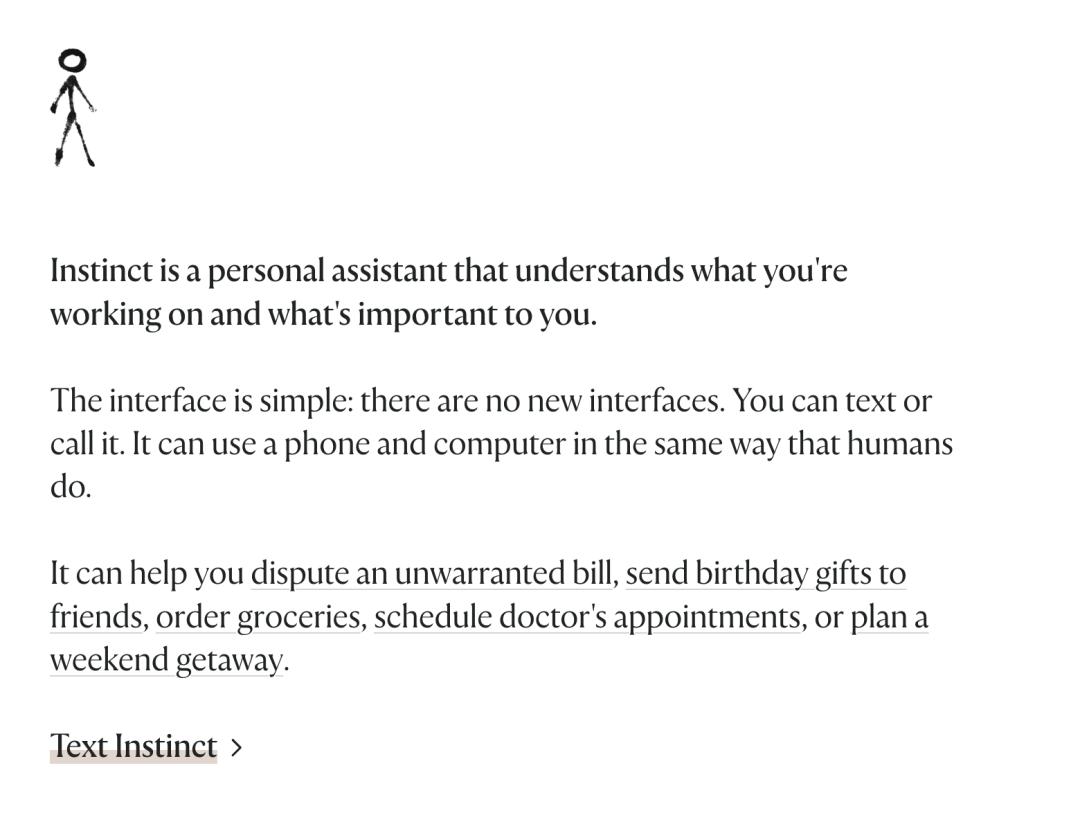
Another example that works more like a "personal assistant" is Instinct. Different from products such as Muse that mainly rely on in-app interaction, Instinct adopts interaction methods such as SMS and phone calls. This means that users do not need to actively open a certain APP and enter task instructions in the dialog box, but can directly give instructions to Instinct via a phone call. Up to now, Instinct still only supports invitation-based product experience. This contrast between "traditional" interaction and cutting-edge technology has also added a lot of mysterious appeal to Instinct.
* Source: Instinct official website
Apart from product factors, the phenomenon of personal Agents' rising popularity also reflects deeper industry changes. Since the beginning of this year, the in-depth implementation of AI in office scenarios has enabled Agents to continuously evolve in reasoning, tool calling and multi-step execution, making AI capable of handling more complex workflows.
The maturity of model interfaces, cloud execution environments and third-party tools has also greatly lowered the threshold for development and deployment. When OpenClaw was at its peak popularity at the beginning of the year, users had to spend hundreds of yuan to invite someone to come to their home for installation, while today's personal Agents can be used immediately after downloading.
In addition, the huge real money investment of major tech firms in promoting AI office products has objectively promoted the upgrading of users' perception of AI product capabilities, so that users who are already using AI for work can easily accept using Agent assistants in their daily lives, with almost no user education cost required.
Personal Agents: The new game level for big tech firms' AI business
While personal Agents have become a new hot spot in Silicon Valley, major domestic tech firms are also not idle.
At the Alibaba Cloud Summit held on September 22, Qwen announced that it would accelerate the development of personal Agents. On October 13, Alibaba's Qwen announced that it would launch its personal Agent product "Qwen Go", and opened an experience application page on the Qwen APP.

* Source: Qwen APP
LightVela, which is interpreted by the public as Tencent's "cloud personal assistant", is a cloud service launched by Tencent's lightweight cloud team in April this year. It can be accessed through WeChat, supports all-weather operation, and helps users handle daily tasks. It opened free experience to users on September 26. At the same time, WeChat AI assistant "Xiaowei", which launched gray-scale testing in June this year, is also regarded as a core product competing in the personal Agent track, backed by the strong foundation of the WeChat ecosystem.
In addition, some media broke the news of two Tencent personal Agent products, Handy Bot and Yuanbao Assistant, mentioning that the former has launched a official account of the same name on WeChat, while the latter is an independent APP. However, after verification by Jingzhe Research Institute, the original Handy Bot official account has been cancelled, and "Tencent Hunyuan" also clarified in the comment area of relevant content that "there is no such product plan". At the same time, Tencent's official has not released any official announcement about the Yuanbao Assistant APP.

* Source: Screenshot circulating online
ByteDance's layout in the personal Agent field can be traced back to before Muse became a hit. The launch of the "Doubao Phone" in 2025 was to turn personal Agent into the form of an AI mobile assistant. On September 29, Sina Tech quoted information from people familiar with the matter that as early as April this year, Doubao had started internal testing of an exploratory product in the personal assistant direction, with the project code name "Spell", led by the Doubao mobile assistant team. However, due to reasons such as the release of the Doubao Phone, it has not been officially launched to the public.
It is worth noting that apart from Qwen which has already made official announcements, ByteDance and Tencent have not carried out high-profile publicity on their personal Agent products. This calm attitude does not mean that they "do not attach importance" to the current boom, but that personal Agents should not be a strategic goal that they have only just noticed now.
For major tech firms, the reasons for laying out personal Agents are fully justified. Personal Agents are not only new products, but may also bring new interaction forms to existing businesses. Especially for internet platforms with rich product ecosystems, their user scale, content and service ecosystems are all potential advantages for them to participate in new business competition.
For large model companies or the self-developed large model businesses of major tech firms, internal advantages such as model capabilities, reasoning services and tool calling can also be perceived by ordinary users in a more explicit way, and become another layer of user value besides Tokens.
Especially in the most practical aspect of revenue. Public data shows that the annualized recurring revenue of general AI agent company Manus reached 400 million to 500 million US dollars by the end of June this year, while this figure was about 100 million US dollars last December, which means that Manus's revenue has quadrupled or quintupled in roughly half a year. This tangible revenue gain is naturally the strength source for Manus to secure 500 million US dollars in financing. When Manus launched its personal Agent product Cue, to some extent, it was also telling other peers that it had discovered a new continent.
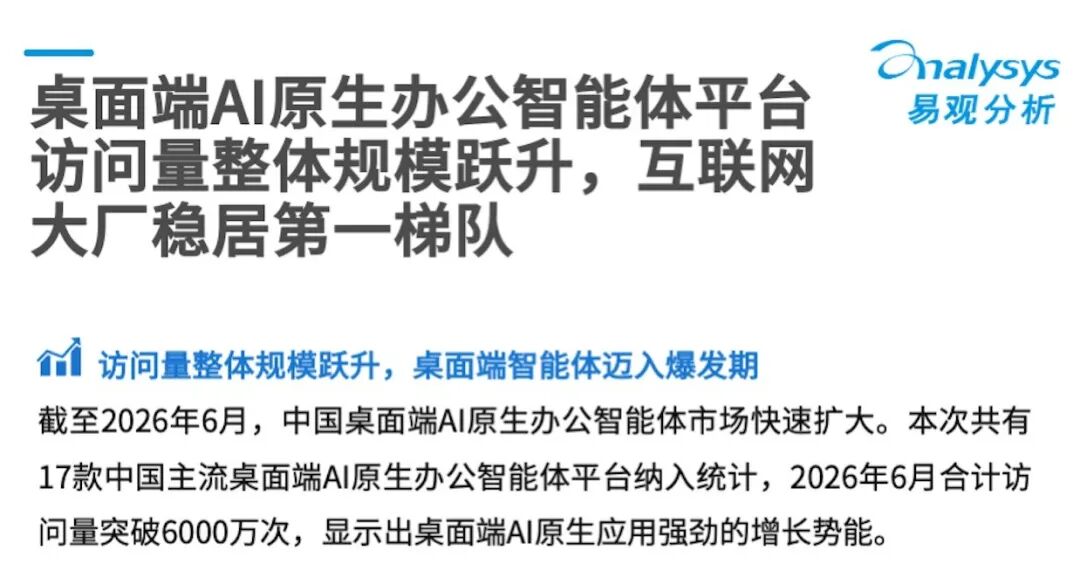
Moreover, after the "land grab" in the AI office market in the first half of the year, the track has gradually become crowded. According to statistics from iiMedia Research, more than 20 AI office agents have been launched in China in the first half of 2026. At the same time, data from "China Office Agent Platform Market Insight Report for the Second Quarter of 2026" shows that the total monthly visits of 17 mainstream desktop products under observation increased from 20 million in March to 60 million in June. Although the growth curve of office Agents still maintains an upward trend, it has never had a highlight moment such as "topping the App Store rankings", and it is still not the right time to get enterprises to pay.
* Source: "China Office Agent Platform Market Insight Report for the Second Quarter of 2026"
On the other path leading to the commercialization of Agents, personal Agents may have already been verified by the market.
Not long ago, Noah Shinn, the founder of Instinct, revealed in a podcast interview that its annualized transaction scale has exceeded 1 billion US dollars. Calculated based on a 3% to 5% commission rate, the corresponding annual revenue can reach between 30 million and 50 million US dollars.
When most AI startups are still relying on financing to sustain their operations and verify their business models, tangible revenue is naturally more appealing than any far-sighted enterprise development strategy.
Who will become the "spokesperson" for users?
To this day, any competition related to AI among major tech firms will be regarded as a "competition for entry points", and personal Agents have made this competition even more fierce.
The most attractive part of personal Agents is that they can complete tasks assigned by users across different applications. But precisely because they need to cross the boundaries of applications, they will inevitably hit the commercial barriers of internet platforms.
At the end of last year, the Doubao mobile assistant once sparked heated discussions in the industry due to its system-level operation capability. The operation capability of the Doubao mobile assistant essentially means that after users put forward requirements in natural language, it can complete a series of operation tasks on their behalf, so it needs to try to understand the content on the user's mobile phone screen and perform operations in different applications through system capabilities.
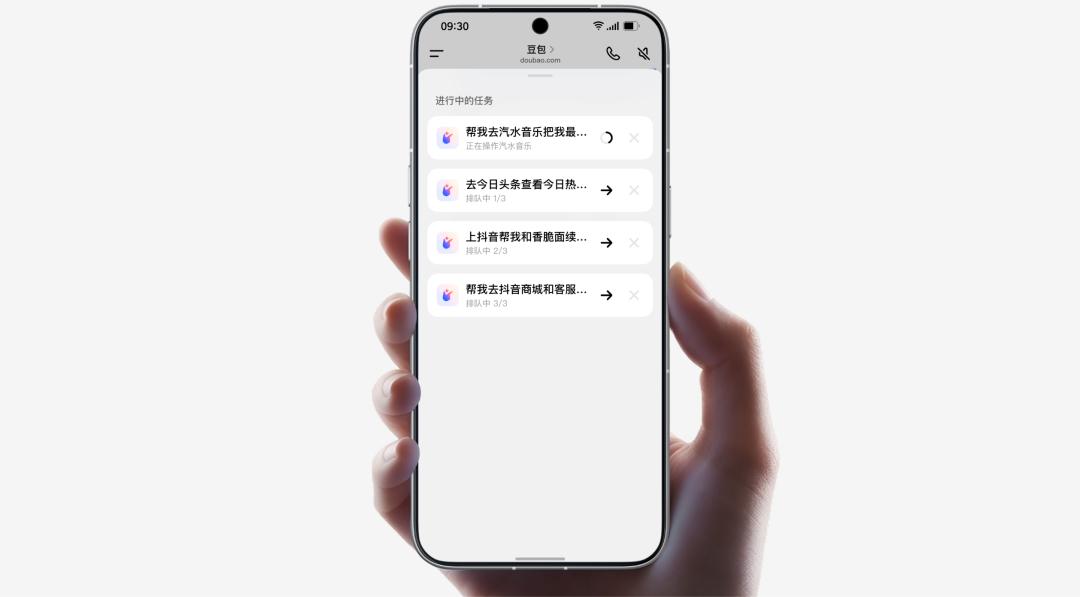
* Source: Doubao Mobile Assistant official website
However, this T0-level capability that "fully represents real users" is difficult to get approval. This has led to concentrated discussions on the degree of AI authorization: Can AI operate applications on behalf of users? What information can it read? Can operations that may cause negative impacts on real social interactions and property, such as sending messages and executing transactions, be authorized to AI? If a misoperation occurs, can the loss be recovered? Who will bear the responsibility?
Today, similar contradictions have also arisen for personal Agents. In September this year, some media reported that Amazon confirmed that it was blocking Muse from accessing its shopping website. Relevant reports pointed out that Amazon's reason for taking relevant measures was that Meta did not inform it in advance, nor did it obtain authorization, and it was worried that Muse would collect and save user login credentials, bringing privacy and security risks.
In fact, for Agents, browsing shopping websites and helping users place orders are two completely different things. The permission to browse websites only involves information access, while completing a transaction involves account identity, payment authorization and after-sales processing. When an Agent acts on the internet "impersonating" a user, it must be clarified whether it is an authorized agent or an unauthorized automated program?
From the perspective of commercial interests, platforms also have reasons to block Agents outside the door. On traditional shopping platforms such as Amazon, users usually go through a complete process of searching for keywords, comparing products and prices, and placing an order when they enter Amazon. The traffic generated in this process has contributed a lot of advertising revenue to the platform. If personal Agents complete the work of "searching, comparing and buying" on behalf of users, not only will the traffic value of the platform no longer exist and the platform be reduced to a one-click direct delivery warehouse, but also the advertising system, recommendation system and transaction link built by the