Is the first "mine" of AI credit about to explode?
Last night, when the US CPI data dominated the headlines of mainstream financial media, what Wall Street professionals truly cared about and feared was something else:
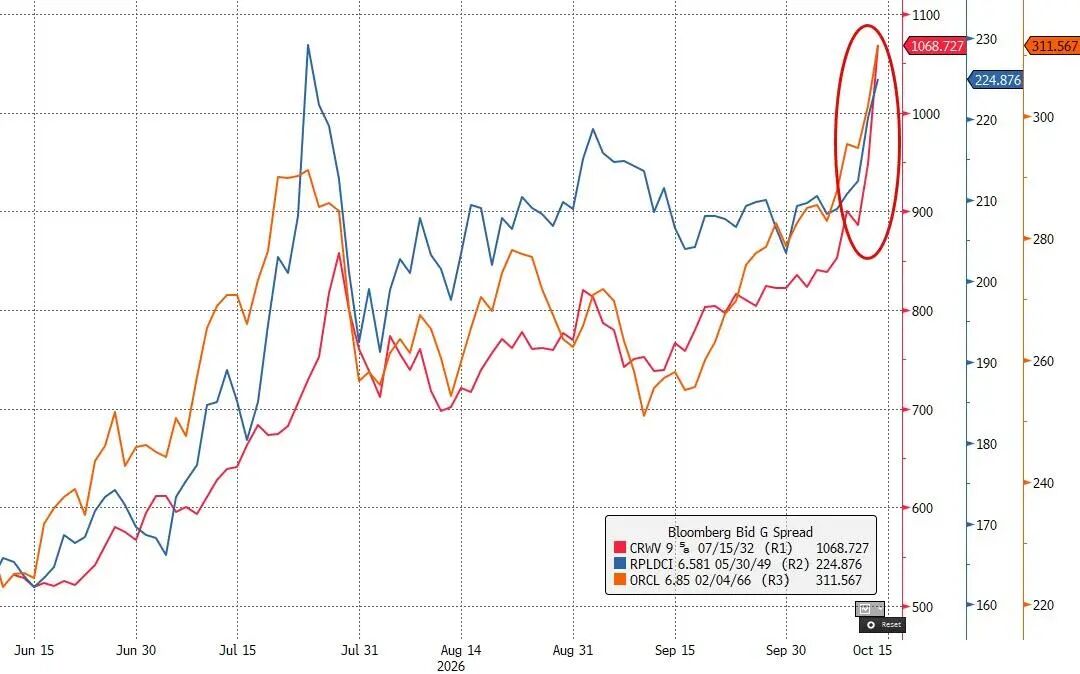
The credit market forecasts that CoreWeave's 5-year default probability is as high as 63%...
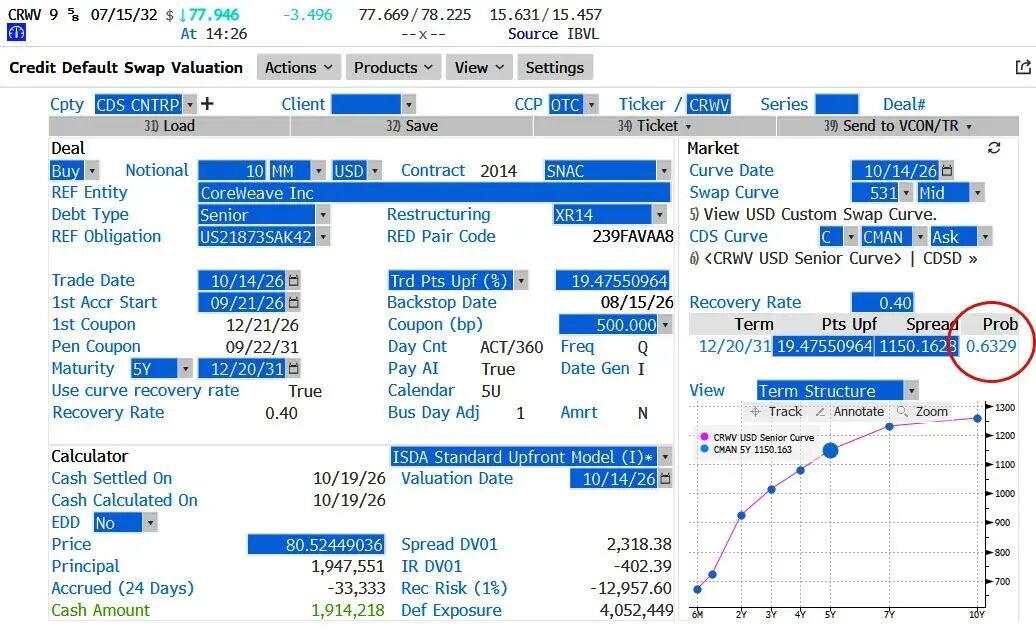
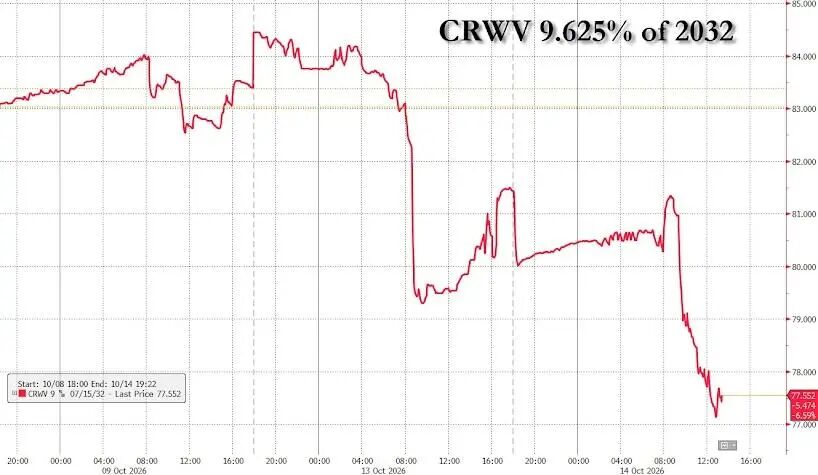
On Wednesday, CoreWeave's bond prices quickly fell to levels that usually signal financial distress, drawing immediate attention from Silicon Valley leaders including Elon Musk and Chamath Palihapitiya.
Quotes from the Trace platform show that the AI cloud computing service provider's 2032-maturity unsecured bonds fell below 80% of their face value on Wednesday. At this trading price, the bond yield exceeds 15%. After Palihapitiya first mentioned this figure, Musk directly responded on social media platforms that it was "terrifying".
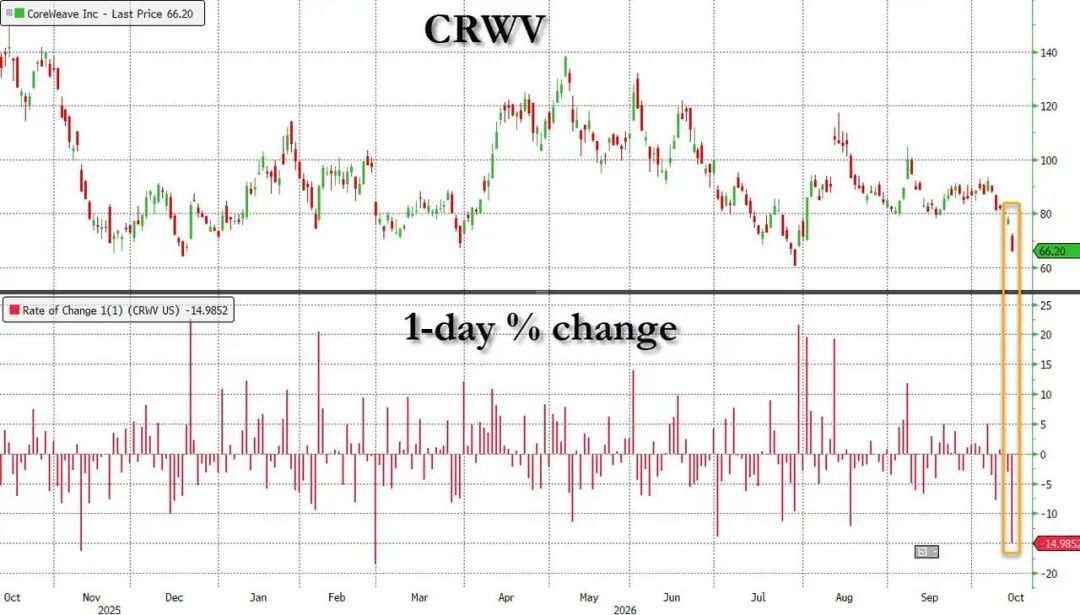
CoreWeave's stock price also took a heavy hit on Wednesday, plummeting 15.5% for the whole day.
CoreWeave Sparks "Zero-Value" Panic
Headquartered in New Jersey, CoreWeave is regarded as one of the earliest "new cloud" enterprises, a group of cloud computing service providers focused on the booming AI market.
The company's business is capital-intensive and highly dependent on the high-yield bond market to fund its expansion. In recent months, CoreWeave has had to pay higher borrowing costs to secure financing.
DA Davidson analyst Gil Luria previously called CoreWeave a "subprime-like" target in the AI sector. On Wednesday, he warned in a podcast that if the AI financing boom fades and CoreWeave is unable to service its high-interest debt, its stock price could fall to zero.
Luria said that by borrowing at such a high interest rate, CoreWeave is "destroying value at every step".
What raised the alarm for Luria is that he found CoreWeave's borrowing cost is as high as around 9%, but its return on investment is only a mere 1%. Even if it reaches the 4% to 5% target return rate set by the company he mentioned, it still cannot cover its financing cost.
He compared this to taking out a loan at a 9% interest rate to buy US Treasury bonds with a 5% yield, and bluntly stated that this strategy is purely value-destructive.
"Borrowing at extremely high interest rates to build increasingly homogeneous data centers outside of hyperscale cloud providers may ultimately not be a good investment," he continued. "The higher the leverage we use to build data centers, the greater the risk we bring to the system."
Jordan Chalfin, an analyst at research firm CreditSights, also said that CoreWeave is indeed "extremely creative" in its financing methods, but investors are deeply concerned about the maturity mismatch between its long-term data center leases and customers' short-term contracts.
"Once there is overcapacity in computing power, what reason do customers have to renew their contracts with CoreWeave?" he asked rhetorically.
At present, the company is seeking lower-cost financing from insurance institutions to continue expanding its artificial intelligence infrastructure. As of the end of June, its total consolidated debt and lease obligations have reached about $520 billion. Visible Alpha market consensus forecasts show that the company's cumulative negative free cash flow between 2026 and 2028 will reach an astonishing $710 billion.
But the problem is that since the yield on its unsecured bonds has already broken through 15%, the company simply cannot find cheaper capital than its existing capital structure — unless it files for bankruptcy protection and carries out a "debt-to-equity swap". When that time comes, the new debt cost of the restructured company will indeed be much lower.
In the past week, the yield of one of CoreWeave's bonds maturing in 2032 has surged by a total of about 150 basis points. Many industry insiders added a rather "thoughtful" comment at this time: once a strict debt restructuring is initiated, creditors will be paid before shareholders — yes, in industry jargon, this is called "Chapter 11 bankruptcy protection".
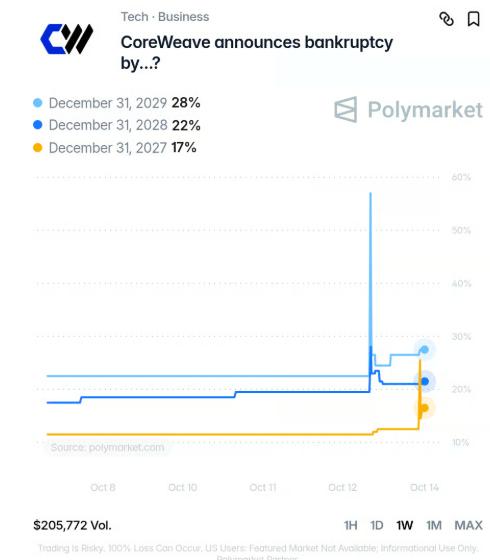
Judging from market pricing, that day is approaching at an accelerating pace. It is worth mentioning that on the prediction market Polymarket, traders are currently betting that the probability of CoreWeave declaring bankruptcy before December 2027 is 17%; and by 2029, this bankruptcy probability will rise to 27%.
Has the Credit Market Smelled the Crisis in Advance?
At the same time, signs of pressure in the US high-yield junk bond market are increasingly intensifying, and AI-linked lending is coming under increasingly strict scrutiny recently.
Craig Manchuck, a bond portfolio manager at Osterweis Capital Management, said in a phone interview that CoreWeave is a "barometer of AI market sentiment". He said the sell-off in its bonds "shook the market a bit today", raising concerns that the company may have borrowed too much too fast and faces the risk of running out of further financing space to support its AI ambitions.
Stephanie Link, Chief Investment Strategist and Head of Investment Solutions at Hightower Advisors, said junk bond traders often "smell problems much earlier than the stock market". She said most of the current rifts are "confined" to the most vulnerable borrowers in the junk bond space, but "I am definitely keeping a close eye on this situation."
In recent years, AI companies have flocked to the bond market to raise funds for the AI boom, including both investment-grade borrowers and high-yield borrowers. The rise in US Treasury yields has fueled concerns that more signs of stress may emerge in the credit market.
Bonds rated CCC in the junk grade zone (the lower tier of junk ratings) have recently suffered a sharp sell-off. Concerns about weaker borrowers are reflected in credit spreads, the extra compensation investors get on CCC-rated bonds relative to prevailing Treasury rates. According to data available via FRED, the spread jumped to 1267 basis points over US Treasury yields on Tuesday, up from 904 basis points in early May.
According to Dow Jones Market Data, on Monday, the cost of five-year default protection for CoreWeave's debt rose to nearly 881 basis points from about 547 basis points at the end of June. This figure is based on credit default swaps (CDS), a type of derivative contract that investors buy to hedge against default risk. Such contracts become expensive when a borrower is seen to have an increased risk of default.
It is quite thought-provoking that CoreWeave co-founder Brannin McBee tried to "put out the fire" of this crisis on Wednesday.
In an interview, he expressed a view completely different from the market: "I don't find those debts scary at all," he argued, saying that taking on debt allows CoreWeave to expand at a faster pace.
McBee insisted that these huge expenditures reflect business expansion, not weakness in existing operations. "If we stop expanding today, the company's cash flow will immediately become extremely abundant," he said.
However, these remarks inadvertently exposed the biggest soft underbelly of the entire AI bubble: once "expansion" stops, this game is completely over... Therefore, no company dares to hit the brakes. Everyone would rather desperately increase leverage and take on as much debt as possible, just to postpone the doomsday that will eventually come when expansion has to stop.
Obviously, not everyone is waiting around to see if the short sellers' predictions come true: according to data from S&P Capital IQ, CoreWeave's three co-founders have cashed out about $2 billion in stocks this year.
CoreWeave explained that the founding team is only diversifying their personal wealth, and the vast majority of their net worth remains in CoreWeave's stock.
"We could have bought a ranch and retired to enjoy life," he said, "but as you can see, we still come to work every day and devote all our energy to this business."
In response, the well-known financial blog site ZeroHedge said, "For now... that is indeed the case, because the bond market still allows you to come to work every day. Once the bond market cuts off the blood supply, we sincerely hope that McBee's ranch has been dug with a wide enough moat to protect him from the siege of angry shareholders."
This article is from the WeChat official account "CLS.cn", author: Xiaoxiang, published with authorization from 36Kr.