AI helped me arrange for five strangers to join me for drinks.

Text | Liu Sijie
Editor | Zhang Wei
Cover Source | Table for Six
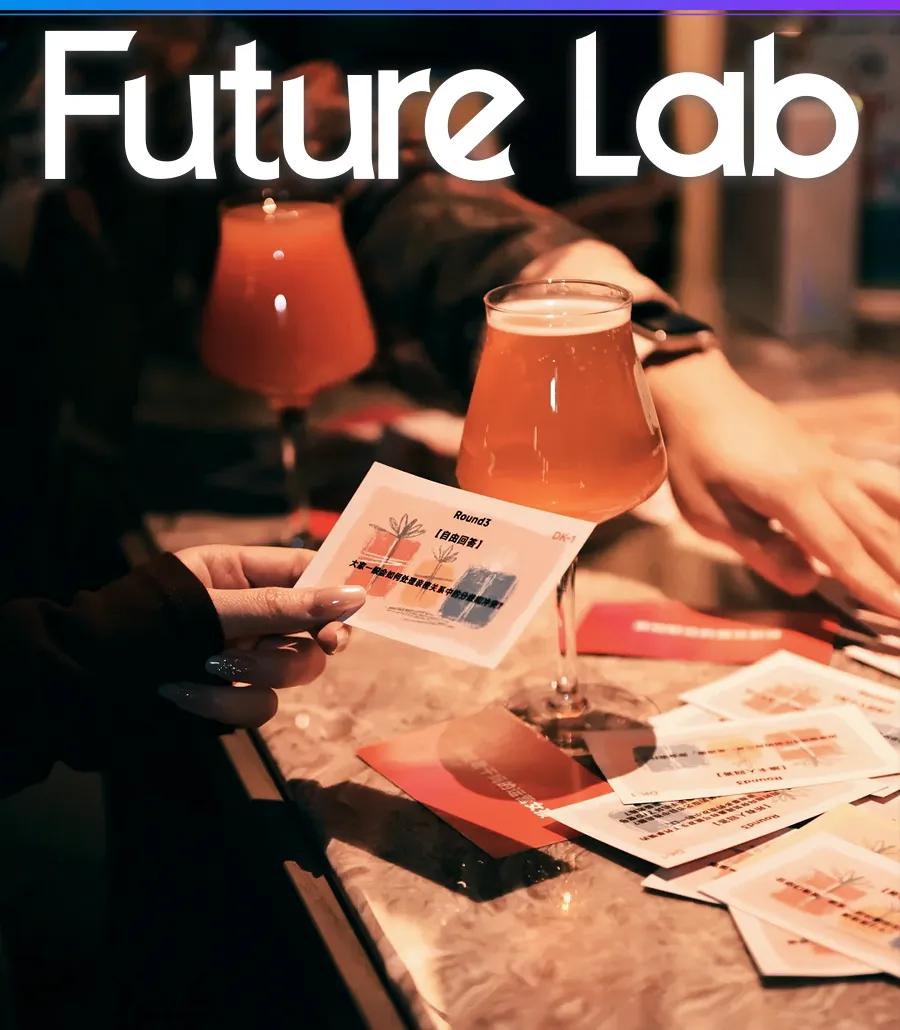
One weekday evening, I was going to sit and drink with five strangers.
Before setting off, I had no idea who they were or where I would go. Based on the personal information users filled in and their expectations for the activity, Table for Six (hereinafter referred to as T46), an AI social product, judged which six people might "spark some chemistry" — that's how I got five "tablemates".
At the same time, similar meetings were taking place at hundreds of drinking tables in 14 cities across the country.
T46 started operation at the end of 2025. "Future Human Lab" exclusively learned that it has received a total of millions of US dollars in angel round financing from BAI Capital and a game company, and the total number of paying users of the product has exceeded 40,000.
At half past eight in the evening, I arrived at a quiet bar in Chaoyang District, Beijing on time.
There were no devices that looked related to AI on the table, only a set of paper cards. On the cards, more than 30 questions were arranged in order from shallow to deep, including the identity cards of the six participants, as well as the questions each person wanted to ask strangers when signing up.
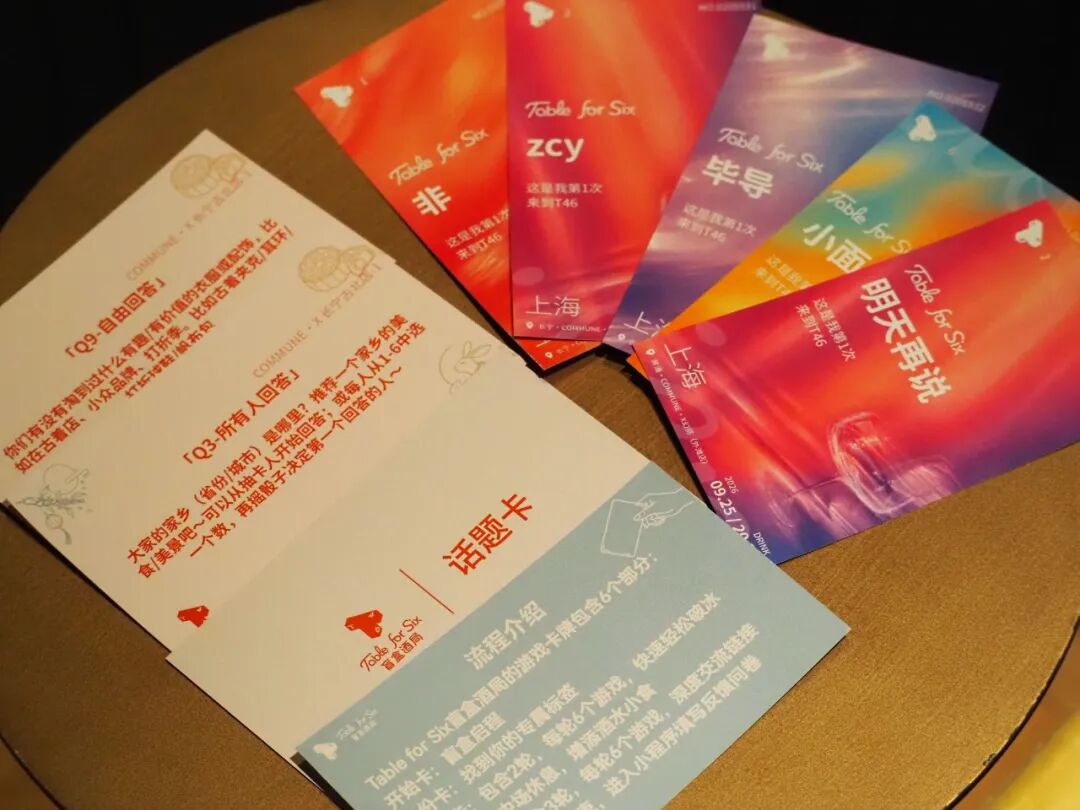
The card deck prepared by T46 for all participants
An outgoing participant who had organized activities before naturally picked up the cards and became the temporary host of the table, organizing everyone to discuss the questions on the cards in turn.
From filling out the questionnaire in the mini-program, selecting personal tags and expectations, to going to the bar for the appointment, I hardly interacted directly with AI during the whole process. No AI avatar greeted strangers for me, nor did an AI strategist teach me how to behave. The product brought me in front of five real people, and then left the rest of the time to humans.
This is different from the direction chosen by many current AI social products. While AI starts to chat for people, provide dating advice, and even intervene in conflict mediation in intimate relationships, T46 seems to have chosen a more restrained position.
But after talking with T46's two founders and investors, I found that AI did not really disappear.
This is a company with only 11 employees, which has to complete personnel matching, venue arrangement, absentee replacement, card production, printing and distribution in 14 cities at the same time. These numerous tedious and error-prone tasks are mainly undertaken by Agents in the background.
In places invisible to users, T46's use of AI can even be described as aggressive.
Before the activity starts, AI understands users, matches tablemates, selects venues, and arranges activity details and processes, but when the real conversation starts, it disappears.

Organizing strangers to drink, is it a good business?
Jeff and Baicai, one is the CEO of T46 and the other is the CTO. The two never planned to start an AI social company at first.
When Jeff and Baicai were at McKinsey, they were colleagues in the same project team. One day in 2024, Jeff called Baicai and said he wanted to start a business, and the two hit it off immediately. Later, they made AI foreign trade products, psychological emotional board games, and drinking card decks.
Because tens of thousands of sets of drinking cards were sold, they opened a pop-up social tavern in Shanghai that only existed for six months. In order to fill the low period on weekday evenings, they posted on Xiaohongshu to organize six-person stranger drinking parties. After several sessions, their own bar could no longer hold the young people who wanted to participate in the activities.
The two realized that this matter "should not serve their own bar", and it might become a larger product.
They decided not to hold activities only in their own stores, but to look for other bars. They found that after changing to another bar, people were still willing to sign up and pay.
Later, the two gave up the bar business and focused their main energy on the six-person blind box drinking parties.
The demand has always existed. Young people in big cities are willing to pay for drinking and eating with strangers. At present, the catering industry is facing difficulties with high customer acquisition costs, and bars and restaurants also need such activities to attract traffic. T46 connects the two and earns a matching difference from it.
Wang Tianfan, senior partner of BAI Capital, compares T46 to early Airbnb: Airbnb connects idle rooms with temporary accommodation needs, while T46 uses activities such as blind box drinking parties to bring people who originally had no plans to go out to bars. Of course, he also admits that the upper limit of this business has not yet been proven. But for an early-stage company, it is already very good that people are willing to pay and participate repeatedly.
But how to keep this business running sustainably and achieve scale?
The traditional way relies on a single organizer to set up parties, which requires the organizer to spend a lot of energy screening people and planning activities, making it difficult to replicate on a large scale.
Around 2010, overseas entrepreneurs tried to turn stranger dining into a platform business, and they once obtained financing. At first, they read users' Facebook profiles, used computers for initial screening, and manually reviewed to match people, select bars and make reservations. Early similar projects such as Grouper once received investment from YC, but after rapid expansion, a large number of non-standard operations increased, and the company eventually shut down.
Now with the emergence of AI, it begins to try to solve the operational bottlenecks that previous generations of products could not solve. The experience that used to exist in the minds of organizers is broken down into questionnaires, matching rules, replacement mechanisms and activity processes, and then handed over to AI to complete. With the help of AI, it can even understand and serve each user better than most traditional organizers.
When I signed up for T46's activity, in addition to filling in information such as age, occupation and interests, I also had to answer some open-ended questions. Jeff told me that AI extracts three key matching criteria from these non-standard answers: what kind of person you are, what kind of person you want to meet, and what you want to talk about.
When six people form a table, the system will also balance age, gender, extroversion/introversion, willingness to express and social energy. Six talkative people will fight for the floor, and six introverts may not speak at all.
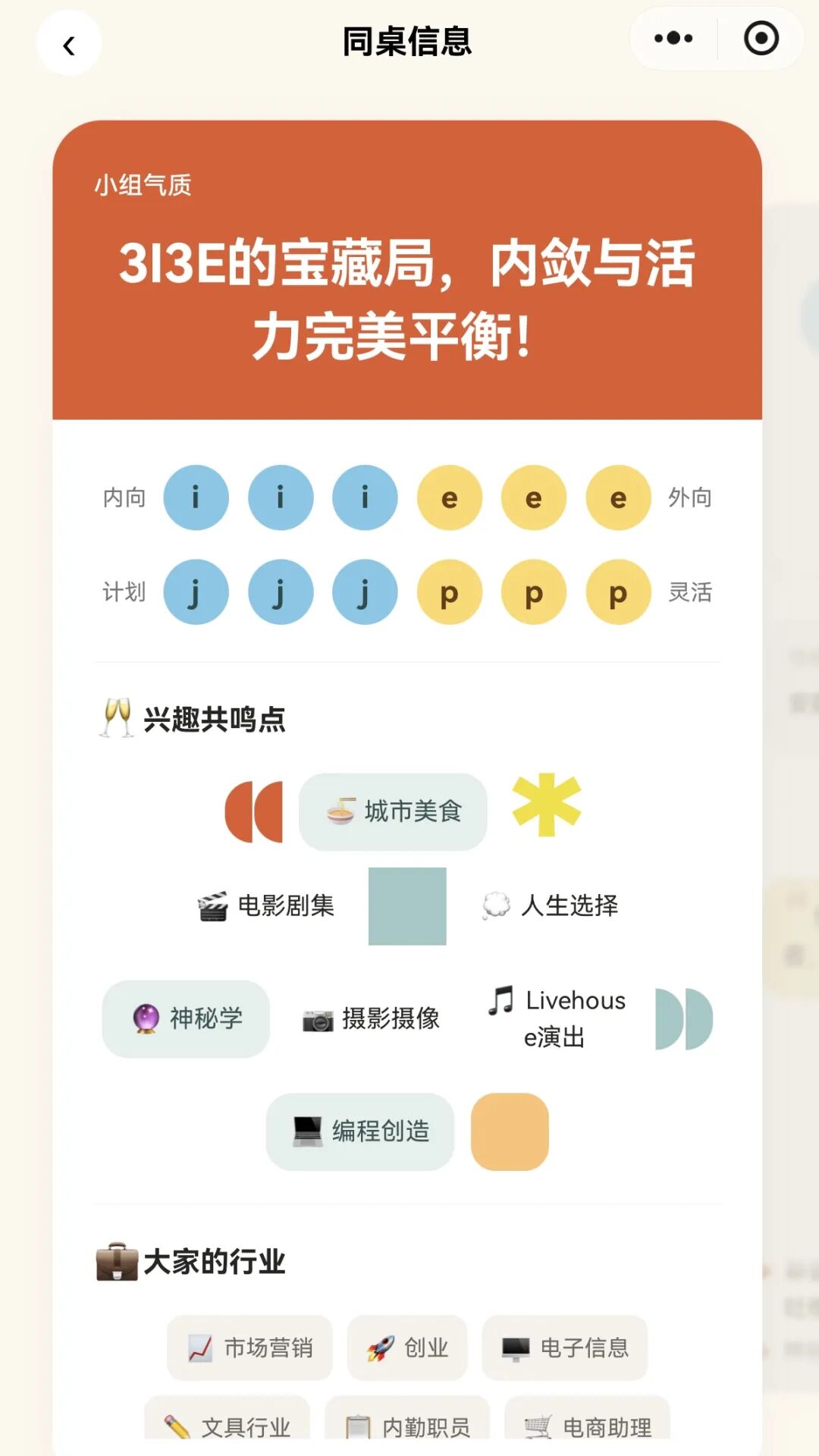
Tablemate matching status
In the activity I participated in, the user who voluntarily took on the work of host was originally the owner of a bar, with an active personality, who always observed the atmosphere on site and guided the conversation. There was also a programmer who often participated in blind box drinking parties, an investor who just came to Beijing to work, a brokerage agent in the entertainment industry who had just resigned, and a girl who came as a substitute because the original registrant did not show up.
There were three men and three women in total. We started chatting according to the order of questions on the cards provided by T46. The first few ice-breaking questions revolved around our hometowns and preferences. Occasionally, some small games were interspersed under the guidance of the cards.
I was not interested in the basic questions on the cards, but I liked hearing everyone's thoughts on some in-depth questions, which was like exploring the inner world of different people.

Cards and pre-simulated conversations
A set of paper cards placed on the drinking table, the conversation between me and five strangers completely depended on it.
After all, six total strangers don't know where to start the conversation, and the cards designed the chat agenda for us.
Baicai is responsible for building the company's AI system and processes. He told me that the content of the cards for different tables will be different, and in addition, each set of cards will have an identity card exclusive to each participant.
This means that before each activity starts, the system has to divide people into tables of six, generate cards separately for each table, send them to the local printing factory, and then deliver the finished products to the corresponding bars.
This sounds like very trivial and messy work.
In traditional activity design, this is a chain that requires a large number of operation staff to keep an eye on. Some people are responsible for arranging tables, some contact bars, some design processes, some send the printed files to the printing factory, and then confirm one by one whether the cards are packed incorrectly and whether the delivery is late, and whether the bar puts the materials on the correct table. Any mistake will lead to the user opening the box and finding that the identity card has the name of someone at another table, which is terrible.
At present, the landing operation of activities across the country is led by COO Brava with three fresh graduates, and multiple Agents participate.
After one Agent and computer algorithm complete the matching for six strangers, another Agent appears, which needs to solve the problem of which bar these six people will go to tonight.
It needs to read multiple groups of constantly changing information at the same time: whether a bar can receive activities on the day, how many tables it can provide, and where the six users live respectively.
After the venue is determined, the system starts to generate card games for this table. It extracts interests, occupations, extroversion/introversion levels, expression and listening tendencies from the six people's questionnaires, as well as how much private information they are willing to expose, and then combines with thousands of seed question banks created by humans accumulated by the team to select and rewrite questions suitable for this table.
The order in which the questions appear also needs to be designed. If the six people are generally introverted or not used to talking about themselves, the safe ice-breaking link will be extended. If the whole table has high willingness to express and "emotional exposure", the cards can enter topics with higher intensity earlier.
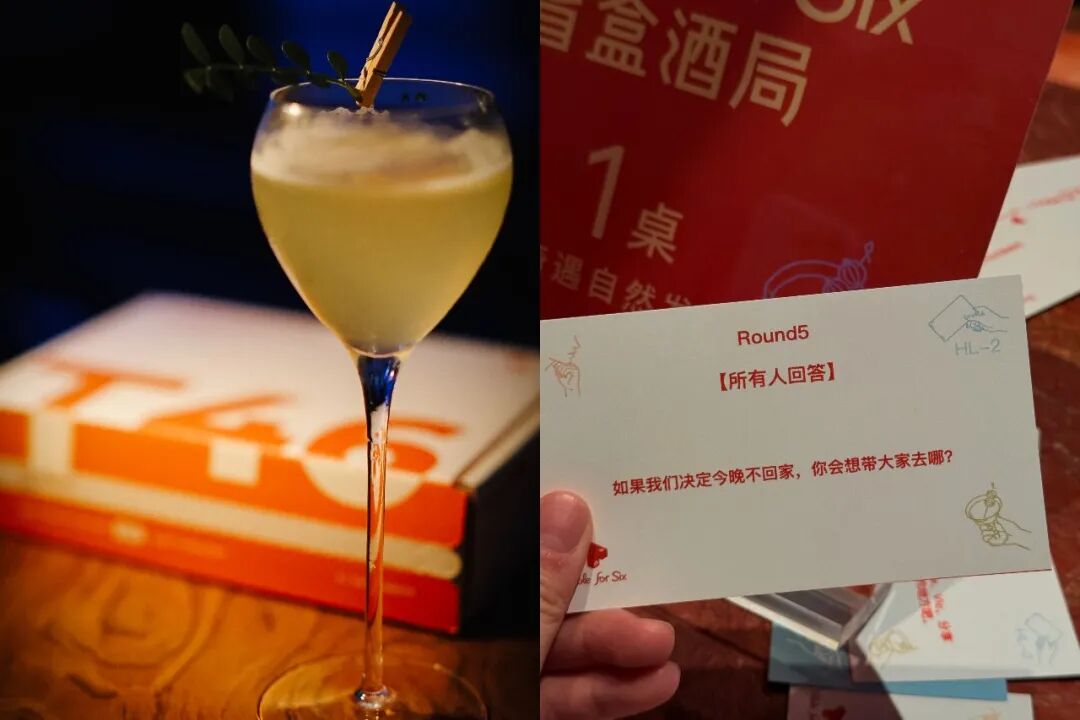
Questions on the cards
Baicai said that when generating the cards, the system will even use six Agents to simulate the six people at the table respectively, preview how they might respond to a question, and what kind of atmosphere the whole table conversation may form.
After the card arrangement is completed, the online system begins to enter the real world.
It automatically generates print files, and Agents send the files of different cities, different bars and different table numbers to the enterprise WeChat groups of the corresponding printing factories, then check whether the printing factory has received the files, confirmed the order, and can produce on time.
The most error-prone part is boxing. Each set of cards and the packaging box have the corresponding city, bar and table number. After the printing factory finishes packing, they need to put the cards and boxes together, take two or three clear photos and send them to the group. The Agent identifies the marks in the photos, checks whether the cards of the first table are put into the box of the second table, and also checks whether the box belongs to the correct bar.
If the verification is correct, the Agent will reply in the group that it can be shipped, and place a flash delivery order at the appropriate time.
This trivial process is basically completely completed by 5 main Agents and their subordinate sub-Agents. T46 has no full-time staff in the cities where the activities are held, and all employees are based in Shanghai.

A "soft-boiled egg with runny yolk"
During the period when I participated in the T46 activity, I also participated in a blind box dinner organized by its competitor. Without cards to guide the conversation topics, the topics were dominated by people who were more willing to share, while quiet and introverted people spoke very little.
This experience is quite different from the T46 conversation guided by cards. The questions on the cards often encourage everyone to answer, and I can hear everyone's views on different questions.
In that blind box dinner without card guidance, the final topic slipped to one person sharing his recent breakup experience, and a part-time matchmaker started to introduce partners to everyone.
In Jeff's vision, this set of cards is just to let everyone break the ice and find topics when there are no topics. He expects that everyone can get rid of this set of cards in the second half and communicate freely.
Essentially, this is human-to-human social interaction. He hopes that everything serves the natural flow of relationships between people.
Jeff loves making friends and has unique observation and grasp of relationships between people. Jeff clearly knows that people who participate in their activities have their own purposes, but the product will not hint or guide users what they can get in the activity, such as hinting that people can find