Transsion's share price fell below its IPO price after listing. Has AI caused Transsion to suffer huge losses?
On October 15, Transsion Holdings, known as the "King of African Mobile Phones", was listed on the Hong Kong Stock Exchange. The opening price was HKD 34.96, 1% lower than the issue price, and it continued to fall after the opening, with the decline once exceeding 7%. As of press time, the share price was around HKD 33.6.
The pricing itself has already explained some problems. On October 13, Transsion determined the H-share issue price at HKD 35.30 per share, the lower limit of the offering range of HKD 35.30 to HKD 38.80. The Hong Kong public offering only received 4.46 times subscriptions. The A-share market reacted earlier. On October 8, the day after the offering price range was announced, Transsion's A-shares fell by 14%, because the H-share pricing was discounted by about 40% compared with the A-share price after conversion. The capital market voted for this secondary listing in advance in this way.
What exactly is the market questioning? Judging from the surface data, Transsion's profit, which was halved compared to last year, has obviously recovered. In the first half of this year, the company's revenue was 35.43 billion yuan, a year-on-year increase of 21.9%, and the net profit attributable to owners of the parent company was 1.77 billion yuan, a year-on-year increase of 46.2%.
The problem is that this round of profit recovery mainly relies on two things: price increases, and low-cost chips stocked up before the price hike. This improvement will most likely only last for one or two quarters. After the low-cost inventory is used up, the gross profit margin will still depend on the price of memory chips.
It is worth noting that AI is the source of Transsion's rising costs, and it is also the main use of this fundraising. According to the prospectus, about 40% of the net proceeds will be invested in AI-related R&D, 30% for marketing and branding, and 20% for mobile Internet and the Internet of Things.
Transsion represents a type of company. Over the past decade, low-price high-volume sales combined with low-cost supply chains is a proven model for Chinese hardware companies expanding overseas, and Transsion has achieved the top mobile phone shipment volume in global emerging markets. Now AI has rewritten the upstream cost rules, and this model has encountered systematic challenges. How Transsion responds is not only related to its own valuation, but also a common challenge for this type of company.
01. Sold less, earned more
In the first half of the year, Transsion's net profit attributable to owners of the parent company was 1.77 billion yuan, a year-on-year increase of 46.2%, but it sold 5 million fewer mobile phones. It sold fewer units but earned more.
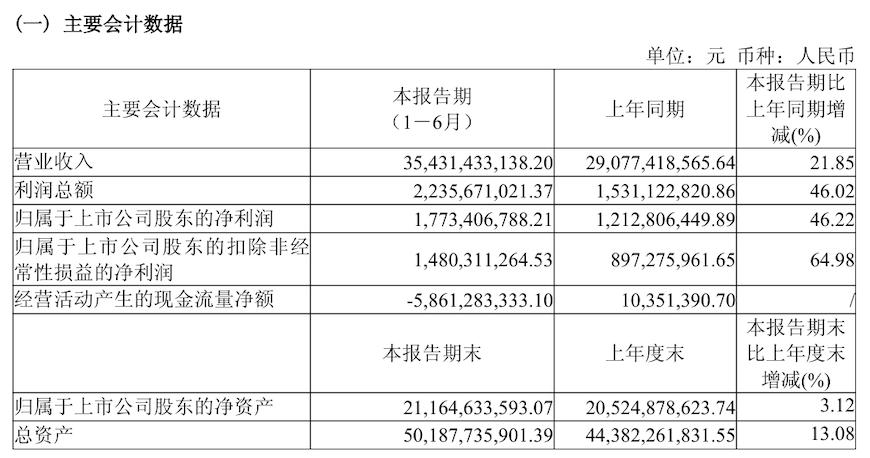
Transsion's performance in the first half of 2026 Source / Transsion 2026 Interim Report
First, look at price increases. The prospectus discloses that Transsion sold 39.5 million smartphones in the first half of the year, while the average selling price increased from 547.5 yuan to 713.4 yuan. The price rose by 30%, the number of units sold decreased by more than 10%, and revenue still grew.
Transsion took two measures. One was to cut low-cost models. The company explained that it actively reduced entry-level models of TECNO and Infinix, and tilted resources to the mid-to-high end. The other was to directly raise prices. The company stated in both the performance forecast and the official interim report that it adjusted product prices according to cost changes and market competition strategies. Third-party data also confirms this. According to Omdia's statistics, the launch prices of new Infinix and TECNO models in the Southeast Asian market in the second quarter were significantly higher than those of the previous generation.
Generally speaking, price increases fall into two categories. One is that brand value has risen, and consumers are willing to pay more. The other is that costs have risen, and the company will lose money if it does not raise prices. Transsion belongs to the latter.
In 2025, Transsion's profit was halved, with the full-year net profit attributable to owners of the parent company reaching 2.581 billion yuan, and shipment volume also decreased by 32.4 million units. When explaining the reasons for the profit decline in the prospectus, the first listed reason was the rise in procurement prices of memory chips. A manufacturer with annual shipments of nearly 200 million units would rather actively cut tens of millions of units of volume, which only shows that at that cost level, low-end phones are almost losing money for every unit sold.
To see how great the cost pressure is, the procurement price of memory is the most intuitive. A person from a memory module manufacturer said that in the first four months of 2026, the average procurement price of Transsion's memory chips was close to 200 yuan per unit, while the full-year average price in 2025 was only about 70 yuan, rising to nearly three times. UBS stated in a report that a 7% price increase for flagship phones can offset the memory price hike, while mid-to-low-end phones need a 17% price increase. For Transsion, a 550-yuan mobile phone has to be sold for more than 640 yuan to maintain gross profit margin, and its actual average price in the first half of the year has risen to 713 yuan.
The second source of profit is low-cost inventory. Transsion's overall gross profit margin in the first half of the year was 22.6%, compared with 20.1% in the same period last year. When explaining the reason for the rebound in gross profit margin, the company mentioned two points: product price adjustment, and historical inventory that delayed the rise in costs.
There is a detail here. The notes to Transsion's interim report state that issued inventory is measured using the moving weighted average method. After newly purchased high-priced chips are put into storage, they are first re-averaged with the cost of old low-priced inventory, and then gradually carried over as mobile phones are sold. To put it bluntly, a considerable part of the mobile phones sold in the first half of the year used chips purchased before the price hike, the selling price is set according to the current level, and the cost is calculated based on the past, so the gross profit margin has risen.
A person from the mobile phone supply chain told "Focus One" that since the second half of last year, mobile phone manufacturers have been snapping up memory chips, depending on who has thicker cash flow and acts earlier.
Transsion also joined the stockpiling, but stocking up takes up cash. In the first half of the year, Transsion's net operating cash flow was negative 5.861 billion yuan, and the extra money spent was mainly used for procurement payments. Inventory even doubled directly from 8.9 billion yuan at the end of 2025 to 18.9 billion yuan, of which raw materials were close to 10 billion yuan, indicating that the increased inventory was mainly materials such as chips. The prospectus also disclosed that inventory fell back to 17.06 billion yuan at the end of August, and the company slowed down the stocking pace in the third quarter.
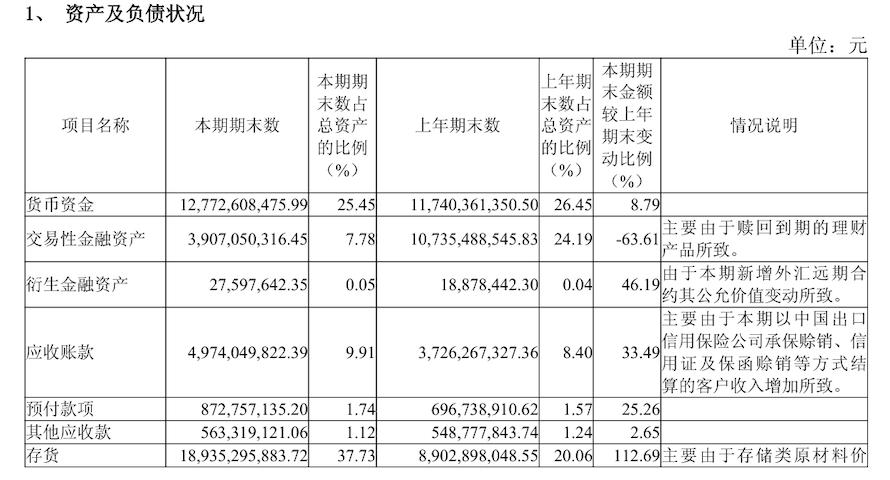
Transsion's inventory status Source / Transsion 2026 Interim Report
Institutions generally judge that memory price hikes will continue until 2027, and stocking up in advance is a correct move. The risk lies on the demand side. Ade, who has been doing mobile phone wholesale in Nigeria for many years, told "Focus One" that for people whose monthly income is less than 1,000 yuan equivalent, a mobile phone rising from more than 500 yuan to more than 700 yuan is a relatively large increase. In the past, a model would be sold out in two weeks, but now it takes more than a month. Transsion's management also admitted at the performance meeting that price hikes have a restraining effect on consumption, and the replacement cycle of some consumers has been extended.
There is another detail in the interim report. Of the 1.77 billion yuan net profit attributable to owners of the parent company, 1.48 billion yuan is left after deducting one-time items such as government subsidies. Operating indicators such as market share and cost control have not improved simultaneously in the first half of the year, and profit growth relies on price difference and time difference.
02. Low-cost mobile phones are getting harder to make
The price transmission caused by rising memory prices is like a game of passing the parcel. The above-mentioned person from the memory module manufacturer told "Focus One" that a basic rule is: the closer you are to the core technical barriers, the greater the pricing power; the closer you are to consumers and the more homogeneous the products, the more you can only passively accept prices. Mobile phone OEMs are at the very end of this chain, but the same impact will be felt completely differently by different manufacturers.
Apple raised the starting price of the iPhone 18 Pro by 1,000 yuan, and people are still queuing up to buy it. Some manufacturers took a step back and reduced the memory of new phones from 8GB back to 6GB. Meizu went even further and directly cancelled the launch of new phones this year. The essence of Transsion's business model is "low-price high-volume sales". Mobile phones must be sold cheaply, and price increases, configuration reduction, and cutting low-cost models will all directly affect market share.
The gap between different players is determined by their positions in the industrial chain. To understand Transsion's position, we can first look at two sets of figures.
The first figure is 20% vs 4.7%. In 2025, Transsion's smartphone sales share in global emerging markets was 20%, ranking first, while its revenue share was only 4.7%, ranking fifth. It sold one-fifth of the smartphones in emerging markets, but earned less than one-twentieth of the profits. When upstream costs rise at a multiple level, there is very little room for profit maneuvering.
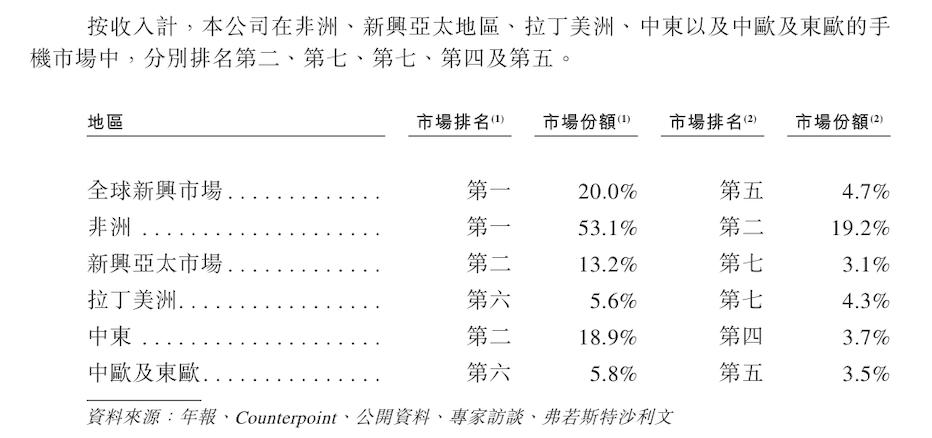
Transsion's market ranking Source / Transsion Prospectus
The second figure is 48.4%. The prospectus shows that in the first four months of 2026, memory chips accounted for 48.4% of Transsion's cost of sold inventory, amounting to 8.42 billion yuan, making it the largest material. For the whole year of 2025, this proportion was only 28%.
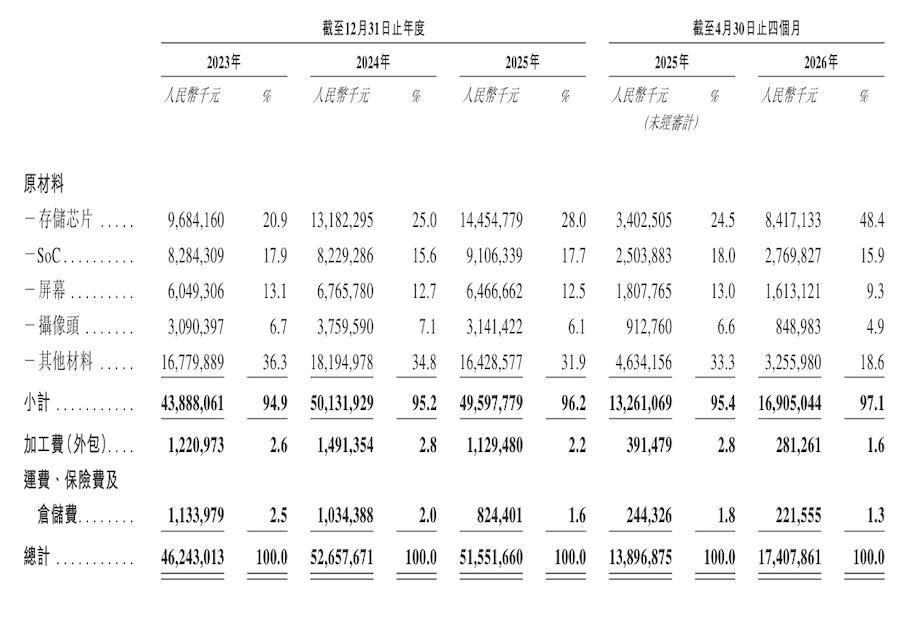
Proportion of raw materials in Transsion's operating costs Source / Transsion Prospectus
Omdia estimates that for mobile phones priced below $400, memory accounts for about 60% of the bill of materials cost, and for models priced below $99, the proportion exceeds 64%. Guo Tianxiang, research manager at IDC China, gave a figure that the memory cost proportion of low-end models has risen from 10% to 15% in the past to 40% to 50%.
The cheaper the mobile phone, the higher the weight of memory, and Transsion's main models are exactly in this interval with the highest weight.
Faced with such a cost structure, does Transsion have room for bargaining? The answer is almost none. Samsung, SK Hynix and Micron control more than 90% of the world's DRAM production capacity, and the original manufacturers' schedules prioritize big customers such as data centers and Apple, leaving DRAM and NAND for ordinary mobile phones and computers continuously shrinking.
The above-mentioned supply chain person told "Focus One" that the main models of Transsion use previous-generation mobile phone memory such as LPDDR4X, which happens to be products that original manufacturers are reducing production or exiting. Transsion only has three paths in front of it: accept price hikes, cut configurations, or switch to domestic products.
Transsion's main market in Africa is also getting harder to do business. Transsion avoided domestic competition and went to Africa back then, relying on low-cost mobile phones and localized functions to achieve more than half of the market share. Its core market is in sub-Saharan Africa, with Nigeria, Kenya and Ethiopia being the countries with the largest sales volume. The relatively developed markets in South Africa and North Africa are mainly Samsung's markets, and in Asia, it focuses on Pakistan and Bangladesh.
Now this base market is being changed by price hikes. In the second quarter of 2026, smartphone shipments in Africa fell by 7% year-on-year, the first decline in three years. Among them, the entry-level market below $100 fell by 34%, a decrease of nearly 3 million units.
Transsion's shipments directly fell by 14%, and its market share dropped from the historical high of 51% to 47%.
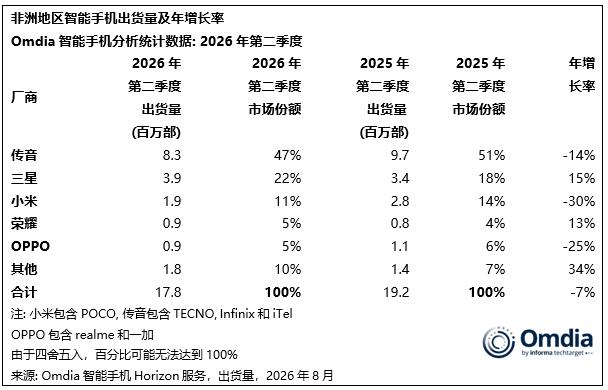
Manish Pravinkumar, chief analyst at Omdia, said that manufacturers can no longer produce smartphones priced at $75 in a profitable way. Omdia expects the African market to decline by 26% in 2026, and the market below $200 will be hit the hardest, which is exactly Transsion's main price range. Xiaomi, which also focuses on low prices, also saw its shipments in Africa drop by 30% in the second quarter.
Other competitors are still stepping up their offensive. Samsung's shipments in Africa grew by 15% in the second quarter. Omdia's report mentioned that Samsung prepared several months of inventory for its main high-volume models in advance, and it has its own memory production lines that can internally absorb part of the cost increase. Honor has maintained growth in Africa for the second consecutive quarter, focusing on the mid-to-high-end market above $300, and the shortage of entry-level components has much less impact on it.
For Transsion's situation in the past two years, we can initially make a judgment that the model of low-price high-volume sales plus low-cost supply chain encountered real problems in 2025. Because the premise that this model relies on is that upstream components are supplied sufficiently at reasonable prices for a long time, and the main market continues to grow. AI changed the first condition, and the second condition is also shaken due to the cost advantage and product advantage of competitors. Next, how Transsion responds depends on what cards it has in hand.
03. "Trapped" by AI, then find a way out with AI
In this Hong Kong stock listing, the most concerned question of the market is how the raised funds will be spent.
The most concerned item in the