New measures have been rolled out to revitalize the existing land stock!
On October 9, the Information Office of Hunan Provincial People's Government held a press conference for policy interpretation of the *Several Measures to Support the Revitalization and Efficiency Improvement of Stock Land to Promote High-Quality Development* (Xiang Zheng Ban Fa [2026] No.44), to systematically interpret the document. Issued on August 25, this document is the first national stock land revitalization policy document issued in the name of the general office of a provincial people's government. It shall go into effect as of the date of issuance with a valid period of 5 years.
The document covers a total of 18 measures involving 40 specific policy points, and its core content can be summarized as: First, flexibly adjust the planning, implement the "positive list" of mixed land use, and allow construction scale indicators to be transferred across plots and across entities within the same control area; Second, support urban renewal, renewal projects can relax technical standards such as green space ratio and building density according to the principle of "not lower than the current situation", and formulate an exemption list of planning permits for micro-renewal projects; Third, enrich revitalization methods, support right holders to independently integrate and voluntarily replace land, transfer land through advance notice registration and property right division, and implement multiple modes such as short-term development and composite utilization to revitalize land; Fourth, strengthen government-court linkage, explore "transfer under seal" for sealed land and adjust planning conditions before auction, and at the same time promote the quality and efficiency of industrial land through measures such as land supply based on industrial chain, preferential bottom price, and no increase in land price after capacity improvement.
Flexibly adjust planning, "positive list" directly exempts from planning adjustment, construction scale indicators can be transferred across entities
Aiming at problems such as insufficient adaptability of detailed planning and complicated planning adjustment procedures, this policy puts forward a "combined set of punches" for planning adjustment: on the one hand, it supports the development of planning technical correction and partial optimization adjustment to make planning adjustment more convenient and flexible; on the other hand, it promotes mixed development and utilization, clarifies that projects that meet the positive list are deemed to comply with the detailed planning, and there is no need to go through the planning adjustment procedure. At the same time, the construction scale indicators are allowed to be transferred between assigned land of the same purpose within the same control area, which can not only be transferred between the plots that the same right holder has acquired, but also be transferred between the assigned plots of different right holders in accordance with the principle of fair and open transaction, and the total construction scale of the control area shall not be exceeded after the adjustment.
The common "indicator transfer" in various regions is mostly limited to the government-led renewal coordination framework or within the same entity. Hunan has written "different right holders" and "the principle of fair and open transaction" into the policy document, which opens a channel for adjusting construction scale indicators between different right holders, and is an innovation of overall indicator coordination under the leadership of the government.
The deregulation on the planning side directly lowers the starting threshold of stock projects, the exemption from planning adjustment shortens the pre-project cycle and reduces uncertainty, and the cross-plot transfer of construction scale indicators allows the indicators of idle plots and plots to be developed to complement each other, thus revitalizing the idle development volume. According to the press conference, two projects in Hunan Xiangjiang New Area, namely Greenland Huxiang Center and Luyun International, have promoted the resumption of work through the overall coordination of 39,000 square meters of construction scale.
Support urban renewal and accelerate the renovation of stock space
Focusing on urban renewal and creating a livable space, this policy allows urban renewal projects to moderately relax technical standards such as building spacing, building setback, building width, building density, sunshine standard, green space ratio, and motor vehicle parking space ratio in accordance with the principle of "not lower than the current situation" after full demonstration, so as to solve the problem that the renovation of old urban areas and old communities is restricted by current technical specifications and difficult to implement. At the same time, an exemption list for planning permits shall be formulated, and planning examination and approval procedures will no longer be handled for small and micro renewal projects; and support the original demolition and reconstruction and independent renewal of old houses.
In terms of impact, the moderate relaxation of technical standards according to the principle of "not lower than the current situation" and the exemption of examination and approval for small and micro renewal directly open up the implementation channel for the renovation of old communities and dilapidated houses, significantly improve the implementability and implementation efficiency of renovation projects, which is conducive to accelerating urban renewal and the functional remodeling of stock space.
Enrich revitalization methods, standardize the handling of start and completion breach of contract, and eliminate the concerns of right holders
This policy provides flexible and diverse revitalization methods, and standardizes the handling of start and completion breach of contract in response to the concerns of market entities that "want to revitalize but dare not act", which mainly includes:
First, support independent integration and voluntary replacement. Support right holders to revitalize stock land by themselves or through transfer, lease, equity contribution, joint operation and other methods, support the merger of adjacent plots for overall development; allow the replacement of construction land in accordance with the principle of "unchanged purpose, equivalent value, and mutual voluntariness of both parties".
Second, promote short-term development and utilization and composite space utilization. When using stock land and real estate to develop state-supported industries such as education, medical care, elderly care, scientific research, cultural tourism, and sports, a maximum 5-year transition period policy can be enjoyed, and the land use entity and planning conditions will not be changed during the transition period; for the development of new industries and new business forms, flexible supply methods such as long-term lease, lease-first-transfer-later, and elastic-year transfer can be implemented. At the same time, the coordinated utilization of above-ground and underground space is encouraged, and a mechanism for layered setting, layered supply and layered registration of construction land use rights shall be established.
Third, support advance notice registration transfer and split transfer. If the development investment does not reach 25% of the total amount and there is an intention to transfer, the advance notice registration can be handled first, and then the transfer registration can be applied after the transfer conditions are met; for stock land with independent development conditions, under the conditions of no ownership disputes and other conditions, it is allowed to register and transfer in units of plots or buildings, floors, and units (rooms).
Fourth, standardize the disposal of start and completion breach of contract. For undeveloped land that is less than one year overdue, if the enterprise promises to start construction within a time limit, a supplementary agreement can be signed to re-agree on the start and completion date and the payment terms of liquidated damages; for construction projects that have actually passed the completion acceptance, the liability for breach of contract of start and completion will no longer be investigated.
The above methods cover different scenarios such as "continued development, cooperative development, temporary non-development, layered development, advance transfer, and split transfer", so that right holders can choose an appropriate path according to their own situation; the exemption and re-agreement of start and completion breach of contract removes the concern of enterprises that "want to resume work but fear being held accountable", which helps to accelerate the circulation and clearance of stock projects.
Strengthen government-court linkage to promote the revitalization of mortgaged and sealed land
Aiming at the difficult problem of disposal of mortgaged and sealed land, this policy clearly defines the construction of a regular information sharing and consultation mechanism between the court, natural resources departments, and industry and information technology departments. On the premise of reaching a consensus with the mortgagee, it supports "transfer with mortgage, transfer of ownership with mortgage, transfer of ownership under seal", and at the same time innovates the dynamic adjustment mode of planning conditions. For plots that have entered the judicial auction procedure, on the basis of protecting the rights and interests of all parties and reaching a value division agreement, optimize the plot planning in combination with regional planning and market demand, so as to improve the market value and adaptability of sealed land; for industrial land, simultaneously promote the mechanism of auction and signing of park admission investment agreement.
The combination of "transfer of ownership with mortgage, transfer with mortgage" and "planning adjustment to increase value + transfer of ownership under seal + agreement to lock the destination" breaks through the judicial and administrative barriers to revitalize stock land, which is expected to effectively solve the consecutive blocking points of difficult land unsealing, difficult transfer of ownership and difficult financing, and greatly shorten the revitalization cycle of mortgaged and sealed land.
Other notable policy highlights
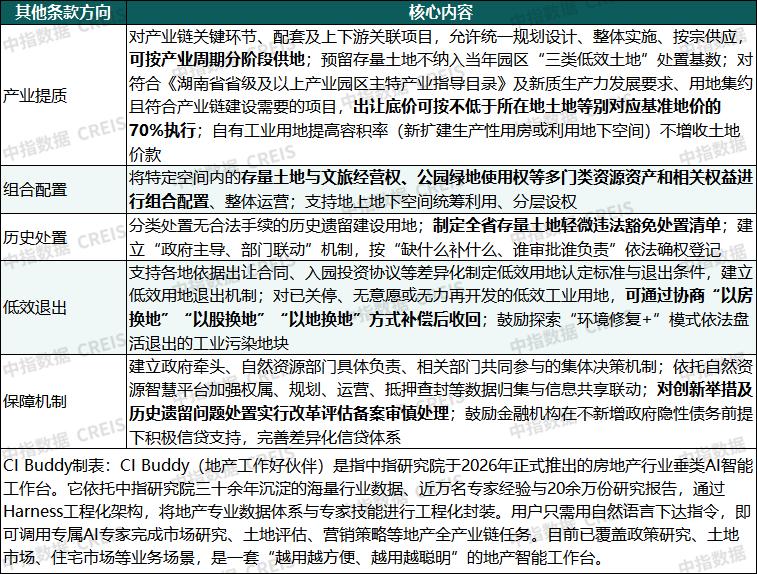
In addition to the above four types of content, this policy also puts forward a number of key measures in the aspects of industrial land quality improvement, combined allocation of resources and assets, disposal of historical legacy problems, and supporting guarantee mechanisms.
For example: explore "industrial chain land supply" around the core and characteristic industries of the park. For projects that meet the core and characteristic industry guidance catalog of provincial and above industrial parks and the development requirements of new quality productive forces, the transfer bottom price can be implemented at no less than 70% of the benchmark land price, and the increase of plot ratio of self-owned industrial land will not increase the land price, which will have direct attraction to the landing of industrial projects; encourage the combined allocation and overall operation of multiple types of resources and assets such as stock land, cultural tourism operation right, and park green space use right, support the negotiated recovery of inefficient industrial land through "land for house", "land for equity" and "land for land"; classify and dispose of historical legacy problems, and formulate a list of exemption for disposal of minor illegal acts; and strengthen the guarantee from four aspects: collective decision-making, information sharing, reform assessment and record disposal, and financial credit support.
On the whole, this policy presents obvious characteristics: first, it is the first national stock land revitalization policy issued in the name of the general office of a provincial people's government; second, the system is relatively complete, forming a systematic institutional toolbox from flexibly adjusting planning, standardizing breach of contract, unblocking transfer to government-court linkage; third, it institutionalizes and popularizes the originally scattered and sporadic practices such as cross-entity transfer of construction scale indicators, transfer of ownership under seal, advance notice registration transfer, and no land price increase after capacity improvement at the provincial level for the first time. This Hunan policy has strong replicability, which provides a useful reference for other provinces and cities to improve the stock land revitalization policy and promote the market-oriented allocation reform of land factors.
This policy will promote the land factor guarantee in Hunan Province to shift from "incremental expansion" to "stock potential tapping", accelerate the revitalization and clearance of approved but not supplied, idle and low-efficiency land, and optimize the allocation efficiency of land resources; for enterprises, even if the entities holding stock land face situations such as breach of contract, mortgage, seal, and less than 25% investment, they all have compliant revitalization and exit paths, and it is expected that the willingness and confidence to participate in the development of stock projects will be enhanced.
This article is from the WeChat official account "China Index Academy", author: China Index Research, released by 36Kr with authorization.