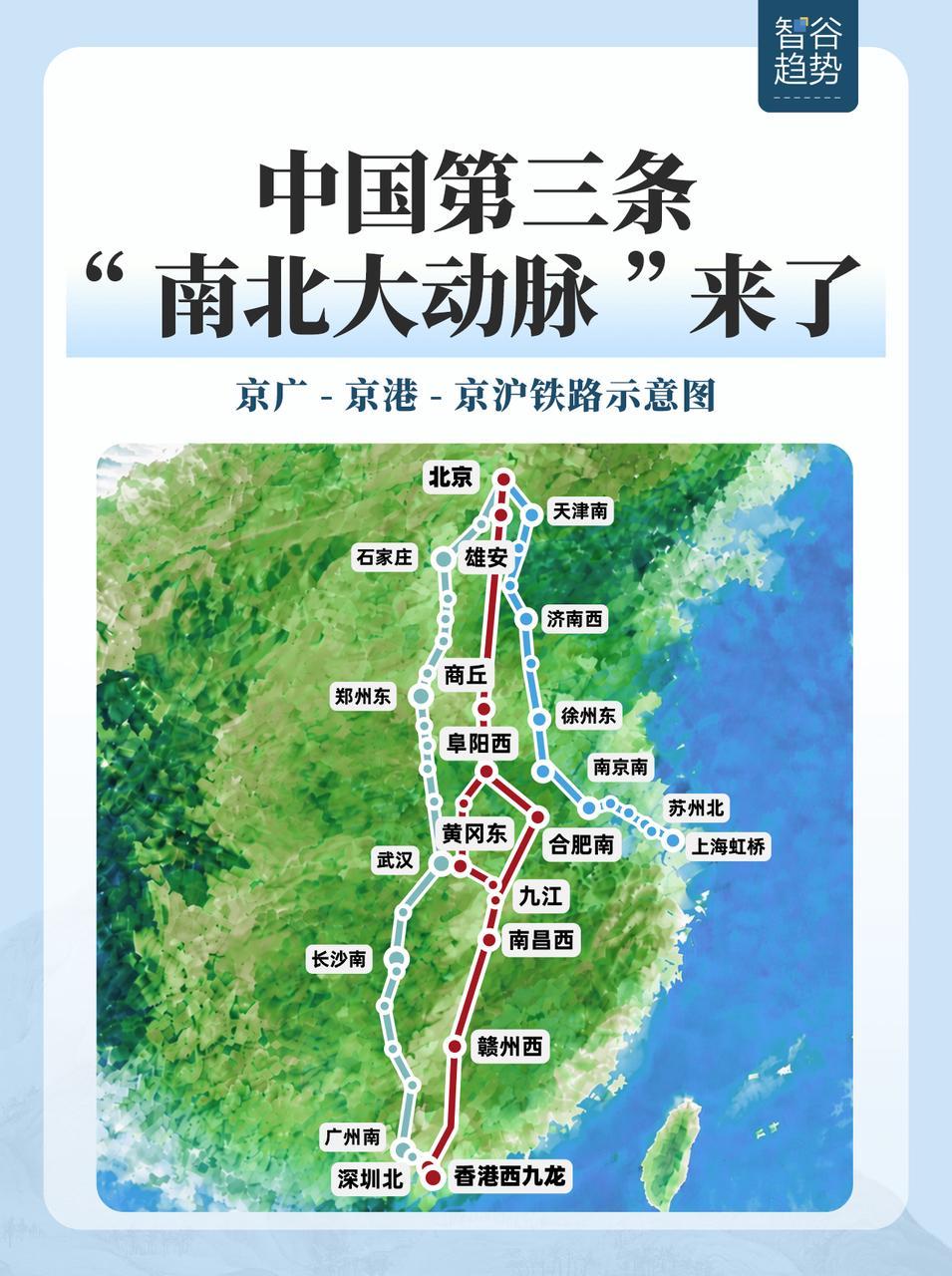
China's third "north-south major transportation artery" is poised to be officially unveiled soon.
China's third "north-south artery" is finally taking shape.
Not long ago, the Xiong'an-Shangqiu section of the Beijing-Hong Kong high-speed railway was officially put into operation, with the fastest travel time from Xiong'an to Shangqiu reaching only 2 hours and 27 minutes. At this point, only a few sections of the entire Beijing-Hong Kong high-speed railway, such as the Nanchang-Jiujiang section, are yet to be connected.
How significant is this event?
This means that China's third north-south high-speed railway main line is finally here. It has been 15 years since the Beijing-Shanghai high-speed railway opened, and 14 years since the Beijing-Guangzhou line was fully connected.
What is more surprising is that, compared with the previous two north-south high-speed railways that mainly pass through provincial capitals and large cities, the areas along the Beijing-Hong Kong high-speed railway are home to a number of "little-known" cities — Hengshui, Liaocheng, Shangqiu... It seems that the route was deliberately designed to pass through these places.
Against the backdrop of the overall slowdown in large-scale infrastructure construction and the high-speed railway network gradually entering the maintenance period, why does the state still build another north-south artery?
01
Some people may think that today, when the high-speed railway network is already quite dense, there is no great need to build a dedicated high-speed railway for a group of small cities.
But the answer is exactly the opposite.
The Beijing-Hong Kong high-speed railway is probably one of the most noteworthy "gap-filling" projects after more than 20 years of China's high-speed railway construction.
China's north-south high-speed railways have long been "insufficient for demand".
The Beijing-Shanghai high-speed railway, known as the "all-workhorse special line", operates nearly 600 trains per day on average, with the shortest departure interval of only 3 minutes during peak hours, which is even denser than that of the subway. The Beijing-Guangzhou high-speed railway covers less than one tenth of China's land area, carries nearly one third of the country's population and nearly 40% of its economic output, and the transport capacity of some sections has long been saturated.
Building the third north-south passage can provide an additional option for the increasingly dense north-south passenger flow.
However, diversion is only the apparent reason. Unfolding the map, we can find that the Beijing-Shanghai high-speed railway runs along the coastal area, connecting Beijing, Tianjin, Jinan, Nanjing and Shanghai; the Beijing-Guangzhou high-speed railway runs through the inland, connecting Beijing, Shijiazhuang, Zhengzhou, Wuhan, Changsha, Guangzhou and other provincial capitals.
The two major arteries are basically connected to the most developed and mature economic zones in China at present. However, a large area is left vacant between the two railways: central and southern Hebei, western Shandong, eastern Henan, almost the whole of Anhui, eastern Hubei, as well as Jiangxi and northeastern Guangdong.
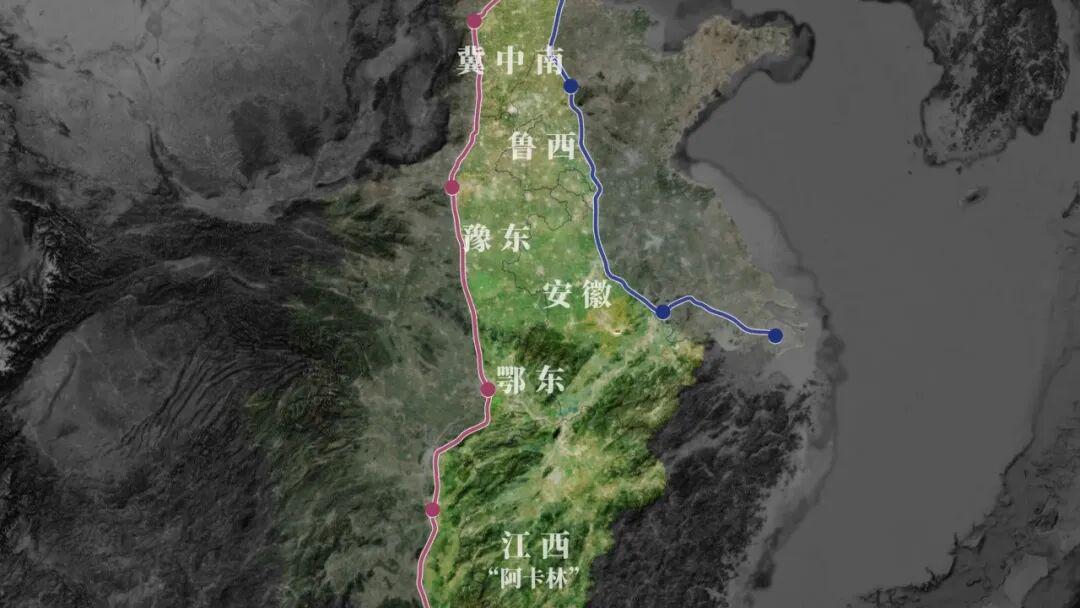
Image source: Earth Knowledge Bureau
The population density of this area is not low at all. Hefei has a permanent resident population of 10 million, Heze 8.5 million, Fuyang 8 million, Shangqiu 7.5 million, Liaocheng 5.7 million, Bozhou 4.8 million, and Hengshui 4.1 million.
But these cities have not had a longitudinal high-speed railway running through them for a long time. Residents here have to make detours if they want to travel north or south.
This contradiction actually existed as early as the era of ordinary railways. The Beijing-Guangzhou Railway was completed in 1957, while the Beijing-Kowloon Railway, known as the "poverty alleviation railway", was not completed until 1996, nearly 40 years later.
Today, the Beijing-Hong Kong high-speed railway connects exactly the large hinterland that was once forgotten by the high-speed railway network. With this longitudinal passage, this hinterland can be more conveniently connected to the national economic aorta.
It is not that the Beijing-Guangzhou and Beijing-Shanghai high-speed railways are not fast enough, but that China needs a third economic corridor.
02
After the Beijing-Hong Kong high-speed railway is opened to traffic, which cities and provinces will benefit?
Looking north along this trunk line, the first to reap the high-speed railway dividend is Xiong'an, which is a national new area.
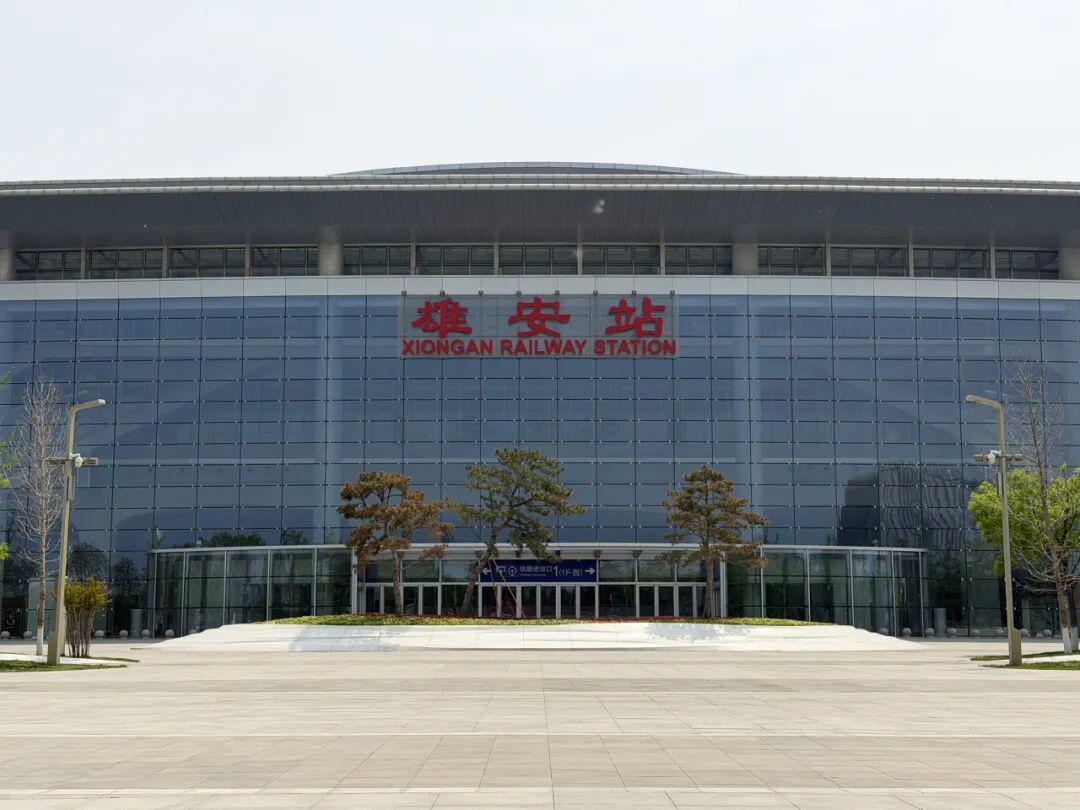
Image source: Earth Knowledge Bureau
In the past, Xiong'an was only a "terminal station" of Beijing. If people in Xiong'an wanted to travel south, they had to go back to Beijing first, then take a detour via the Beijing-Guangzhou or Beijing-Shanghai line.
After the Xiong'an-Shangqiu section of the Beijing-Hong Kong high-speed railway is opened, Xiong'an has instantly become the starting point of the north-south artery. Starting from Xiong'an, you can go all the way south to Shenzhen and Hong Kong, and it has transformed from a "dead end" into a new hub in the Beijing-Tianjin-Hebei region.
Hefei, which has developed rapidly in recent years, is another city that has achieved leapfrog development.
In the era of ordinary railways, Hefei was once marginalized for a long time. At that time, Bengbu was the major railway hub in Anhui. Hefei was sandwiched between the Beijing-Shanghai and Beijing-Guangzhou lines, with no north-south direct railway access.
With the opening of the Beijing-Hong Kong high-speed railway, Hefei has been promoted to the second "meter-shaped" high-speed railway hub in China. With this independent north-south trunk line, plus the east-west Yangtze River coastal passage, this "most successful venture capital city" now has a more solid foundation as a transport hub.
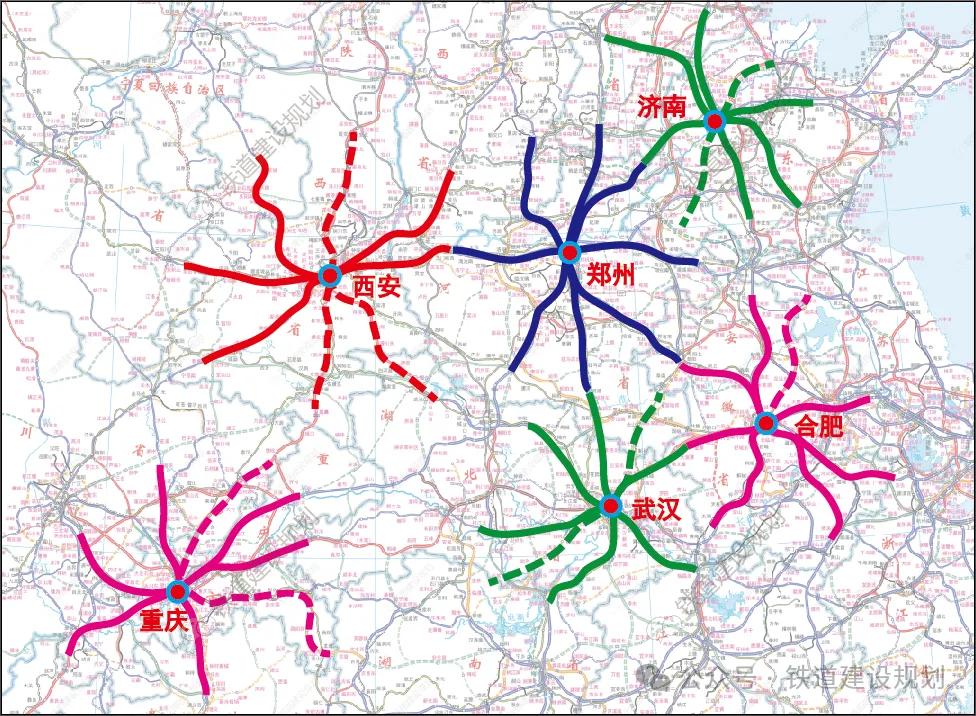
Image source: Railway Construction Planning
But the most noteworthy ones are those little-known prefecture-level cities.
Take Hengshui as an example. After the Beijing-Hong Kong line is opened, it will end the history of having no direct high-speed railway to Beijing. Starting from Hengshui South Station, you can reach Beijing West Railway Station in as fast as 90 minutes.
There are also three central cities with similar locations: Liaocheng, Heze and Shangqiu. They have transformed from "passing stations" in the past to new "intersections" now.
In the past, these three cities either had no high-speed railway or only had one stop. After the Beijing-Hong Kong high-speed railway is opened, they will intersect with east-west trunk lines such as Jinan-Zhengzhou, Rizhao-Lankao and Xuzhou-Lanzhou lines, and become real high-speed railway hubs.
For example, starting from Liaocheng West Station, you can reach 19 provincial capitals and municipalities directly under the central government with direct one-stop trains.
There are also Renqiu, Suning, Linqing, Yanggu, Yuncheng, Taiqian... These places whose names you may not have heard of are now stepping into the high-speed railway era for the first time.
Moreover, almost all these counties along the route hide a "hidden champion":
The scale of the green petrochemical industry in Renqiu is close to 100 billion yuan; there are more than 5100 bearing enterprises in Linqing; Taiqian has an important national down processing base...
The bigger picture lies in Jiangxi, which used to be called the "Akalin Province" (a province long overlooked in regional development).
After the entire Beijing-Hong Kong high-speed railway is fully connected, Jiangxi will become the first province in China where "every city has access to high-speed railways with a speed of 350 km/h" — in the past, only a few cities such as Nanchang and Jiujiang had such access.
More crucially, the Beijing-Hong Kong high-speed railway has opened up a direct connection channel between southern Jiangxi and Shenzhen. In the past, it took four to five hours to travel from Ganzhou to Shenzhen, with detours and transfers. Now, you can reach the destination directly all the way.
What does this mean? A dedicated passage has been created between the "Guangdong-Hong Kong-Macao Greater Bay Area" and the mountainous areas.
The industries, capital and technology from Shenzhen, as well as the labor force, agricultural products and tourism resources from southern Jiangxi, can now be interconnected smoothly. The once "high-speed railway belt surrounding Jiangxi" can now truly enjoy the benefits of favorable conditions from all sides.
03
Never underestimate the power of a railway.
Shangrao in Jiangxi has become a high-speed railway hub out of a small city in northeastern Jiangxi, because the Shanghai-Kunming high-speed railway and the Hefei-Fuzhou high-speed railway intersect here. The Shangrao Economic Development Zone has undertaken the industrial transfer from the Yangtze River Delta, and industries such as photovoltaics and new energy vehicles have risen rapidly.
For a city, what the high-speed railway really changes is not the convenience of transportation, but its position on the regional economic map.
Looking along the Beijing-Hong Kong high-speed railway, a number of cities are embracing historic opportunities:
The Tangyi gourd in Liaocheng has been planted for 2000 years, and in the past it was only sold locally and in surrounding areas. After the high-speed railway is opened, this intangible cultural heritage product can be directly connected to the cultural and creative market in Beijing, and the orders of inheritors have been scheduled to next year for the first time.
The wire mesh in Anping, Hengshui has an annual revenue of over 100 billion yuan, making it the largest wire mesh production and sales base in China. In the past, to receive customers from Beijing and Tianjin, people had to make a detour via Shijiazhuang. Now the model of "R&D in Beijing and Tianjin, manufacturing in Hengshui" has turned from a slogan into daily practice.
The refrigeration equipment in Minquan, Shangqiu is one of the five major production bases in China. After Shangqiu becomes a "double cross" high-speed railway hub, its products are directly delivered to the Yangtze River Delta
...
There is a bigger background: The era of rapid expansion of China's high-speed railway construction has come to an end.
At present, the operating mileage of China's high-speed railway has exceeded 50,000 kilometers, and the completion rate of the "eight vertical and eight horizontal" main trunk lines has reached 86%. By 2030, the planned mileage will reach 60,000 kilometers.
In the past 10 years, China has built more than 30,000 kilometers of high-speed railway. In the next 5 years, the newly added mileage will only be about 10,000 kilometers. Most of this 10,000 kilometers is already under construction, and there are very few new routes to be started in the future.
In the past, high-speed railway construction focused on continuously building new lines to connect cities. Now, the priority has shifted to networking, gap filling and chain strengthening — filling in the blanks on the map in the past, and connecting isolated lines into a network.
The second half of high-speed railway development is not to build as many new lines as possible, but to connect more previously overlooked cities and turn them into new economic nodes.
And this may be the next decade of China's economy.
References:
1. National Strategy Research: Another "north-south artery" is coming in China
2. Earth Knowledge Bureau: Coming soon! China's third north-south major passage runs through three provinces across mountains and rivers
This article is from WeChat official account "TrendInsight", written by Xiyun, edited by Zibuyu, and authorized for release by 36Kr.