With industry giants pouring in more investment, is this central Chinese provincial capital gaining much greater clout?
Apple's first foldable smartphone, the iPhone Duo, will open for pre-orders on October 16.
Prior to that, on October 11, Apple's Chief Operating Officer (COO) Sabih Khan visited the key manufacturing processes of the iPhone Duo production line at the Foxconn Science Park in Zhengzhou Airport Economy Zone. This campus is widely recognized as the world's largest iPhone manufacturing plant, and even the largest smartphone manufacturing plant globally.
Fifteen years ago, Cook, who had just taken office as Apple's CEO, paid his first visit to China, and the highlight of his itinerary was a tour of Foxconn Zhengzhou. Now, the visit by senior Apple executives once again sends a key signal to the outside world —
The iPhone Duo is regarded by Apple as one of the most challenging products it has ever developed. Apple's decision to bet on this strategic new product in Zhengzhou is itself a vote of confidence based on manufacturing capabilities. This also proves that after Apple's leadership reshuffle this year, Zhengzhou still occupies a critical position in the "Apple supply chain".
It is worth noting that the SoC chip-level surface sputtering intelligent manufacturing project that the Apple executives focused on visiting is the latest technological achievement of Henan Hongchuang Technology Co., Ltd., a joint venture established by Foxconn and Zhengzhou state-owned assets at the end of 2025. Hongchuang is also Foxconn's first state-owned enterprise joint venture in Zhengzhou.
With the development of the project, it is expected to form a new industrial scale of 100 billion yuan. What matters more than the scale is its position in the industrial value chain: the industry has long discussed the "Foxconn dependency" of Zhengzhou and even Henan Province. To this day, Foxconn remains the ballast of Zhengzhou's industry and foreign trade, and is also a key variable for the local electronic information industry to move towards high-end and intelligent upgrading.
Not long ago, Zhengzhou also proposed to build a diversified industrial pattern covering three chains: the "Apple supply chain", the "automobile supply chain" and the "computing power supply chain". People keep asking who is more inseparable from whom between Foxconn, Zhengzhou and even the whole Henan Province. This old question may have found a new solution.
Achievements
The visit of senior Apple executives to Foxconn Zhengzhou Science Park has once again drawn global attention to Zhengzhou's electronic information industry chain.
A thought-provoking detail is that the core matters of this visit include inspecting the key manufacturing processes of the iPhone Duo production line, Apple's first foldable smartphone. The iPhone Duo is one of the most challenging products Apple has ever developed. The core purpose of Sabih Khan's trip is precisely to "supervise and promote" the mass production ramp-up of this strategic new product.
This product is exclusively assembled and produced by Foxconn's factories in China. Foxconn is stepping up stocking to prepare for the upcoming pre-sale. According to previous media reports, Apple's foldable phone still faces many thorny problems before its official launch. The overall yield rate of Foxconn's assembled iPhone Duo is only about 60%, and the output of the first batch is relatively small.
When asked about the progress of production capacity, Sabih Khan responded positively that the production scale is being expanded in accordance with high-quality standards. "Everyone has seen what the production line looks like. The production line is very busy, everyone is very excited, and we hope to deliver the products to the whole world as soon as possible."
Apple's decision to place the exclusive assembly of its strategic new product in Zhengzhou is itself a vote of confidence based on manufacturing capabilities, and also confirms that after the change of Apple's management, Zhengzhou still occupies a key position in its global industrial chain.
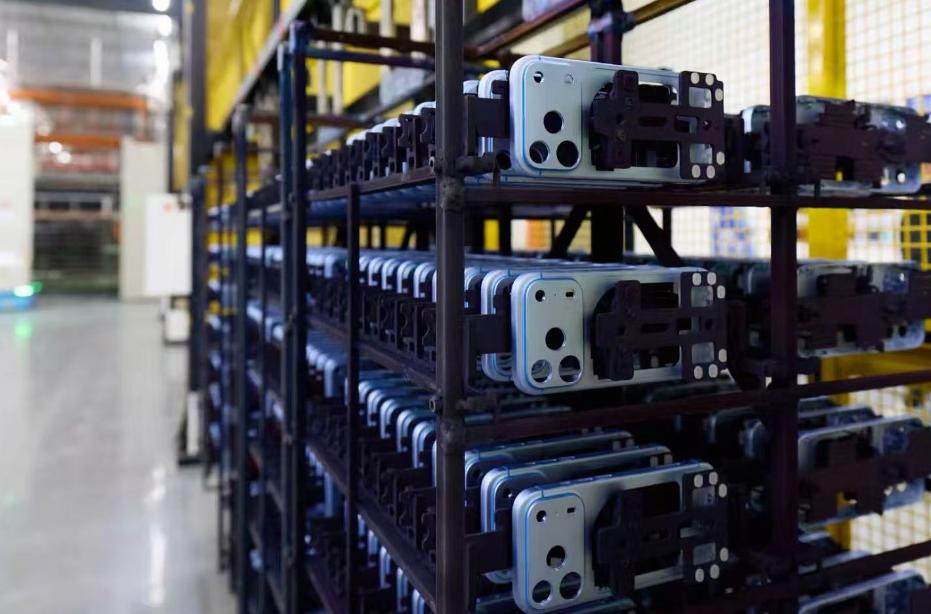
Image source: Zhengzhou Daily
This new production line is also a "touchstone" for Foxconn and Zhengzhou state-owned assets to jointly explore a higher industrial value chain. "Henan Hongchuang has conquered the sputtering process, which has been applied to the production of the iPhone 18 Pro series and the iPhone Duo," introduced Jiang Jiheng, Rotating CEO of Foxconn Technology Group and General Manager of the Business Group. Compared with traditional methods, this process can reduce the module thickness by 20% and significantly improve the heat dissipation performance.
The full name of Henan Hongchuang is Henan Hongchuang Technology Co., Ltd. It was jointly established at the end of 2025 by Foxconn and the state-owned assets platform of the Zhengzhou Airport Economy Zone Administrative Committee. It is also Foxconn's first state-owned enterprise joint venture in Zhengzhou, with a registered capital of 20 billion yuan, focusing on R&D and manufacturing of high-end electronic components.
The company's technological achievement, the SoC chip-level surface sputtering intelligent manufacturing project, as the first cooperation project between Foxconn and Zhengzhou state-owned assets, was put into operation in July this year, and only a few months later, it appeared on the visit list of senior Apple executives.
Jiang Jiheng said that Foxconn is gradually upgrading from its traditional positioning as a "world factory" to a technology manufacturing platform service provider. With the continuous development of the SoC sputtering project, it is expected to form a new industrial scale of 100 billion yuan and contribute to the local economic development of Henan.
Hao Aimin, Dean of the School of Economics of Zhengzhou University of Aeronautics, told City Evolution that the key sputtering process developed by the joint venture of Foxconn and Zhengzhou state-owned assets shows that Zhengzhou is moving from "assembling according to drawings and delivering on schedule" to "participating in new processes and undertaking new products" in Apple's supply chain.
In his view, the in-depth significance of this cooperation upgrade is that when Apple and Foxconn disperse part of their production capacity to India and Vietnam, Zhengzhou is beginning to shift from competing on cost to competing on complex processes, flexible manufacturing and new product introduction capabilities, which determine Zhengzhou's higher ecological niche in the "Apple supply chain" that cannot be replicated by others in a short period of time.
Variables
From an industrial perspective, Foxconn remains the core "ballast" of Zhengzhou's industry and foreign trade.
In 2025, Zhengzhou produced nearly 150 million mobile phones, with a year-on-year increase of about 15%. Among them, Foxconn Zhengzhou produced more than 88 million iPhones, accounting for more than half of the city's total output; the support for foreign trade is equally prominent. In the same year, Zhengzhou's total import and export volume exceeded 650 billion yuan, ranking first among central Chinese cities and fourth among provincial capital cities nationwide. The Xinzheng Comprehensive Bonded Zone where Foxconn is located completed total import and export value of 466.52 billion yuan, still accounting for about 70% of Zhengzhou's foreign trade scale.
Beyond the increment of output and foreign trade, Foxconn has driven the agglomeration of upstream and downstream enterprises with its leading enterprise effect, promoting Zhengzhou's electronic information industry to extend from a single assembly link to a complete industrial ecosystem. At present, the scale of Zhengzhou's electronic information industry has exceeded 800 billion yuan, ranking first among the seven 100-billion-level leading industrial clusters, and is the most recognizable industrial "golden business card" of Zhengzhou.
It can be said that for a long time in the past, Foxconn was the most reliable "stabilizer" of Zhengzhou's economy. However, Hao Aimin reminded that behind this large volume, there are still obvious structural shortcomings: the output value is large, but the retained added value is not high. "We roughly calculate that if Foxconn Zhengzhou's output value in 2025 is 500 billion yuan, according to the added value rate of about 10% in the assembly link, it is about 50 billion yuan, which only accounts for 3% of Zhengzhou's GDP, and the value retention capacity is relatively weak."
Conversely, this is exactly where the space for industrial upgrading lies: if the output value remains unchanged, every one percentage point increase in the added value rate will bring about 5 billion yuan more, which is equivalent to contributing 0.3 percentage points more to Zhengzhou's GDP.
Image source: Zhengzhou Daily
This in-depth cooperation between Foxconn and Zhengzhou state-owned assets is precisely aimed at solving this pain point — landing core processes such as sputtering process, high-end components and R&D links in Zhengzhou, directly driving up the industrial value chain. In a sense, this is also a key variable for the local electronic information industry to advance towards high-end and intelligent development.
This path of industrial upgrading is also highly consistent with the local strategy. In April this year, the top leaders of Henan Province met with Liu Yangwei, Chairman of Foxconn Technology Group, and his delegation in Zhengzhou, stating that Foxconn's new development strategic plan is highly aligned with Henan's deployment of building a strong manufacturing province and a strong digital intelligent province, and hopes that the two sides will work together to develop high-tech industries, build intelligent terminal industrial clusters, jointly open up new tracks, create new advantages and achieve new development.
In fact, more "seeds" of industrial upgrading have taken root and sprouted in some key regions. Driven by the leading project Foxconn, the Zhengzhou Airport Economy Zone has cultivated a number of leading enterprises in segmented tracks in recent years.
Take Dongwei Microelectronics as an example. The company is committed to producing materials and equipment components for high-end integrated circuit manufacturing. The core product process of its semiconductor materials is exactly the high-purity sputtering target applied to Apple's new mobile phone this time. It can be said that Foxconn and the "Apple supply chain" have provided the company with a precious technical verification scenario and product value endorsement.
This echelon development industrial pattern has also become one of the growth poles of the local future economic development. Facing the "15th Five-Year Plan", the Zhengzhou Airport Economy Zone intends to build a world-class enterprise support base, not only to support leading enterprises to become better and stronger, but also to promote mid-tier enterprises such as Dongwei Microelectronics and Zhengzhou Hejing to expand their scale, targeting at "the information technology industrial cluster with the best ecology in the whole province and national influence".
Industrial Chain Building
Foxconn's industrial value to Zhengzhou goes far beyond the "Apple supply chain".
In February this year, Foxconn's new energy vehicle R&D center located in the Automobile City of Zhengzhou Airport Economy Zone was officially put into operation. This is Foxconn's first new energy vehicle R&D center laid out in Chinese mainland, built adjacent to BYD's Zhengzhou factory.
From the launch of the project in July 2024 to the operation of the R&D center, it only took about a year and a half. Foxconn is accelerating to build new energy vehicles and energy storage into its second growth curve, aiming to create a "new Foxconn" for Zhengzhou.
In Hao Aimin's view, the rise of the "automobile supply chain" has rewritten Zhengzhou's industrial pattern. In 2025, Zhengzhou's new energy vehicle output exceeded 700,000 units, more than ten times that of 2021 (38,900 units). In recent years, the global consumer electronics terminal market has entered a downward cycle, and it is the increment of new energy vehicles that has filled the gap of mobile phone output fluctuation for Zhengzhou.
Zhengzhou's "computing power supply chain" is also emerging simultaneously. Chaojuhua, the leading enterprise of Zhengzhou's computing power industry, is already the second largest server enterprise in China, and ranks first in the sales share of the domestic server market. In 2025, Chaojuhua's revenue reached as high as 58.2 billion yuan, and its net profit exceeded 1 billion yuan, becoming another representative enterprise in Zhengzhou after Foxconn and BYD.
From the "Apple supply chain" undertaking global mobile phone manufacturing, to the "automobile supply chain" landing new energy vehicles, and then to the "computing power supply chain" layout, Zhengzhou's industrial layout path to get rid of single product dependence is clearly visible.
As evidence, a relevant person in charge of the Zhengzhou Airport Economy Zone revealed a few days ago that during the "15th Five-Year Plan" period, the zone will continue to expand the three advantageous industries of information technology, new energy vehicles, and commercial logistics, while accelerating the development of three high-growth industries of computing power and computing power equipment, biomedicine, and robots, and strive to build a "city of artificial intelligence".
This is also an inevitable choice for central cities to compete in industrial development. While Hefei has formed an industrial closed loop through its "chip, screen, automobile and integration" strategy, and Wuhan has built a dual-pillar industry with optoelectronics and automobiles, Zhengzhou must also open up more sustainable industrial growth spaces beyond the electronic information industry.
But Hao Aimin also reminded that Zhengzhou should avoid changing from one "single dependency" to three "single dependencies", cultivate a number of local supporting enterprises in each industrial chain, precipitate independent R&D capabilities, and form a real industrial ecosystem.
Of course, diversification does not mean abandoning the "Apple supply chain". Hao Aimin believes that the rapid implementation of the automobile supply chain and computing power supply chain is inseparable from the "family assets" left by the "Apple supply chain" to Zhengzhou, including the engineering team, supply chain management experience, air freight and port system. The agglomeration of three leading enterprises in the same city is also Zhengzhou's unique endowment — the upgrading of the "Apple supply chain" stabilizes the stock, the "automobile supply chain" and "computing power supply chain" expand the increment, and the collaboration of industrial clusters increases the local industrial added value, which is exactly the core driving force of Zhengzhou's future economic growth.
This article is from the WeChat official account "City Evolution", written by Liu Xuqiang, and published with authorization from 36Kr.