Government-subsidized rental housing REITs have started to expand into second- and third-tier cities, with the rate of return serving as the entry ticket.
On September 30, the CICC Hangzhou Anju Ningchao REIT fund contract came into effect, marking the official launch of Zhejiang's first public offering REIT for indemnificatory rental housing. This product was filed at the Shenzhen Stock Exchange on April 29 and received the registration approval from the China Securities Regulatory Commission on September 3, with the entire process taking 127 days.
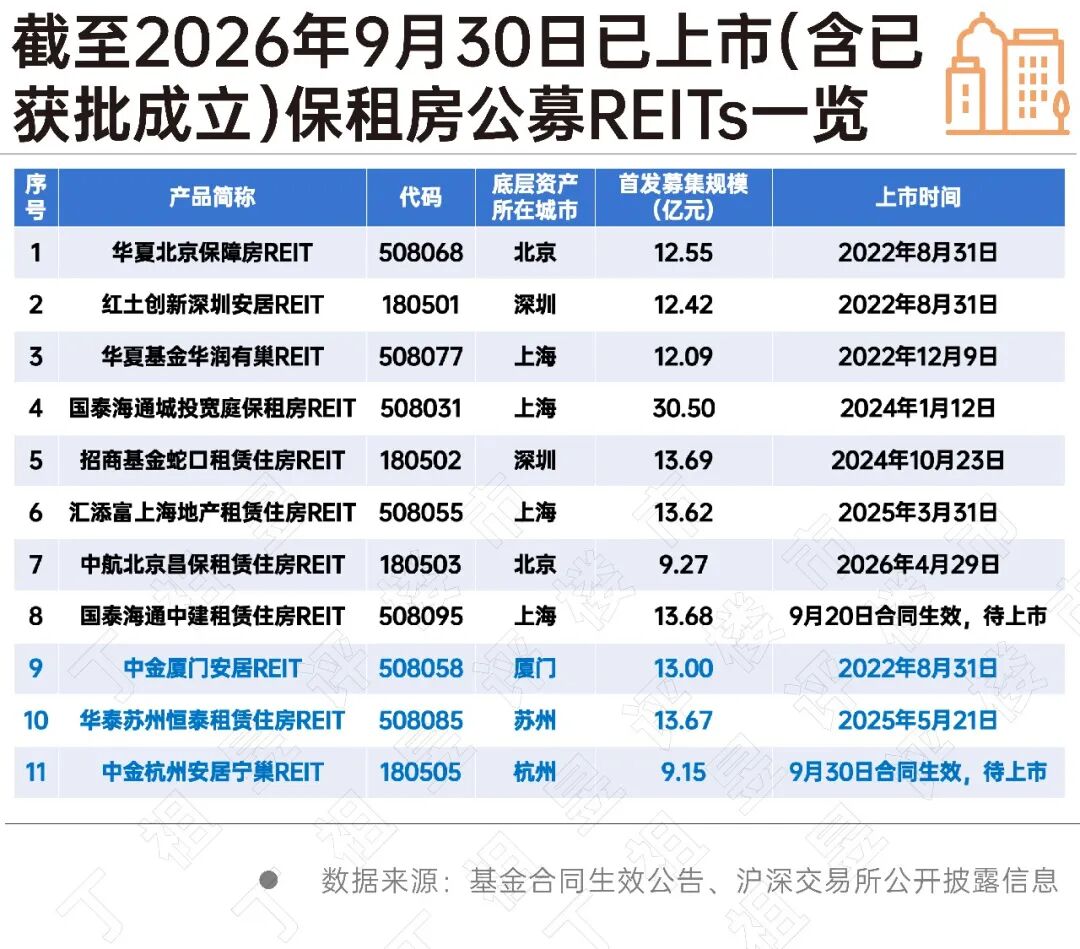
Standing alone, this single case is not particularly noticeable. With 300 million shares issued at a price of 3.050 yuan per share, the total raised capital reached 915 million yuan. Among the 11 publicly traded and approved indemnificatory rental housing public offering REITs, the 915 million yuan raised here is the smallest fundraising scale.
However, from a trend perspective, 3 rental housing REITs have been approved in the first nine months of 2026, making it the year with the most intensive issuances since 2023, bringing the total number of such products in the industry to 11. More importantly, the cities that are queuing up to launch their own projects have changed.
01
As of September 2026, there are 11 publicly offered indemnificatory rental housing REIT products that have been listed (including those that have been approved for establishment). These 11 products are only distributed in 6 cities, of which 8 are located in Beijing, Shanghai and Shenzhen in total, with a total fundraising scale of 11.781 billion yuan; Xiamen, Suzhou and Hangzhou each have 1 product, raising 3.582 billion yuan in total. First-tier cities account for 72.7% of the total number of products and 76.7% of the total fundraising scale.
This structure is no accident. The first three indemnificatory rental housing REITs were launched in August 2022, with underlying assets coming from the indemnificatory housing platforms in Beijing, Shenzhen and Xiamen, and Xiamen was the only non-first-tier city among them. In the following four years, new projects were highly concentrated in Shanghai and Beijing: the four products of China Resources Youchao, Chengtou Kuanting, Shanghai Real Estate and CSCEC Xingfu+ are all located in Shanghai. In Beijing, the platform of Changping District filled the gap of district-level REIT in April 2026. Suzhou launched its first product in May 2025, which is the first such product in Jiangsu Province and the second one in second- and third-tier cities in the four years.
In other words, before the Hangzhou product was launched, from August 2022 to March 2026, a period of three years and seven months, second- and third-tier cities only obtained two quotas for indemnificatory rental housing public offering REITs.
02
The CICC Hangzhou Anju Ningchao REIT serves as a signal, which verifies that talent-specialized rental housing in non-first-tier cities can be independently developed into a single REIT product without needing to combine multiple projects to gather a sufficient scale.
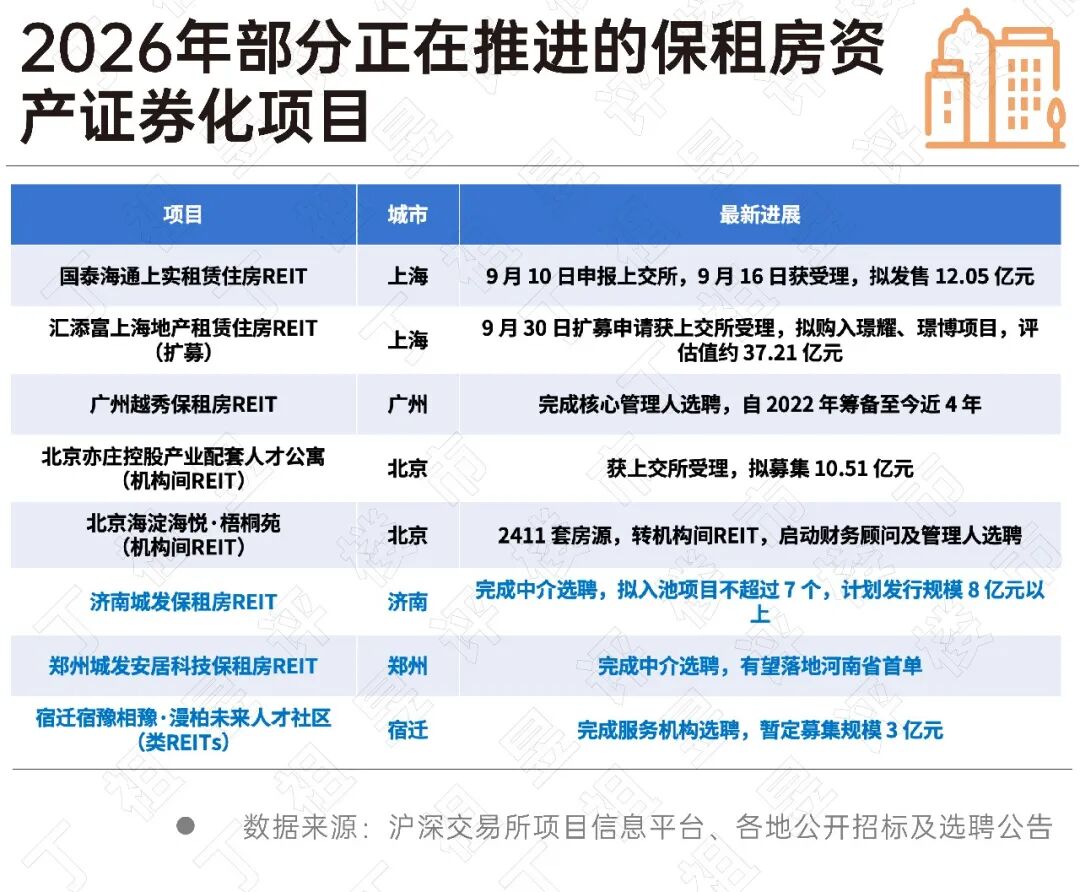
Judging from the ongoing asset securitization projects of indemnificatory rental housing, the signal that indemnificatory rental housing REITs are starting to expand to second- and third-tier cities is more obvious, first of all, Jinan and Zhengzhou, two municipal urban investment platforms have completed the selection of intermediary agencies, which means that the issuing entities have extended from central enterprises and provincial capital urban investment platforms to municipal-level platforms. Then there is Suqian, where a county-level talent community is also looking for an exit for asset securitization.
Reserve projects in more peripheral areas are also being rolled out. Cities including Nanjing, Chongqing, Xi'an, Qingdao, Tianjin and Fuzhou have simultaneously promoted project reserves, and the embryonic form of a nationwide issuance network is taking shape.
03
A considerable part of the indemnificatory rental housing owned by second- and third-tier cities is built on allocated land. For this type of asset to be included in REITs, the first bottleneck is land ownership: the land use right corresponding to the shared land of the houses on allocated land cannot be directly included in the asset pool.
On August 25, 2026, Zhengzhou Municipal Bureau of Natural Resources and Planning publicly solicited public opinions on the "Zhengzhou Municipal People's Government's Measures for Asset Disposal of Issuing Infrastructure Real Estate Investment Trust Funds for Indemnificatory Rental Housing Projects (Draft for Comments)". The document applies to eight districts in Zhengzhou: Zhengdong New District, Zhengzhou High-tech Zone, Zhengzhou Economic Development Zone, Zhongyuan District, Erqi District, Jinshui District, Guancheng Hui District and Huiji District. The document clearly stipulates that the shared land use right of the house shall be changed from allocation to transfer, and the supplementary land price difference shall be implemented with reference to the standard of supplementary land price for the listed sale of public housing that has been purchased, calculated as "shared land area of the house × current residential benchmark land price × 5%", following the four-step process of application, accounting, supplementary payment and registration. The annotation column of the real estate ownership certificate shall indicate "indemnificatory rental housing"; in terms of operation, the property can only be rented but not sold, and it is prohibited to split the right confirmation, split transfer, split mortgage, split sale, or carry out sale by means of rent; If the REITs listing and issuance is completed by transferring the equity of the project company, the aforementioned restrictive clauses on asset disposal can be exempted, and projects that fail to be issued must continue to operate in accordance with the regulatory provisions for indemnificatory rental housing.
This type of document seems highly technical, but in reality it is a precondition for second- and third-tier cities to issue REITs. It answers the three questions of "whether allocated land can be included in the asset pool", "how much money needs to be supplemented" and "who is responsible for approval" at one time, which allows Zhengzhou Chengfa Anju Technology to complete the selection of intermediary agencies within the same time window.
The higher-level institutional background is also equally clear. On April 15, the General Office of the State Council issued the "Opinions on Deepening the Reform of the Investment Approval System" to support the revitalization of existing assets by issuing REITs; on August 28, the China Securities Regulatory Commission stated in the "Opinions on the Capital Market Supporting the Construction of a New Real Estate Development Model" that it clearly supports the issuance and expansion of REITs.
04
Policy only opens the door, and it is the market that actually drives the progress.
According to data from Beike, in July 2026, the rental yield of 50 key cities on the Beike platform was 2.80%, while the figures for Beijing, Shanghai, Guangzhou and Shenzhen were 2.15%, 2.11%, 2.21% and 1.97% respectively.
The rental yield of first-tier cities is systematically lower than the average level of key cities, while the overall level of second- and third-tier cities is higher than that of first-tier cities.
In the past, second- and third-tier cities could not launch REITs, and a practical reason was that local assets could not meet the investor's requirements for distribution rate, but now, under the background of overall housing price decline, the rent is relatively stable, so the yield has risen.
The offering announcement of CICC Hangzhou Anju Ningchao REIT shows that based on the fundraising scale of 915 million yuan, the forecasted net cash flow distribution rate from April to December 2026 is 3.67% (annualized), and the 2027 annual figure is 3.75%.
It is worth noting that at the prospectus stage, the product was measured based on the evaluated value of 833 million yuan, and the corresponding two figures at that time were 4.03% and 4.11% respectively; the final offering price was set at 3.050 yuan per share, with 915 million yuan raised, and the distribution rate was diluted by about 36 basis points.
These few data mean that new projects in second- and third-tier cities can already achieve a level of return acceptable to investors. With the accounts adding up, the expansion to lower-tier cities can be realized.
The urban boundary of indemnificatory rental housing REITs is indeed expanding outward. This round of expansion is driven by both institutions and local willingness, as well as the rising rate of return in second- and third-tier cities.
However, it is worth noting that the sinking of the public offering channel has its limits. The three hard thresholds of the thickness of the asset pool, the capability of packing multiple projects and the capability of continuous expansion determine that the entities that can enter this channel are still mainly provincial and municipal platforms and central enterprises. What really sinks to districts, counties and lower-level cities are inter-institutional REITs and quasi-REITs. The two categories are not at the same level in terms of scale, liquidity and pricing logic, and cannot be confused.
In the future, indemnificatory rental housing REITs will most likely maintain the structure of "expansion in first-tier cities, and first issuance in some second- and third-tier cities". The expansion of listed products in first-tier cities is still in the queue. For second- and third-tier cities, the current situation still depends on whether Jinan and Zhengzhou can successfully complete the official filing. The rental level and renewal stability of projects in second- and third-tier cities are generally weaker than those in first-tier cities, and the final outcome still depends on the actual issuance pricing and operation performance.
This article is from the WeChat official account "Ding Zuyu Comments on Real Estate Market", written by the editorial department, and is authorized for release by 36Kr.