When Stars Shine: The Collective Portrait of Scientists Behind OpenAI's 722 Publicly Released Papers
After OpenAI made public 722 AI-authored manuscripts on mathematics and theoretical computer science, the open-source project *On Whose Shoulders* initiated by Qiongxiu Li from the AI Security Lab of Aalborg University, Denmark, conducted item-by-item verification and systematic traceability analysis of all relevant citations of these AI manuscripts.
The results cover more than 5 centuries, 11,067 human works, and about 9,600 mathematicians, among whom 114 are winners of the Fields Medal, the Abel Prize or the Wolf Prize.
This kind of work is often summarized as "AI solved such-and-such difficult problem".
This statement only tells half of the story, and the other half is: on what prior work the AI based its solution.
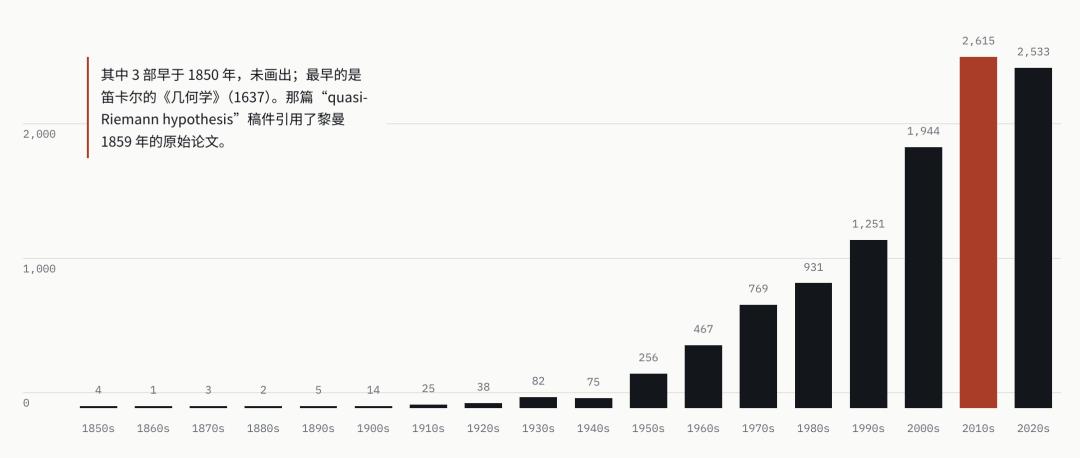
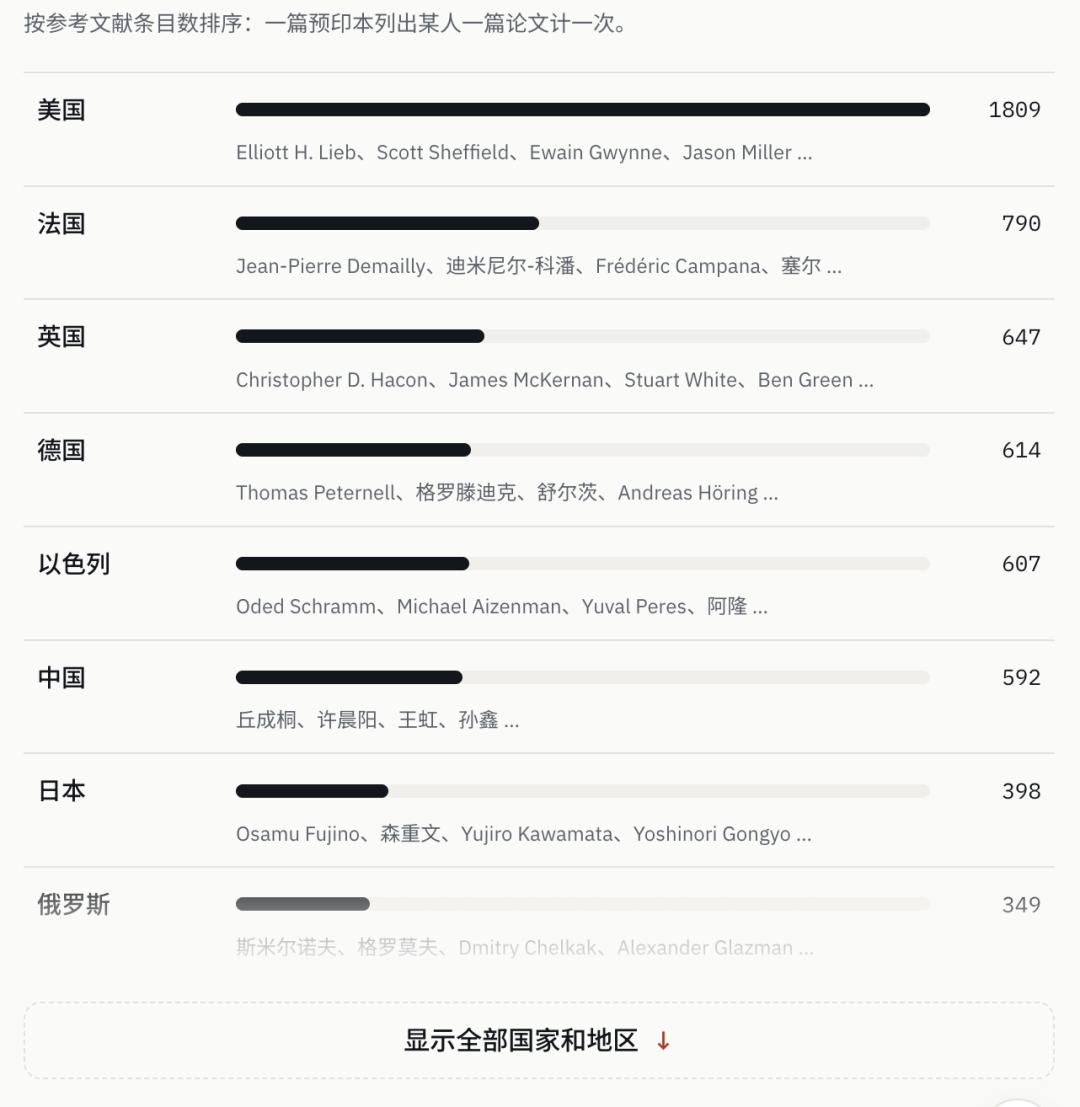
Most of the cited authors are not names from history books, but active mathematicians and theoretical computer scientists today.
As the original content shows, the AI manuscripts treat the achievements of these scientists as tools to use:
In arithmetic geometry, one manuscript cites "[Fargues–Scholze 2024]" to establish the correspondence between certain vector bundles and p-adic local systems, which is the work of Laurent Fargues and Peter Scholze.
In birational geometry, some manuscripts follow the recent strategy of Caucher Birkar and a collaborator, some apply Birkar's theorem on bounded complements; others are built on the induction method of Osamu Fujino, as well as the work of Omprokash Das, Christopher Hacon and Mihai Păun.
In probability theory, the manuscripts rely on the critical crossing estimates for random cluster models by Hugo Duminil-Copin et al., as well as the "mating of trees" theorem by Bertrand Duplantier, Jason Miller and Scott Sheffield.
A graph theory counterexample uses the graph limit sampling construction of László Lovász and Balázs Szegedy; a combinatorial counterexample follows the sum-product method of Jean Bourgain, Nets Katz and Terence Tao.
A manuscript on spin glass uses the cavity method of Michel Talagrand.
One Ricci flow argument uses Perelman's entropy monotonicity from 2002; one Hodge theory argument uses Deligne's semi-simplicity argument.
Every achievement of AI in each field stands on the shoulders of a group of people:
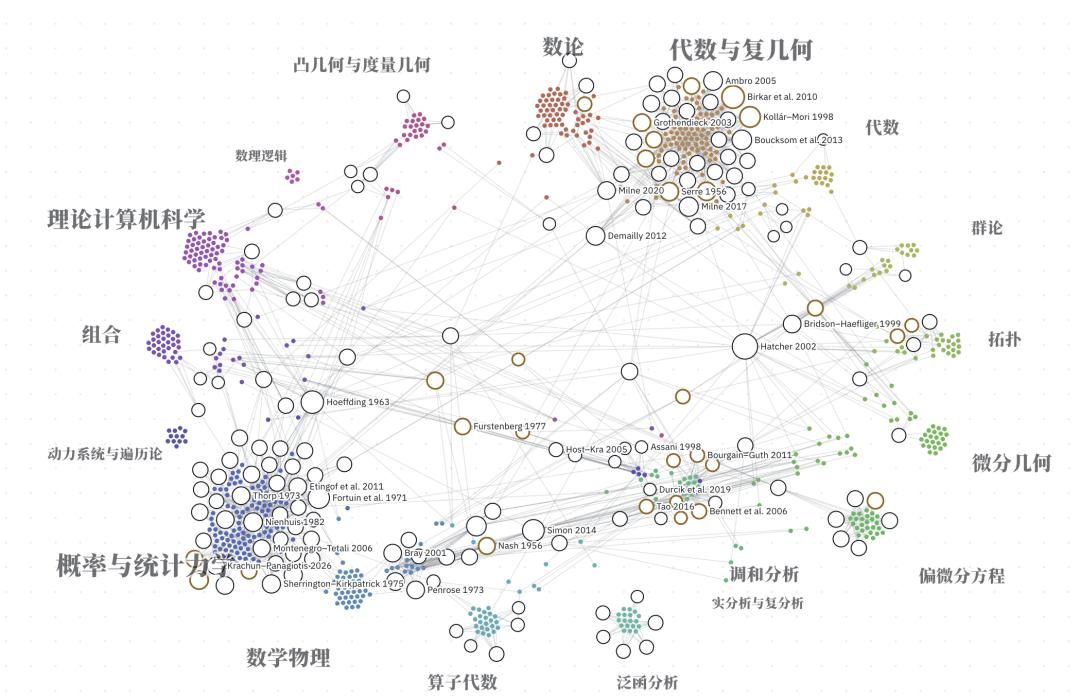
Each small dot is an AI preprint, clustered into "continents" by discipline; the larger circled dots are human papers co-cited by multiple preprints, with their size indicating the number of citations, and their position located between the papers that cite them.

*On Whose Shoulders* project: seafill.info/Shoulders
Data source: github.com/openai/math
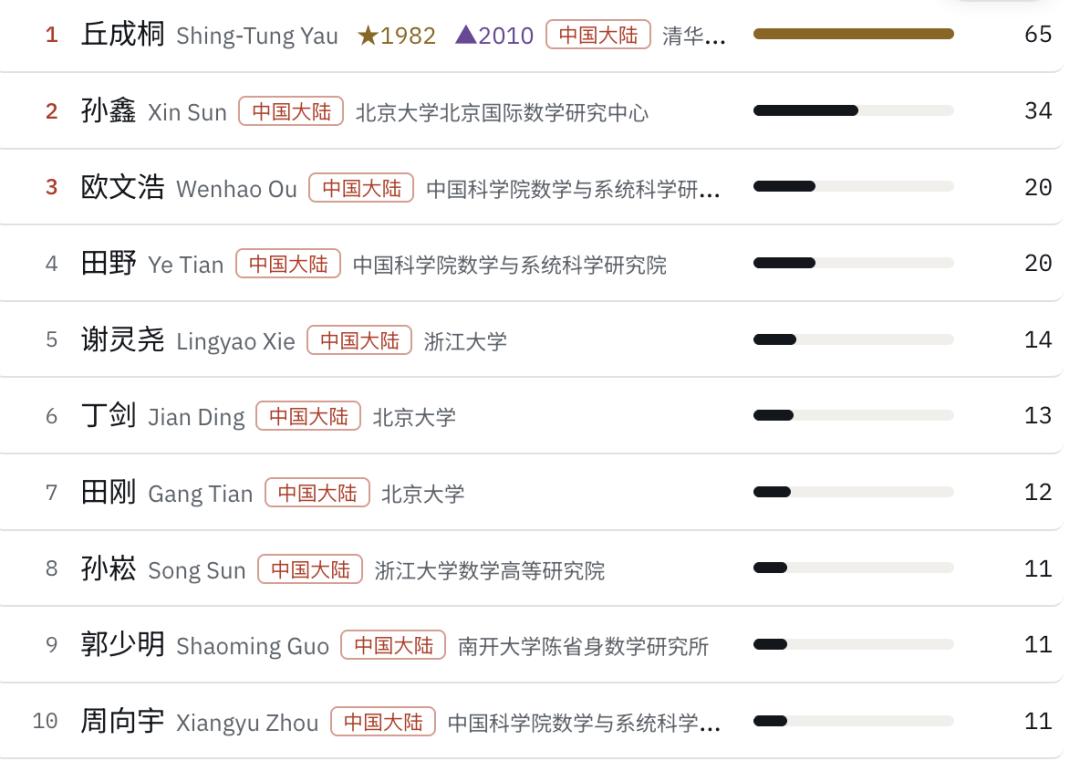
Number of cited works of some active mathematicians in Chinese Mainland
For example, the work of Shing-Tung Yau, Xin Sun, Wenhao Ou, Ye Tian, Lingyao Xie, Jian Ding, Gang Tian, Song Sun, Shaoming Guo, Xiangyu Zhou and others has been repeatedly used by OpenAI.
Chinese mathematicians in this relay:
Shing-Tung Yau's work proving the Calabi conjecture in 1976 is cited by more than 10 manuscripts.
Shiing-Shen Chern's intrinsic proof of the Gauss-Bonnet formula in 1944, and the Chern-Simons form he proposed with James Simons in 1974, are each used in three works; one of them writes "we use the Chern-Simons transgression functional". The affine maximal surface problem studied in two other works was exactly proposed by Shiing-Shen Chern in 1979.
In the recently booming harmonic analysis, OpenAI's 4-dimensional Kakeya manuscript is built on the proof of the 3-dimensional Kakeya conjecture by Hong Wang and Joshua Zahl in 2025, and the Bourgain condition in the proof also cites the 2024 work of Hong Wang, Shaoming Guo and Ruixiang Zhang. For the closely related Bochner–Riesz problem, the 2025 work of Shaoming Guo, Changkeun Oh, Hong Wang, Shukun Wu, Ruixiang Zhang and the 2003 bilinear restriction estimate by Terence Tao are used, listed side by side as the source of the wave packet method.
A manuscript on the abundance conjecture follows the foliation criterion of Chenyang Xu and Lei Zhang. A manuscript on hard sphere gases introduces the estimates for deriving the Boltzmann equation from particle dynamics by Yu Deng, Zaher Hani and Xiao Ma.
The monograph on Ricci flow and the Poincaré conjecture by Gang Tian and John Morgan, the proof of the satisfiability conjecture by Jian Ding, Allan Sly and Nike Sun, as well as the 1957 paper on hard-sphere Bose gases by Chen-Ning Yang, Tsung-Dao Lee and Kerson Huang, are all included in the references...
The above situation also applies to other scientific discoveries. OpenAI's Navier-Stokes equations paper starts from the equation proposed by Euler in 1757, then reviews the weak solution proposed by Leray in 1934 and the partial regularity theorem of Caffarelli, Kohn and Nirenberg. Google AlphaFold is trained on protein structures that structural biologists have resolved one by one over decades; its premise can be traced back to the publication by Anfinsen in 1973, that the sequence of a protein determines its shape.
Engineers build the machine, scientists give it something to learn
For a model that makes scientific breakthroughs (GPT, Claude, etc.), engineers build the machine: architecture, training code, data pipeline, and computing power. Scientists provide high-quality content for it to learn, and also determine where it goes. Pre-training. What the model learns is to predict the next word based on the preceding text.
One AI manuscript reads: "By the splitting theorem of vector bundles on the projective line, E is a direct sum of line bundles". This fact was not discovered by the model.
Alexander Grothendieck gave its classic form in 1957, and since then mathematicians have written this step over and over again in papers, textbooks and lecture notes.
The intuition of scientists is knowing which lemma to use next; the intuition of the model is the probability estimated from thousands upon thousands of "next steps" written by humans. Supervised fine-tuning. The model learns "how to solve problems step by step" on a batch of carefully selected reasoning chains. Some of these reasoning chains are written by humans, and some are synthesized by the model; but the synthesized ones also start from problems and instructions given by humans, and their retention or removal is determined by human-designed tests.
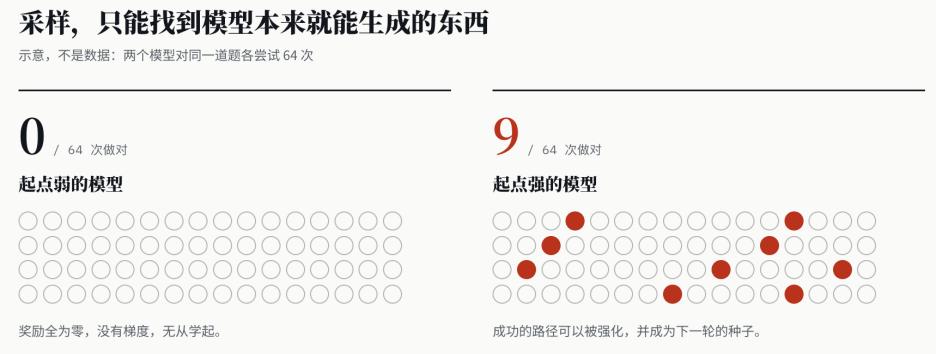
The final reinforcement learning and sampling during inference can only reinforce or find things that the model could already sample originally.
Reinforcement learning and sampling during inference. The model tries a problem many times, and the verifier keeps the correct ones. This relies on sampling: if the model almost never writes a correct proof, all rewards are zero, and there is nothing to learn from.
It is the quality of the previous training data that largely makes "getting it right" go from almost non-existent to occasional. Simply put: engineers make learning possible, and a large part of the learnable content comes from scientists in different fields.
Scientists provide high-quality learning signals
Pre-training and supervised fine-tuning give the model intuition and reasoning methods, but cutting-edge new results rely on large-scale sampling: reinforcement learning during training, search and agents during inference. Their common point is to let the model make many attempts (rollouts) on a problem, and then the verifier decides which ones count.
Successful trajectories can become training data for the next round. But to make this "attempt-verify" loop truly translate into the improvement of model capabilities, the key lies in the quality of the signal. The gradient determines what the model learns from a sample, and its quality depends on the underlying signal.
A large part of the strong signals come from scientists: rigorous proofs give training clear next steps to learn; properly selected problems prevent rewards from being all zero or all one; precise verifiers ensure that the signals point in the correct direction. Whether sampling occurs during training or inference, scientists can be in three positions of this loop.
(1) Selecting problems. Training is most efficient when learning on problems that are "just within reach", and the computing power during inference is most worth spending on such problems. Good problems leave good seeds for the next round of model training, while mediocre problems only leave mediocre seeds. To pick out such problems requires what scientists call "taste". For example, the problem lists of Paul Erdős, Shing-Tung Yau and David Hilbert are doing exactly this.
(2) Defining what counts as correct. During training, the verifier determines the reward; during inference, it determines which one to keep among many attempts. If the verification standard is loose, the model training will exploit loopholes. The reason why mathematics can become the first test ground is that mathematicians have long defined "proof" extremely precisely.
(3) Judging results. On October 7, OpenAI withdrew 3 manuscripts after finding a symbolic error and revised 14 others. Their repository note also states that some unformalized results "may be problematic". Judgments of which results hold, which are important, and which directions are worthy of investing computing power in the next round are still the work of the scientific community.
Therefore, no matter how powerful AI is, it needs a driver. This is like oil extraction: no matter how powerful the drill rig is, geologists need to decide where to drill and judge whether what is pumped up is oil. In the following cycle, scientists select problems, define correctness, and judge results; AI makes attempts at a scale that humans cannot reach.
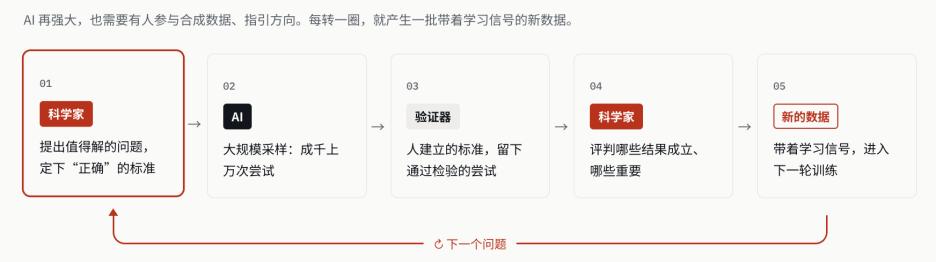
Scientists select problems, define correctness, and judge results; AI makes attempts at a scale that humans cannot reach.
If scientists step back, the gradient signal will weaken
What will happen if scientists really step back?
The model will still sample and still make attempts. But it will be directed to increasingly narrow problems, use increasingly loose verifiers to filter answers, and use increasingly single data to shape its own sampling. Without good instruments, sampling cannot touch new knowledge. More troublesome is that in the absence of external verification, a model that is mainly fed by its own output will gradually degrade.
Existing studies have found that if a model is repeatedly trained on data generated by the model itself, it will lose the rare parts of the distribution and gradually degrade. New problems, new ideas, new experimental data, and the instruments to test them still require the participation of scientists today: to raise questions, design experiments, and judge results. In the future, part of the new data may come from the closed loop between AI and the physical world, such as automated laboratories; but what experiments to do, whether the measurement is accurate, and what the results mean still require the participation of domain scientists.
Therefore, the sentence "AI can solve everything, scientists are no longer needed" is not just about scientists. It will affect where the incentives of society flow, and also affect whether young people are still willing to devote themselves to science. Both of these two things will eventually come back to the model: if there are fewer such people, there will be fewer new problems and fewer verifiers, and the gradient signal will naturally weaken.
Finally
For thousands of years, humans have been the only intelligent life engaged in scientific research, and many discoveries are the result of the lifelong efforts of scientists.
Today, superintelligence is touching the frontiers of science, and what it can prove, discover and predict will only grow more and more.
But every breakthrough is built on those lights: the highest wisdom, the deepest solitude, and the longest efforts of mankind.
Scientists are the bridge connecting human knowledge and AI. This is dedicated to paying tribute to scientists in the era of artificial intelligence — their names should be linked to the achievements built on their work.
The *On Whose Shoulders* research project of the SeaFill AI team was initiated by Qiongxiu Li, assistant professor at the AI Security Lab of Aalborg University, Denmark.
References:
seafill.info/Shoulders
This article is from the WeChat official account AI Era, author: LRST, published with authorization from 36Kr.