Credit crisis in the AI infrastructure sector of US stock market, institutions warn of CRWV default, NBIS and AMD plunge sharply
Three major negative factors have directly hit CRWV and NBIS hard!
In fact, we saw this news yesterday that the yield of CoreWeave (CRWV) unsecured bonds soared to 15%, triggering market concerns over the company's financing cost and debt risk.
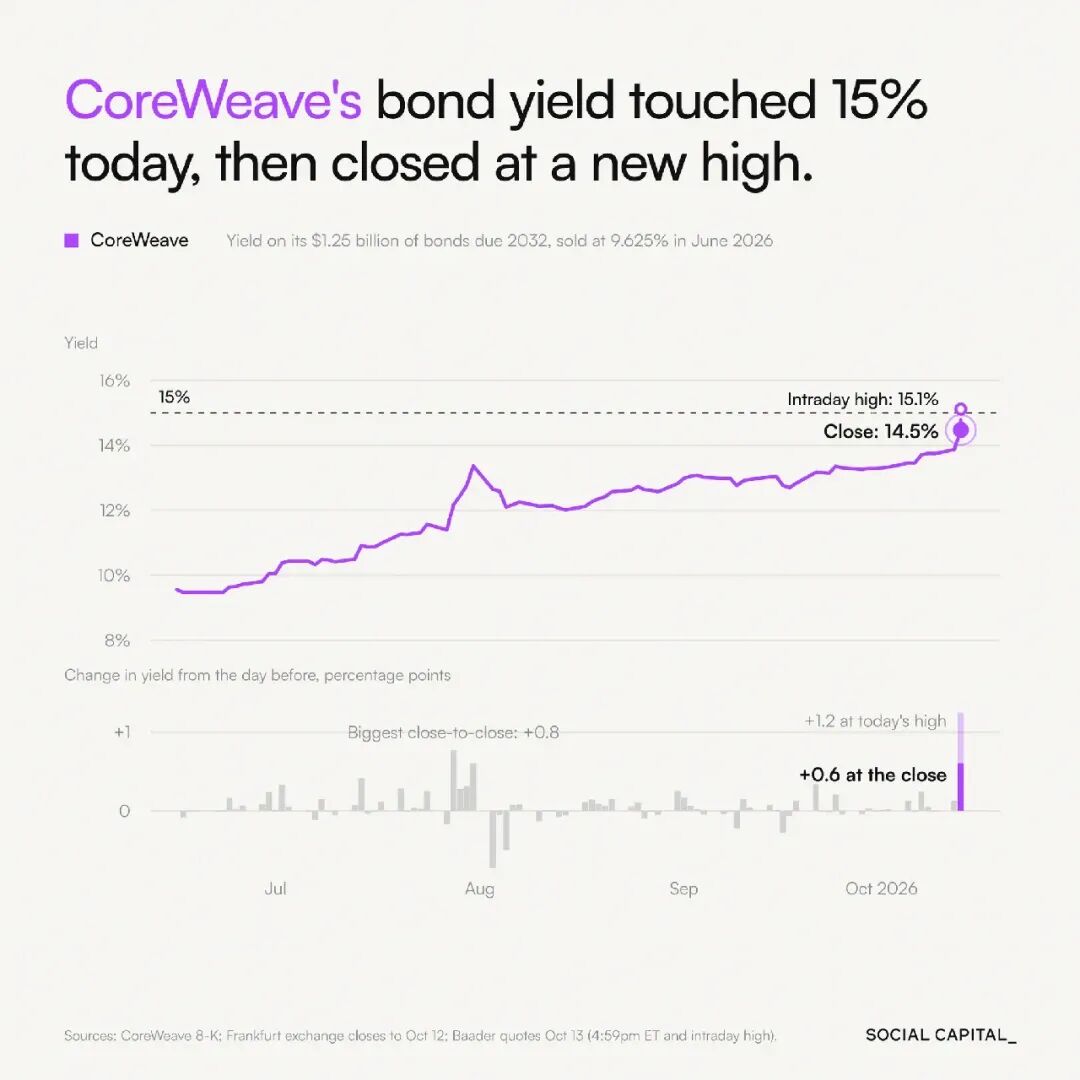
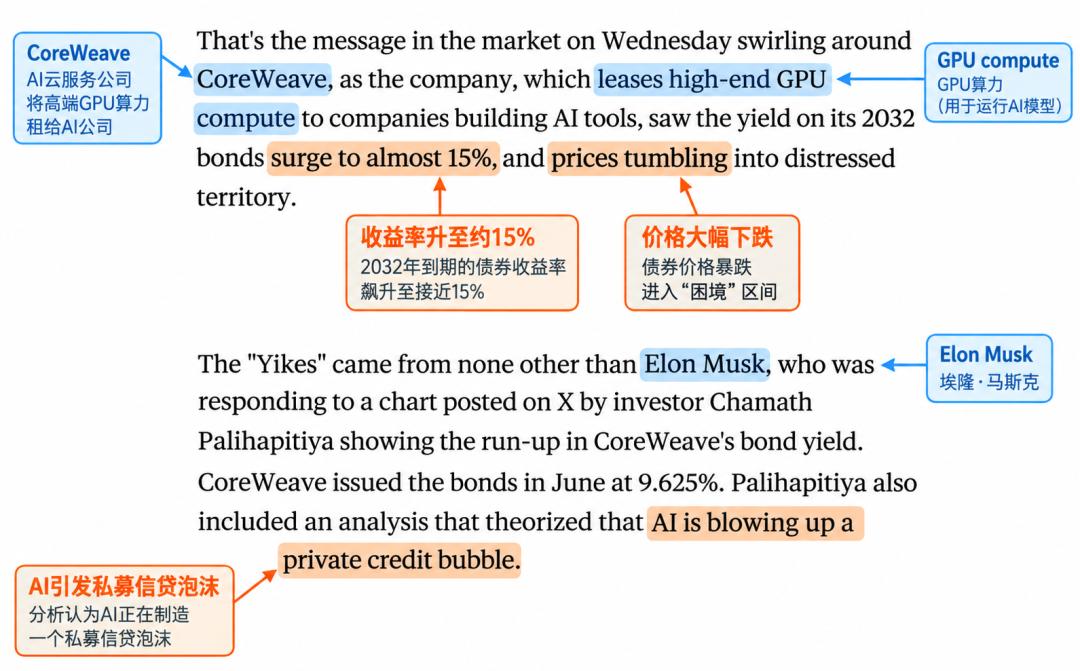
The well-known venture capitalist Chamath Palihapitiya warned that a potential "private credit bubble" may be forming in the AI industry, but after NBIS plunged and rebounded yesterday, I thought it was just an early warning and did not pay much attention to it.
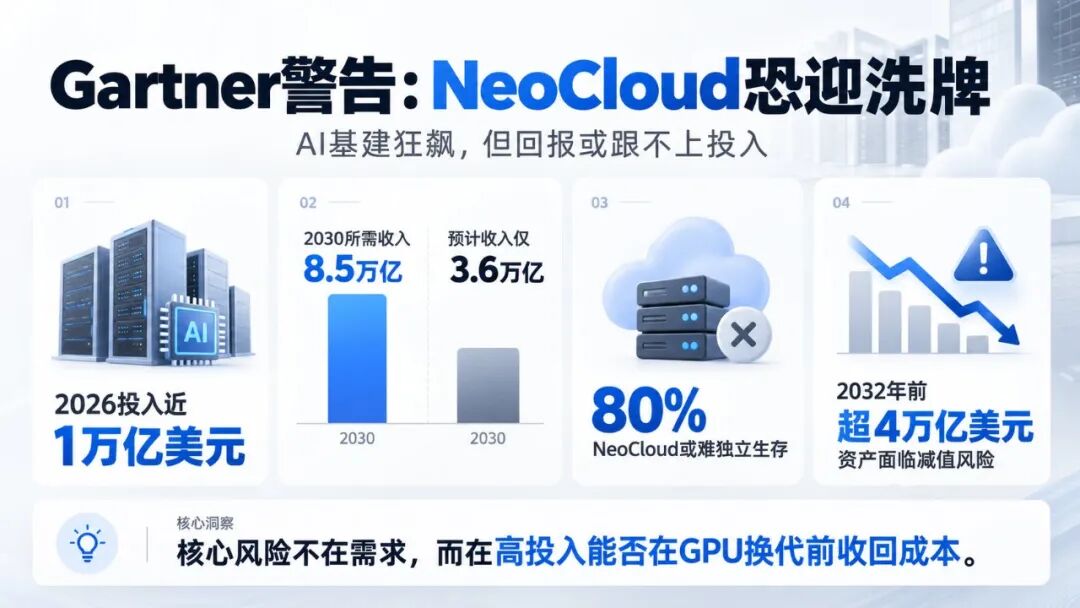
However today, research institution Gartner released a report predicting that if AI infrastructure investment continues to expand at the current astonishing rate, by around 2030, more than 80% of NeoCloud companies will no longer be able to operate as independent enterprises.
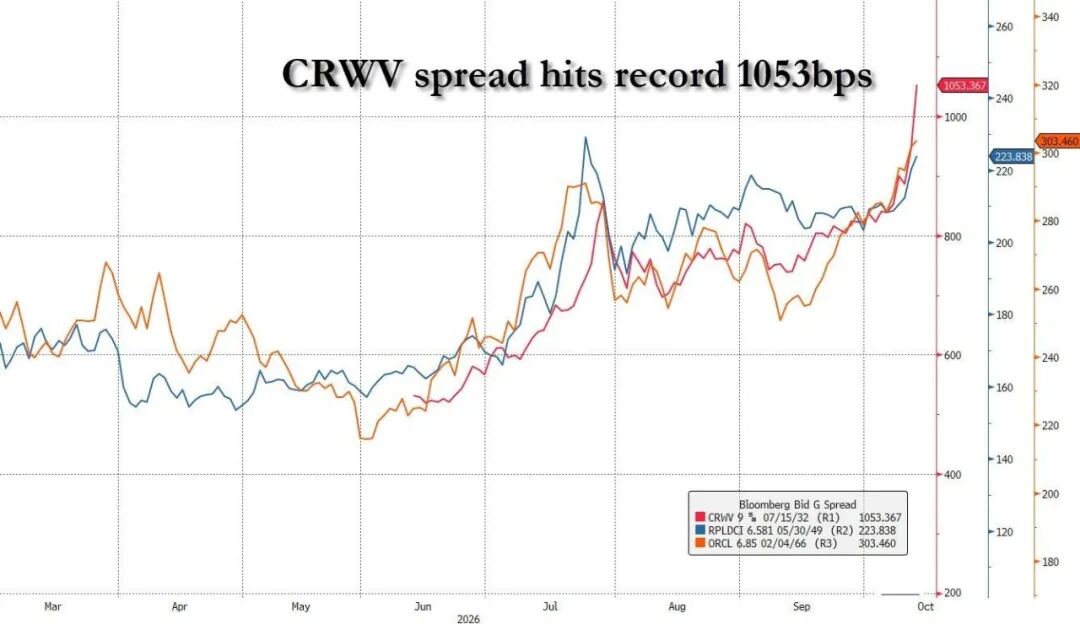
Meanwhile, ZeroHedge issued the latest warning: CoreWeave (CRWV) is mired in "deep credit distress", with credit risk signals continuing to deteriorate, and the credit spread has further expanded from 1,000 basis points yesterday to 1,050 basis points, while the price of Credit Default Swap (CDS) has skyrocketed.
Today, US Stock Investment Network will conduct an in-depth analysis for you on whether CoreWeave is likely to go bankrupt and whether the AI bubble will burst:
Let's first explain the credit signal: 1,050 basis points is equivalent to 10.5 percentage points. If this refers to the bond credit spread, it means that investors require the yield of CRWV bonds to be 10.5 percentage points higher than the corresponding benchmark interest rate.
Generally, a credit spread exceeding 1,000 basis points falls into the severe credit pressure zone. CDS is similar to debt default insurance. The higher the price, the greater investors' concerns about default risk, and the higher the cost they are willing to pay to purchase protection.
Why is it worth alerting?
CRWV is highly dependent on external financing to build AI data centers. The yield of its 9.625% bonds maturing in 2032 has risen to about 15%, and the market is reassessing its solvency and future financing costs.
In addition, CoreWeave is planning to introduce insurance capital today to reduce the financing cost of purchasing AI chips and building infrastructure. This year, the company has raised more than 35 billion US dollars through chip mortgage loans, various bonds and stock issuances, with a large volume of debt and lease obligations, and continues to raise funds for the expansion of AI business.
Let's first look back at August this year, when CRWV completed a 2.6 billion US dollar financing arrangement:
CoreWeave DDTL 5.5 Financing Structure
Loan term: about 5 years
Average term of underlying customer contracts: about 3 years
The loan is about 2 years longer than the customer contract. This only refers to this specific financing, and does not represent all debts of CRWV. This means that before the loan matures, the customer contract that initially supported the financing may have expired, and the company needs to renew the contract, find new customers, or rely on other cash flow and asset value to fulfill its debt obligations.
Assuming CRWV purchases a batch of GPUs and uses the customer rent of the first three years to repay the loan. But three years later, NVIDIA has launched new GPUs with higher performance and lower unit Token cost, and customers require a significant price reduction. Even if the GPU can still operate normally, the future rent may be far lower than the initial estimate.
CRWV may face threefold pressure:
Decline in GPU residual value
Decline in rent
Rise in refinancing cost
It needs to be emphasized that matching five-year debt with three-year customer contracts does not mean that there will inevitably be a funding gap after five years. The loan may have been partially amortized during the contract period, and there may be additional collateral, cash reserves and new customer revenue. But it does transfer a certain degree of renewal risk to lenders. This is why Wall Street has begun to reassess these GPU mortgage loans.
The market has begun to diverge, and not all AI debts are welcomed.
A debt for xAI chip financing traded at about 99% of its face value in December 2025, and later rose to 106% as SpaceX acquired xAI.
But the opposite is true for another Project Jupiter financing related to Oracle data centers. Project Jupiter involves about 18 billion US dollars of data center loans, facing concerns about construction progress, power infrastructure, local opposition and Oracle's credit status.
This shows that the market does not simply consider all AI debts as bad debts, but begins to treat the cash flow, execution capacity and credit support of different borrowers and projects differently.
What is more noteworthy is that the Financial Times reported on October 10 that the issuance of AI-related debts fell to about 23 billion US dollars in September 2026, less than half of that in August. This may be an early signal that the capital market is beginning to tighten, but it is not enough to prove that a systemic credit crisis has broken out.
Next, let's look at the warning released by research institution Gartner that there may be severe overinvestment in the AI industry in the future. The demand for computing power continues to grow, but the profits and return on investment of computing power leasing companies are declining.
In order to cover the announced capital expenditure and financing cost, and achieve a 12% Return on Invested Capital (ROIC), the owners of AI data centers need to cumulatively generate 8.5 trillion US dollars in revenue by 2030.
But the problem is, it is expected that by 2030, the revenue scale related to AI data centers can only reach 3.6 trillion US dollars. This is a huge gap.
Sommer further said: "Since most AI-native service providers adopt an asset-light business model, we expect that service providers with a large number of AI infrastructure assets will eventually get less than half of the total AI industry revenue."
Based on these forecasts, Gartner believes that more than 80% of NeoCloud service providers will struggle to survive as independent enterprises after 2030.
If AI infrastructure continues to expand along the current trajectory, more than 4 trillion US dollars of asset value may face the risk of write-down by 2032.
Under this scenario, Gartner expects the entire industry to wait at least until the end of 2032 to achieve a 12% return on invested capital.
Under this pessimistic forecast, large cloud computing giants such as Amazon, Google and Microsoft are in a more favorable position for survival. The reason is that these enterprises have large and highly diversified revenue sources.
In contrast, NeoCloud companies must rely on AI-optimized Infrastructure as a Service (AI-optimized IaaS) platforms to obtain a sufficiently high return on investment to maintain operations.
Gartner predicts that spending in the AI-optimized IaaS market will grow from 66 billion US dollars in 2027 to 174 billion US dollars in 2030.
Sommer finally warned:

"The growth of spending in the AI-optimized IaaS market is still too slow for most AI computing power providers to recover their AI investments before the current generation of AI semiconductors is replaced by the next generation of products."

US Stock Investment Network believes that the most fatal problem is the mismatch between the economic life of GPUs and the investment recovery cycle.
Assuming a NeoCloud company invests 10 billion US dollars to buy GPUs and expects to get the capital back in five years. But in the third year, NVIDIA has launched a new generation of GPUs with stronger performance and lower unit inference cost.
This company may face a very awkward situation: the old GPUs have not yet recovered the cost, and the new GPUs have begun to push down the market rental price.
If the lease term is not long enough, customers may also request a price reduction or directly switch to a new computing power platform. At the same time, the principal and interest of the loan for building the data center still need to be repaid. This is why the continuous growth of computing power demand does not mean that computing power leasing companies will definitely make money.
Why is CRWV more worrying than NBIS?
By comparing the latest financial data of the two companies, you can understand why the market has begun to reprice credit risk.
CoreWeave's revenue in the second quarter of this year reached 2.575 billion US dollars, a year-on-year increase of about 112%, and the backlog composed of unfulfilled contracts and other promised revenue was about 104 billion US dollars, indicating that the market demand is indeed strong.
But in the same quarter, CRWV's net interest expense reached 640 million US dollars, accounting for about 25% of the quarterly revenue, and the net loss was 626 million US dollars.
In contrast, NBIS's revenue in the second quarter was 582 million US dollars, which is much lower than that of CRWV, but it had about 8 billion US dollars in cash by the end of the second quarter, and completed an asset-backed financing with an interest rate of SOFR plus 2.5 percentage points in July.
This means that NBIS has advantages in some financing channels, but it does not mean that it is necessarily safer. Both companies need huge capital expenditures, and NBIS has not yet proved that it can continuously generate positive free cash flow after rapid expansion.
I think the next step should focus on comparing the capital investment per megawatt (MW), annual contract revenue, actual cash recovery cycle of the two companies, and the debt maturity pressure in the next three years.
80% of NeoCloud cannot operate independently, does it mean that 80% will go bankrupt?
Answer: No.
This is the most easily misunderstood part of the market.
Gartner predicts that more than 80% of NeoCloud providers will cease independent operations, not explicitly predicting that 80% will go bankrupt.
Possible scenarios include mergers between companies, acquisitions by large cloud vendors such as Microsoft or Amazon, asset sales, and debt restructuring.
In fact, Gartner also predicted in June this year that NeoCloud companies will occupy 20% of the AI cloud market with a scale of about 267 billion US dollars by 2030.
These two judgments are not contradictory.
The entire NeoCloud market may continue to expand, but eventually the market share will be increasingly concentrated in a few winners.
The collective plunge in stock prices today is not entirely caused by the Gartner report, and there is a macro factor that cannot be ignored.
Today, US inflation data was higher than expected, and the market began to increase bets on the Federal Reserve to raise interest rates further. For enterprises that need continuous financing to build data centers, this is undoubtedly adding insult to injury. Reuters also listed the rising interest rate expectation as an important reason for the sharp drop of AI infrastructure stocks today.
So today is actually a superposition of two major negative factors:
Long-term concerns about the return on AI infrastructure investment
And the short-term risk of rising financing costs
My Final Judgment
US Stock Investment Network believes that the most noteworthy part of this Gartner report is not the so-called disappearance of 80% of companies, but that it reveals a problem that may change the valuation system of the entire AI industry chain:
In the past, Wall Street valued AI infrastructure companies based on the growth of GPU demand, and in the future it may increasingly value them based on return on capital.
In particular, companies such as CRWV, NBIS, IREN, and APLD cannot only tell investors how many billions of dollars in contracts they have signed and how many GW of power they have in the future, but must also prove that these investments can recover costs within a reasonable period.
I don't think this means that the AI industry is about to collapse. In fact, if GPU rental prices continue to fall, it may instead stimulate more enterprises to adopt AI and expand the entire AI application market. But this may not be beneficial to companies that buy and rent GPUs.
In the future, AI may show a very distinct differentiation: AI applications are becoming more and more popular, and more and more enterprises using AI are making money, but some companies that bear huge computing power capital expenditures may instead suffer serious losses due to fierce competition and high depreciation.
This has a certain similarity with the Internet and telecommunications optical fiber construction boom in those years.
In addition, regarding the judgment of this Gartner report on October 14, 2026, I think one point needs to be reserved: the huge gap between 8.5 trillion US dollars and 3.6 trillion US dollars is based on its forecast assumptions such as revenue, capital expenditure, asset life and target rate of return. This is a risk scenario that deserves high attention, not a 4 trillion US dollar loss that is certain to happen.
From an investment perspective, I will pay more attention to the survival of the fittest among NeoCloud. If CRWV really goes bankrupt, it will definitely benefit NBIS in the end. I have made a lot of money on NBIS this year, and I have given back 20% in the past few days.