The next golden age belongs to the organizations that have achieved proper strategic alignment.
Five approaches to anchoring your strategic core that help businesses maintain steadiness amid turbulence.
Imagine you are a member of the capital allocation committee at a large corporation whose business spans eye care, consumer health products, generic drugs, and innovative pharmaceuticals. Two proposals are currently pending review. The first requests billions of dollars in funding to build a new-generation production base for manufacturing consumer health products such as over-the-counter painkillers. The logic behind this investment is straightforward: market demand is stable, profit margins are predictable, and production processes are already highly mature.
The second proposal also requests billions of dollars to acquire three leading companies in radioligand therapy, an emerging therapeutic field. This is an entirely new cancer treatment method that attaches radioactive particles to specific molecules to achieve highly precise targeted tumor therapy. The technology holds promising prospects but is still in its early stages, with innovative production processes and an unclear regulatory path, making it an "edge case investment" — an investment that goes beyond traditional investment logic, features high risks, and carries high upside potential.
How should you choose? The factory proposal for producing over-the-counter painkillers feels safe and reliable, while the investment in radioligand therapy carries high risks. The economic benefits of the former can be calculated through models, but the potential returns of the latter can only be imagined. Under traditional capital allocation logic, the safe option usually prevails.
However, if an enterprise decides to shape its organizational identity, formulate strategies, and allocate resources around a clear and consistent organizational principle, the safe choice may not be the best option. Another bet may be wiser, as the leaders of the company I just mentioned — Novartis — discovered. At that time, Vasant Narasimhan, CEO of Novartis, focused on the R&D of innovative drugs to truly help patients in specific disease areas, so he did not regard the investment in radioligand therapy as a gamble. In his view, this investment was directly aligned with Novartis's strategic direction.
Shortly after Narasimhan learned the scientific principles behind radioligands, Novartis acquired two leading companies in the field. Today, Novartis is a global leader in a small but promising field that has the potential to transform cancer treatment. As for Novartis's consumer health product business? It has been divested.
What follows gets interesting. In 2018, when Narasimhan took over as CEO of Novartis, the combined valuation (market capitalization) of all its businesses ranged from $190 billion to $200 billion, with a total of 126,000 employees. Today, this smaller company focused on innovative pharmaceuticals has a market capitalization of approximately $300 billion and only 76,000 employees. Alcon, the eye care company spun off by Novartis in 2019, currently has a market capitalization of around $40 billion; Sandoz, the generic and biosimilar drug company spun off in 2023, has a market capitalization of about $35 billion. Haleon, the company spun off by GSK that includes the consumer health business divested from Novartis, has a market capitalization of roughly $40 billion. Calculated in this way, the total market capitalization of these independently operating companies today is about twice Novartis's original valuation; and during this period, there have been no significant changes to their respective core businesses (excluding dividends and share repurchases).
The strategic concept embodied in Narasimhan's move is, in my opinion, exactly what today's business environment urgently needs. In this era, enterprises face extreme uncertainty, industry boundaries are constantly blurring, and value creation is accelerating its shift from tangible to intangible assets. I call this concept "strategic centering": the deliberate selection of an organizational principle by an enterprise to provide clear direction and internal consistency for its strategy, especially when traditional anchors — stable market positions, mature industries, and long-term tangible assets — gradually lose their effectiveness.
In the following article, I will introduce this concept and sort out different types of "strategic centering" that enterprises can consider. But before expanding on that, I will start with the background of this idea.
The End of the "Stuff Economy"
Most of the strategic frameworks that corporate executives rely on were formed in an era we can call the "stuff economy". Michael Porter's groundbreaking Five Forces Model played a remarkable role in an era where industry boundaries were stable and the roles of various participants (buyers, suppliers, etc.) were clearly defined. The resource-based view is built on the assumption that enterprises can acquire or create assets and capabilities that are valuable, rare, durable, and difficult to imitate.
Even Chan Kim and Renée Mauborgne's influential Blue Ocean Strategy assumes that managers create definable market spaces where they can clearly determine whether existing competition exists. These frameworks were reasonable in an era when most corporate value resided in tangible assets such as factories, distribution networks, inventory, and equipment. In 1975, about 83% of the book assets of Fortune Global 500 companies were tangible assets. Strategy at that time was essentially about identifying opportunities or defending positions in physical space.
Today, this proportion has reversed: about 90% of corporate value comes from intangible assets such as software, data, brands, networks, intellectual property, and organizational capabilities. The "technological revolution" referred to by economic historian Carlota Perez has accelerated this shift. Such revolutions usually occur every half a century, reshaping not only technology itself but also the entire logic of economic operation. She argues that there have been five "technological revolutions" in the history of capitalist development, each driven by a low-cost input that can be widely applied across the entire economic system. These five revolutions are: the First Industrial Revolution, the Age of Steam and Railways, the Age of Steel and Electricity, the Age of Oil, Automobiles and Mass Production, and the current Age of Information and Communications.
Each revolution follows a certain pattern. During the irruption phase and installation phase, massive amounts of financial capital pour in, bubbles form continuously, and inequality intensifies. Then comes a turning point — a period of economic crisis and institutional adjustment. Finally, in the deployment phase, the new paradigm is gradually established, the institutional system adapts accordingly, and a new era of inclusive prosperity becomes possible.
We are at such a turning point. The signs are all too obvious: huge income gaps, intensifying political instability, widespread discontent, and the productive potential of the old strategic paradigm has been exhausted without being replaced by a new one. A defining feature of this transition phase is what I call "dematerialization": value creation is shifting from physical products to digital services, collaborative ecosystems, intangible assets, and experiences.
Take the changes in the music industry as an example. In the past, when you wanted to listen to a favorite song, you had to buy sheet music to play it. Later, you could discover new songs by listening to the radio. If you really liked a song, you could buy a record to listen to the artist's original performance; later, that turned into buying a CD. Today, most people no longer buy physical music products. Music is transmitted wirelessly to devices, and algorithms recommend songs to listeners based on their preferences. This shift from physical products to "dematerialized" services is taking place in one industry after another, including media, financial services, healthcare, and even manufacturing.
As value continues to "dematerialize", old strategic anchors disappear. When digital technology breaks down industry boundaries, what exactly is your industry? Where is your competitive advantage in the digital age, where intangible assets can be quickly replicated or surpassed? How do you determine your planning cycle when technologies emerge, converge, and become obsolete in years rather than decades? Corporate executives need a new anchor — not to defend positions, but to lock in a strategic core.
What "Strategic Centering" Is, and What It Is Not
In a world where value creation is increasingly "dematerialized", "strategic centering" means that an enterprise consciously selects an organizational principle to guide resource allocation, opportunity selection, and the shaping of organizational identity. This requires the enterprise to answer a simple yet profound question: What are we really here to do?
"Strategic centering" is different from "purpose". Today, the concept of "purpose" is too broad and idealized to play a practical role in strategic decision-making. (For example, a theater troupe with the purpose of "creating art that touches people's hearts" does not have a clearer basis for deciding whether to produce experimental plays or popular musicals than troupes that have not put forward a purpose.) "Strategic centering" is also different from "vision". The latter is often regarded as a static end point rather than a dynamic direction. It is definitely not a "core competence". When underlying technologies change, core competencies can become constraints for enterprises.
The concept of "strategic centering" is more aligned with Theodore Levitt's famous question to railroad executives: "Are you in the railroad business, or the transportation business?" But the connotation of "strategic centering" goes a step further. Because in a "dematerialized" world, the problem is no longer just to broaden the definition of your own industry. More importantly, when the industry itself is constantly blurring, how an enterprise chooses a dimension to explore a coherent portfolio of opportunities.
A strategic core serves three purposes. First, it defines the scope of the opportunity portfolio without closing it off. Enterprises know they cannot chase every opportunity, but a strategic core helps them explore a range of possibilities with a shared logic. When Novartis took innovative drugs as its strategic core, it was not just narrowing its business scope; on the contrary, it opened up a whole landscape of therapeutic technologies, including radioligand therapy, gene therapy, and small interfering RNA (siRNA) drugs, opportunities that would otherwise have been obscured by the old group structure.
Second, "strategic centering" solves the capital allocation dilemma. In a diversified enterprise without a core, every investment decision can turn into a game of conflicting logics. Once an enterprise clarifies its strategic core, resources will naturally converge in that direction. Going back to the earlier example, the investment debate over "painkillers vs. radioligands" no longer exists.
Third, defining a strategic core enables what I call "permissionless action". When employees at all levels of the organization have a clear consensus on this core, they can make independent decisions and take actions without waiting for approval from their superiors. They know the direction to move forward, so they do not need to seek permission for every step. This significantly improves organizational speed and reduces the benefits people gain from internal political games. When the organization's focus shifts from climbing the hierarchical ladder to upgrading the strategic core, its operating logic will undergo fundamental changes.
Five Approaches to Defining Your Strategic Core
My research identifies five types of "strategic centering", each built on a different organizational principle (see the chart "Five Types of Strategic Cores"). Strictly speaking, they are not mutually exclusive, and any enterprise may have elements of several of them at the same time. But the organizations with the clearest strategies often have a dominant core and the discipline to put it above other considerations.
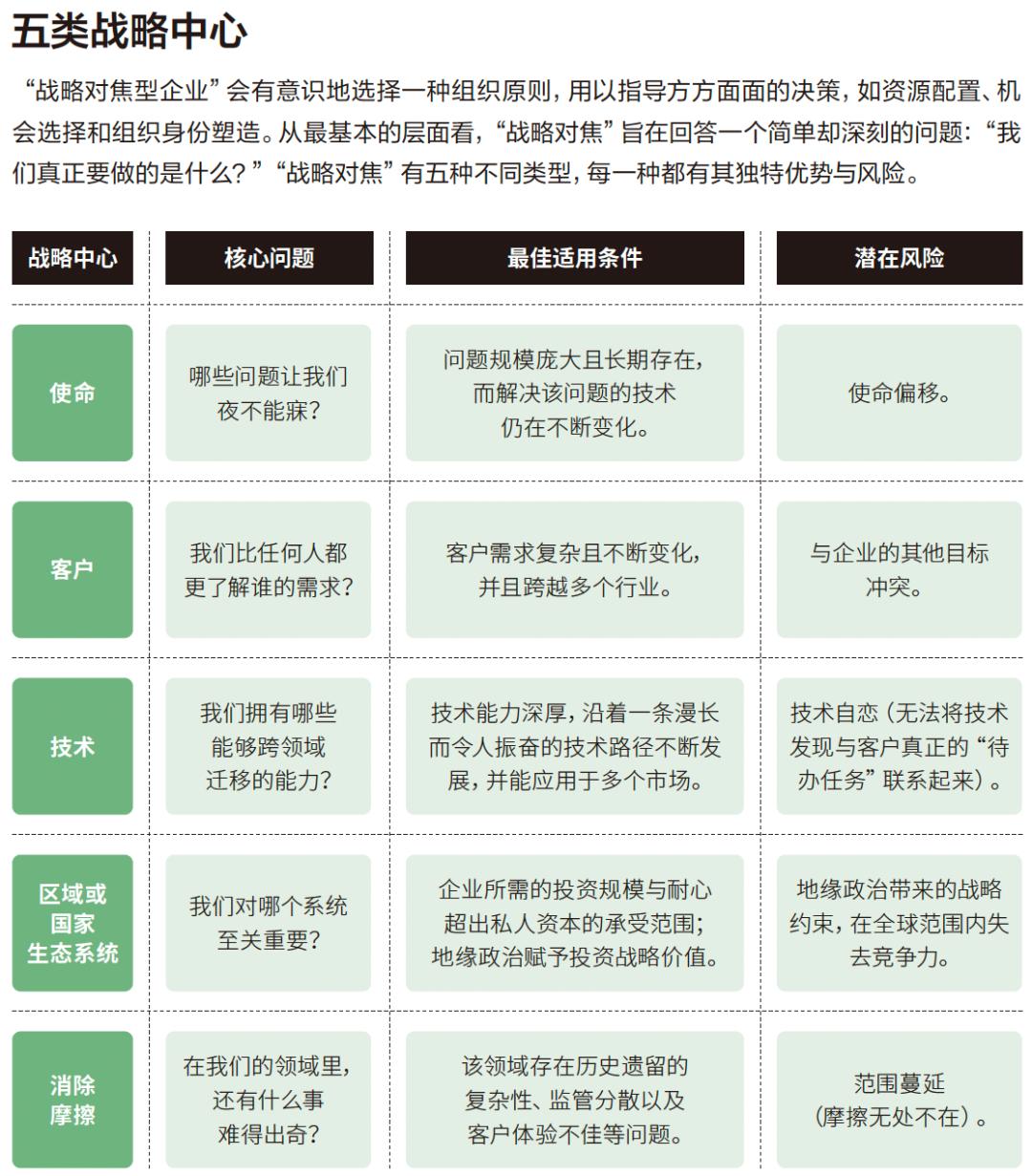
Mission-Centered: "What Problem Are We Solving?"
Being mission-centered means that the enterprise's organizational principle is a problem to be solved, not limited to a specific technology, customer group, or product category. The enterprise will keep exploring along this problem, no matter where it leads.
Novartis under Narasimhan's leadership is a clear example. By focusing on R&D of innovative drugs in specific therapeutic areas, Novartis gave itself the freedom to explore any of the most promising therapeutic technologies, even if these technologies (such as radioligand therapy) are completely different from the company's traditional compound R&D path. Narasimhan's scientific background gave him a unique advantage in identifying these opportunities; but what really gave Novartis clear direction and the ability to act quickly was its capacity for "strategic centering".
Canadian e-commerce company Shopify provides another example. The company's mission — "to make commerce better for everyone" — has led Shopify to gradually expand from a simple online store business to payment processing, logistics and distribution, POS (point-of-sale) systems, and business financing. From an industry perspective, such a business portfolio may seem inconsistent; but from a mission perspective, it is highly consistent.
The mission-centered approach works best when: the problem the enterprise is solving is significant enough to support decades of continuous exploration; the technologies relied on to solve this problem are still constantly changing; and the enterprise has deep professional experience in the field, enabling it to span technology iteration cycles and continuously transfer capabilities. The risk is "mission drift" — the enterprise keeps broadening the scope of its mission until it covers everything and becomes meaningless.
Customer-Centered: "Who Are We Serving?"
Being customer-centered means that the enterprise's organizational principle is built on a deep understanding of customers and their evolving needs. The enterprise must follow the direction of these needs and cross industry boundaries when necessary. The "jobs-to-be-done" concept proposed by Tony Ulwick and Clayton Christensen is very inspiring in this regard. Enterprises need to ask themselves: "What jobs can we do for these specific customer groups?"
Amazon's early development history is a model example. The operating principle of "starting from the customer and thinking backwards about how to use online technology to meet their needs" drove all kinds of investments: from 1-Click ordering to Prime membership services, and then to Amazon Web Services (AWS). AWS originally started as a set of internal infrastructure solutions designed to serve customers better and faster. The customer-centered principle provided Amazon with a consistent business logic, allowing it to expand from books to electronics, cloud computing, streaming media, fresh groceries, and even healthcare, a development trajectory that completely breaks the limits of traditional industry classification.
Brian Chesky, co-founder of Airbnb, returned to what he calls "founder mode", which is a story of "re-centering". After a period of strategic drift, Airbnb became a real estate platform that tended to serve landlords and institutional operators. In response, Chesky pulled the company's strategic core back to the customer experience — travelers who want to "belong anywhere". This "re-centering" drove Airbnb to redesign its products, search experience, and relationship with the landlord community.
The customer-centered approach works only when customers' needs are complex and constantly changing, crossing traditional industry boundaries, and a deep understanding of customers can continuously accumulate advantages. The risk of this approach is that over time, the goal of truly adhering to "customer centricity" may conflict with other goals of the enterprise. For example, Amazon has been criticized for allowing ads to interfere with customer experience. This may mean that the company is gradually deviating from its strategic core. Southwest Airlines, under pressure from activist investors, began to introduce (once unthinkable) assigned seating, tiered services, and baggage fees, and was criticized for becoming no different from other airlines.
Technology-Centered: "What Can We Do With Our Capabilities?"
Being technology-centered means that the enterprise's organizational principle is a set of deep technological capabilities, and it looks for application scenarios in any field where these capabilities can create value. This model is not tied to specific customers and markets; the enterprise follows the direction of technology application and extends wherever it can be implemented.
The comparison between Fujifilm and Kodak is one of the most enlightening cases in modern business history. Back then, both companies faced the same turning point — digital photography was destroying their core film business. The CEO of Kodak mistakenly focused on the photo printing business, leading the company to become a relatively small B2B enterprise with 4,000 employees today. Fujifilm, by contrast, now has more than 72,000 employees and is developing strongly. The difference between the two lies in their different strategic cores.
Fujifilm reviewed its film business and began to shift its focus to underlying technologies — compounds, precision coating, optical films, and imaging science — no longer limited to a specific type of customer. This line of thinking led the company to enter multiple fields: cosmetics (leveraging its technical expertise in collagen films and antioxidants), medical imaging, pharmaceuticals, and advanced materials for LCD displays. These application areas seem unrelated, but from the perspective of "strategic centering", they have internal consistency.
Two companies in the energy industry show how different the technology-centered approach can be. Oil giant Shell positions itself as a "molecules company", which means that even as it gradually exits the fuel business, its future development direction remains in plastics, chemicals, and hydrocarbon derivatives. By contrast, BP positions itself as an "integrated energy company", whose development direction naturally extends to solar energy, wind energy, nuclear energy, and battery technology. The "strategic centering" approaches of these two companies have brought completely different opportunity portfolios, capability investments, and organizational identities. Ultimately, this has led Shell and BP into different competitive arenas.
The technology-centered approach works when an enterprise has deep technological capabilities that can be transferred across different fields, and it has a compelling roadmap for continuous improvement. For example, Nvidia focused on parallel computing architecture and grew from the field of game graphics processing to become the backbone of the AI revolution. In this case, the enterprise discovered new possibilities through the technology-centered approach that were almost unimaginable when the strategic core was first established. The risk of this approach is "technological narcissism": the enterprise is so obsessed with its own technological capabilities that it misses the critical moment when technology becomes obsolete, or fails to connect its technological capabilities to truly important problems.