WeChat has joined the competition in the short drama track, and the players in this sector no longer only take Hongguo's quotations as the benchmark.
The offer from Hongguo has for the first time attracted heavyweight players to raise the stakes.
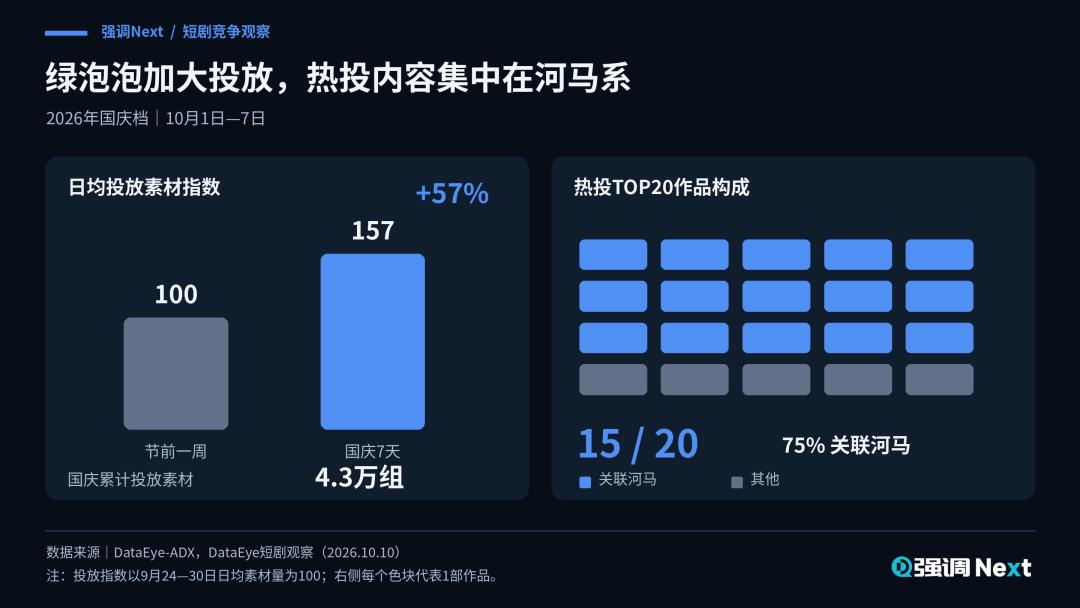
Starting from October 16, WeChat's new round of mini-program incentive program for micro short dramas will be launched again. High-quality new dramas jointly distributed by Lv Paopao can get up to 100% revenue incentive. Previous data shows that during the 7-day National Day holiday, Lv Paopao short dramas on WeChat had a total of 43,000 sets of launched materials, with the average daily material volume increasing by 57% compared with the week before the holiday.
WeChat is reaching out to content producers on one hand and audiences on the other. Standing in its way, Hongguo already hit 168 million daily active users in July, surpassing the combined total of about 155 million of Tencent Video, iQiyi, Youku and Mango TV. Lv Paopao cannot catch up with this user scale in the short term, but it does not need 168 million users to drive up the quotation for the next hit drama.
Over the past year, short drama production companies have basically only had one major buyer. The revenue sharing ratio, guaranteed minimum payment and traffic allocation are all decided by Hongguo, and the pricing of a drama is almost set by it. With WeChat entering the market with incentive policies, content producers have for the first time got a second quotation from a major player, even if this quotation is currently supported by subsidies.
How long the subsidies can last, and whether WeChat's distribution efficiency can match the traffic scale of Hongguo, will determine whether this quotation is a long-term variable or just a temporary boom. As for whether the extra revenue can finally stay in the pockets of content producers, that is another separate calculation.
WeChat is giving up revenue share and also tapping into the advertising business of content producers
WeChat has no shortage of audiences for short dramas. Data from QuestMobile shows that in February this year, the monthly active users of WeChat short drama mini-program channels reached 427 million, exceeding the 335 million of independent short drama App channels. The problem is that these audiences are scattered in different mini-programs and leave after finishing watching one drama. What Lv Paopao is doing is to aggregate dramas together, so that users can smoothly swipe to the next one after finishing the current drama.
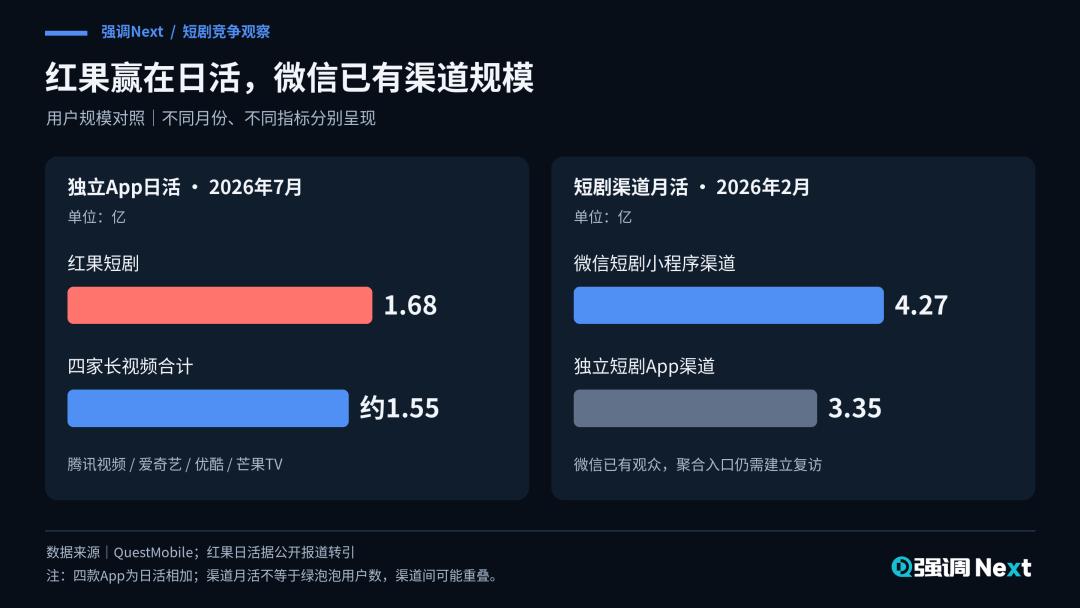
Aggregation is exactly the capability that WeChat needs to prove. Audiences used to click into a certain mini-program to watch dramas through advertisements, and they will not automatically develop the habit of following dramas on this official entrance just because WeChat has launched it. The predecessor of Lv Paopao was registered in April 2025, renamed in July this year, and was still significantly increasing its launch volume during the National Day holiday. WeChat's channel scale has long existed, but the aggregated product still needs to acquire users on its own.
After acquiring users, WeChat starts to redistribute them. In the new round of incentives launched on October 16, the maximum 100% revenue incentive consists of 90% cash share and 10% advertising credit, of which 10% can only be used for promotion. Joint distribution also connects to promotion channels such as Tencent Marketing and Video Account. The higher the share content producers get, the smoother the path that guides them to buy exposure in return.
Thus WeChat stands at both ends of the transaction.
It gives up content revenue share, and earns money from content producers buying traffic; the more producers invest in promotion and the more intense the bidding is, the more expensive the advertising spaces will be, and the more revenue it can get from this end.
While bringing more exposure to more works, it also makes more content producers compete for the same batch of advertising spaces. For production companies, the number of potential users at the entrance is not that important. What matters is how much promotion cost this entrance can save for them.
The flow of subsidies has also shown a concentration trend. According to DataEye's statistics, among the top 20 most heavily promoted dramas during the National Day holiday, the producers of 15 of them are affiliated with Hippo. WeChat is expanding the supply of AI-generated dramas with the help of existing suppliers, and the newly added exposure first falls on these works.
Ordinary content producers thus get a quotation sheet that requires them to bear their own costs. They not only have to compete with existing partners for promotion resources, but also compete with AI-generated content with lower production thresholds for audiences. The revenue sharing ratio is higher, but the competition for market access has not decreased at all.
If WeChat wants to get the next hit drama from content producers, it ultimately has to rely on the settlement result: how much is left after deducting the promotion, distribution and production costs for a drama. This figure, more than the scale of the entrance, determines which platform content producers will hand over their next drama to.
Hongguo has a large user scale, and also needs to pay to retain high-quality teams
Hongguo's advantage is that audiences have already gathered on its platform. For the same drama, the lower share ratio of a large platform may bring more revenue than the higher share ratio of a small platform. It is difficult for WeChat to make production companies give up this certainty just through one round of subsidies.
Hongguo itself is also increasing investment on this certainty. In May this year, the Short Drama Copyright Center of Douyin Group disclosed that the guaranteed minimum support budget for live-action short dramas in 2026 exceeds 1.5 billion yuan, and the average guaranteed minimum payment per drama has increased by about 60% compared with the previous year. This arrangement was made earlier than Lv Paopao's increased promotion during the National Day holiday, and ByteDance's price increase was well prepared in advance.
Another change disclosed at the same event also explains why it is willing to increase investment: the proportion of viewing duration for series dramas has risen from 6% to 15%. If audiences are willing to follow the next drama after finishing one, the platform will save the trouble of re-acquiring audiences for new dramas. Teams that can continuously develop works are more irreplaceable than suppliers that can only deliver one single drama.
This is exactly where WeChat can leverage its strength. It does not need to take away Hongguo's old drama library. As long as it participates in the investment and distribution of the next drama of high-quality teams, it can break the original one-sided negotiation pattern. Hongguo still holds the largest audience pool, but to retain these teams, it has to continuously offer attractive terms. The traffic accumulated in the past cannot buy out high-quality content in the future.
The rights arrangement in the hands of content producers thus becomes critical. Le Li, chief editor of Hongguo, once stated in a public interview that the platform does not force full-channel exclusivity. The "Guoran" project requires premiere or simultaneous launch, but not necessarily exclusivity. Non-exclusivity means that the same drama can be sold to two platforms at the same time, and both have to bid for their own share, which is also the premise for WeChat's 100% incentive to take effect. Who to give the premiere right to, who to give the sequel right to, and who to give the next new project to, are the real bargaining chips that content producers can use.
The problem is that not every team has this bargaining chip.
AI is increasing the optional content available, platforms have more dramas to broadcast, but the customer acquisition cost for content producers may rise instead. The operating data of Kunlun Wanwei in the first half of the year has already shown that cheaper production does not mean better business: its AI short drama platform business revenue reached 1.535 billion yuan, a year-on-year increase of 163.28%, but the gross profit margin dropped by 15.6 percentage points to 67.49%; in the same period, the group's sales expenses increased by 82.75%, and the company explained that it was mainly due to the increase in marketing promotion and channel fees of the AI short drama platform.
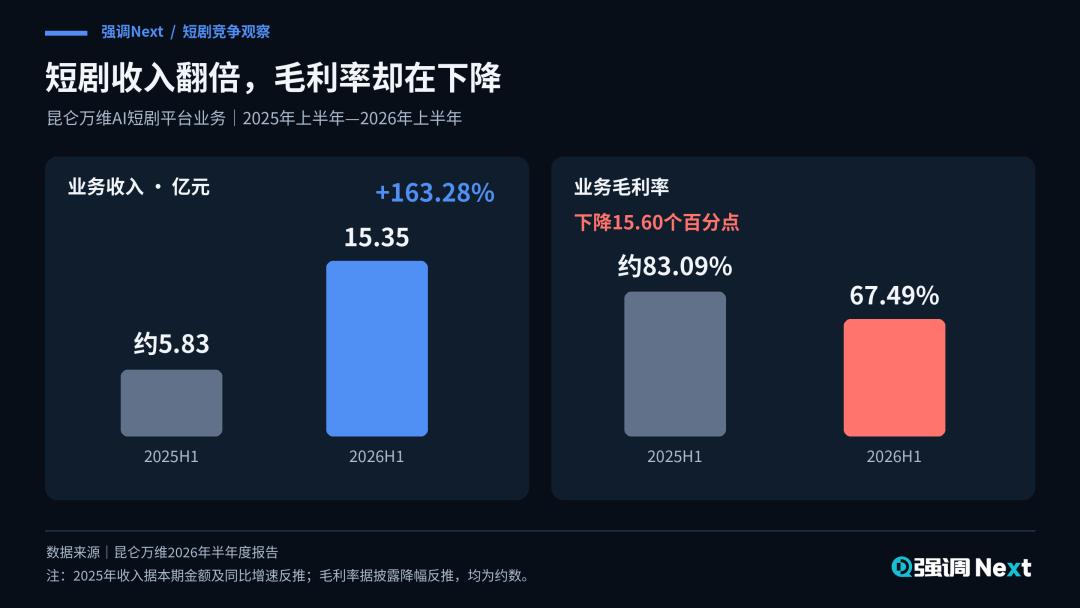
Revenue is growing rapidly, but promotion and channels are also taking away more revenue. The channel fees Kunlun Wanwei pays, and the advertising credit content producers pay to WeChat, are collected by different parties but go to the same destination: The money saved at the production end is taken away by the distribution link.
This is also the most difficult point to align between content producers and platforms. Content producers hope to retain profits from a drama, while platforms care more about whether this drama can retain audiences and make them continue to watch the next one. If a team can only keep delivering dramas and keep buying exposure, it will be difficult to accumulate past success into bargaining chips for the next negotiation.
With one more distribution platform, content producers have one more object for comparison. But what makes this quotation continuously effective is whether content producers have portable assets in their hands: sequalable series, recognizable teams, and audiences who recognize dramas more than platforms. These have to be produced drama by drama, which cannot be provided by platforms.
Ai You Teng (Tencent Video, iQiyi, Youku) is on the defensive, and short dramas have first changed their internal procurement accounting
Ai You Teng, which has been cornered by Hongguo, is also offering terms to short drama teams.
Tencent Video continues to adopt the "guaranteed minimum plus revenue sharing" model this year. In the horizontal-screen short drama policy, high-quality new teams can get a guaranteed minimum payment of no less than 3 million yuan per project after passing the evaluation, and the revenue sharing period can be extended to up to 3 years. The platform takes part of the risks first, and then gives the works a longer time to make profits, so as to compete for production teams.
These investments have brought results that can be included in the ranking list. Tencent Video Post cites data from Yunhe as saying that among the high-quality short dramas launched in the first half of the year, 43 dramas have publicly disclosed revenue sharing exceeding 1 million yuan, 32 of which are from Tencent Video; 12 dramas have revenue sharing exceeding 10 million yuan, 8 of which are from Tencent Video.
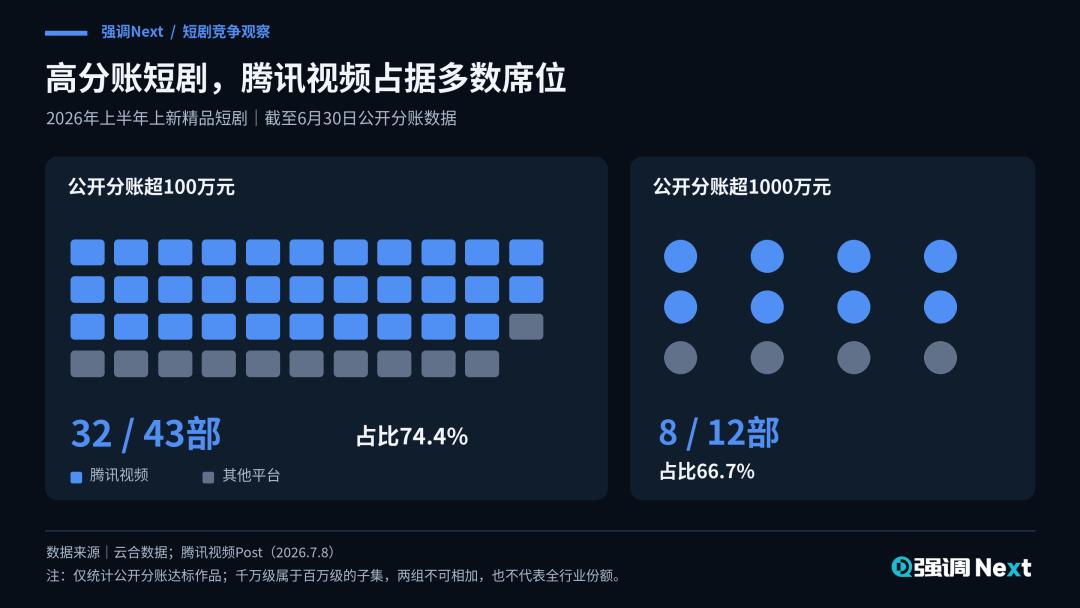
This ranking list is enough to recruit production teams, but it cannot answer the platform's own profitability question. High revenue sharing shows that the works have brought revenue to content producers; how much procurement and promotion expenses long video platforms have spent on these works, and how much more membership fees they have earned, are not disclosed in the ranking list.
For Ai You Teng, the first cost they spend on making short dramas is procurement money: 3 million yuan guaranteed minimum and 3-year revenue sharing period are all costs for purchasing content, and whether they can be converted into membership revenue is another separate calculation. The main profit ByteDance and Tencent earn from short dramas comes from promotion fees, which Ai You Teng cannot get.
For short dramas to improve the operation of Ai You Teng, they need to bring new paid subscriptions, make members renew their subscriptions, or replace part of the higher-cost content. Even if existing members watch one more short drama, Ai You Teng may not get an extra subscription fee. If Ai You Teng only adds a popular short drama channel but keeps the original procurement scale of long dramas, the new content supply may even turn into additional expenditure.
The data of iQiyi in the second quarter shows this pressure: membership revenue was 4.01 billion yuan, a year-on-year decrease of 2%; content cost was 3.82 billion yuan, a year-on-year increase of 1%. Sales and management expenses decreased by 22%, which the company mainly attributed to the control of marketing expenditure, but operating loss still expanded from 46.17 million yuan in the same period of the previous year to 105 million yuan.
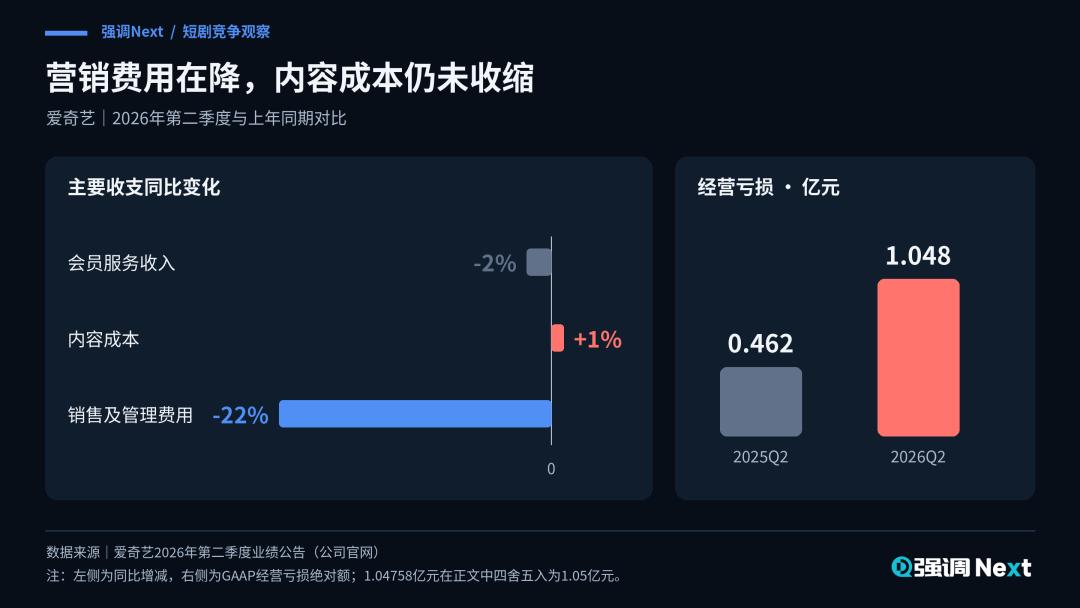
Marketing expenses have been controlled, but content costs are still growing. Whether short dramas can take on more user retention tasks must be reflected in the procurement budget. Otherwise, while the platform talks about improving efficiency through short dramas, it continues to pay high prices for replaceable long dramas. No matter how popular short dramas are, it will be difficult to fix the original operational problems.
iQiyi has already found opportunities to sell subscriptions directly overseas. At the second quarter performance meeting, the company said that the overseas micro short drama membership revenue increased by more than 300% year-on-year, becoming the second largest membership revenue category in the local market after long dramas. This at least has clear charging results. The performance of short dramas on domestic platforms also needs to move beyond the number of new launches, channel activity and revenue sharing rankings, to the comparison between revenue and cost.
The richer the supply of free short dramas, the more paid long dramas need to prove their irreplaceable value. Works that can attract new members and make users willing to renew their subscriptions are worthy of continued investment, while projects that only fill the schedule have to accept the input-output comparison with short dramas. Longer production time and higher cost cannot be the reason to keep the procurement price high.
This pressure is particularly direct inside Tencent. Lv Paopao can expand its advertising business with free content, but Tencent Video still needs to convince audiences to pay for membership fees. For the group, it is also valuable that audiences stay on WeChat. But for Tencent Video, a sum of advertising revenue flowing to WeChat cannot fill its own content bill.
If WeChat wins the short drama market, it can be good news for Tencent. The long drama procurement of Tencent Video that cannot retain paying users still needs to be re-priced: now it has to compare how much viewing duration the same amount of money can bring, with the free content available on WeChat.
Note: The data in this article comes from public materials and does not constitute investment advice.
This article is from the WeChat official account "Emphasize Next" (ID: leo89203898), author: Dingshan, editor: Xiaobai, published by 36Kr with authorization.