Elon Musk has disrupted the century-old telecom business with an $8 billion deal.

On August 11, 2026, a company named Grain Management spent 2.9 billion US dollars to acquire a batch of spectrum licenses and a set of 600MHz spectrum resources from T-Mobile.
In October two months later, it resold these licenses to Elon Musk's SpaceX at a price of 8 billion US dollars.
Bought in at 2.9 billion and sold out at 8 billion, with only two months between the two deals, it made a net profit of 5.1 billion US dollars.
Probably no one can match the speed at which Grain Management counts its earnings. But on the exact same day the transaction closed, the three giants of the US telecommunications industry all ushered in the darkest day of this century.
T-Mobile plunged 13.27%, marking its worst single-day performance since its listing in 2013, and was also the worst-performing stock in the S&P 500 that day. AT&T fell 9.81%, hitting its worst record since 2000. Verizon dropped 8.75%, the lowest level since July 2002. The combined market value of the three companies evaporated by about 60 billion US dollars in a single day.
Oddly enough, at the same time, the stocks of tower companies were skyrocketing. Crown Castle rose by more than 15%, American Tower climbed by nearly 8%, and the total market value of the three tower operators increased by about 11 billion US dollars.
Why could an 8 billion US dollar deal cause such a huge stir in the whole market?
This is far from an ordinary acquisition. It is an almost unsolvable overt conspiracy in the commercial history of the past 30 years. With 8 billion US dollars, SpaceX has pulled out the foundation of a century-old business. The whole process is completely out in the open, and operators can see every step from start to finish, yet they cannot stop it from happening.
What Operators Sell is "Coverage"
To understand this incident, we must first answer a most plain question: What on earth are US telecom operators selling?
Many people assume that operators sell data traffic, but that is not the actual case.
What they have been selling for 30 years is "coverage". To put it simply, it refers to how wide a range the signal can cover and how deep it can penetrate to be accessible for use.
Coverage relies on two core resources: spectrum and communication towers.
What is spectrum? You can understand it as a "radio operation license" issued by the government. Radio waves are a kind of public resource, and the government divides them into different segments and distributes them to operators through auctions, with the highest bidder obtaining the right to use the corresponding segment.
Because of its scarcity, spectrum is extremely expensive. And because it is costly, outsiders cannot easily enter this industry.
Communication towers are even easier to comprehend. To make signals travel far and penetrate deeply, a large number of base stations have to be built; to deploy massive base stations, you need to construct communication towers. This is the family property accumulated by spending huge real capital for decades. The more towers you have, the better the signal quality will be; the better the signal, the less willing users are to change their phone numbers.
"Spectrum licenses plus tower density" is the core profit foundation that global telecom stocks have relied on for decades.
The logic Wall Street uses to price telecom operators has always been very straightforward: their earnings are stable, just like bonds; their industry barriers are solid, just like fortified castles. Combined, the two attributes make them a very stable dividend stock choice.
But this logic has an unspoken precondition: spectrum and communication towers are not accessible to external players.
In September 2025, the first crack appeared in this precondition. SpaceX spent about 17 billion US dollars to acquire a batch of frequency bands from EchoStar, obtaining the medium and high frequency capacity required for satellite direct-to-cell connectivity, and the FCC approved this transaction in May 2026.
On October 8, 2026, the second crack appeared. With 8 billion US dollars in cash, SpaceX acquired a nationwide 800MHz low-band portfolio with up to 14MHz of paired spectrum. In the same week, the FCC also approved SpaceX's second-generation direct-to-cell constellation, which can deploy up to 15,000 satellites. The official statement notes that the bandwidth density of a single satellite in this constellation is more than 100 times that of the currently active satellites.
The two pillars of the old industry paradigm, one was purchased away, the other was replaced by satellite orbits.
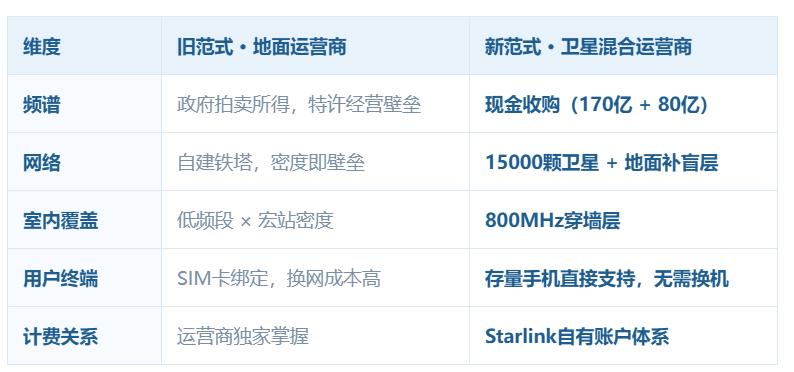
Figure: Comparison between the old and new paradigms
What Exactly Did Elon Musk Purchase
Satellite direct-to-cell is referred to as Direct-to-Cell in the industry.
This term has two layers of meaning, and these two layers happen to be the core secret of the whole incident.
Technically, it means that satellites skip ground base stations and communicate directly with your mobile phone.
Commercially, it means that SpaceX skips telecom operators and establishes a direct connection with end users.
The intermediate link that is eliminated by this "direct connection" is the telecom operators themselves.
The essence of the entire business of telecom operators has always been collecting tolls between spectrum resources and users: they purchase spectrum and network capacity in bulk from the upstream, and retail coverage services and phone bills to downstream users.
In the past two years, SpaceX has played the role of a "coverage partner" in this system. T-Mobile lends its own spectrum to Starlink satellites to provide SMS and limited data services in dead zones without ground signals. The core of this model is: the spectrum belongs to T-Mobile, the users belong to T-Mobile, and T-Mobile is the party that collects the service fees. SpaceX is nothing more than a high-altitude construction service provider.
After the 8 billion US dollar transaction, all three of these core elements have new owners.
The spectrum now belongs to SpaceX itself, and it no longer needs to rent spectrum from any third party. The user relationship also belongs to SpaceX: Starlink already has about 12 million broadband users in 205 countries around the world, and its account system is fully ready. The service revenue will no longer be collected through telecom operators.
There is only one last obstacle left: the mobile phone is in the user's pocket. And this obstacle has been solved by physical characteristics of the spectrum.
The 800MHz frequency band is characterized by long transmission distance, strong diffraction ability, and excellent wall penetration performance, which can pass through concrete walls and energy-saving glass. The indoor scenario is precisely the biggest short board of satellite communication, and also the most profitable business battlefield for ground telecom operators. T-Mobile's own technical team once released a statistic: more than 70% of mobile traffic occurs in indoor environments. The low frequency band exactly makes up for this long-existing short board of satellite communication.
More critically, the vast majority of mobile phones currently on the market support the 800MHz frequency band by default. Users do not need to replace their phones or buy dedicated terminals, they can use the service as long as they sign a service contract.
If you compare this business structure with the situation in 2007, you will find that it follows exactly the same routine. When the iPhone entered the market back then, it did not choose to cooperate with telecom operators to launch customized phones. Instead, it entered the market with ready-made iTunes accounts, music libraries and payment systems, allowing Apple to reach end users directly, and reducing telecom operators to a mere data transmission pipe.
"Stock ecosystem plus new network" against "new terminal plus old network". The two dimensionality reduction attacks have exactly the same structure.
The only difference is: back then Apple subverted the customized phone system, This time SpaceX is subverting the transmission pipe itself.
With 8 billion US dollars, Elon Musk has overturned the century-old telecom business model.
On the Same Day, the Market Distinguished Two Kinds of Assets
Telecom operators lost nearly 60 billion US dollars in market value, while tower operators gained 11 billion US dollars in market value.
The market made a very precise ruling on that very same day.
The moat attribute of spectrum as an asset has become invalid. Because it can be acquired as a whole. A barrier that can be bought with capital is nothing more than a market admission ticket.
The real estate attribute of tower assets is well preserved. Because no matter who builds the fourth nationwide network, the ground layer requires physical station sites, and SpaceX has satellites but no self-owned towers.
According to the plan disclosed by the media, SpaceX's ground layer does not intend to replicate a large number of towers. It plans to deploy small base stations next to Starlink antennas, use satellite links for backhaul, and rely on "stock terminal small base stations plus orbital capacity" to achieve indoor coverage. This means it still has to lease station sites from tower operators. That is why the stock price of tower operators skyrocketed that day.
This turning point is very meaningful. The 11 billion US dollars in market value that tower companies gained that day is essentially a reverse bet on the "decline of the traditional telecom industry": the industry will restructure, but the rent of physical infrastructure will still be collected as usual.
The opposing parties are still putting forward doubts. Verizon released a statement saying that a company can own billions of dollars worth of spectrum, but if there is no supporting network to use it, it is just a bunch of "empty radio waves".
Analysts from Bernstein said that buying spectrum does not equal a commitment to build a full nationwide network.
JPMorgan Chase believes that the short-term risk to existing telecom operators is limited. To provide a comparable user experience, SpaceX still has to build a large number of ground macro base stations.
The CEOs of AT&T and Verizon both bet on the "laws of physics": in densely populated urban areas, the capacity of satellite signals cannot replace millions of ground base stations.
All these doubts are valid. But none of them answer the real core question.
Not a single cent of Verizon's 8.75% drop was priced for "Starlink will be able to provide equivalent services next year". SpaceX's own service roadmap only extends to the end of 2027. What the market is pricing for is something else: a fourth player with its own spectrum, its own satellite constellation, its own user system, good regulatory relations, and almost unlimited capital has already obtained the market admission ticket.
And this admission ticket has never been circulated in the past 30 years.
The last time the three operators suffered such a severe single-day drop was in 2000, 2002 and 2013 respectively. The two previous drops were caused by the collapse of the moats of the long-distance telephone era and the fixed network era. More than 20 years later, this sector received a copy of the exact same obituary notice.
There was another layer of market transmission that took effect that week. The European telecom sector fell by 2.9% in tandem, Deutsche Telekom fell 7.9% (it holds about 54% of T-Mobile's shares), Vodafone fell 4.4%, and Telefónica fell 4.37%. The two chains of equity and business model are tightening at the same time.
What This Incident Means to the Capital Market
There are two core mappings of the transmission of this incident to the capital market.
One is the offensive line: satellite internet and direct-to-cell connectivity.
Previously, the biggest weakness of this track was that "the business model has not been verified". Constellations are being deployed, rockets are being launched, but whether the market demand can form a closed loop has always stayed at the stage of conceptual storytelling. With 8 billion US dollars investment and a huge market value earthquake, SpaceX has proved what the end of this closed loop looks like: a satellite operator can in turn seize the core market share of traditional telecom operators.
This verification is equivalent to telling the whole industry that the ceiling of this track has been raised from "equipment and service supplier" to "infrastructure competitor".
On the domestic market, related progress is also moving forward steadily.
Both the GW National Grid Constellation and the Qianfan Constellation are accelerating their networking deployment. Qianfan already has 256 satellites in orbit, plans to complete the deployment of 324 satellites for global networking by the end of 2026, and has completed the first domestic test of direct satellite call using stock commercial mobile phones.
In terms of policy, satellite internet was included in the 2026 government work tasks for the first time, and it was listed as a major key project in the "15th Five-Year Plan". The transmission sequence of the industrial chain is also very clear: mass production of satellites and payloads (phased array, TR components, inter-satellite laser) come first, followed by gateway stations and direct-to-cell terminals (radio frequency front end).
But the related risks also need to be clearly stated. The price-to-earnings ratio of the CSI Satellite Industry Index is as high as 162.9 times, at the 65th percentile of historical level; the price-to-book ratio is 4.57 times, at the 83rd percentile of historical level; it has already corrected by 23.7% in the past three months. The industry catalyst is real, and the high valuation is also real. What SpaceX proved is that the final goal is achievable, not that the development path is free of cost.
The other is the defensive line: intelligent scheduling of multi-operators for ground networks.
When the precondition of "relying on only one single network" is shaken, the value of the terminal side rises instead. eSIM, multi-network switching, multi-operator aggregation scheduling, these technologies that allow users to move freely between multiple networks are natural tools for existing users to hedge network risks.
In the era of pipe competition, the scheduler of data pipes is closer to end users than the owner of data pipes.
Conclusion: An Unsovable Overt Conspiracy
For a hundred years, the foundation of the telecom business has only two core bricks: spectrum, which is issued by the government through licensing; communication towers, which are accumulated by massive capital investment. Neither of them was accessible to external players.
SpaceX spent real capital, one transaction of 17 billion US dollars and another of 8 billion US dollars, bought the spectrum brick; then used 15,000 satellites to put the tower brick into the orbit space.
The most ruthless part of this incident is that it is a completely open card. It buys spectrum openly, Grain is willing to sell, and the FCC is willing to approve the deal. It launches satellites with its own rockets, builds its own constellation. The users belong to itself, Starlink has 12 million users worldwide. It collects service fees without going through telecom operators. Mobile phones support 800MHz by default, users don't even need to change their phones.
Every step is completely out in the open, every step is legal and compliant.
But when these steps are combined, they pull out the core foundation of traditional telecom operators. This is exactly what "overt conspiracy" means: a set of cards laid out on the table, you watch every move from start to finish, but you cannot stop it from landing.
Looking back over the past 30 years, there is no second such almost unsolvable situation in commercial history.
This incident provides a test that can be applied to all industries