The leading player in the AI companion industry has gone bankrupt, and the startup founded by the author of Transformer was sold to Disney at a bargain price of 20 million.
The AI unicorn founded by Transformer veterans — how did it suddenly hit rock bottom??
The top-tier pioneer AI companion platform Character.AI has officially filed for bankruptcy protection with a U.S. court.
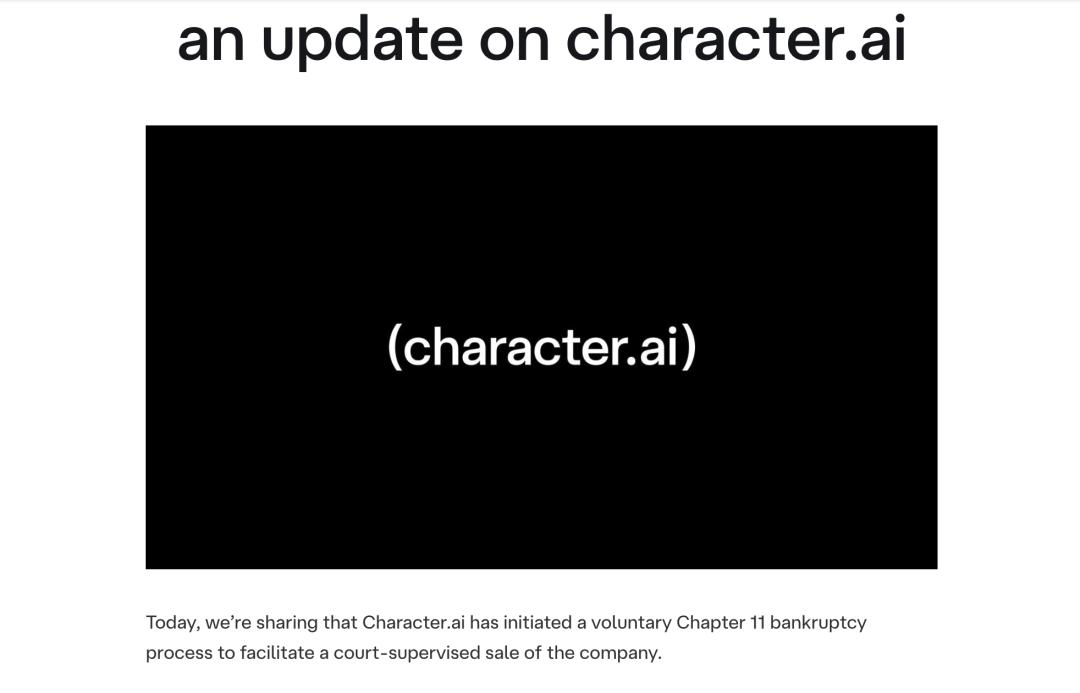
Even more absurdly, the current floor price for a potential acquirer is a mere 20 million USD, less than one seventh of its Series A financing amount (150 million USD).
For just 20 million USD, you can get the chance to obtain a permanent license to use part of Character.AI's intellectual property.
And guess who is the party willing to pay this sum to take over the assets?
Disney, which was nearly dragged into a lawsuit with the company before...
It's absolutely surreal.
Recently, Muse has hyped up personal Agents to such a fever pitch, and everyone was expecting a new round of explosive growth for consumer-grade AI.
But the leading player in the AI companion track, whose valuation once hit 1 billion USD and whose average daily usage duration even outperformed all major social media platforms —
It's all over just like that???
Five Years of Rise and Fall: From Universal Acclaim to Founders' Departure
To be honest, after seeing the news of Character.AI's bankruptcy, I felt a whirlwind of conflicting emotions.
Back at the end of 2021, when ChatGPT had not yet been launched, large language models were still an unfamiliar academic concept for most people.
At that time, two top technical experts at Google could no longer hold back: one was Noam Shazeer, the core author of the landmark Transformer paper Attention Is All You Need;

The other is Daniel De Freitas, a top-tier engineer.
The two of them developed the epoch-making conversational model Meena and the subsequent LaMDA at Google, and could not wait to bring this AI that can chat with real people about everything in the world to the global audience.
But Google at that time was far too conservative, fearing that the AI would make inappropriate remarks and damage its own brand, so it kept delaying the public launch of the beta test.
The two pioneers resigned in a fit of anger and founded Character.AI.
Their vision was extremely pure, even tinged with idealistic romance: to enable everyone to customize their exclusive AI characters, chat with them anytime, anywhere, and seek emotional companionship.
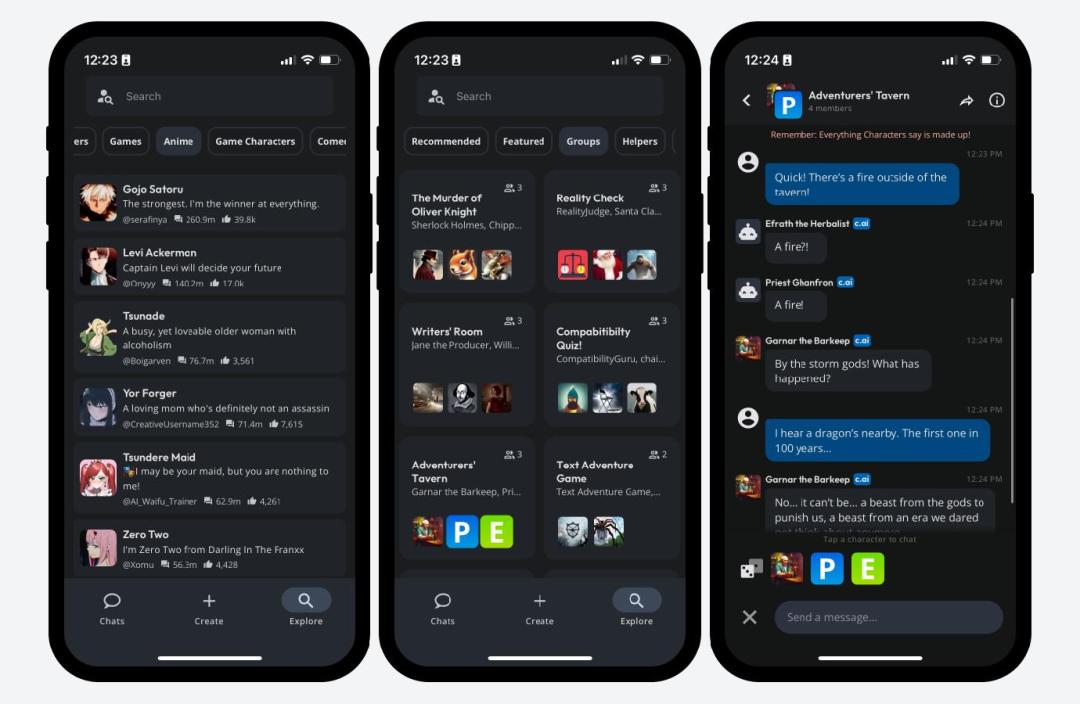
The moment the product launched, it immediately took the entire internet by storm.
Between the end of 2022 and the beginning of 2023, riding the massive boom of generative AI, Character.AI became the most sought-after super unicorn across Silicon Valley.
They secured 150 million USD in Series A funding led by a16z, pushing their valuation directly above 1 billion USD, which later kept surging even higher.
When it comes to performance metrics, its data results shocked a whole host of investors.
According to statistics from third-party institutions at the time, in the first week after the mobile app was launched, its download volume exceeded 1.7 million times.
Even more staggering was its user stickiness.
Young people chatting on the platform spent an average of over 2 hours per day on it.
Within five months, the total number of chat messages on the platform exceeded 2 billion, and its monthly active users quickly broke through 20 million.
You could discuss philosophy with Socrates, fall in love with your favorite anime characters, and even debate all night long with Elon Musk or Albert Einstein on the platform.
Everyone was exclaiming: Look, this is the perfect killer C-end application in the generative AI era!

However, the prosperity faded far faster than anyone could have imagined.
The turning point came in August 2024.
Its old employer Google "returned to its senses" (not really) and spent a whopping 2.7 billion USD to buy the non-exclusive license for Character.AI's technology.
More importantly, it conveniently brought the two co-founders Shazeer and Freitas back to Google as a bundled package.
I thought something was off right then...
Isn't this exactly the "reverse acquisition-style poaching" that is all the rage in Silicon Valley right now??
The core technology is taken away, the soul figures are poached, leaving an empty shell company and the rest of the operation team in total disarray.
(By the way, Shazeer has a pretty legendary career: he hopped between his old employers repeatedly, and no one expected that later when Google's situation worsened, he jumped to OpenAI, never having to go through any hardship at all.)
After that, the company hired Karandeep Anand, a former executive from Meta and Brex, to take over as CEO, and started desperate self-rescue efforts.

They gave up their focus on underlying large model development, and instead tried to find a way out on the application layer: making vertical-screen short dramas, developing AI video generation tools, building social feeds, testing all kinds of new ideas one after another.
But these patchwork efforts could not save the company that was already bleeding out heavily.
According to the latest bankruptcy court documents, Character.AI's current total liabilities are between 50 million and 100 million USD.
All the cash on its books was burned out, no life-saving financing could come in, and this once top-tier unicorn finally marched toward its demise on the eve of its 5th anniversary.
Disney Buys the Dip for 20 Million USD: Former Arch-Rival Becomes the Acquirer
In this bankruptcy restructuring, the most darkly humorous role is none other than Disney.
In the bankruptcy filing, Disney is listed as the "stalking horse bidder" (the bidder that sets the starting floor price).
Disney is willing to pay 20 million USD to buy part of Character.AI's assets, and obtain a non-exclusive permanent license for certain technology patents.
What does 20 million USD mean?
In a decent school district in Silicon Valley, buying two top-tier luxury villas would cost roughly that much...
What is even more ironic is their past relationship.
In the early years when Character.AI was red-hot, there were tens of thousands of unauthorized Disney character bots on the platform: Queen Elsa, Spider-Man, Darth Vader...
Young users interacted frantically with these virtual idols on the platform, and even generated all kinds of inappropriate storylines...
Disney was furious, and sent a strict Cease and Desist letter to Character.AI, publicly denouncing that the platform had seriously infringed on Disney's IP image and commercial interests.
And what happened next?
In the business world, people change their stance faster than turning the pages of a book.
Just last month, Disney announced that it had hired Karandeep Anand, the former CEO of Character.AI, to serve as Disney's Chief Technology Officer (CTO).
It also poached a whole batch of Character.AI's core technical staff as a bundled package...
This deal is an absolute steal.
First they poach the managing CEO from you, and take away the technical backbones who are familiar with your architecture;
When you are completely out of resources and file for bankruptcy, they step in at the bargain price of 20 million USD, and naturally take your technology patents and training assets into their own pockets.
Colin Adams, the current CEO, wrote helplessly in his public statement:
Over the past year, the company has taken a number of measures to keep operations running in the face of significant legal, regulatory and operational headwinds.
After a comprehensive evaluation of all alternative options, the board of directors believes that the court-supervised sales process is the best way to maximize value for all stakeholders.
If no other wealthy investor comes up with a better offer in the auction process from the end of November to early December, the entire Character.AI platform will be completely shut down and deregistered.
A generation of legend has finally become cheap nourishment for the giant IP empire.
The More Popular It Gets, The More It Loses: The Fatal Dead End of Consumer-Grade AI Companion Products
Many people may wonder: it clearly has tens of millions of active users, and its average daily usage duration is even more impressive than all kinds of short video apps, how did it end up going bankrupt?
Trust me, under the current business logic, high user stickiness is not a moat at all for many consumer-grade AI applications.
Liang Wenfeng is right, C-end users are nothing but a bottomless pit.
There are two main reasons —
Computing power cost.
Building C-end conversational AI has the most counterintuitive cost structure in the entire industry.
In the traditional internet era, the longer users stay on your app, the higher your ad value becomes, and the marginal server cost is almost negligible.
But large language models are different.
Every conversation, every long-context interaction of a large model is consuming real money on GPU computing power behind the scenes.
If a user chats on Character.AI for two hours a day, each user will generate hundreds to thousands of high-context inference calls per day.
This staggering level of user activity is not an asset at all in commercial terms, but a heavy liability!
The more people use your product, the more users love it, the faster you burn through your cash.
Meanwhile, the willingness to pay for companion products is extremely fragile.
The vast majority of free users will never pay, and a monthly subscription fee of more than ten dollars is completely negligible when facing the astronomical server bills and inference costs.
Security risks.
As we all know, the emotional companion track naturally falls in a highly sensitive zone.
In the past two years, Character.AI has been tangled up in endless lawsuits, which we will not go into detail here, all kinds of dramatic incidents broke out one after another.
In order to meet compliance requirements, the platform had to fully tighten its security review, and even announced last year that: minors are completely prohibited from using the open chat function.
But this one-size-fits-all move directly cut off the largest part of the platform's user base...
Later, former CEO Anand tried to transform the company by doubling down on micro short dramas, AI video generation and social feeds, trying to turn the platform into an interactive narrative community.
But the cracks in the business model could no longer be mended.
According to Reuters reports, Character.AI's current monthly loss is as high as 8 to 9 million USD.
After the Bubble Bursts: The Cold Winter for AI Application Entrepreneurs
The death of Character.AI is not an isolated case.
Inflection AI, Adept AI... all of them have seen their core teams leave, and their assets sold in bundles to big tech giants.
People used to think that underlying models are like water and electricity, and the real big money will be made by the user-facing application layer.
But what is the reality now?
Office Agents, code Agents (such as Claude Code), and enterprise-level workflow tools are gaining massive traction, and capital and attention are flowing back on a large scale to underlying model vendors and practical productivity tools.
Pure C-end products focused on emotional chat and search Q&A are getting squeezed into an ever-narrower living space under the system-level crushing from big tech giants that come with their own massive user traffic.
Even Perplexity, the once high-flying AI search product, has barely made any noise recently.
You can also think back: apart from a few hardcore productivity tools you use for daily office work and coding, how long has it been since you opened those AI chat toys you downloaded just out of curiosity on your phone?
Capital and attention are contracting rapidly toward productivity tools and the foundational model layer.
Want to build a new commercial empire with a valuation of tens of billions of dollars relying on chatbots?
This kind of narrative seems to have completely collapsed.
Technology is advancing in a spiral, and if your product form cannot meet the demands of the current technical stage, getting a head start will only turn into a first-mover disadvantage.
And the first pioneer that took the risk to try this path — Character.AI — has already paid the price with its life, sounding the alarm for the entire industry.
Sigh.
Five years ago, when the Transformer veterans walked out of the Google building with the wild ambition to change the world, they certainly never imagined that the company they founded would end up like this —
A bankruptcy filing statement, and 20 million USD in Disney's pocket.
Reference Links:
[1]https://techcrunch.com/2026/10/13/just-5-years-in-interactive-chatbot-platform-character-ai-files-for-bankruptcy/
This article is from the WeChat Official Account QbitAI, written by Jay, and republished with authorization from 36Kr.