Twenty-one years ago, he was an honorary professor at Renmin University of China; today, he is a Nobel Prize laureate!
Beijing Time October 12, the 2026 Nobel Prize in Economic Sciences was announced, Michael Woodford and Robert Hall won the award jointly, in recognition of their outstanding contributions to the foundational microeconomic research that underpins macroeconomic stabilization policies.
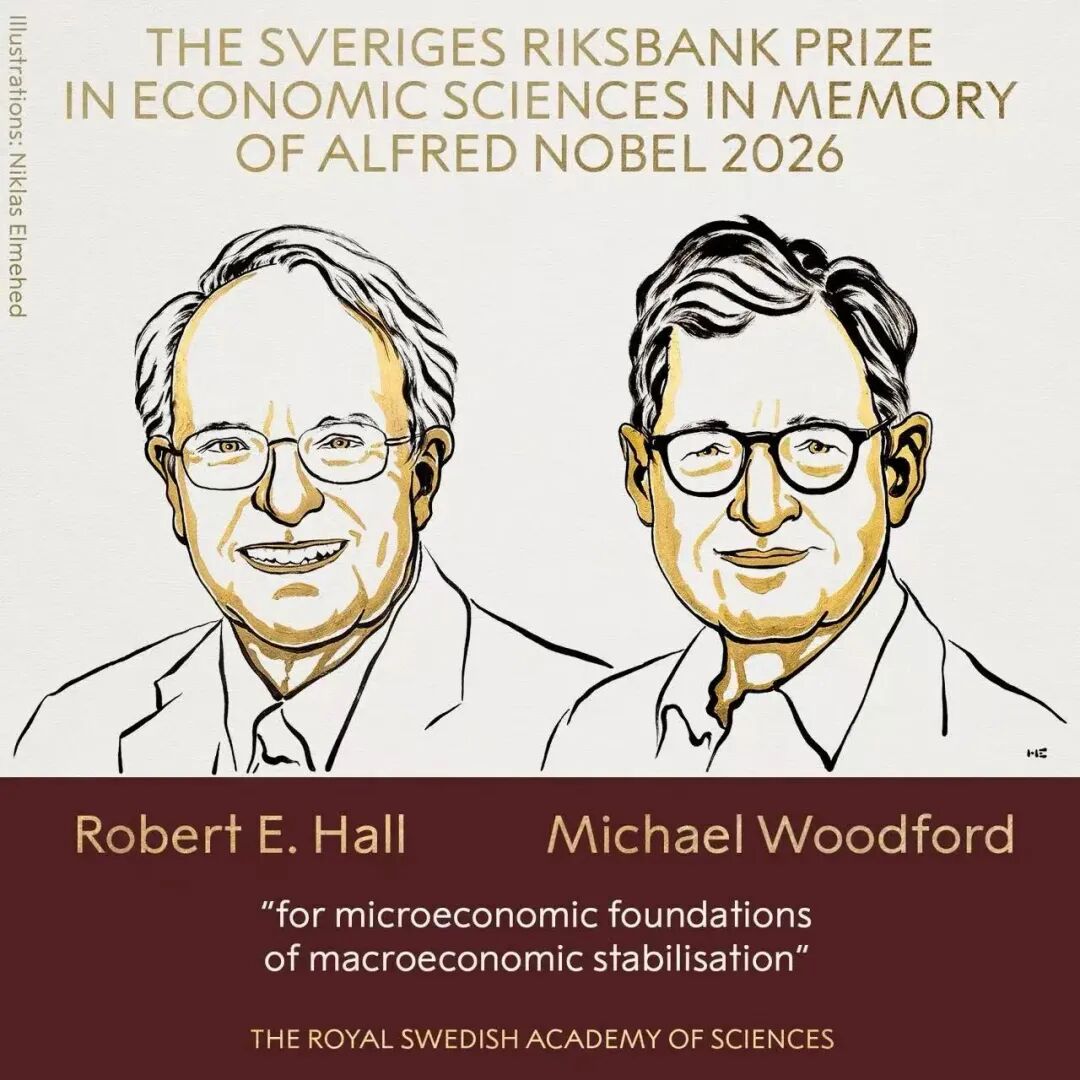
Three weeks ago, on September 17, Woodford was just named a Clarivate Citation Laureate — an award known as the "precursor of the Nobel Prize." But when he received the award call from Stockholm, he still frankly said: "This is a great honor, and it also came as a total surprise."
The scholar who wrote the "bible for central banks" has taken an academic path far different from most of his peers.
Physics, Law, Economics: Three Cross-Disciplinary Academic Journeys

Woodford was born in 1955 in Chicopee, Massachusetts, United States. In 1973, he enrolled at the University of Chicago, initially majoring in physics, before his interest gradually shifted to cognition and decision-making issues, and he earned his Bachelor of Arts (A.B.) degree in 1977.
After graduating from undergraduate studies, Woodford entered Yale Law School, obtaining his Juris Doctor (J.D.) degree in 1980. During his time at Yale, he took economics-related law courses including antitrust, securities regulation, and corporate finance.
After that, he went to the Massachusetts Institute of Technology to pursue his doctorate in economics. In 1981, 26-year-old Woodford became the first recipient of the MacArthur Foundation's "Genius Grant." In 1983, at the age of 28, he obtained his doctorate in economics from the Massachusetts Institute of Technology. In 2004, he returned to Columbia University and served as the John Bates Clark Professor of Political Economy.
It is worth noting that Woodford's research direction in recent years has returned to the field of cognitive science, focusing on bounded rationality, integrating cognitive psychology and neuroscience to study the economic outcomes of people making decisions based on imprecise mental representations.
The "Bible" for Global Central Banks: Interest and Prices
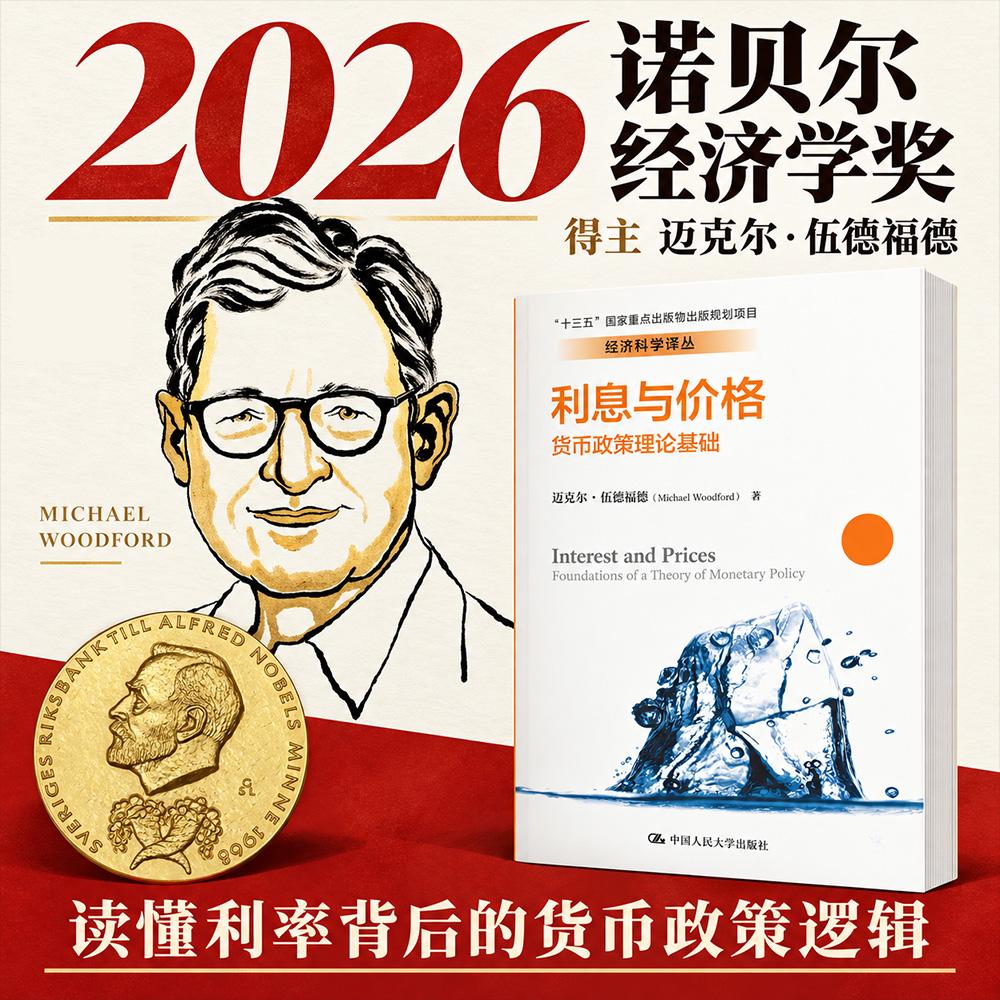
Speaking of Woodford, the book Interest and Prices: Foundations of a Theory of Monetary Policy published in 2003 is impossible to overlook. This nearly 800-page work pays tribute to Wicksell's 1898 classic of the same name, and is widely known in the industry as the "bible for central banks."
Wicksell proposed in 1898 that inflation depends on the deviation between the central bank's interest rate and the natural interest rate. More than a hundred years later, Woodford reconstructed this theory with modern analytical tools. In his framework, the natural interest rate refers to the equilibrium real interest rate when prices are fully flexible and output is at its potential level.
Before this book was published, traditional Keynesian models relied on statistical relationships between macro variables to carry out policy analysis, and the Lucas Critique pointed out that such analysis had fundamental flaws; the rational expectations school could hardly explain the real-world phenomenon that prices cannot adjust instantaneously. Woodford completed the theoretical integration: he embraced rational expectations while retaining the assumption of price stickiness, incorporated the optimal decision-making of households and enterprises into a unified model, and constructed a New Keynesian DSGE framework with micro-foundations.
The book puts forward the analytical framework of a "cashless economy": the core of monetary policy is not to regulate the money supply, but the gap between the policy interest rate and the natural interest rate, as well as the public's expectations of future interest rates. Household consumption and enterprise investment are based on long-term financing costs, and the long-term interest rate is equal to the average of the market's expectations for a series of future short-term interest rates — therefore, the central bank's communication and commitment can affect public expectations, and are themselves an integral part of monetary policy.
The book systematically explains the Taylor principle: for every 1 percentage point rise in inflation, the nominal interest rate must be raised by more than 1 percentage point to push up the real interest rate and anchor inflation expectations. The book also proposes that monetary policy has inertia, and interest rate adjustments do not need to be in place in one step; in response to the time inconsistency problem of policies, it proposes the "eternal perspective" method to ensure the long-term credibility of monetary policy rules.
The Theory Was Fully Prepared Five Years Before the Crisis
One of Woodford's most important theoretical achievements is forward guidance — and he completed this set of theories a full five years before the crisis arrived.
In 2003, Woodford and Eggertsson co-published The Zero Bound on Interest Rates and Optimal Monetary Policy, which rigorously proved that: When the nominal interest rate hits the zero lower bound and the room for traditional interest rate cuts is exhausted, the central bank can still commit to maintaining low interest rates for a period of time in the future to lower the long-term market interest rate, and stimulate consumption and investment without further cutting interest rates.
The 2008 financial crisis broke out, and nominal interest rates in many countries hit the zero lower bound. At the 2012 Jackson Hole Symposium, Woodford systematically compared the two policy tools of forward guidance and quantitative easing, demonstrating the key role of expectation management. In December of the same year, the Federal Reserve FOMC officially adopted a forward guidance framework centered on unemployment and inflation thresholds.
From the Lecture Stage of Renmin University of China to the Chinese Version of Interest and Prices
Woodford's formal exchanges with Chinese economics academia began in 2005.

Mr. Gao Hongye and Woodford shook hands and talked at the Shaw Conference Center
On June 1, 2005, an appointment ceremony was held at the Shaw Conference Center of Renmin University of China, where Woodford was appointed as an honorary professor of Renmin University of China. After the appointment ceremony, Woodford delivered an academic speech titled "Optimal Inflation Targeting" in the Shaw Second Lecture Hall.
In 2010, the Chinese translation of Interest and Prices was published by Renmin University of China Press. The work of the honorary professor of Renmin University was finally translated and introduced to Chinese readers by Renmin University of China Press.
Twenty-one years later, this honorary professor of Renmin University of China won the Nobel Prize. After years of being a popular candidate, he finally achieved the well-deserved honor.
Understanding Expectations Means Understanding the Economy
John Hassler, Chairman of the Nobel Committee for Economic Sciences, said at the award ceremony that the work of the winners "provides a theoretical foundation for stabilization policies, and these models are now adopted by central banks and governments around the world."
The core insight of Woodford's research is: Macroeconomy is not a simply controllable lever. Households and enterprises will anticipate future interest rates, inflation and income, and adjust their consumption, pricing and investment behaviors in advance — the policy effect largely depends on the management of public expectations. The high priority that central banks around the world attach to policy press conferences, expectation guidance and policy credibility today is all built on the theories constructed by Woodford.

This article is from the WeChat Official Account "Crup Economics", authorized for release by 36Kr.