Natura-1 Release: Learning Zero-Shot Generalization and Dexterous Manipulation from Millions of Hours of Human Experience
Making wontons is a simple task for most people: hold the wrapper in one hand, scoop the filling with the other, fold the wrapper in half, pinch the edges, and seal the opening. Few people realize that during this process, the palm is always supporting a dough wrapper that can deform at any time, the fingers are constantly sensing the rebound of the filling and the wrapper, and the two hands also need to cooperate at the right moment.
This type of daily movement designed for human hands is extremely difficult for robots. But these difficulties are now being overcome. Now, in a 1 minute and 12 second uncut full-speed video, a pair of robotic dexterous hands has successfully completed the whole process for the first time.
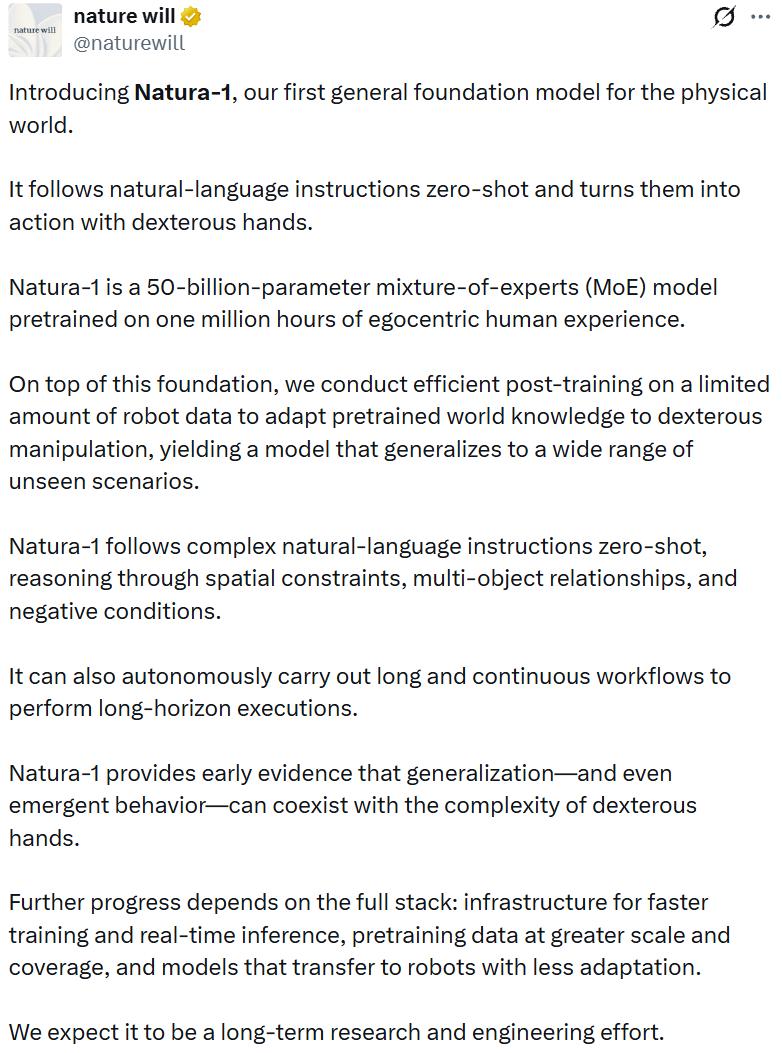
Driving these hands is Natura-1, a newly released model by Nature Will, a Beijing-based embodied intelligence company. It is a 50B-parameter Mixture of Experts (MoE) model pre-trained on 1 million hours of first-person human experience data. Taking language and vision as inputs, it drives the 20-degree-of-freedom dexterous hands within a 100-millisecond control loop.
The wonton-making demonstration answers the question of "can it do the task well". What Natura-1 aims to answer is another more challenging question: when switched to a completely new task that it has never practiced before, can it directly perform the task without additional adaptation?
Dexterity and Generality: Hard to Achieve Both
First look at dexterous manipulation. The human hand has more than 20 degrees of freedom, and daily objects are often soft, deformable and resilient, with each contact changing the state of the object, so the robot can only adjust its movements while performing the task; but the difficulty is also obvious: the complexity grows exponentially with the number of degrees of freedom. Parallel grippers can greatly simplify control, at the cost that many actions requiring supporting, twisting and bimanual cooperation are hard to complete.
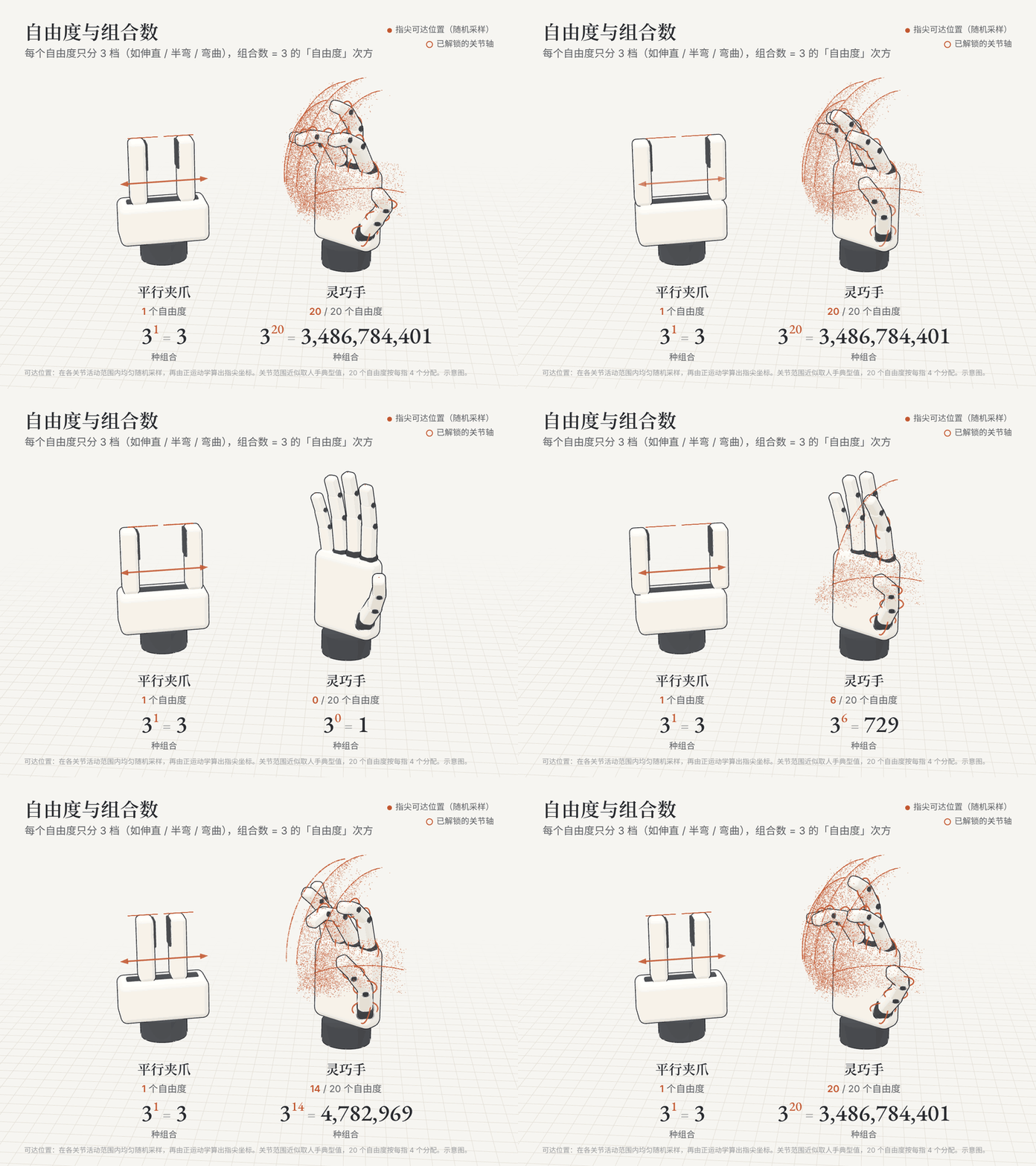
Degrees of freedom and combination numbers of parallel grippers and dexterous hands, generated by AI
In the view of the Nature Will team, most previous works thus focused on only one of the two ends: either general policies oriented to grippers, or dexterous manipulation systems built for a single specific task.
On the generality side, there have been some important advances such as π0.7, but to achieve such generality on dexterous hands, the first bottleneck lies in data. Generalization relies on large-scale, diverse training data, while real robot data is inherently expensive, and teleoperation collection for dexterous hands is even slower and more difficult.
The Nature Will team also pointed out a more fundamental loop: robots can only collect data in scenarios where they already know how to work, and they can only work in scenarios where they already have data. To break this loop, the data has to come from outside the robot itself.
As a result, more and more teams are turning to an existing data source: human beings themselves.
In February this year, EgoScale released by NVIDIA and other institutions pre-trained a VLA model with 20,854 hours of first-person human operation videos, and observed a log-linear relationship between data scale and validation loss; after deployed on a 22-degree-of-freedom dexterous hand, its average success rate is 54% higher than the baseline without human data pre-training.
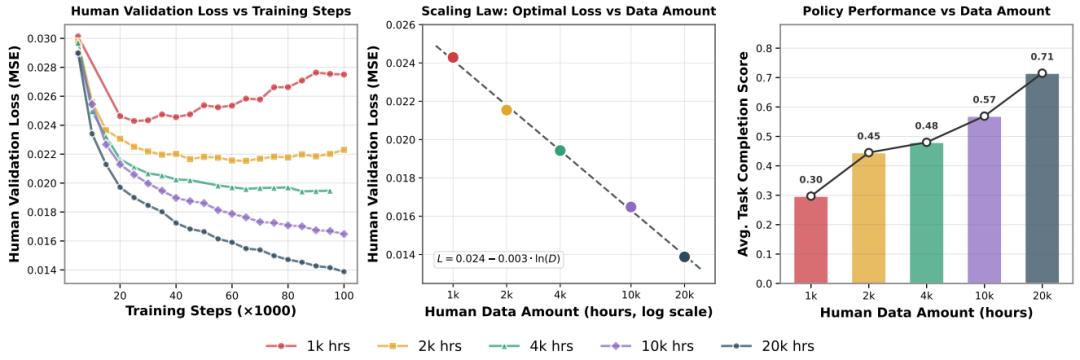
Scaling behavior of human pre-training, the function of optimal validation loss at convergence against human data scale, revealing an almost perfect log-linear Scaling Law, arXiv:2602.16710
Six months later, this magnitude has been increased by about 50 times. On August 10, Dyna Robotics, an American robotics company, released the world-action model DYNA-2, which used more than 1 million hours of first-person human videos for pre-training, without any robot data included in the pre-training stage; according to Dyna's report, when the data scale was gradually expanded from 1000 hours to 1 million hours, the average normalized score of the model on 14 robotic tasks rose from 20% to 53%.
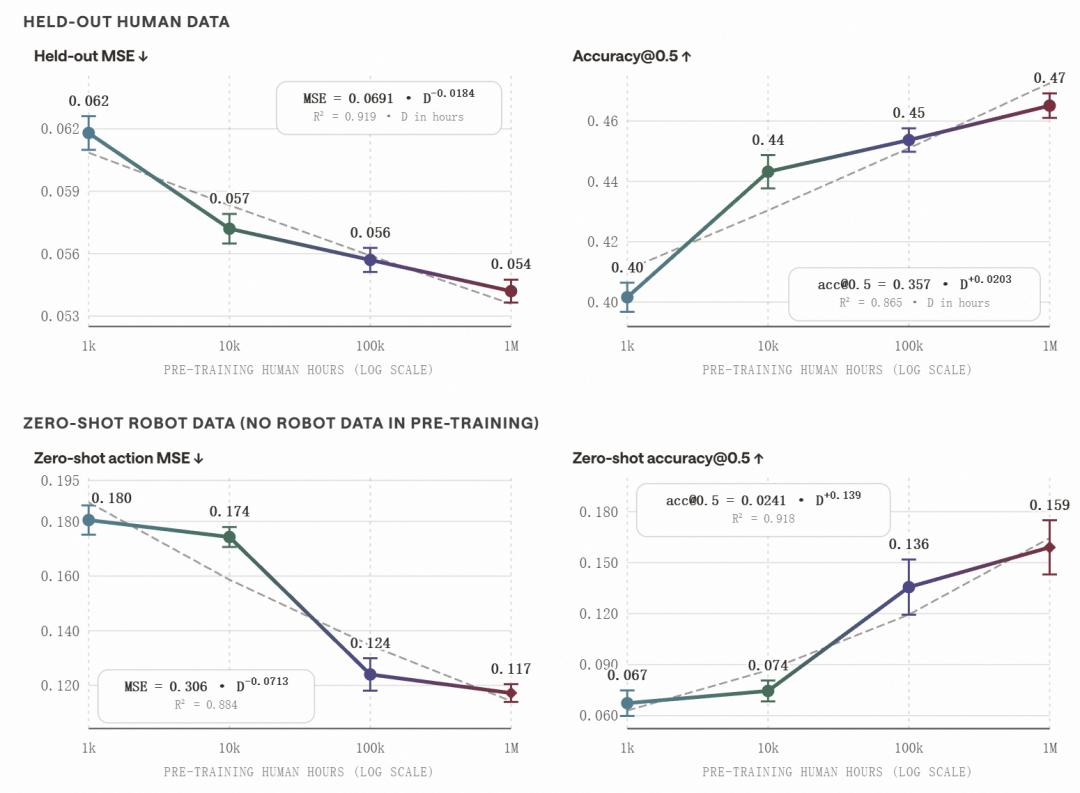
Scaling Law of Dyna-2 world-action model, trained based on human video data rungs from 1000 hours to 1 million hours. https://www.dyna.co/dyna-2
However, both of these two works did not bypass the same link: to transfer human experience to specific tasks, additional adaptation is still required. EgoScale relies on a small amount of human-robot alignment data for intermediate training, and DYNA-2 uses up to 10 hours of robot data for post-training on each evaluation task.
It has been proven that human experience can be fed to robots at scale. The next question is: on a dexterous hand with high degrees of freedom, can these experiences be directly transferred to new tasks without task-by-task adaptation?
Natura-1: One Model, Two Core Capabilities
Nature Will was founded in January 2026 by Ning Ding, assistant professor in the Department of Electronic Engineering of Tsinghua University, as a research-oriented company focused on foundational models for the physical world. It set its core goal as Physical AGI: to train a general foundational model that can complete the closed loop of perception, prediction, reasoning and action in the real world.
The Nature Will team told the platform Machine Heart that this comes from two judgments:
A general foundational model for the physical world is feasible;
Human first-person data already meets the conditions for large-scale collection.
The methodology behind these two judgments is inherited from LLM research, that models, data and infrastructure need to develop in tandem. The Nature Will team said: "We followed the idea of coordinated growth of model scale and data scale in large language model research. In the early stage, we used smaller models and less data to quickly verify the architecture, and gradually expanded after confirming the direction, instead of deciding to make a 50B model from the very beginning."
Natura-1 is Nature Will's first general foundational model for the physical world. Its training is divided into two steps: first pre-train on 1 million hours of human experience data, then use limited robot data for one round of efficient post-training, to adapt the world knowledge learned in pre-training to dexterous manipulation.
Different from many systems that split "understanding instructions", "predicting the world" and "generating actions" into separate modules, Natura-1 is a single MoE Transformer, jointly trained on language, images, videos and actions. It targets two core capabilities:
Dexterous manipulation, relying on dexterous hands to complete multi-finger coordination, object pose adjustment and complex contact operations;
Zero-shot instruction following, for unseen scenarios and tasks, directly complete the manipulation according to natural language instructions, including handling spatial constraints, multi-object relationships and negative conditions.
What Can Natura-1 Do?
The Nature Will team tested Natura-1 from three levels:
Long-horizon tasks examine how fine and how persistent a skill can be after training?
Zero-shot testing examines whether the model can directly perform tasks that it has never practiced before?
The last part records what can be called emergent capabilities, that is, when the task does not go smoothly, can the model figure out solutions on its own?
Dexterity: Six Uncut Long-horizon Task Demos
In addition to making wontons, the Nature Will team also released five other demos: making tea, making yogurt bowls, packing express deliveries, applying phone screen protectors, and writing Chinese calligraphy with a brush, the longest one exceeds 3 minutes, all are played at original speed, uncut, and without any human intervention. Each demo contains multiple sub-tasks, and the robot needs to continuously handle liquids, granular materials, soft tools and flexible components in the same workflow.
Taking the 3-minute screen protector application demo as an example, Natura-1 first wipes the screen, then puts the alignment frame with pre-installed protective film on the phone, aligns and presses it tightly with both hands; then one hand presses the phone and the alignment frame against the fixture, the other hand smoothly pulls off the release film, and finally uses the fingertips to push along the edges to squeeze out all bubbles.
When packing express deliveries, it needs to switch grasping methods between raffia grass, plush toys and laptops, one hand presses the resilient box cover, the other hand pushes the tape dispenser to seal the box, and finally pastes the label and scans the barcode.
These actions change the shape of objects and contact conditions while being executed, so the model must continuously make corrections based on real-time feedback, instead of following a fixed trajectory to the end.
It needs to be emphasized that these six demos show the manipulation depth after task fine-tuning. Whether the capabilities can be transferred to unlearned tasks depends on the zero-shot test.
Zero-shot: Tasks Never Practiced Before
What counts as zero-shot? The Nature Will team told Machine Heart: "The Zero-shot we refer to here means that after the model completes pre-training and real robot post-training, it will no longer collect data or conduct additional training specifically for the test tasks, and directly accept instructions to execute."
The team built a benchmark test covering 12 capability dimensions, and the test tasks, their scenarios and action combinations did not appear in the post-training data; next to each test video, the most similar demonstration in the training set is also placed side by side for the public to judge the difference. For example, one task requires putting an apple into a bowl, placing a bottle on a tray, and then carrying the tray away, while the training set only has discrete actions such as "pick up the fruit" and "carry the already loaded tray". Natura-1 combined these actions, and did not touch the other adjacent tray when carrying the tray.
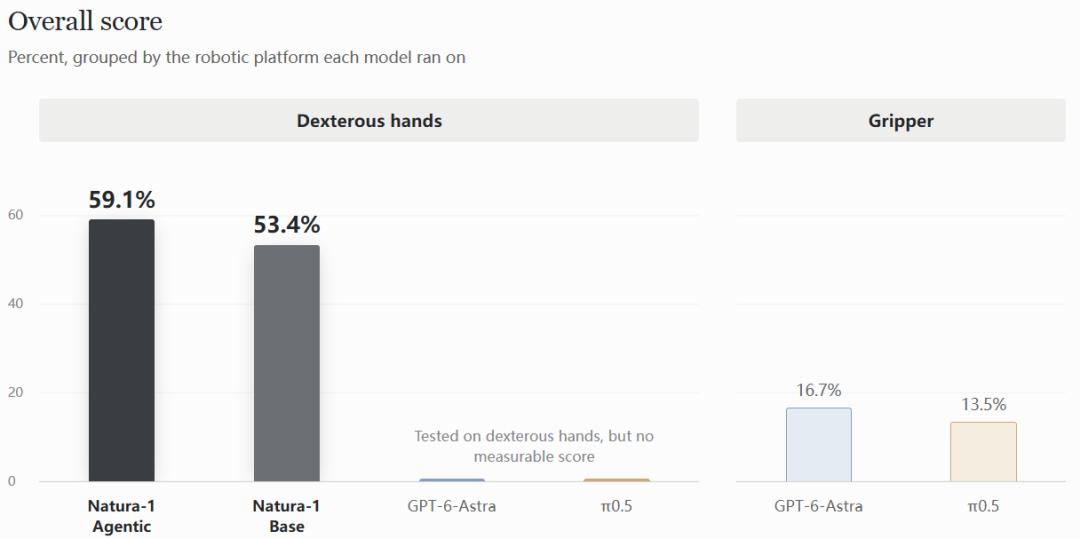
On this benchmark, π0.5 and OpenAI's GPT-6 Astra (which acts as a control policy by writing code) failed to get any scores on the dexterous hand platform; after switching to the gripper platform, the two got 13.5 points and 16.7 points respectively, while Natura-1 got 53.4 points (Base) and 59.1 points (Agentic) on the dexterous hand.
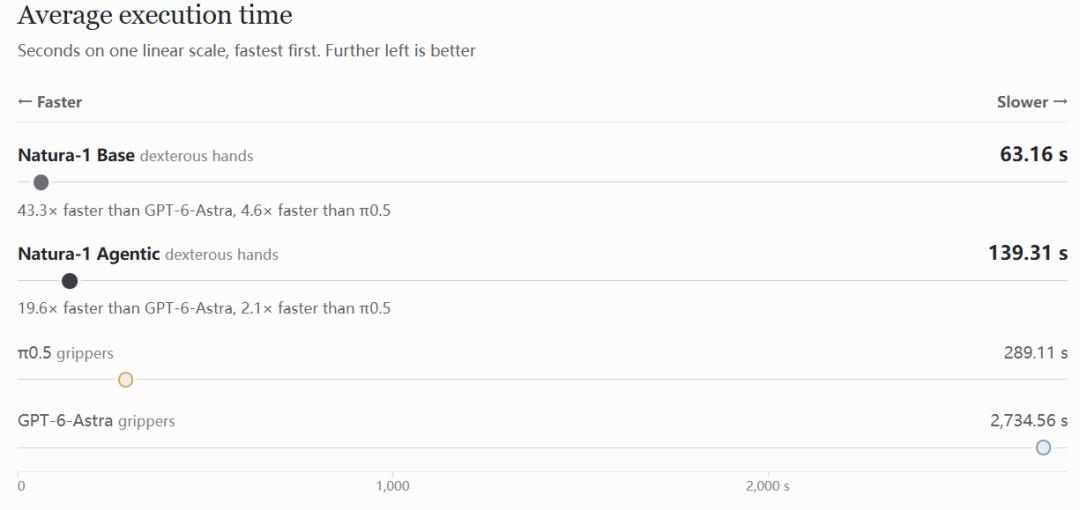
Not only that, Natura-1 also has obvious advantages in execution time.
The team also conducted tests with open instructions casually thought up by researchers in daily work, many of which are deliberately tricky. For example, for the task of putting the toothbrush box and water bottle into the basket, the instructions require putting them with both hands at the same time, putting the left one first then the right one, and putting the right one first then the left one respectively, Natura-1 executed all of them as required.
For the definition of "unseen", the team gave a limitation: "The pre-training data covers a very wide range, which may already contain related items and operation experience, so the 'unseen' here is mainly relative to the real robot post-training." The example they gave is pressing the space bar of a laptop: this task is not included in the robot post-training data, but similar actions are very likely to appear in human videos.
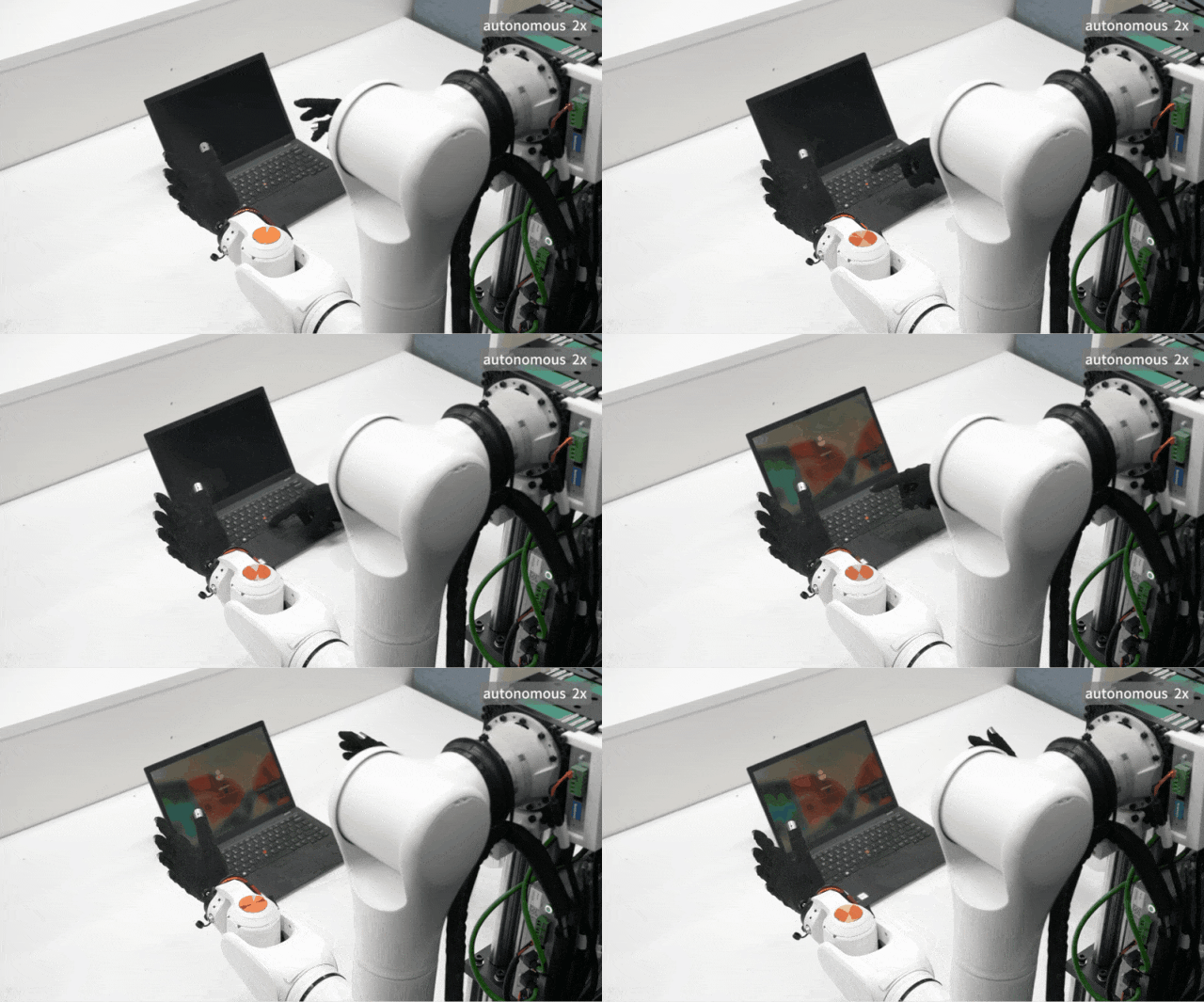
This points out the meaning of zero-shot on this technical route: can the experience in human videos be directly invoked on real robots without corresponding robot data. As the team said: "What we focus on is not only whether the robot can still grasp when the object is changed, but also whether it can organize its existing capabilities to complete the task when facing task requirements that have not been specially trained."
Unexpected Emergent Capabilities
The team also observed some behaviors that were not in the test plan.
In a deliberately arranged scenario, a basket of yarn is placed on a high platform out of reach, with a long rod threaded through its handle, and the only instruction is "Try to grasp the yarn". Natura-1 grabbed the long rod to pull the basket closer, then one hand stabilized the long rod, and the other hand took out the yarn. On another occasion, it failed to pinch a playing card from the edge, so it changed its strategy to push the card to the edge of the box, let part of it hang in the air, and then picked it up with two hands cooperating. According to the team, none of these intermediate steps have corresponding demonstrations in the robot demonstration data.
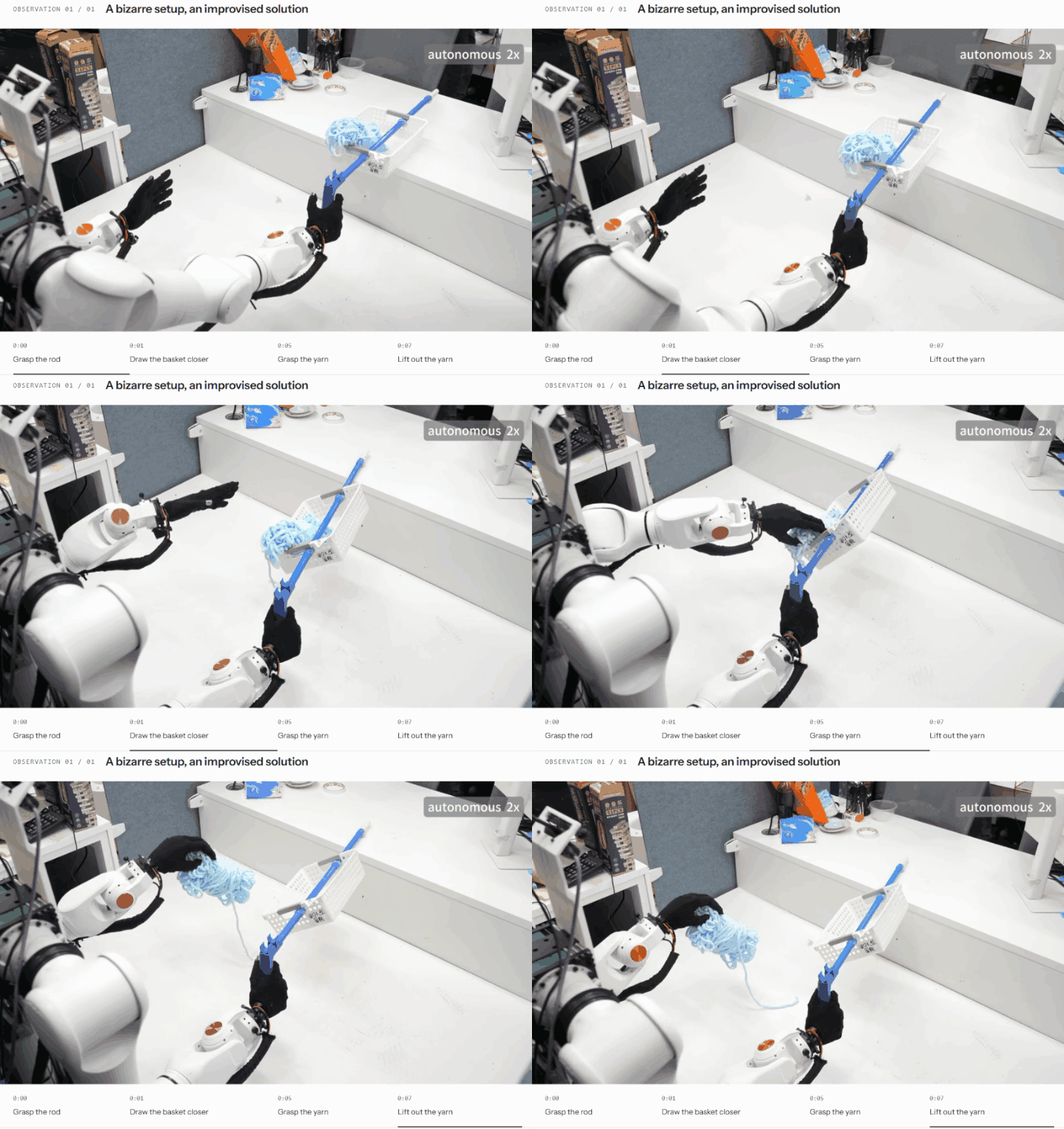
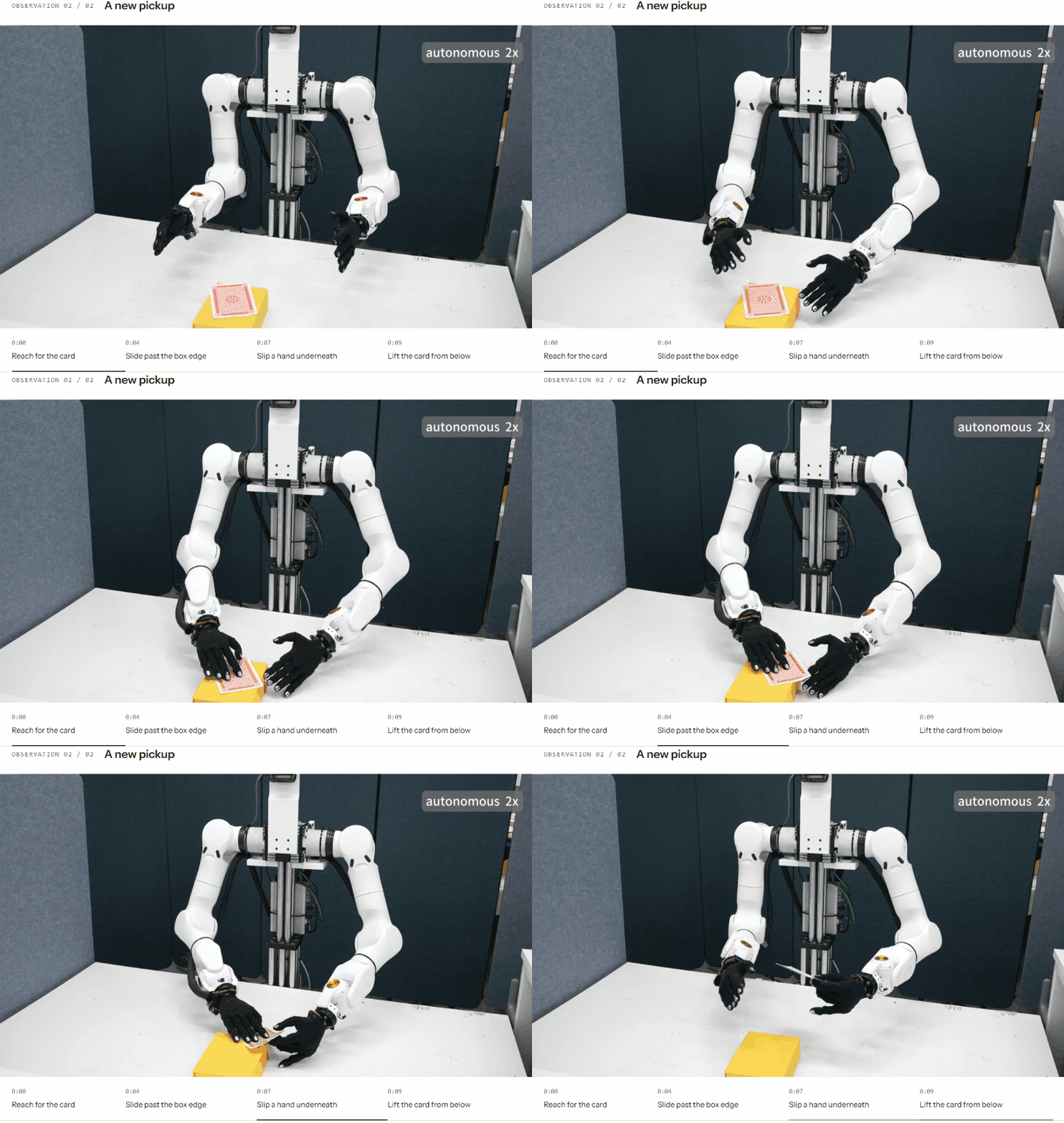
The team recalled that when the data scale was small, the model failed to grasp the target, but the hand continued to move according to the original plan; after the