Why does a professor who has taught advertising directing for 28 years embrace AI?
Interviewee's Profile:
LIU Xiaowei, Professor and Doctoral Supervisor | Director of the Teaching and Research Section for Intermedia Art Major, School of Fine Arts, Beijing Film Academy;
Member of the 1994 Film and Television Advertising Directing Class of Beijing Film Academy (the first cohort nationwide);
Graduated from the Directing Department of Beijing Film Academy with both bachelor's and master's degrees, and began teaching in the Film and Television Advertising Directing Major after graduation;
Lead of the virtual production + AI image creation team.
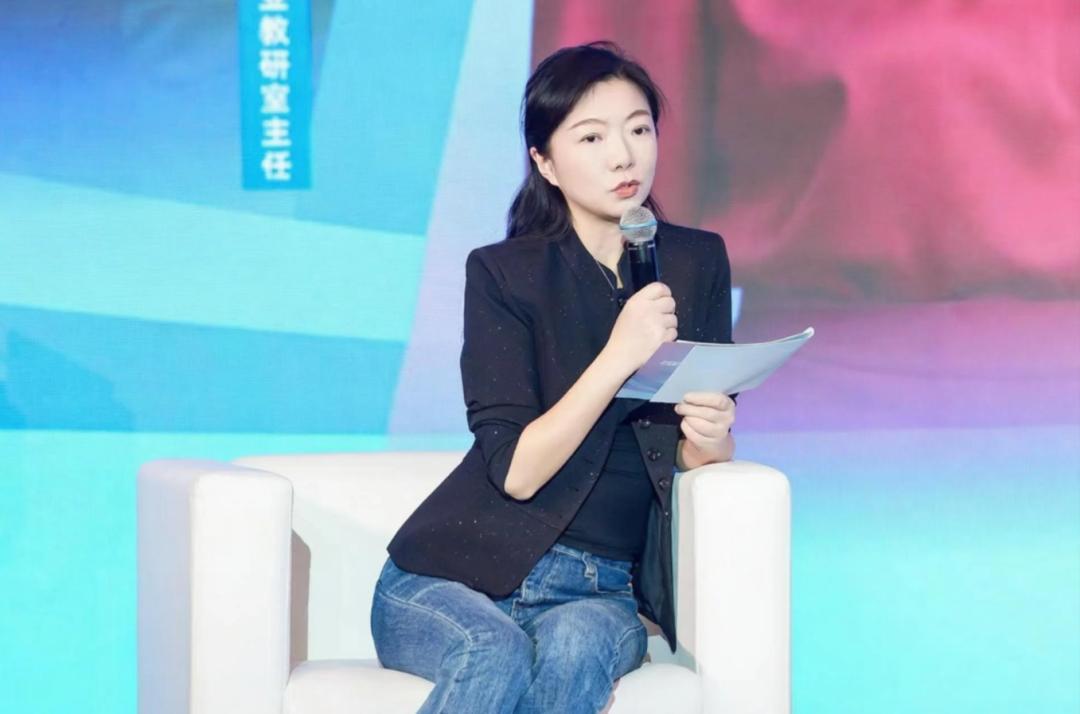
Professor LIU Xiaowei
(The following content is dictated by Professor LIU Xiaowei, organized and edited by Cultural & Entertainment Value Officer)
The old campus of Beijing Film Academy, located at Jimen Bridge in Beijing, retains the architectural style of China in the 1990s, with a neat and regular layout. The 9th floor houses the School of Fine Arts, and the corridors are fully hung with works by teachers and students for exhibition.
In 1994, 16-year-old LIU Xiaowei was admitted to Beijing Film Academy, becoming a student of the first national Film and Television Advertising Directing class, and was in the same class with WU'ershan and others. Starting from the first Film and Television Advertising Directing class in 1994, this major has gone through nearly 30 years of development. In 2023, the Film and Television Advertising Directing training direction welcomed its last cohort of graduates; and it was exactly in this year that LIU Xiaowei began to promote the transformation of the major to "Intermedia Art" together with other teachers.
She hopes to retain the professional foundation of directing training and film and television narrative, and expand into new fields such as interactive image, virtual production and AI image creation. For her, this is not a simple name change, but a process of finding a new development direction for the major.
From film, digital photography, to virtual production and AI-generated images, every iteration of film and television technology forces film creators to re-understand their own work. LIU Xiaowei is one of the first teachers to introduce LED virtual shooting into teaching practice, and lead teachers and students into the production process of AI narrative films. She does not regard technological changes as "switching software", but as a method of reorganizing creation and teaching. In her words, "The era is pushing you forward, and you cannot resist it".
Why did this professor from Beijing Film Academy who has been deeply engaged in film and television creation take the initiative to move to the forefront of technological change? When AI can generate films quickly, what is irreplaceable about the professional training in film academies? In the conversation with Cultural & Entertainment Value Officer, LIU Xiaowei gave her answers around professional transformation, industrialized trial and error, and the judgment of creators.

The sense of being pushed forward by the era that a university professor feels
I was admitted to Beijing Film Academy in 1994, when I was 16 years old, and I was classmates with WU'ershan and LI Weiran — we were the first Film and Television Advertising Directing class. I graduated from the Directing Department for both my bachelor's and master's degrees. Later, with the professional adjustment, the Film and Television Advertising Directing major was transferred to the School of Fine Arts for enrollment in 2000. From student to teacher, I have been practicing the school motto: Respect teachers and value the path, pass the torch from one to another.
I have come all the way from the first cohort of students to today, and I have deep feelings for this major. We train students in the direction of "Drama and Film Directing (Advertising Directing)", and have accumulated nearly 30 years of creation and teaching experience. But when the communication media, industrial demand and enrollment training system are all changing, we must think: how can these accumulations continue to generate value?
With the changes in the setting of undergraduate majors and talent training requirements, we have gradually extended the original advantages of film and television narrative to the teaching of intermedia art. So in 2021, the Film and Television Advertising Directing major was renamed as the Intermedia Art major. For me, this is not a simple change of major name, but a rethinking of what students learn, what they create, and what kind of industry they will face in the future.
The "intermedia" in my understanding is not a concept discussed only within the field of visual art, but cross-media narrative developed around the same story world. For works like Harry Potter and The Matrix, the stories not only exist in films, but also can be extended in games, comics and other media. Different media do not just copy the same content, but provide new narrative experiences respectively.
What we want to cultivate is not only art creators who are familiar with a certain tool, but people with narrative ability, aesthetic judgment and cross-media organization ability. Students may face vertical short films, commercial images, theater screenings, and may also face interactive film games and immersive experiences. The media can change, but audio-visual language, story structure and creation ability are the foundation; only by building these abilities can the major truly respond to the needs of the industry.
I always respect the value of pure art creation, but the unique advantage of Beijing Film Academy is film narrative, audio-visual expression and industrialized creation training. The Intermedia Art major must not lose this gene, but should form its own professional recognition based on it.
Seeing many film and television related majors constantly adjusting or even shutting down in recent years, looking back at the collective choice of all colleagues in our teaching and research section in 2021, it was very timely and even ahead of its time. When we started the professional transformation, generative AI was far from changing the industry as profoundly as it does today.
We did not decide to transform just because we saw the arrival of AI, but judged earlier that future content creation cannot be developed around only one medium, and the training of advertising directors must also move towards a broader cross-media narrative.
Later, AI quickly entered the industry, and the advertising industry was exactly the one that was hit most directly and severely. It changed the production mode of advertising content, and redefined the industry's requirements for creators. Looking back, I am even more grateful for the original decision: this transformation is not only an inevitable result of the development of the times, but also a choice we made actively.
It is precisely because we took this step in advance that we can bring the director thinking, audio-visual language and narrative ability accumulated for 30 years into the AI era. This makes the professional transformation not just an adjustment of name and direction, but a well-prepared active departure. I am more convinced that professional construction cannot only stick to the existing name, but judge the direction of technology and industry. Active transformation is not equal to chasing every hot spot, the key is to match our teaching advantages with the needs of the times.
I have experienced the starting point, development and transformation of this major. So I don't feel that the Film and Television Advertising Directing major "ended" in my hands. It is more like bringing the 30 years of accumulation of narrative teaching into the new media environment. For me, this is a continuation, and also a new departure.
In 2018, I directed a series of micro films commemorating the 40th anniversary of the reform and opening up, and then went to the United States for academic visit. During the visit, I began to pay close attention to virtual production, and started to think about how to practice it after returning to China. At that time, I spent more than 300,000 yuan out of my own pocket to go to the virtual studio in Wuxi to try and make mistakes, and led more than 20 students of different majors to shoot the first domestic "watchable" virtual production teaching experimental film Rescue on Alien Planet.
At that time, we entered the studio at 8 a.m., and did not shoot the first shot until 4 p.m. The complexity completely exceeded expectations. Most of the more than 300,000 yuan was the cost of trial and error. The short film was shot for five days, and the time cost was too high.
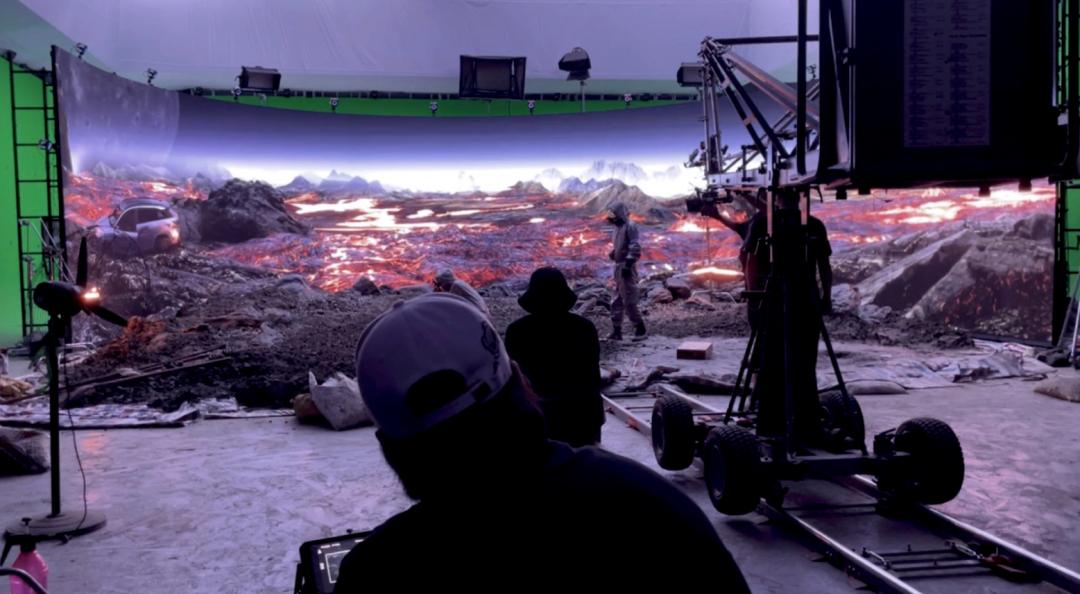
Working photo of Rescue on Alien Planet
But these trials and errors were not in vain. Rescue on Alien Planet later won many domestic and international professional awards, and accumulated rich experience in virtual production. Now every year we lead student teams to participate in the VPC National College Student Virtual Production Competition and the 48-Hour International Student Virtual Shooting Competition, and we can all win the gold award. Now we can prepare sufficient digital assets and complete the on-screen verification in minutes, which is a change of magnitude.
I also led the student team to introduce AI into the virtual production process, combining AI, virtual shooting, CG and Moco (robotic arm shooting) together.
In early 2025, when AI's generation capability was still limited, many complex effects still relied on CG. We generated and tested repeatedly until the early morning for a key shot, and AI only accounted for a part of the whole production process. But I also saw the disruptive changes brought by AI, because the VPC National College Student Virtual Production Competition requires that each participating team has no more than 3 people and must finish shooting within 48 hours. Without the participation of AI in creation, it is hard to imagine how to complete a sci-fi film with heavy special effects within 48 hours.
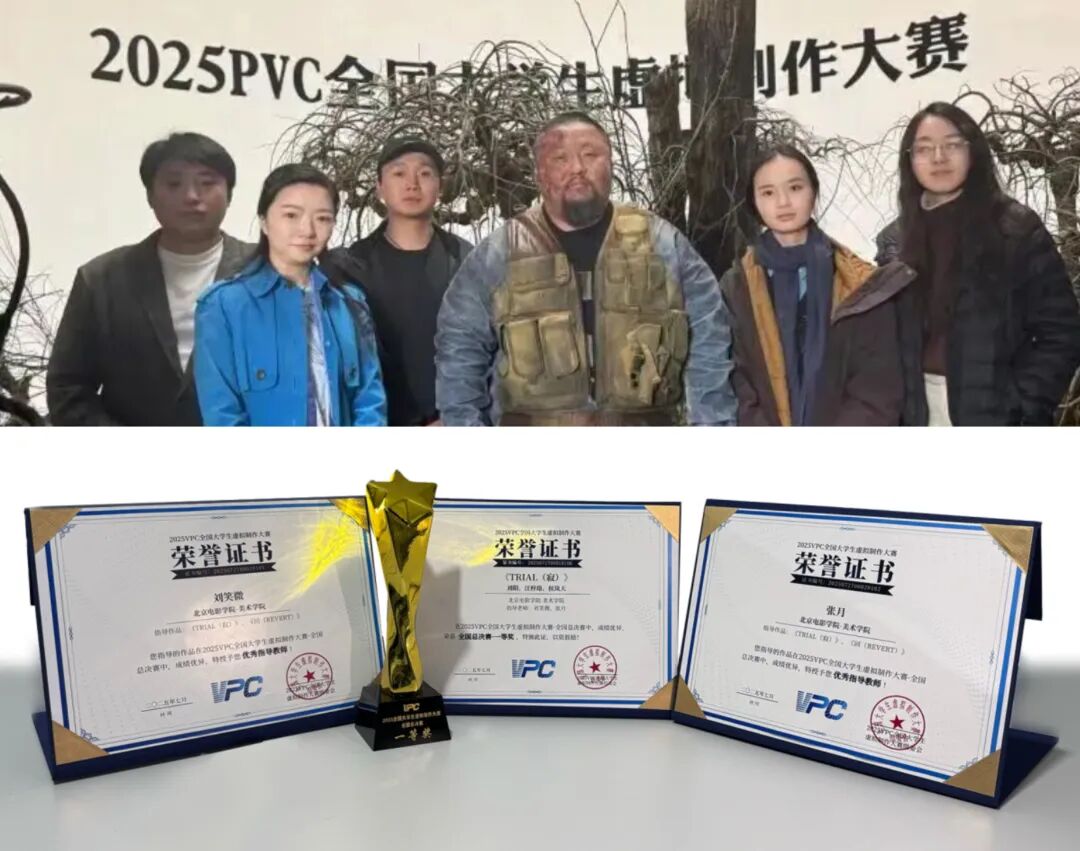
TRIAL Silence won the first prize of the National Virtual Shooting Competition
At present, our team has formed an industrial-grade film production system covering the whole process of shot design, digital assets, real scene construction, photography and lighting, and AI participation. So the solution of virtual production technology + AI is also believed to be an important development direction of the future film industrial process.

From industrial trial and error to completing the whole film in ten days
The creation experience that really made me feel a chill down my spine
In 2025, I tried to organize the creation of AI narrative films systematically for the first time according to the industrial process, which was leading the team to participate in the "Peter POW & iQIYI AI Theater" creation camp.
Because Mr. POW is a very rigorous and experienced filmmaker, he required us to submit work clips of different lengths week by week, and the pressure was very high. With the background of Beijing Film Academy, we respect this industrial process very much. I also demanded that the script, characters, shots, sound and delivery standards must be unified into an executable process. This is also the reason why Mr. POW finally commented that "your team has the most stable quality". The AI short film we created that time was Untouchable.
When creating Untouchable, in order to get more credible real human texture, we combined virtual shooting, AI-generated images, professional dubbing and sound design, and also tried to build digital actor assets that can be continuously used in different works. At that time, the consumption of generation points was very large, and the actual cost of technical trial and error and professional production was far higher than the outside world imagined, and the project funds were not enough to cover all the investment.
Untouchable is available for viewing on iQIYI
When we made Untouchable, in order to pursue a sense of reality, we mixed the authorized image mode of real actors and virtual shooting, and also invited professional sound directors and dubbing actors. In the process, we incidentally created a sustainable digital actor LIN Moqing.
At that time, it was the period of Seedance 1.5, and the character consistency and controllability of the model were far less than they are now, with an extremely high scrap rate. We had to constantly confirm every day whether the character looked like our real actress. The most common sentence in the office during that period was: Does it look like it? If the expression, line of sight, movement, costume, or lighting is not correct, the audience may be distracted.
Therefore, AI generation does not mean that professional review can be omitted. Our team has always had a very clear aesthetic pursuit, that is, super realism, which is as close as possible to the film effect of real shooting. We don't want the audience to think at first glance that "this is made by AI", let alone use exaggerated visual wonders to cover up the problems of characters and narrative. The micro-expressions and eyes of the characters, the natural texture of skin and clothing, where the light comes from, and why the camera moves in this way must all conform to the visual logic of film. Only when the image is credible enough can the audience believe the character, forget that it is made by AI, and truly enter the story.
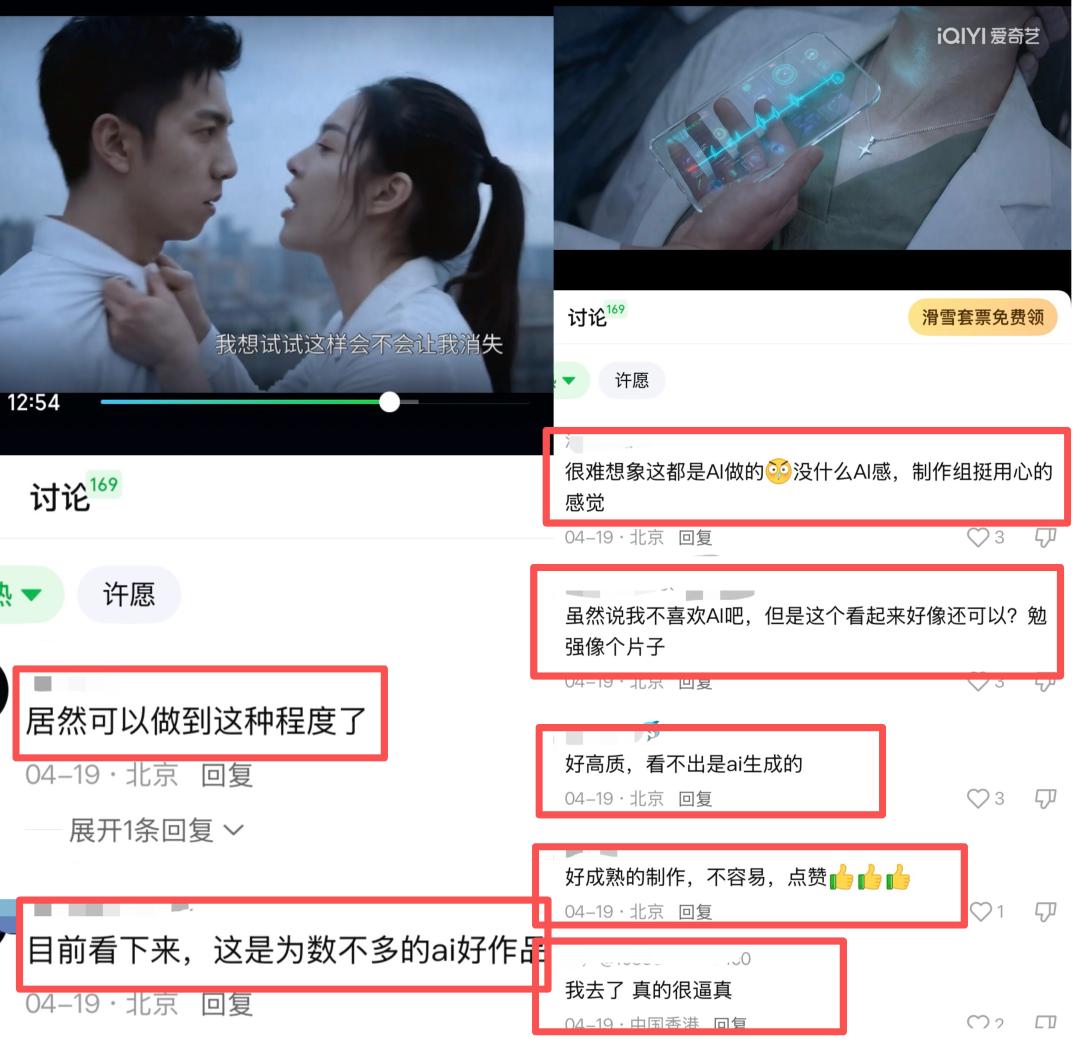
The high-quality picture of Untouchable was widely praised by iQIYI users
But the progress speed of the model is really amazing. In just a few months, the character consistency and shot controllability have been significantly improved, but this does not mean that complex movements, long performances and cross-scene continuity have been completely solved. Technological progress allows us to put more energy back into stories, characters and shot expression.
But whether the character "looks like" is only the foundation. Why use this shot and what is its relationship with the previous and subsequent narratives still depend on the creator's judgment and design. Moreover, super realism does not mean that a single static frame is realistic enough. When it comes to continuous narrative, the performances and movements of the characters must be coherent, and the light, spatial relationship and overall image style after shot switching must also be reasonable. We hope to test AI works with the standards of big-screen films, rather than lowering the requirements for picture authenticity and film completion just because AI is used.
Therefore, what we pursue is completely different from what many AI creators pursue.
Speaking of the pursuit of professionalism, we participated in the creation of AIGC multimedia images for the musical drama Summoned: Dunhuang directed by TIAN Qinxin. It was the end of 2024. As we all know, AI generation tools were still in the initial stage at that time, and the difficulty of this theme was not the dazzling technology first, but how to respect the historical and cultural context of Dunhuang, so that the pictures can withstand professional scrutiny.
The color matching, patterns of the monk robes and the identities of the characters in the first generation did not match. We consulted historical materials, and constantly adjusted the costumes, architectures, landforms and cultural