Changxin's disruptive foray has led to a sharp slump of global chip giants.
A single chip has sent global memory stocks tumbling, and Changxin has been making quiet yet earth-shaking moves.
On October 13, the Korea Exchange activated the SIDECAR circuit breaker to suspend programmatic selling. The last time this circuit breaker mechanism was triggered was back in April this year.
Samsung Electronics closed down 7.39%, SK Hynix dropped 10.09%, and the KOSPI index was dragged down by 5.46%, hitting its lowest closing price since April 13.
Across the ocean, Micron Technology closed 3.88% lower last Friday, with its stock price falling below $1000 per share, down nearly 20% from its June high, stepping one foot into the territory of a technical bear market.
What caused the collective "blood loss" of the three global memory giants is neither an earnings miss nor a policy shift by the Federal Reserve, but a speech delivered by a Chinese company at an academic conference 10 days ago.
What exactly is the breakthrough brought by 4F²?
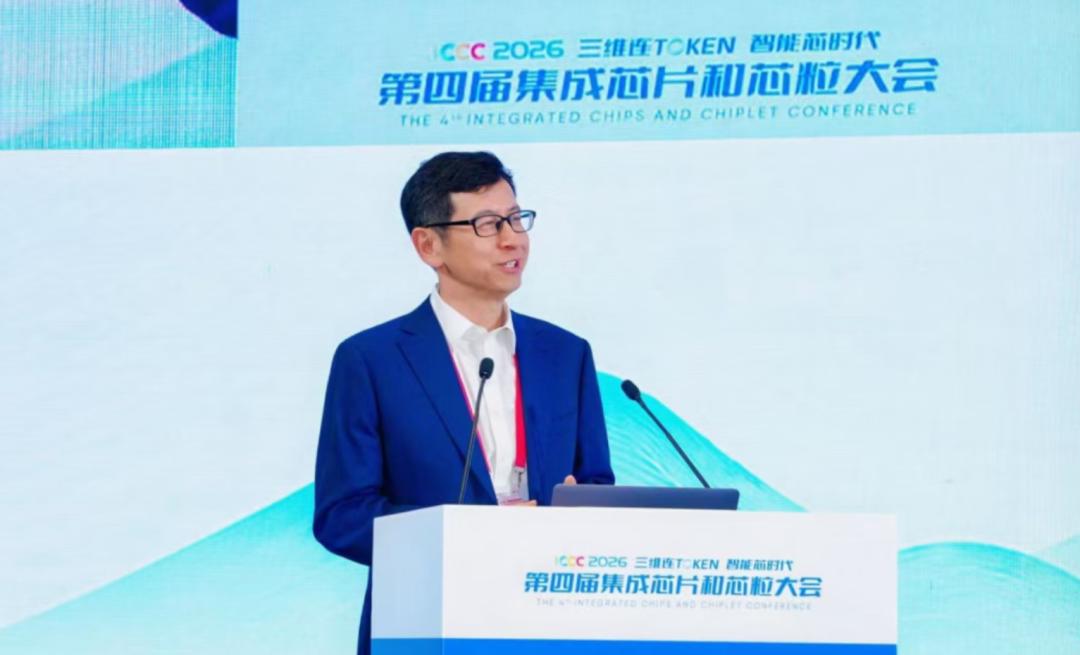
On October 10, at the 4th Integrated Chip and Chiplet Conference in Shanghai, Cao Kanyu, President of Changxin Technology, took the stage and announced two major developments: key progress has been made in the R&D of the 4F² DRAM architecture, and a new generation of DDR5 RDIMM products integrating the 4F² architecture and wafer-level hybrid bonding technology is expected to be launched by the end of the year.
There is a core formula to measure technology in the DRAM industry: the cell area equals a multiple of F². F refers to the minimum feature size, and the smaller the multiple, the more transistors can be packed into the same area.
For decades, the mainstream architecture in the industry has long been the 6F² design.
Changxin has pushed the multiple down from 6 to 4.
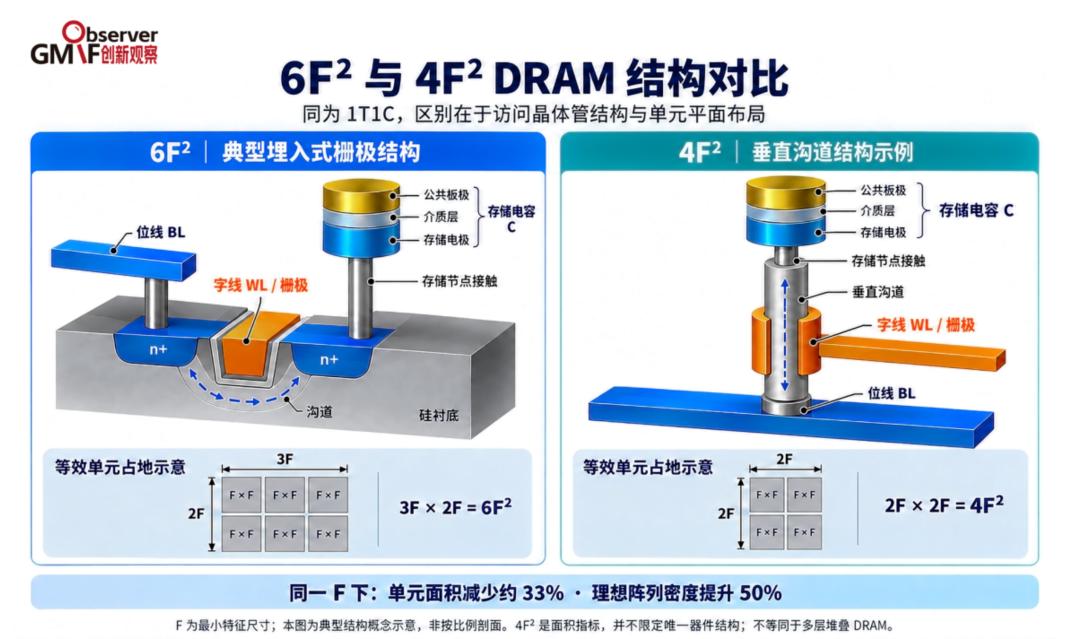
The implementation path is even more noteworthy. Cao Kanyu introduced at the conference that the core innovation of the 4F² architecture is the self-developed VSG vertical-surrounding channel transistor, which adopts a vertical-surrounding channel structure to enhance gate control capability and mitigate leakage current and short-channel effects.
To put it plainly, this design turns transistors from "lying flat" to "standing upright", and improves density through architectural innovation rather than process miniaturization.
The significance of this move can only be fully appreciated when viewed against the backdrop of the global competitive landscape.
SK Hynix first unveiled its 4F² VG technology roadmap at the IEEE VLSI Symposium in June 2025, planning to apply it to nodes of 10 nanometers and below. Samsung, on the other hand, has set its mass production target for sub-10nm DRAM in 2028.
If Changxin delivers the products as scheduled by the end of the year, the generation gap with its peers may be widened to around two years.
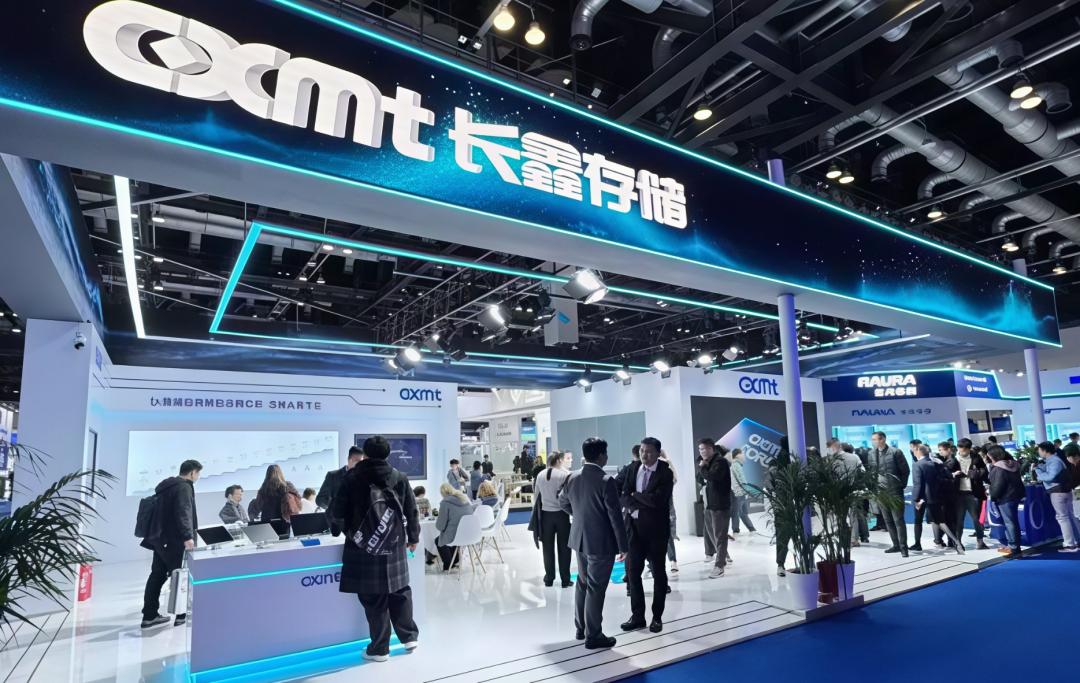
There is also an easily overlooked detail. Changxin has launched 4F² research and patent layout since its establishment, with more than 300 published patent families, a number leading manufacturers at home and abroad.
It published the first 4F² architecture paper in Chinese mainland in 2021, and continuously disclosed iterative results at the International Electron Devices Meeting in 2023 and 2025.
This is not a last-minute effort, but a decade-long dedicated grind.
What exactly is Micron, which has seen its stock price surge 261%, afraid of?
Sentiment is sentiment, fundamentals are fundamentals. Behind the panic sell-off, three forces are converging.
The technology narrative has been rewritten. Memory chips are an oligopoly business. Samsung, SK Hynix and Micron have long divided over 90% of the global DRAM market between them, controlling pricing power, capacity allocation and technology roadmap.
Changxin's 4F² architecture has broken the narrative inertia that "technology leaders will always stay ahead".
The share repurchase "safety cushion" has been removed. Samsung and SK Hynix previously launched a combined record-breaking $40 billion share repurchase plan, which the market viewed as a signal to prop up stock prices.
However, this move ended several weeks ahead of the scheduled time, and Samsung's repurchase was actually terminated on October 6. After the prop was removed, the KOSPI index fell by about 8% cumulatively in the following three trading days.
Foreign capital is fleeing. Foreign investors have begun to question the sustainability of the boom cycle in the memory chip industry and keep selling off South Korean stocks.
Ecaterina Bigos, Senior Market Strategist at BNP Paribas Asset Management, told CLSA that the rise in bond yields and concerns over AI investment returns have jointly driven this round of sell-off.
Let's look at a set of comparative data.
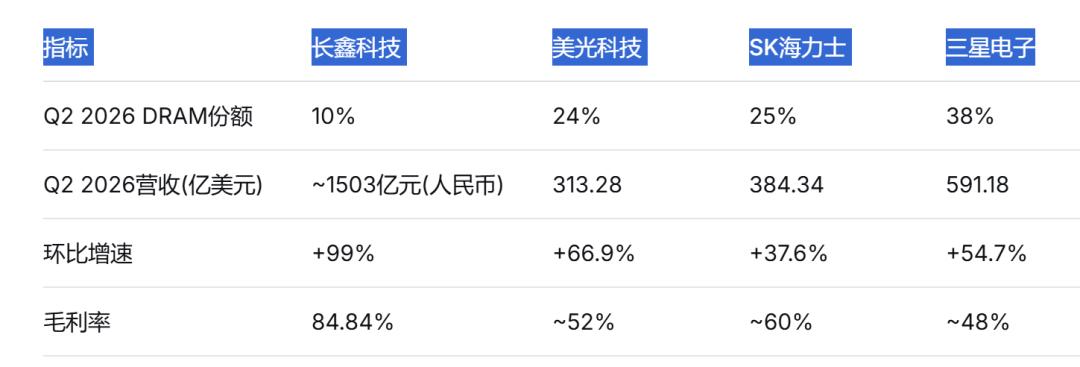
Data source: Counterpoint Research, financial reports of respective companies
Changxin Technology's financial data for the first half of the year is also noteworthy: operating revenue reached 150.31 billion yuan, up 873.64% year on year; net profit attributable to shareholders hit 77.605 billion yuan, compared with a loss of 2.332 billion yuan in the same period of last year; net cash flow from operating activities was 131.156 billion yuan. The gross profit margin of its main business reached 84.84%.
What does an 84.84% gross profit margin mean? This level is high enough to silence most companies across the global semiconductor industry.
In terms of market share, a report from Counterpoint Research shows that Changxin's share in global DRAM revenue has climbed from 4% in the second quarter of 2025 to 10% in the second quarter of 2026, up 4 percentage points year on year and 2 percentage points quarter on quarter, firmly ranking as the world's fourth largest DRAM manufacturer.
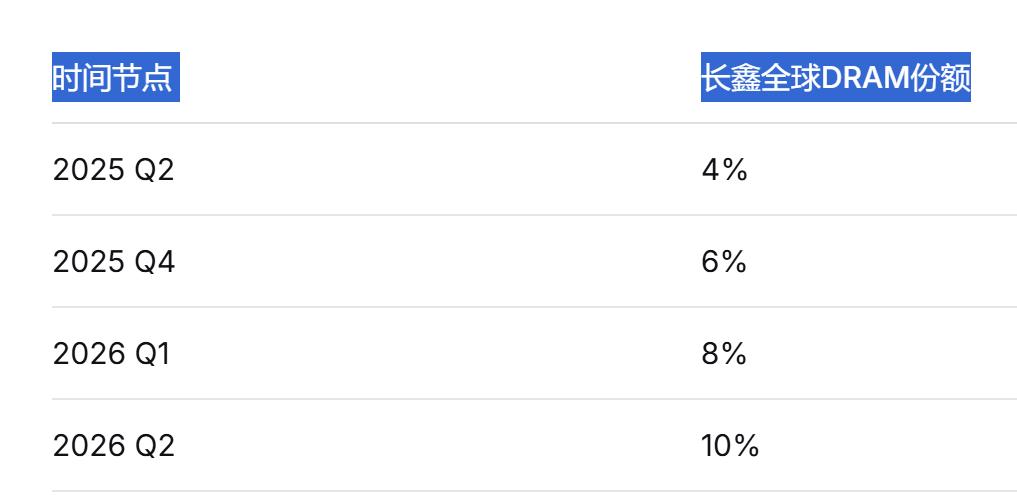
Data source: Counterpoint Research
It took only four quarters to grow from 4% to 10% share. No precedent of such speed exists in the history of the memory industry.
Changxin's product launch pace is also accelerating. The G5 platform has entered mass production, with the half-pitch of the active area shrunk to 11.95 nanometers, and the number of dies produced per wafer increased by at least 50% compared with the previous generation.
The self-developed LPDDR6 chip has been put into mass production and commercial use, making its debut on the Xiaomi 18 Fold flagship foldable phone, becoming the world's first LPDDR6 product deployed on flagship mobile phones.
That said, Changxin still lags far behind in the HBM field.
Samsung's HBM4 took the lead in mass production and shipment in February 2026, with cumulative sales exceeding 1 billion US dollars just four months after supply started.
SK Hynix's HBM3E has been in mass production for a long time. Changxin's HBM3E is expected to enter mass production in 2027, with an overall progress lagging behind by three to four years.
In emerging technology fields such as HBM and 3D stacking, Changxin is still in the catch-up stage.
This is far more than a simple "domestic substitution" story
Many people interpret Changxin's rise as "domestic substitution", but the author believes that this framework is far too simplistic.
The real change is that memory chips are evolving from cyclical commodities to core resources of AI infrastructure.
The latest forecast from Gartner shows that global memory revenue will reach 837.3 billion US dollars in 2026, accounting for 54% of the 1.56 trillion US dollar semiconductor market, a sharp increase from 27% in 2025.
Omdia estimates that memory chip revenue will account for more than 50% of the total global semiconductor revenue.
Morgan Stanley believes that AI is both a computing power issue and a memory issue, which makes this round of memory cycle structurally different from previous ones.
Goldman Sachs predicts that the tight supply and demand of traditional DRAM, NAND and HBM will continue until 2028.
This means that the underlying logic of memory chips is shifting from "purchasing memory" to "scrambling for memory".
Price data can illustrate this point. According to Counterpoint's report, memory prices rose 80% to 90% quarter on quarter in the first quarter of 2026, with general-purpose server DRAM being the core driving force.
The price of 64GB RDIMM server memory modules skyrocketed from $255 in the third quarter of 2025 to $450 in the fourth quarter, and further climbed to about $700 in March 2026.
A report from Barclays shows that as of October 2026, the contract price of DDR4 has risen by 24% cumulatively in the past three months, and DDR5 by 20% cumulatively.
But we must also see the flip side of the coin.
Statistics from Counterpoint show that global smartphone shipments in the third quarter of 2026 fell 20% year on year, hitting the lowest level for the same period since 2012. The memory price hike is being transmitted from the supply side to the consumer end, and downstream manufacturers are facing harsh operating conditions.
What is more worthy of vigilance is that the "boom-bust" cycle of the memory industry has never really disappeared.
According to estimates from Digital Chat Station, the recent combined cost increase of DRAM and NAND has reached 340%, exceeding the price of some top-tier SoCs.
Once the supply growth rate catches up with or even surpasses demand, the pressure of price correction will be released in a concentrated manner.
Final notes
Samsung Electronics announced record third-quarter results last week, with operating profit surging nearly 8 times year on year.
The better the performance, the steeper the stock price drop. This shows that what the market cares about is not "how much profit is made", but "how long this profit can last".
Changxin's 4F² architecture is interpreted at this juncture as a new variable that affects the answer to "how long this profit can last".
Objectively speaking, a product that will not be launched until the end of the year cannot rewrite the industry landscape overnight.
Samsung's first-mover advantage in the HBM field, SK Hynix's locked long-term contracts with clients, and Micron's deep cultivation in automotive-grade memory are all barriers that cannot be shaken in the short term.
But Changxin's growth curve is truly extraordinarily steep. It took less than 10 years to grow from scratch to the world's fourth largest, and only one year to expand its market share from 4% to 10%.
The G5 platform solves the manufacturing capability problem, and the 4F² architecture solves the problem of technological discourse power. When these two variables are both satisfied, the competitive logic of the global memory market has to be re-examined.
As for this round of stock price plunge, the market will sooner or later give the answer as to how much of it is rational pricing and how much is emotional stampede.
But one thing is certain: the era of "three-party dominance" in the global memory chip industry is being torn open.
Changxin has not only secured a seat at the table, but is also moving closer to the center of the stage.
This article is from the WeChat official account "Investment Banking Circle", written by Senior Sister of Investment Banking, and republished with authorization from 36Kr.