What Makes On Justify Pricing Its Entry-Level Offering at 1,350 Yuan? | Exclusive Interview
Text by He Zhexin
Edited by Qiao Qian
In Zurich
On is more like a Silicon Valley tech company than a running shoe enterprise.
In Zurich West, the former heavy industrial zone of the Swiss city, On's global headquarters On Labs is located here. The whole building has a cool, minimalist style, with a large amount of stainless steel and glass used for interior decoration. On one side of the square is the workshop, where high-precision spray-weaving robotic arms stand on the rough concrete floor. In the laboratory not far away, athletes come from time to time to test the latest products. Scientists stand beside the treadmill, recording data into computers as the basis for the next round of product adjustments.
On the first floor of the building is a vegetarian restaurant called Roots. On sunny middays, you will see all employees wearing On shoes dining and resting here. Within a five-minute walk are the Zurich University of the Arts and the Zurich University of Applied Sciences — On regards them as natural neighbors for innovation, design and talent cultivation.
David Allemann, co-founder of On, likes to compare the brand with some tech consumer goods companies. "On should be like Apple and Dyson," he told 36Kr, "with exquisite appearance, innovative core and high-end positioning."
"Premium" is also the most frequently used word by On's management and employees during our visit.
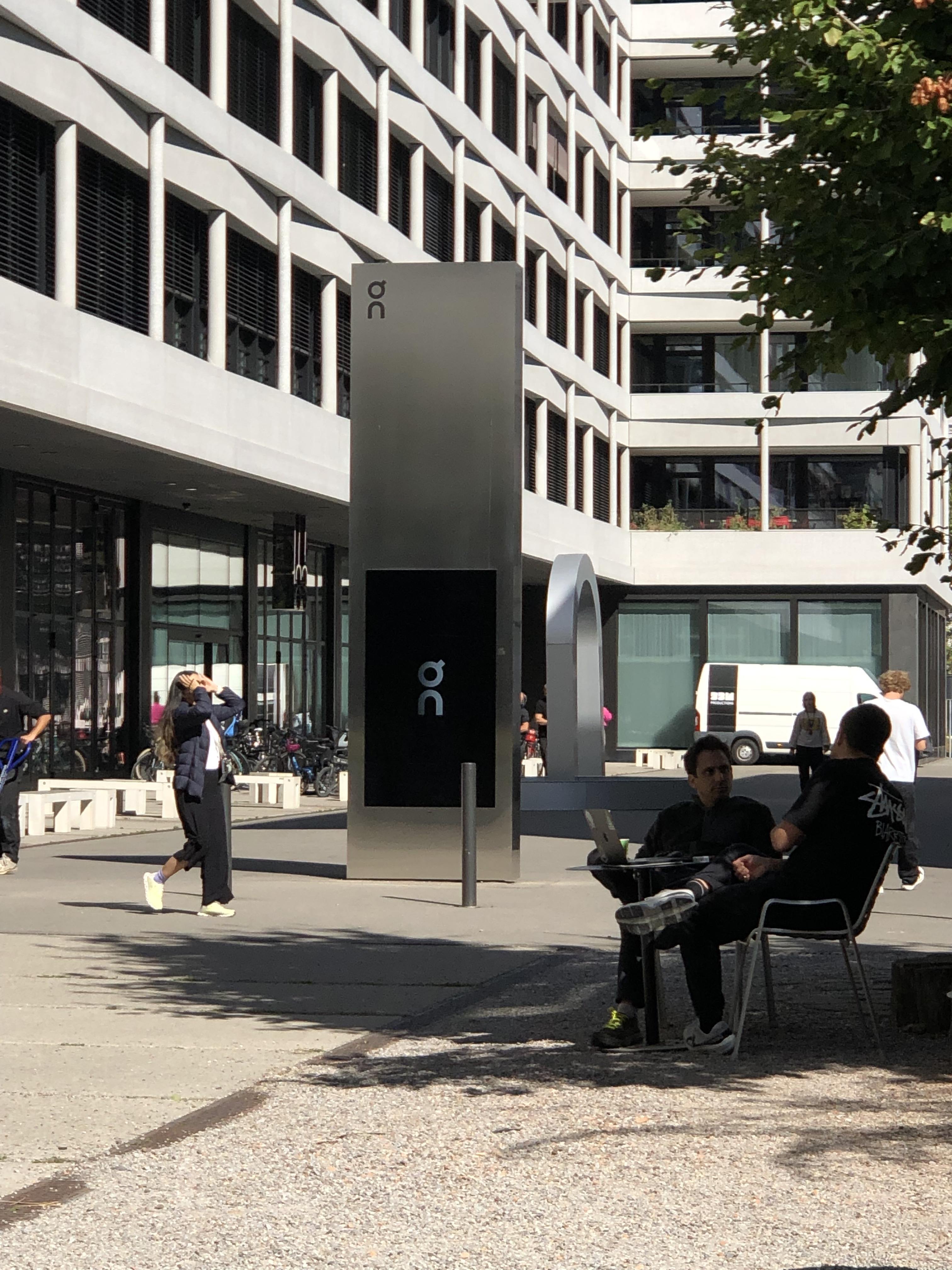
On Labs, On's headquarters building in Zurich | Photo by the author
What exactly does "premium" mean in On's definition?
For example, On has set a threshold of 160 CHF (about 1350 RMB) for the entry-level performance running products, followed by 200 CHF, and then nearly 300 CHF. Some lifestyle models, such as the leather Roger tennis shoes, can be sold for 400 CHF. On says such products "will definitely find buyers" in China, and some co-branded models may be priced even higher.
On attributes the emergence of its target consumer group to a "structural shift" in the sports industry. In their narrative, sports has evolved from a weekend pastime to an identity practiced every day. Health, vitality and longevity have become new symbols of premium identity — On named this group of people the "Movement Class". In the past two years, luxury brands have shut out about 80 million aspirational consumers.
"Where will these consumers go?" Allemann's judgment is that there is a large gap between mass brands that rely on low prices and luxury brands that rely on scarcity, and that is exactly where On wants to position itself.
Challenges
Just two days before this visit, On successively announced its entry into two new categories: football and golf. It also announced its cooperation with Kylian Mbappé — the football player who is arguably the most commercially valuable athlete at the moment. In addition to becoming the brand's spokesperson, he also received shares in On, which is quite similar to the cooperation with Roger Federer in the past.
For a company that has been established for only 17 years, launching two new business lines within a week caught the outside world by surprise. Another founder Caspar Coppetti put forward three criteria that the company must pass before entering a new sport: Can it be disrupted with innovation and "Swiss engineering"? Does it have cultural relevance beyond performance? Is it ready to be premiumized?
Golf checks all three boxes. In Coppetti's words, this sport "is born to be premium". Football certainly has sufficient cultural relevance, but this category has historically been driven by wholesale, with a more mass consumer base and higher price sensitivity. So why football? Allemann's answer to 36Kr is: "Look at basketball."
"If you compare the price trend of basketball shoes in history and today, you will find that this category has been successfully premiumized," he mentioned the contribution of Air Jordan, "We believe football has the same potential. The premise is that you have to start from athletes — so that the sport can smoothly move from the court to the street."
The question is how to achieve all this? As Allemann himself said, every single component of On's products can be copied: a certain type of foam can be reverse-engineered, a beautiful store can be imitated, and the signed athletes can switch to other brands at any time. What cannot be copied is how these components reinforce each other.
The system that makes them reinforce each other is the Premium Playbook that On's management repeatedly elaborated on at the Investor Day on September 22.
First, the company needs talents who are good at breakthrough innovation and a culture with high risk appetite; second, products need to be actually used by athletes and celebrities, "not bought endorsements"; third, both self-operated channels and third-party channels need to impress customers with a consistent overall premium experience; fourth, it is necessary to maintain pricing discipline; finally, the high revenue obtained from this set of playbooks should be reinvested in the next round of innovation process.
According to On, the average selling price of On's footwear has risen from "$145 to $170" in five years, which is strong evidence of its pricing power; in the past three years, profit growth has outpaced revenue growth, which is proof of the so-called "high-quality growth"; and in many markets including the United States, On has the highest average selling price and the lowest discount rate in the entire industry.
"During the 618 Shopping Festival, one of the largest shopping events in China in the first half of the year, On entered the top 20 sports brands for the first time," Rebecca Cai, who took office as Chief Global Marketing Officer on September 1, said at the Investor Day, "And we were the only one among these 20 brands that sold all products at full price."
But On's management knows better than anyone that now is not the time to rest on its laurels. When releasing its Q2 financial report in August, On lowered its full-year guidance from at least 23% constant currency growth and net sales of at least 3.51 billion CHF to a growth of just over 20% and net sales of 3.47 billion to 3.56 billion CHF. The stock price fell by about 20% on that day.
This is largely caused by North American sports market revenue falling short of expectations. The growth of the Americas region in Q2 was only 4.5% on a reported basis. In order to maintain full-price discipline, On actively reduced shipments to North American wholesale channels — North America is On's largest market, accounting for more than half of its revenue, and it is also the market where sports categories have seen the most severe discounts since the beginning of this year.
In China, the goal of "accounting for 10% of global revenue" set three years ago has not yet been achieved. CFO Frank Sluis gave the latest timeline as "before 2029". Next year, the number of relocated stores in China will be as many as the number of newly opened stores. David Allemann admitted to us that carbon plate and supercritical foaming technologies have completed "commoditization in a sense", and the market needs something more innovative.
North America needs to get back on track, and China also needs to catch up, but On's latest three-year plan has not been compromised. By 2029, On's net sales will grow from about 3.5 billion CHF this year to at least 5.6 billion CHF, with a profit margin of 22% and a gross profit margin maintained above 65%.
The management also stated that there will be no substantial expansion in gross profit margin, and the extra 2 percentage points of profit will be saved from expenses. In addition, 75% of net sales growth in the next three years will be driven by three major categories: running, sneakers and apparel, while football and golf, which have grabbed all the headlines, only make a "modest contribution" in this financial model.
New news
To support this growth curve, On first needs more running products that can convince the market.
Launched on October 1, Cloudsurfer 3 is a cushioning running shoe. Its origin was a spot observation at a specialty running store in North America, and it is the brand's first attempt to "drill holes in super foam".
The production process of super foam is to first make a small blank, inject gas, put it into an autoclave for pressurization, and then release the pressure within milliseconds. Once the pressure is released, the blank expands like popcorn to reach the size of the midsole. It is almost impossible to drill holes in such a process. But On says they have found the corresponding technology and craft.
This new craft was described by David Allemann as "the perfect combination of physics and chemistry". Before that, this field only involved chemistry — "such as EVA foam that gets better generation by generation."
He compared the weight of this breakthrough to the launch of CloudTec in the past. Around 2010, Allemann was at a mold factory in Guangzhou, where he was told that it was impossible to drill holes in the rubber outsole because there was no such mold. Later, On made a pair of molds with "fingers" by itself. More than ten years later, he described that the same "impossible" problem has appeared on super foam, and they "have made it again".
To some extent, this is also On's response to the "commoditization" of super foam and carbon plate technologies. When a material becomes available to everyone, the difference can only be found in places that are harder to replicate.
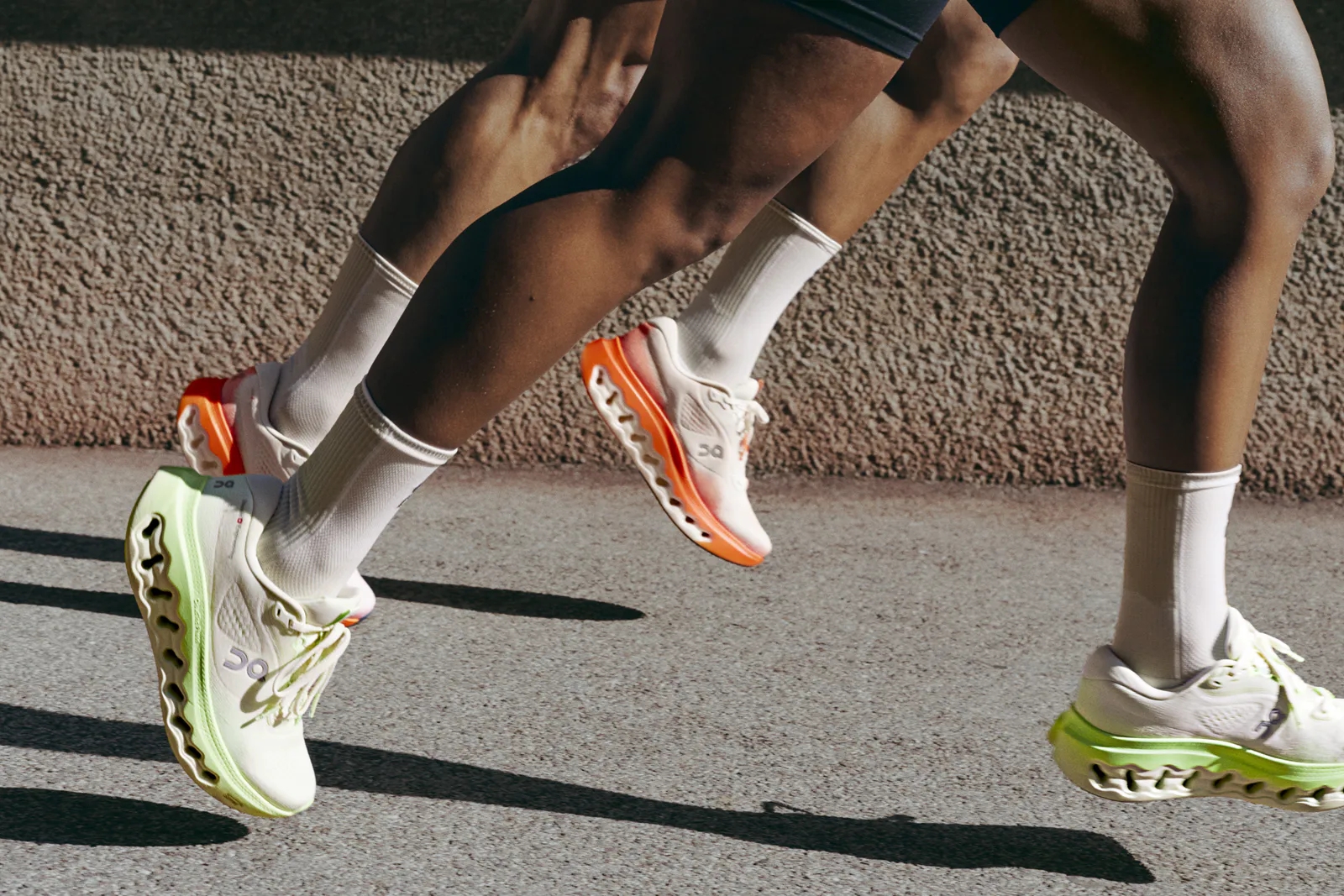
On Cloudsurfer 3
LightSpray is also a product of this logic. This upper spray manufacturing process, which was called "disruptive enough to reshape the footwear manufacturing industry" by The Wall Street Journal, can now be applied to running, lifestyle, football and golf scenarios. Allemann believes that it can minimize the distance between the foot and the ball, and is On's secret weapon to make "distinctive football shoes". He revealed that the football shoes made with LightSpray are "already in the final optimization stage".
"We can spray a certain texture on the part where the foot touches the ball to make it more flexible; spray another texture on the part that is easily stepped on to make it more pressure-resistant," he told us, "This is impossible for leather football shoes, and also impossible for shoes assembled from hundreds of components."
According to the introduction of the head of LightSpray technology, a pair of shoes made by LightSpray takes about 50 minutes to complete, and the robotic arm only takes three minutes to spray the upper itself. By changing a parameter, a new version can be sprayed on the same day. In addition to costs, the R&D cycle has also been greatly shortened. This can make sales forecasts more accurate and reduce forced discounts.
The midsole of LightSpray shoes is made in Vietnam, and the upper is sprayed in Zurich and South Korea. According to Reuters, the South Korean factory produces about 1,000 pairs per day; during the visit, On introduced that the annual output of the Zurich factory is between 40,000 and 50,000 pairs. At the Investor Day, Scott Maguire, President and Chief Operating Officer, revealed that the demand for the LightSpray racing shoe Cloudboom Strike 2 has reached six times the initial supply, "We are working hard to catch up."
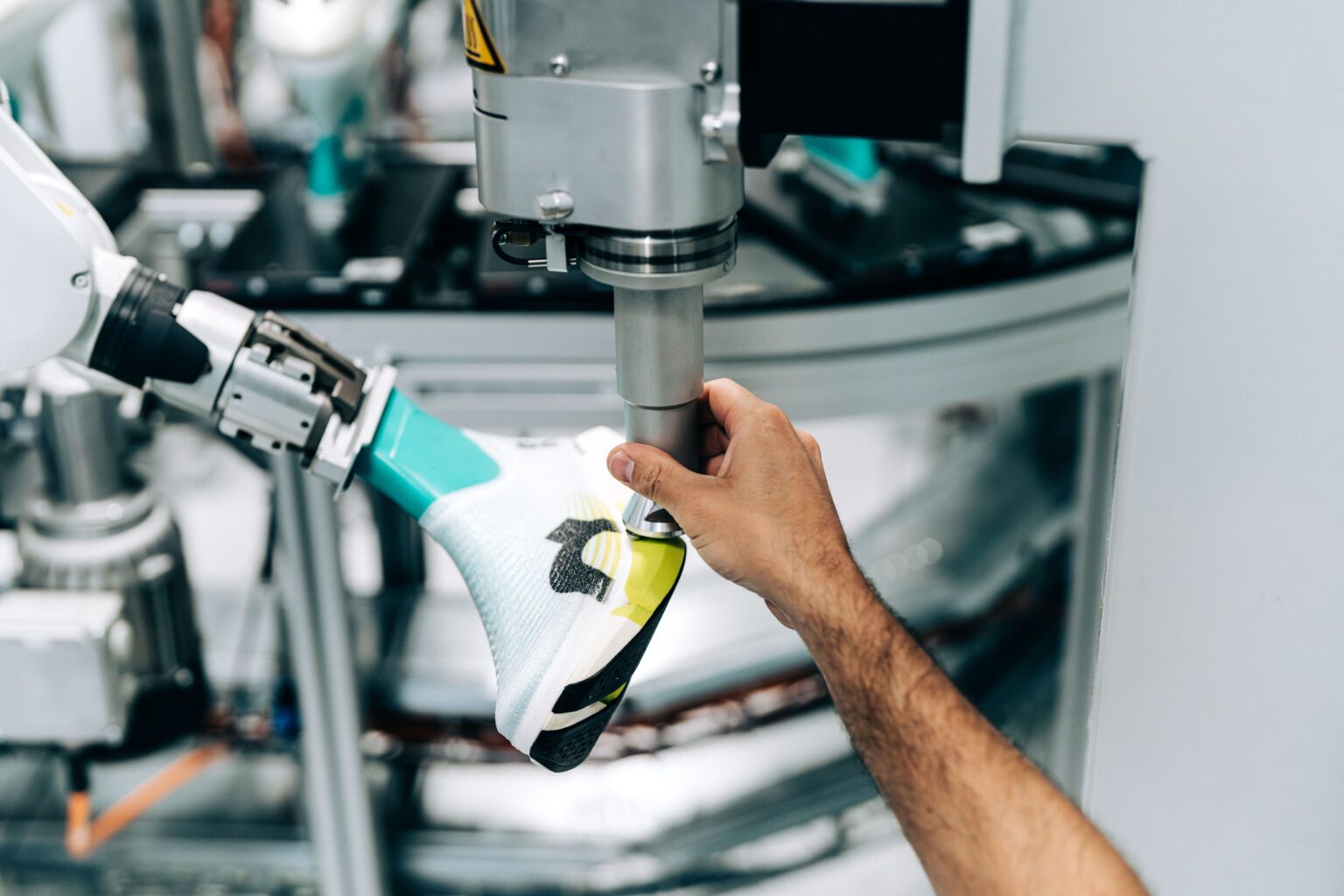
The LightSpray workshop at On's Zurich headquarters, which focuses more on innovation than mass production
Exploration
Another premise for making accurate forecasts is to be close enough to consumers. For a brand that started with wholesale, the closest touchpoint is its own direct-to-consumer business. Three years ago, On had only 22 self-operated stores worldwide, and today there are about 80. It plans to open 180 stores by 2029, with the goal of self-operated channels and wholesale channels each accounting for half of net sales — currently self-operated channels account for 10%.
The most important lesson learned in retail in recent years, according to Allemann's summary, is "bigger is better". Small stores can hardly fit anything other than shoes, and apparel is only an accessory. After the store becomes larger, 70% of the display space can be used for apparel, and 30% for shoes. But the revenue structure is the opposite: most of the sales still come from shoes, and apparel brings new incremental revenue that did not exist before. Allemann told us that the customer lifetime value (LTV) of apparel consumers is higher than that of footwear consumers.
More importantly, direct-to-consumer business gives On the opportunity to figure out exactly what channels and what kind of people are driving growth. A figure mastered by the company is that in key markets, the LTV of customers who consume both in stores and online is up to 4.5 times that of customers who only use a single channel.
"We know this multiple," Alice Delahunt, the newly appointed Chief Customer Officer, said at the Investor Day, "What we haven't built yet is a mechanism that can consciously cultivate more of these customers."
Delahunt joined On in September this year, is based in New York, previously served as Chief Content Officer and Chief Digital Officer of Ralph Lauren, and earlier participated in the digital transformation of Burberry. She is responsible for On's direct-to-consumer channels, focusing on retail, digital, customers and membership programs.
"Her responsibility is to ensure that no matter where customers meet us, whether in wholesale channels, in our own stores, on our official website or on partner websites, they get the same premium experience," David Allemann told us.
The first item on Delahunt's to-do list is "know the customers". On's current data of the same customer is scattered in more than one system, "Personalized services have been launched, but they are still in the early stage." The second item is the membership program. "We don't have a membership program today," she said, "In the past three years, our priority has been products and demand, which was the right choice. But the next question is what we do with this demand."

On's Runner Base in West Bund, Shanghai
Today, On is facing a brand new test paper. During the Q&A session of the Investor Day, Bernstein analyst Aneesha Sherman asked, "You are becoming a big player in this market... Will you sooner or later have to choose between growth and profit margins?" She pointed out that competition and promotions in the industry are intensifying, and the lifestyle and apparel categories that On is focusing on are exactly the categories that are most often discounted.
Caspar Coppetti's reply is: "I don't think that statement holds water... We are educating consumers not to expect us to offer discounts."
The final result of this process will of course take several more years to see, and On has performed quite well on the current small quizzes.
The daily model Cloudtilt is a "explosive product line". Al