A nine-month-old company enables robots to step out of the "rehearsed world".
In the exceptionally bustling nine months of embodied intelligence, there is a team that has remained remarkably low-profile.
While peers compete for attention with one robot demo after another, it has bet on a slower yet more costly undertaking: training a general-purpose model for the physical world.
This company is called Natural Will. Founded in January 2026, it has set its sights on a general foundational model for the physical world from the very beginning, with the goal of enabling the same set of models to continuously adapt to new tasks.
It was not until October 2026 that this team stepped onto the stage with its product for the first time, releasing Natura-1, a 50B-level general foundational model for the physical world. It completes pre-training using millions of hours of first-person human data, and has so far demonstrated dexterous manipulation and zero-shot instruction following capabilities. When faced with unfamiliar objects and ad-hoc instructions, it can mobilize existing experience to organize movements, and after adaptation, it can even handle more complex long-horizon tasks.
Now, Natura-1 has also begun to absorb real-world experience.
01 Robots Learn to Solve New Problems
It is no longer news to see robots in daily life. Take the common coffee robot in shopping malls as an example: the robotic arm picks up the cup from a fixed position, adds ingredients in a pre-set order, and then places the finished product at the pickup counter. As long as the cups and ingredients stay in their familiar positions, it can work stably.
Trouble often starts with an accident. When the cup deviates from its original position, the coordinates written in the program will no longer work. The robot's movements are still accurate, but the result is that it precisely grabs thin air.
Team members once summed up this difference in one sentence: "If there are no variables, there is no need for modeling - programming alone will suffice."
This is indeed the case. Pre-programmed robots act according to processes written in advance by engineers, and are prone to failures once the environment changes. Robot models, however, add an extra step of judgment: they observe the environment in front of them, understand the instructions given by humans, and then organize movements according to on-site changes.
It is when reality deviates from the program that the model comes into play.
The Zero-Shot Instruction Following highlighted by Natura-1 is designed to address such changes: the model skips dedicated training for the current task, directly learns autonomously under unfamiliar instructions, and executes movements accordingly.
For example, the training data teaches the robot to pick up apples, but does not teach it to wipe objects, nor does it arrange the task of wiping apples. However, when the staff gives this ad-hoc instruction, the model can quickly and autonomously learn the new combined movement of wiping apples.
In another test, the Natural Will team first asked the robot to move objects on its left and right sides, and it completed two grabs in sequence. After adding the word "simultaneously" to the instruction, the robot's movement changed: one hand grabbed the object and stayed in place, the other hand then completed the grab, and finally both hands moved together.
In another test, the team temporarily brought a laptop and asked the robot to open the screen and press the space bar. The computer and keyboard had never appeared in past training, and the team did not have very high expectations originally. Surprisingly, the robot quickly lifted the screen, moved its hand above the keyboard, and finally extended its index finger to press the space bar.
This is undoubtedly an interesting experiment, which shows that the model can already bring the accumulated object knowledge and movement experience from the past to unfamiliar tasks. After several months of training, the progress of Natura-1 has become increasingly obvious: it can not only handle more ad-hoc instructions in a zero-shot manner, but also complete longer consecutive operations after task adaptation.
These two examples seem very trivial, but behind them lies a long-standing problem in embodied intelligence: robots can memorize a set of movements during training, but new problems and requirements arise in the real world every day. Only by understanding the relationship between objects and movements can the model recombine the experience it has learned.
For robot companies, this capability will also change the project delivery model.
Natural Will has long integrated post-training and real-machine reinforcement learning. Therefore, it can soon complete tasks such as making dumplings with a gripper, but the team believes this is not the end point. In their view, "The world is built for hands", and dexterous hands are the future. From a practical perspective, the knife holders and trays that seem to be casually placed on the table in many robot demonstrations have actually undergone several rounds of testing. If they are moved a few centimeters to the side, the success rate may drop significantly.
As a result, behind a smooth video of a few minutes, there are often one or two weeks of debugging. As the number of projects increases, the number of on-site debugging personnel also needs to increase. Every robot sold adds an extra delivery workload to the company.
General-purpose models are trying to change this situation. They first master a wider range of manipulation experience, and only need a small amount of supplementary data when entering new scenarios, which also allows engineers to focus their energy on more long-tail links.
Natural Will later chose to test making wontons with dexterous hands. The team found a simple wrapping method online, asking the robot to place the wonton wrapper on the palm of its hand and then pinch it closed with the other hand. However, the small model often pinched at thin air, and sometimes used too much force to puncture the wonton wrapper.
According to past experience of making demonstrations, this meant that the process had to be redesigned. But the next day, after a version of the model trained with more data was put into use, the robot itself aligned with the wonton wrapper and controlled the finger force. The movement that was originally expected to be modified repeatedly succeeded just like that.
This is also why Natural Will chose dexterous hands. Grippers are mature, but their movements are mainly opening and closing. When facing scissors, they need specially modified supporting tools; when handling soft objects, the two directions of opening and closing can hardly express the subtle coordination between fingers.
Dexterous hands allow robots to work in the same way humans do. Zero-shot instruction following enables them to understand new ad-hoc tasks, while dexterous manipulation is responsible for turning understanding into movements. With the combination of the two capabilities, robots can get rid of the working mode of one set of programs for one task, and have the opportunity to turn customized deliveries one after another into products that can be replicated at scale.
02 Where Do Millions of Hours of Data Come From
After the dexterous hand route was determined, the team soon faced the next challenge: data collection.
Repeatedly collecting data around the same task will indeed make the model more and more proficient, but the next task still has to be prepared from scratch. If general capabilities depend on the model having seen a sufficiently rich variety of manipulations, the data sources must be continuously expanded over the long term.
Natural Will identified Ego first-person data as its core training data very early. Compared with robot teleoperation, the collection process of Ego data is much lighter. A mobile phone fixed on a person's head can record the whole process of both hands completing real work. The collection scenarios can be expanded quickly, and the cost is easier to control. Based on this, Natural Will has gradually built a complete data processing pipeline. Today, the pre-training data used by Natura-1 has reached millions of hours, mainly coming from human manipulations in the real world.
Ego first-person videos record human hands. Information such as how fingers bend, how the palm holds the object, and how the contact point changes are all hidden in the videos. If a gripper is used in the end, most of these details can only be compressed into one opening and closing movement.
In the exact words of the team, "Information can be reduced from more to less, but it cannot be increased from less to more."
Human hand movements can be simplified into gripper movements, but gripper data cannot generate the coordination of five fingers. Since Natural Will chose human manipulation data, dexterous hands have become a more matching carrier.
When choosing the model architecture, the team spent two to three weeks testing different solutions at first, one of which was close to the common VLA in the industry, and the other paid more attention to action generation efficiency. In the end, the team did not hesitate much, and quickly established the route of "general foundational model for the physical world".
It is not a pure Action Model (world action model). As the training scale expands, Natural Will has incorporated language understanding and visual information into the same model. The team believes that Natura-1 can hardly be fully classified into the existing categories of VLA or WAM, so it defines it as an independent route of general foundational model for the physical world.
This is not a simple naming game. The computing power and capital of a startup are limited, and every extra training run of the model consumes real money. With the same batch of input data, an architecture with higher learning efficiency can obviously avoid many detours.
After rounds of training, the parameter scale of Natural Will's model has reached 50B, making it a physical world foundational model with an exceptionally large parameter scale in the public disclosures of the industry so far. When the data volume is only tens of thousands of hours, the performance of the 5B and 50B models is similar. But after the data increases to a larger scale, the 50B model has enough space to absorb more experience.
In other words, 50B parameters and millions of hours of data are a set of supporting investments. Millions of hours of data provide the model with broader experience, and the 50B parameters are responsible for accommodating these experiences. In the team's view, the Scaling Law that has been verified by large language models will also take effect in the physical world: as the data volume and model scale grow synchronously, robots will gradually acquire new capabilities that previously required item-by-item training.
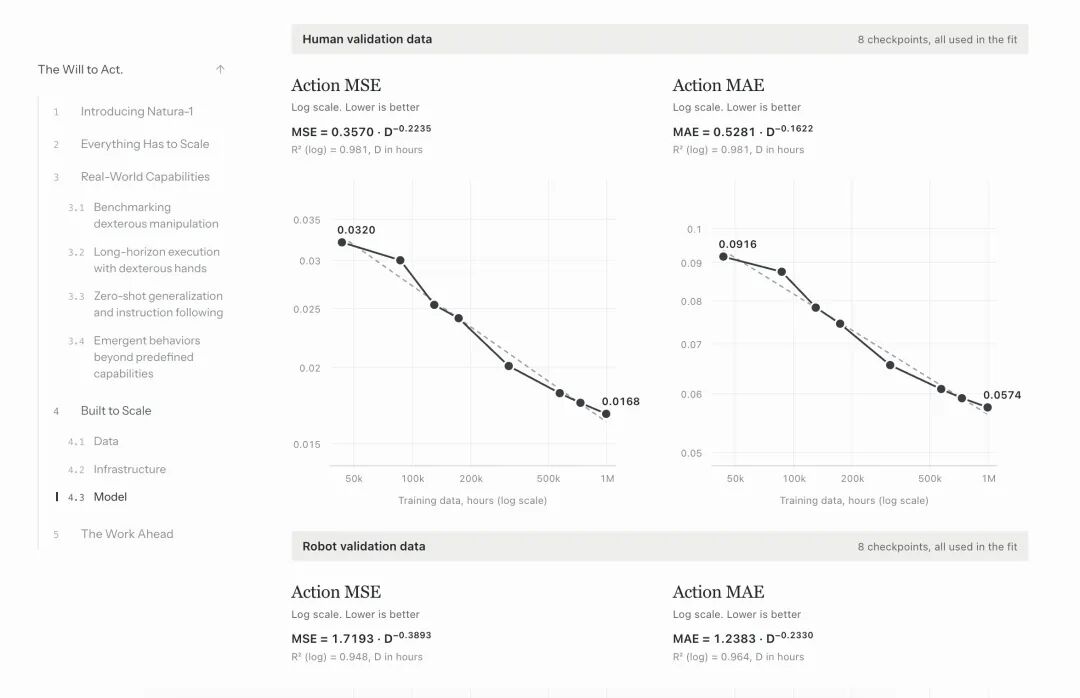
For a startup, this route means heavier upfront investment. Many robot companies first take on projects and then use revenue to support R&D; Natural Will chose to build a data system first, and then train large models. The former is easier to get orders in the short term, while the latter bets on the repeated use of the same set of models in more scenarios, which brings greater industrial scale effects.
New data improves the model, the improved model returns to real machines for verification, and the mistakes in testing provide clues for the next round of training. Natural Will hopes to build a continuously evolving physical intelligence infrastructure through this loop, so that the capabilities of robots can keep growing with the accumulation of data.
03 After Stepping Out of the Demo
After the model scale was expanded, Natura-1 brought another pleasant surprise: the model began to learn to correct errors on its own.
A test required the robot to pick up the mobile phone on the table and then place it at a designated position. In the early version, after the first grab missed, the robotic arm would still continue to move towards the target position, as if the mobile phone was already in its hand. When the arm reached the end point, it sometimes realized that the task was not completed, and then returned to the original position to start over.
The new version reacts much earlier. When the fingers touch the mobile phone but fail to grab it firmly, the robotic arm will stay in place and readjust its angle. Sometimes it will even try several times in a row until the mobile phone is truly lifted off the table.
Humans can naturally interact with the model through language, and then the robot executes movements. If it fails, it will try and correct the error on its own.
A similar situation occurred when using scissors. After the fingers missed the scissors loop for the first time, the robot would continue to fine-tune downward, let the fingers find the entrance, and then pick up the scissors. The team introduced that only a small number of consecutive failure samples were added to the training, and the model most likely learned this retry mechanism from millions of hours of human manipulation data. Just like when people occasionally slip their hands when picking up a mobile phone, the next reaction is usually to grab it again in place.
This also involves the memory capability of Natura-1. Some early robot models only generate movements based on the current frame, and each frame is like a brand new start. The Natural Will team described this state as "Every day is the first day."
Natura-1 will refer to the frames it has seen before. It knows that it has tried to grab once just now, and can compare the changes before and after the movement. For short tasks that only last a few seconds, the role of this memory may be limited; but as tasks extend, memory capability becomes increasingly indispensable.
The emergence of error correction capabilities brings robots closer to real work, but Natural Will believes that another standard is equally important: occasional success only proves that the model has the possibility to complete the task. Only when the task can be stably reproduced can it be regarded as a mastered capability.
After the model is released, Natural Will plans to invite external personnel to conduct on-site tests. Visitors can input ad-hoc instructions, or take out items they carry with them, and let the robot operate on the spot. Compared with pre-prepared demonstrations, this kind of test is closer to the customer environment that the model will face in the future. Of course, it will also more directly expose its limitations.
Fortunately, the future is becoming clearer and clearer. The team gave an example of stir-fried pork with green peppers: the robot recognizes green peppers and knows how to use a knife, but to independently complete the whole dish, it not only needs to control the size of the cut pieces, handle various changes during cooking, but also accurately put the used knife back into the knife holder. Once the knife falls, all subsequent steps need to be adjusted accordingly. The team's goal is that after a robot enters an unfamiliar kitchen, it can complete the whole set of operations according to a new recipe.
Of course, there are dozens of layers of uncertainties between a short instruction and finishing a whole dish. The model may produce errors at every step, and the hardware also needs to run for a long time. In specific scenarios, factories will compress the operation to a fixed beat, while families will put forward stricter requirements for safety.
This is also the gap between all current embodied models and commercialization. What is surprising about Natura-1 is that it has demonstrated the capability to handle unfamiliar instructions, and has begun to actively retry after failures. In the next stage, Natural Will will put the model into more complex long-horizon tasks, and test the zero-shot capability with the completion rate of the whole set of tasks.
By then, millions of hours of data will become the basic standard configuration of general physical models, and tens of billions or even larger parameter scales will also become a business with greater imagination.