Yuexin Semiconductor Achieves Breakthrough, the Top Provincial Capital "Gets a Seat at the Table"
The 18-year "chip pursuit" story in Guangdong has finally ushered in its most crucial capital moment.
On October 13, Guangzhou Yuexin Semiconductor Technology Co., Ltd. (hereinafter referred to as "Nexchip") was listed on the ChiNext Board of the Shenzhen Stock Exchange. On its first trading day, the company's share price surged sharply, closing at 38.80 yuan, up 233.06% from the issue price of 12.01 yuan.
Back in 2008, Guangdong's special plan for the integrated circuit industry during the 11th Five-Year Plan period explicitly noted that "the manufacturing sector is dominated by foundry services, lacking independent brands". By 2017, the domestic 12-inch wafer production capacity had been highly concentrated in the Yangtze River Delta, North China regions including Shanghai, Beijing and Wuhan, while the "Guangdong-made chips" in the Pearl River Delta still remained a blank.
Nexchip is the first locally cultivated 12-inch wafer manufacturing enterprise in Guangdong to achieve mass production. Taking Nexchip as the core starting point, Guangzhou has gathered and cultivated a fleet of local integrated circuit industry players, with the goal of building a core bearing area for the third pole of the national integrated circuit industry. The question is how Guangzhou, which "took a slower step", can form a differentiated layout with "first-mover players" such as Beijing, Shanghai, Hefei and Wuhan.
The automotive-grade chip business is regarded as the core starting point for Nexchip to break through. During the 15th Five-Year Plan period, Guangzhou proposed to build a trillion-yuan automobile industry and realize in-depth transformation towards electrification and intelligence, which cannot be achieved without the supply chain support of independent automotive-grade chips.
On one side are the traditional pillar industries that support the urban economy, and on the other side are the emerging growth poles that determine future competitiveness. Can Guangzhou's "auto-chip linkage" be implemented as scheduled? Can Nexchip Semiconductor become a key variable affecting the overall economic transformation of Guangzhou?
Completing the "Chip" Puzzle
Before the establishment of Nexchip, Guangzhou had long suffered from "chip shortage".
Before 2017, the domestic semiconductor industry was mainly concentrated in the Bohai Rim region, the Yangtze River Delta, and the Pearl River Delta represented by Shenzhen. Guangzhou started late with a small industrial scale, and its industrial chain had not yet taken shape.
At that time, industry symposiums pointed out that the overall added value of Guangzhou's integrated circuit industry was relatively low, mainly dominated by processing trade for foreign-funded enterprises and brands. In particular, there was still a blank in high-end manufacturing, and no integrated circuit production line had been built yet.
However, the contradiction between supply and demand mismatch was very prominent. As the largest province in China's electronic information industry, Guangdong's chip consumption accounts for more than 40% of the national total, and its downstream covers a broad market including consumer electronics, communication equipment, and new energy vehicles. Guangzhou is one of the core regions in this scope.
Cultivating a leading local chip manufacturer is not only the key to solving the structural contradiction between supply and demand, but also an industrial necessity for Guangzhou to build a "World Display Capital" and "International Famous Software City".
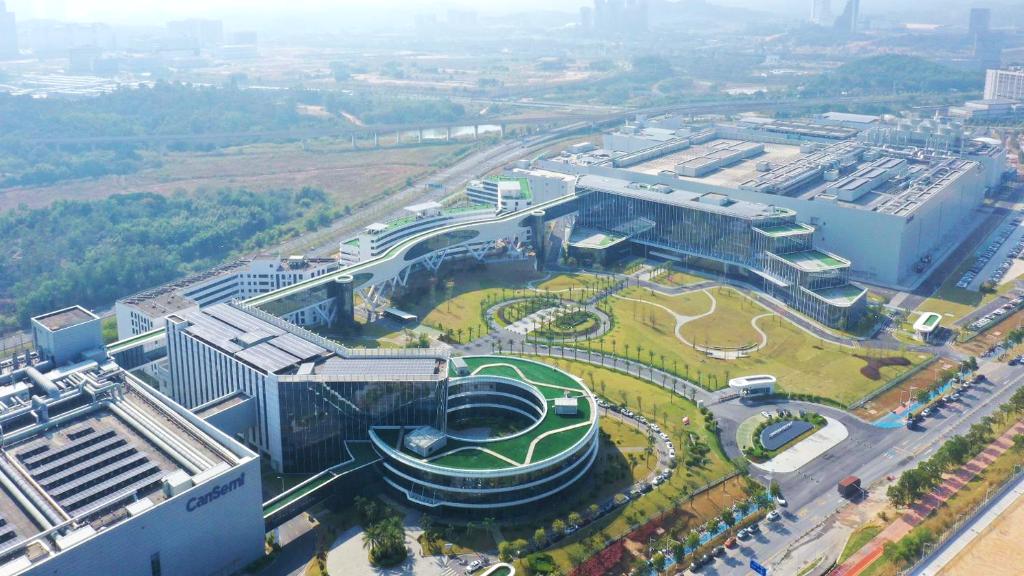
Exterior view of Guangzhou Yuexin Semiconductor Technology Co., Ltd. Image source: Xinhua News Agency
At the end of 2017, Nexchip Semiconductor settled in Huangpu, Guangzhou, filling this industrial gap. But a question followed: what direction should the late-mover Guangzhou take as its breakthrough point?
Instead of following the trend to compete for the most advanced process nodes, Guangzhou anchored a differentiated track. Analog chips are the core devices connecting the physical and digital worlds, widely used in consumer electronics, automotive and industrial fields. At that time, China's analog chip market accounted for 45% of the global total, but local production only accounted for about 10%, leaving a huge industrial gap. Combining the local industrial endowments of automobile manufacturing and consumer electronics, Nexchip has locked in the "analog characteristic process" ranging from 180nm to 55nm since its inception, using mature processes as a fulcrum to drive industrial breakthroughs.
At the end of 2017, Nexchip settled in Huangpu, Guangzhou, and achieved "from scratch to mass production" in only 18 months, rewriting the pattern that there was no local 12-inch mass production wafer fab in Guangdong, and was praised as "Guangzhou's first chip".
Its growth is also inseparable from the support of Guangzhou's state-owned capital. Guangzhou and Huangpu district state-owned capitals deeply participated in its first three rounds of financing. Science City Group, as the founding shareholder, is still the fourth largest shareholder, helping the enterprise go through industry cycles through the mode of "state-owned capital guidance + market operation". By the end of 2025, Nexchip's annual operating revenue exceeded 2.5 billion yuan, completing the breakthrough journey from 0 to 1 in less than 9 years.
The leading driving effect has also emerged simultaneously. With Nexchip as the chain leader, Guangzhou has gradually formed a "one core, two poles, multiple points" industrial pattern with Huangpu, Nansha and Zengcheng as the bearing areas. Among them, Huangpu District, as the core, has gathered more than 150 integrated circuit enterprises, and achieved an output value of over 34 billion yuan in 2025, a year-on-year increase of 17.1%.
Iteration
At the beginning of the 15th Five-Year Plan, the national integrated circuit industry has entered a new round of competition, and integrated circuits have been placed in a more important position in many regions.
Wuhan recently proposed to accelerate building integrated circuits into its "primary industry", which is the first time Wuhan has put forward the concept of "primary industry", showing the priority of integrated circuits in local development.
In the context of the national industrial layout, Guangzhou's position is slightly delicate. Hu Gang, professor of Jinan University and founding president of South China Urban Research Association, pointed out to City Evolution that Nexchip, Guangzhou's "chain leader" enterprise, only achieved mass production in 2019, and the output value of integrated circuits in Huangpu District where it is located was about 34 billion yuan in 2025, far behind the hundreds of billions of yuan industrial scale of Shanghai and Shenzhen.
It needs to be emphasized that Nexchip's revenue structure is still deeply bound to the consumer electronics track. From 2023 to 2025, although the proportion of consumer electronics in Nexchip's main business revenue has decreased year by year, it has always maintained an absolute dominant position of more than three quarters. With the cyclical decline in market demand for consumer electronics, Nexchip's wafer business has been impacted. It is expected that the company will achieve profit turnaround on a consolidated basis as early as 2029, and its short-term profit cannot be compared with that of CXMT and YMTC which are in an upward cycle.
This also means that if Guangzhou wants to truly become the core bearing area of the "third pole" of the national integrated circuit industry, it must break path dependence and iterate and upgrade to a more diversified and deeper track. The intelligentization wave of new energy vehicles provides Guangzhou with the most promising breakthrough point.
At present, as the new energy vehicle industry continues to develop towards electrification and intelligence, the market scale of automotive-grade chips is growing rapidly. The two Guangzhou auto companies, GAC and XPeng, have a total shipment volume of more than 2 million vehicles in 2025. Calculated at about 1000 automotive chips per vehicle, there will be 2 billion automotive chip demands per year, which can rapidly drive the development of Guangzhou's automotive chip industry.
More importantly, the shareholders of leading auto companies such as GAC, SAIC and BAIC are bound to the automotive-grade demand, providing a market "moat" for the development of automotive-grade chips in Guangzhou.
However, this industrial synergy advantage has not yet been transformed into a substantive change in the revenue structure. According to Nexchip's financial report, although the revenue proportion of high-end products such as automotive-grade and industrial control-grade chips has increased steadily, it has not yet formed a scale effect.
What Guangzhou needs to continuously answer is whether it can truly transform the scale advantage of the automobile industry into the technical discourse power of automotive-grade chips. This is also the core key direction for Guangzhou's semiconductor industry in the next step. The Outline of the 15th Five-Year Plan of Guangzhou has clearly proposed to accelerate breakthroughs in key fields such as characteristic process chip manufacturing and automotive-grade chip design.
The major fourth-phase project of Nexchip, which Guangzhou is accelerating construction with a total investment of about 25.2 billion yuan, targets the growing demand in emerging fields such as automotive electronics, industrial control and AI, which will help Nexchip accelerate its iteration from consumer-grade wafer foundry to industrial-grade and automotive-grade wafer foundry, expand downstream applications of artificial intelligence, and improve market competitiveness.
In a sense, the core growth pole of Guangzhou's "strengthening chips" strategy has clearly pointed to the automotive sector.
Optimization
Semiconductors and integrated circuits play an important role in driving regional scientific and technological progress and economic development, which determines their key position in Guangzhou's economic transformation.
Guangzhou has proposed that by 2035, its GDP will double compared with 2023 to reach 6 trillion yuan, realizing the main goal of "rebuilding a new Guangzhou". In terms of industrial indicators, Guangzhou's total industrial output value will reach 3 trillion yuan by 2030, an increase of 500 billion yuan over 2025.
Where does the increment come from? To support the realization of this goal, the core driving force is new industries, that is, the construction of a modern industrial system. The value of the chip industry is also reflected in this process.
The first is the "empowerment" of the chip industry to the automobile industry, Guangzhou's largest pillar industry. The Outline of the 15th Five-Year Plan of Guangzhou clearly proposes to build a trillion-yuan automobile industry cluster, and raise the output value ratio of parts manufacturing to complete vehicle manufacturing to 0.7:1. Recently, Guangzhou once again emphasized that it will build a "trillion-yuan smart vehicle city" by 2030, realizing the transformation from a traditional automobile production base to a highland of intelligent connected new energy automobile industry.
Hu Gang believes that Guangzhou's automobile industry is transforming from fuel vehicles to new energy intelligent connected vehicles. Compared with competing for the high-computing power chips for intelligent driving that Beijing, Shanghai and Shenzhen are good at, it is more suitable for Guangzhou to focus on segmented tracks such as automotive-grade analog chips with high certification barriers and strong customer stickiness. Therefore, automotive-grade chips, as key technologies and core components, are the key entry point for Guangzhou to rise from an "automobile manufacturing city" to a "smart vehicle city".
But the significance of the chip industry to Guangzhou goes far beyond that. The "Guangzhou Advanced Manufacturing Strong City Construction Plan (2024-2035)" released earlier this year accurately analyzed its own "shortcomings and weaknesses" ——
Guangzhou's automobile industry has prominent problems of "single dominance of automobiles" and "strong fuel vehicles but weak new energy vehicles", and the electronic information manufacturing industry has missed the development opportunities of terminal products such as mobile phones and computers. Emerging industries such as artificial intelligence, biomedicine, new energy storage and integrated circuits have been laid out late with small scale.
Changes have already taken place. Since the beginning of this year, the two industrial curves of Guangzhou's automobile and integrated circuits have been rising at the same time. From January to August, the added value of Guangzhou's automobile manufacturing industry increased by 6.6% year on year, of which the output of new energy vehicles increased by 48.9%; in the same period, the electronic product manufacturing industry increased by 10.1%, the added value of the integrated circuit manufacturing industry increased by 67.9%, the output of electronic components increased by 46.3%, and the output of analog chips increased by 39.9%.
This structural change has also been elevated to the city's strategic choice. Recently, Guangzhou clearly mentioned that it will expand its advanced manufacturing industry around six major tracks: "land, sea and air" and "chips, displays and medicine". Among them, the "chip" industry represented by semiconductors and integrated circuits has joined the core tracks together with the intelligent connected new energy vehicles.
Hu Gang believes that by 2030, the direct output value of Guangzhou's chip industry is expected to reach the 100-billion-yuan level. More importantly, it can extend the automobile, display, AI terminal and robot industries from assembly to the upstream wafer and module sectors, and enhance the industrial added value.
Hu Gang further pointed out that in the coordinate system of the national hard technology competition among cities, the breakthrough significance of Nexchip has long gone beyond the enterprise itself: it proves that Guangzhou has the ability to deploy asset-heavy hard technology, breaks the outside world's stereotype that "Guangzhou is only good at commerce and assembly", and also opens up new imagination space for this city — advancing from "automobile city" to "smart vehicle with strong chips", Guangzhou is recalibrating its own ecological niche in the regional industrial competition and cooperation.
This article is from the WeChat Official Account "City Evolution", written by Liu Xuqiang, and published with authorization by 36Kr.