The landmark Sheraton that used to be priced at 2,000 yuan per night has quietly been debranded.
Many people have never set foot in South Taihu Lake in Huzhou, but most have heard of the name of this hotel.
The huge circular building lies quietly on the lake surface. When night falls and the lights are turned on one by one, a whole stretch of reflection spreads across the Taihu Lake surface. The public mostly calls it the Moon Hotel, and some people always tease it as the "toilet seat hotel".
More than ten years ago, it was the cover representative work on Starwood's official website, built at a cost of 1.5 billion yuan, and was once the Sheraton with the highest construction cost in China.
In the first few years after its opening, the hotel's room rate could easily reach 2000 yuan. The project was originally positioned even higher, and the St. Regis brand was planned to be introduced. Even if it was replaced by Sheraton in the final implementation, it was still a benchmark project among domestic Sheraton hotels.
Recently, a notice letter from Sheraton Huzhou Hot Spring Resort has caused quite a stir in the hotel industry. The brand management contract between the owner and Marriott has expired and will not be renewed. Starting from October 1, 2026, the hotel was officially renamed Huzhou Taihu Lake Moon Hot Spring Resort.
At first glance, it is just as simple as the removal of the brand tag of this internet-famous landmark and the name change. But behind this incident is the in-depth reshuffle of China's high-end hotel industry that has continued for many years.
Most people only lament that an internet-famous landmark has come to an end, but few notice the more than ten years of interest tug-of-war between the owners and international hotel management groups.
A number of Sheraton hotels are quietly removing their brand tags
For a long time, the Sheraton brand basically represents the landmark buildings of cities and a relatively high standard in the wedding banquet market. Its golden signboard is also regarded as a representative for local governments to attract foreign investment and high-end consumption.
However, in recent years, many consumers have begun to continuously complain about some Sheraton outlets on social platforms:
The hardware facilities of the outlets are aging, the walls are peeling, the elevator makes loud noise during operation, and the breakfast dining area is very crowded at peak hours. These comments all point to the decline of the hotel's service and management level.
The delisting of Sheraton Huzhou is not an isolated case. In recent years, many Sheraton hotels in China have experienced the phenomenon of owners removing brand tags.
Looking back in time, we can see the project of Sheraton Shanghai Hongkou Sanying. In 2023, this hotel located on Siping Road with a view of the Huangpu River was put up for disposal on Ali's judicial auction platform, and the final transaction amount was 1.643 billion yuan. After the property right transfer was completed, the first work carried out by the new owner was to remove the Sheraton brand logo.
At the beginning of 2024, the Sheraton sign was officially removed, and the hotel was renamed Shanghai Hongkou Sanying Hotel. In the same year, this hotel was also removed from the list of five-star hotels.
It is worth mentioning that after two years of handover and renovation, the hotel will make a brand-new comeback at the end of 2026 and be renamed Sheraton Shanghai North Bund.
The Sheraton hotel project originally planned to be built in Yichang, Hubei, appeared in the official documents released in 2023, but the word "Sheraton" was no longer visible in the project planning documents in 2024.
In 2021, Gemdale Group announced that it had signed a contract for Sheraton Xi'an Jinhui, but later the hotel joined Accor and was renamed Pullman Xi'an Jinhui. In 2026, Sheraton Wenzhou also completed the brand tag removal. This old international hotel that has been in operation for more than ten years ended its brand cooperation with Marriott Group in June this year, and the hotel has been renamed Wenzhou Jinxiu Hotel to continue its business.
The most direct reason for this delisting is that the property owner Wenzhou Jinxiu Hotel Investment Co., Ltd. has a serious insolvency problem, and the enterprise has been in a state of loss for a long time.
As of June 30, 2025, the total assets of this enterprise amounted to 252.1 million yuan, the total liabilities amounted to 402.9 million yuan, and the net assets of the enterprise were negative.
Its major shareholder Wenzhou Airport Group has listed and transferred 48% of the equity of Wenzhou Jinxiu Hotel Investment Co., Ltd. twice in August and October 2025 respectively. The bottom price of the equity transfer was set at 67.67 million yuan, and no intended buyer took over after the two listings.
In this context, the owner finally reluctantly chose to remove the brand tag. Connecting these cases together, it is not difficult to outline a clear trend. The batch of Sheraton hotels born in the golden era of real estate are now collectively facing a major test.
Sheraton under pressure from both sides
After Marriott acquired Starwood in 2016, Sheraton was included in its huge brand portfolio, but its brand positioning has since fallen into a dilemma.
It has neither entered the luxury brand portfolio such as The Ritz-Carlton and St. Regis, nor kept up with the trend of emerging brands such as W Hotels and EDITION. Sheraton, which is in the sandwiched zone, has seen its development space continuously compressed.
In 2018, Marriott launched the "Sheraton Transformation Plan", hoping to reshape the brand through owner-funded renovation. However, according to a report by Hotel Business, about 70% of the owners refused to contribute funds, on the grounds that they did not believe the renovation could bring premium, so the plan was difficult to implement.
At the same time, Sheraton's brand narrative has gradually become empty in recent years, and it has been evaluated by overseas media as "unable to tell a clear story". In a report titled "How Sheraton Lost Its Way and How Marriott Revived It", Skift pointed out that Sheraton's biggest problem is that it failed to tell a clear story, and without a clear story, it is difficult to form a memory point in users' minds.
As an international high-end hotel brand that has been operating in China for 40 years, the price of some Sheraton hotels has now dropped to the range of mid-range hotels, and they are starting to compete head-to-head with mid-range hotels.
Taking October 13 as an example, the query on the OTA platform shows that the starting price of the king bed room (excluding breakfast) at Sheraton Xi'an North City near Daming Palace is 419 yuan, and the price of the same type of room is lower than that of Atour Hotel near Daming Palace. Similarly, the starting price of Sheraton Bailuhu Resort, Huizhou is as low as 436 yuan.
Behind the head-to-head competition is the squeeze from both the supply and demand sides. In the past two years, local mid-to-high-end hotel brands have continued to seize market share by virtue of their more flexible product iteration, digital operation and advantages in sinking channels. On the other hand, the industry standard requires a major renovation every 8 to 10 years, and many international high-end hotels are just at this node that requires renovation.
Young consumers have also begun to gradually get rid of the fascination with "foreign big brands", and the identity labels that foreign hotel groups used to have in the past have gradually weakened.
The price reduction strategy of some Sheraton hotels is essentially to exchange price for volume. Faced with the pressure of vacant rooms, if they do not cut prices, the occupancy rate will continue to decline, and the loss caused by asset depreciation will be even greater. However, this path may further erode the high-end recognition accumulated by the brand for many years. Once the brand premium is broken, it will be difficult to recover.
In the same city, high-end hotels like Sheraton and mid-range hotels compete head-to-head, which was almost unimaginable ten years ago.
When Chinese owners start to look at Sheraton with an equal perspective
In fact, the delisting of international hotels has become the norm in the industry in recent years.
Huamei Consulting mentioned in "Changes in the Supply of Five-Star Hotels" that the stock market of domestic five-star hotels is facing significant structural adjustment in 2025.
Among the tracked delisted, rebranded and closed projects, 51.1% of the high-end hotels are in the suspected closed state (not open for reservation), 28.4% have been delisted, and the remaining 20.5% have been rebranded.
When the real estate industry was developing at a high speed, local governments and real estate enterprises all needed to rely on overseas hotel brands to create the city's external display image.
The brand operation team outputs hotel management services and collects brand-related fees, and they do not need to bear the capital risks generated by property construction. The project owner is responsible for raising funds to purchase land, organizing engineering construction, and bearing all the capital pressure of the project. This cooperation model has been running for decades.
After the development situation of the real estate industry changed, this long-used cooperation model has also begun to be re-evaluated by project owners.
The project owner needs to raise funds on its own to buy the land, arrange the construction work, and bear the capital burden brought by the whole project. This cooperation method has been used for decades. After the development environment of the real estate industry changes, this long-used cooperation method has also been re-examined by project owners.
In recent years, the capital burden faced by real estate enterprises has been increasing, and they do not want to continue to pay high brand management related fees.
The time for domestic five-star hotel projects to recover their investment cost is generally 30 to 50 years, and the capital return speed is relatively slow. After decades of cooperation and running-in, many owners have accumulated sufficient hotel operation experience, which is also a very important change.
Owners are no longer willing to only hold property assets. They will participate in all kinds of daily hotel operation affairs, want to get more returns brought by assets, and obtain more independent operation permissions.
Under the pressure brought by operating costs, owners will give priority to choosing management solutions with more appropriate cost performance. Most of the management contracts signed by international hotel brands are long-term agreements, with a contract term of ten or twenty years. Many hotel projects that reached cooperation in the early years have successively reached the node of contract renewal in recent two years.
At the same time, the expansion of foreign brands in China has also reached a turning point.
In 2025, the number of guest rooms of the top 30 foreign brands only increased by 6.64% year on year, and the number of outlets showed a negative growth of 3.69%. Local mid-to-high-end brands continued to seize market share by virtue of more flexible product iteration and digital operation. In the first half of 2026, more than 3,500 new hotels were added nationwide, with more than 316,000 new guest rooms. Local brands accounted for 90.4%, and international brands only accounted for 9.6%.
The dilemma Sheraton is facing now is a concentrated epitome of this industry inflection point.
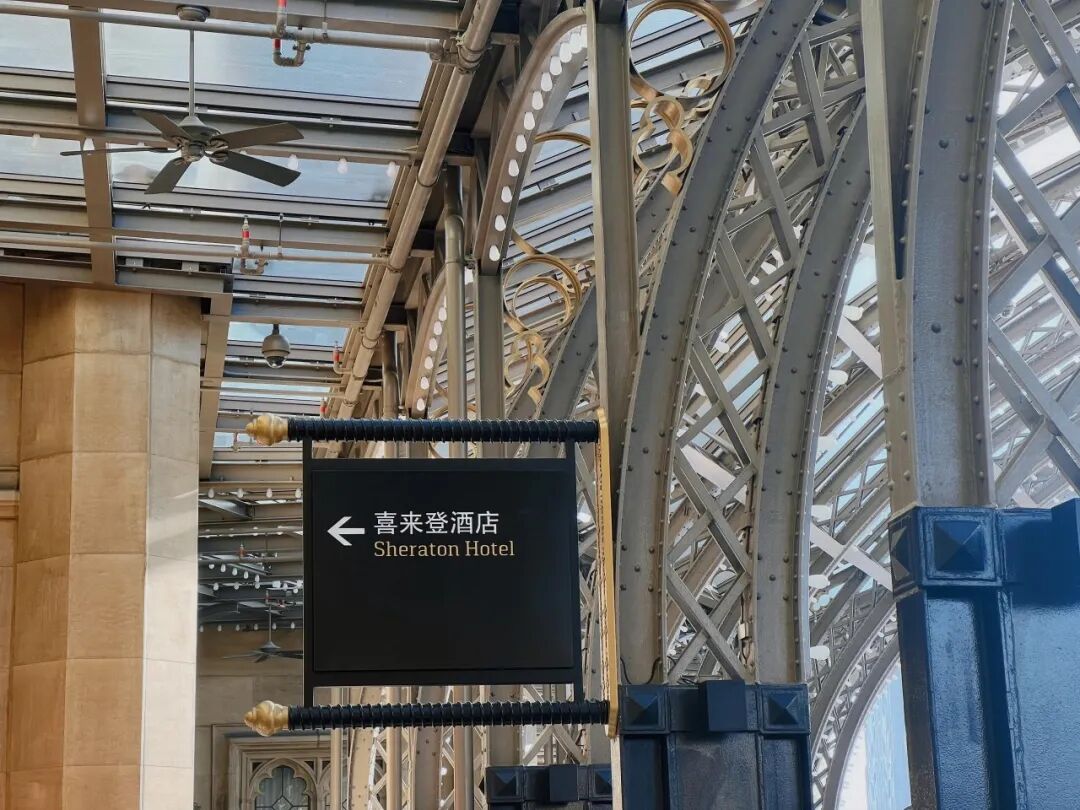
Source: Xiaohongshu
Now the domestic hotel market has long changed, from incremental competition to stock game, from the previous land grabbing to the head-to-head rebranding battle.
Sheraton is one of the earliest international hotel brands to enter the Chinese market. It has a large number of old properties in its portfolio, and a large number of cooperation contracts are concentrated to expire. Its brand positioning is in the middle range, so it is difficult to compete for the top luxury hotel market upwards, and it is squeezed by domestic mid-range chain hotels downwards. With a variety of conditions superimposed, it is not difficult to understand why the owners choose to remove the brand sign.
This is not the defeat of international brands, but an inevitable process in which Chinese owners are becoming mature and the logic of hotel asset operation returns to the essence of business. The golden signboard of international hotel groups can not be kept shiny forever.
This article is from the WeChat official account "Hotel Finance", written by Nanchuan, and authorized for release by 36Kr.