2026 Autumn Campus Recruitment: Does it require fresh graduates to have "3 years of work experience" on average?
It is the time of the annual "Golden September and Silver October" recruitment season, and another fierce autumn campus recruitment battle has kicked off.
What major is the most sought-after in the job market today? The answer almost always points to "AI".

The high demand for AI talents does not mean that all fresh graduates can easily land a job. A close look at the 2026 autumn campus recruitment reveals a cruel divide.
Some people are offered a million-yuan annual salary before graduation;
Some people who want to apply for an internship are required to have 3 years of programming experience first.
When hunting for their first job, some are fought over by big tech companies with rising salary offers, seeing their market value surge by 410,000 yuan in just a few weeks, while others can barely find an entry-level position that allows them to "learn on the job".
The starting salary for a tiny minority keeps going higher, but the access to entry-level positions for ordinary people is getting narrower.
The abstract "K-shaped differentiation" in the job market that experts used to talk about in the past has now shown its most concrete form in this year's autumn recruitment.
Graduates of the Class of 2028 have already been targeted by big tech companies in advance
Observing the autumn recruitment in the AI era brings mixed feelings.
Let's start with the bright side of the coin, those top talents who are frantically chased by HRs in the recruitment season.
Let's take a quick look at the talent recruitment targets of several major tech companies this year:
For Alibaba's 2027 campus recruitment, AI-related positions account for more than 80%, while the proportion exceeds 90% at its rival Baidu;
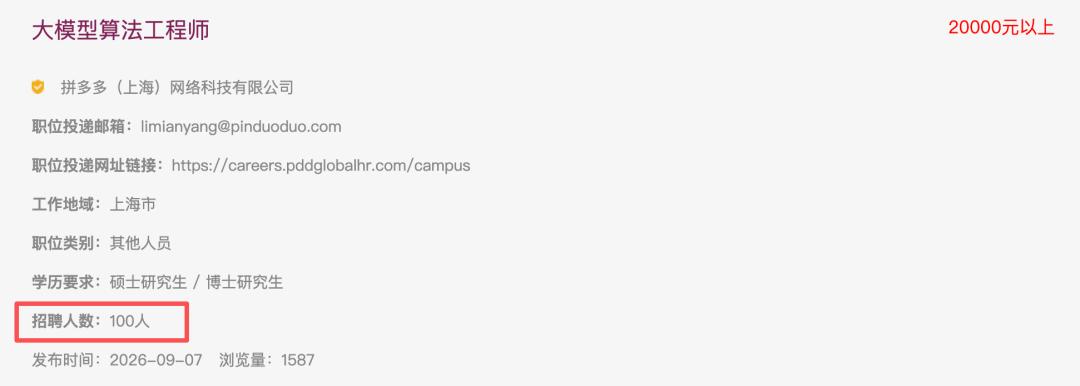
Pinduoduo opens recruitment for no less than 100 large model algorithm engineers at one go, and Kuaishou defines AI competence as the "standard talent requirement" for this year's recruitment.
If we look at the situation across a longer time span, it is not hard to find that enterprises' demand for AI talents has been continuously rising since the beginning of this year.
In the first half of this year, the number of newly released AI positions skyrocketed by 789% year on year;
One year ago, there was only 1 AI position in every 40 new job openings, but now the ratio has reached 1 in every 4;
This "demand surge" is not limited to first-tier cities including Beijing, Shanghai, Guangzhou and Shenzhen. The growth rate of new AI positions in cities such as Hefei, Chengdu and Suzhou all exceeds 1000%. Among these openings, positions like high-performance computing engineer have even witnessed an unprecedented scene where "7 positions compete for 1 candidate".

Top high-achieving students at the center of this autumn recruitment naturally get enviable salary packages.
According to relevant statistics, the median monthly salary for fresh graduates in core AI R&D positions this year ranges from 25,000 yuan to 27,000 yuan, and some positions even offer 30,000 to 40,000 yuan per month.
This is only the so-called "high salary for fresh graduates" in the general sense. For master's and doctoral graduates in related majors from top universities, they step onto the fast track to high income right after they leave campus.
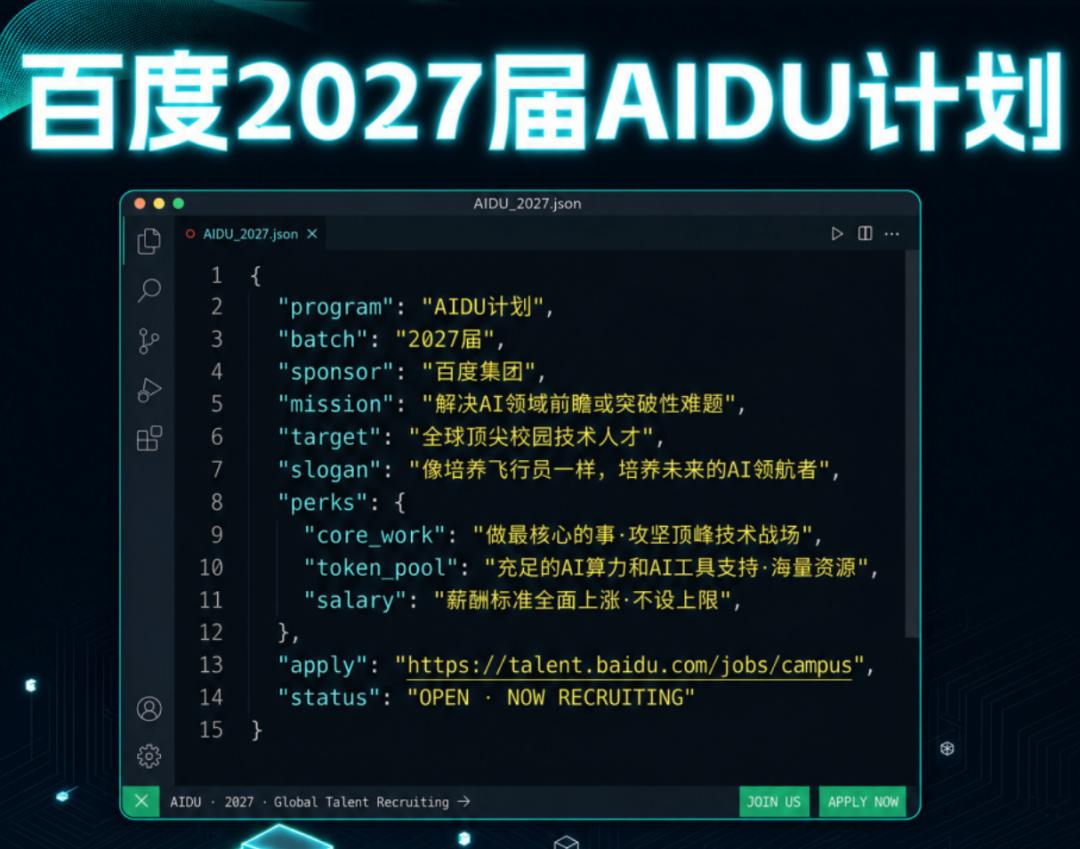
In the recruitment guidelines of major tech companies, Baidu's AIDU Program promises "a starting annual salary of 1 million yuan for fresh graduates", and Tencent's Qingyun Program sets "no upper limit for compensation for top AI campus recruits";
A computer science PhD graduate from a top university has been offered an annual salary of 7 million yuan by a large enterprise.
In September 2026, in an interview with Yang Hongbo, co-founder of headhunting firm INR by Pencil News, it was mentioned that in June this year, a fresh PhD graduate from University of Science and Technology of China originally planned to accept an offer of 620,000 yuan, then another enterprise offered a salary of about 850,000 yuan, and right before his onboarding, a third company snatched him away with a sky-high offer of 1.03 million yuan.
In just a few weeks, the annual salary offer for this fresh PhD graduate rose by 410,000 yuan.
It is not only about high salaries. This year, major tech companies have tried every means to compete for the top AI talents:
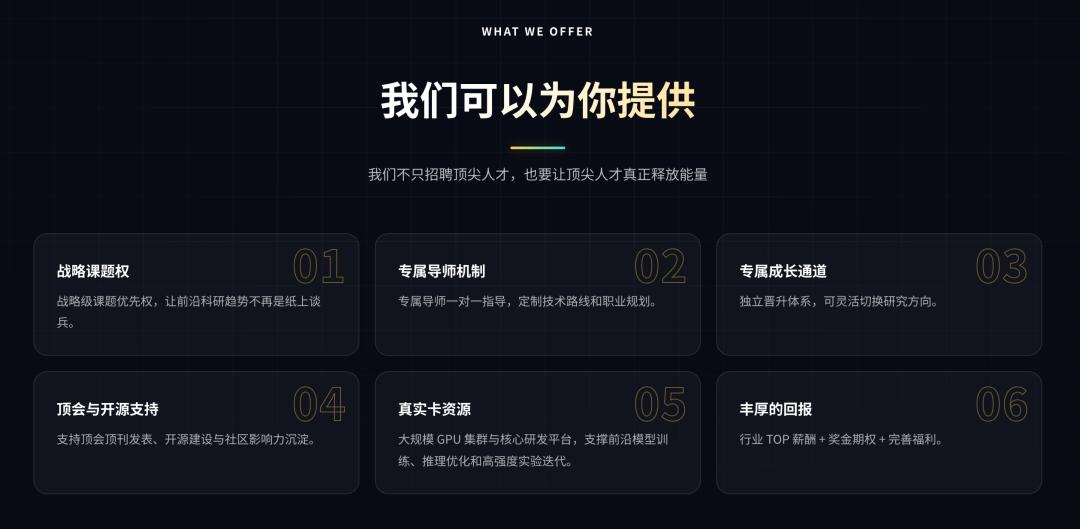
Some provide supporting infrastructure, GPU clusters, unlimited computing power, free access to major global databases, and flexible work locations, focusing on creating a comfortable research environment for talents;
Some offer great freedom, allowing talents to work part-time.
You do not need to leave the academic circle, as long as you help with our work, you will get full pay, as well as corresponding stock options.
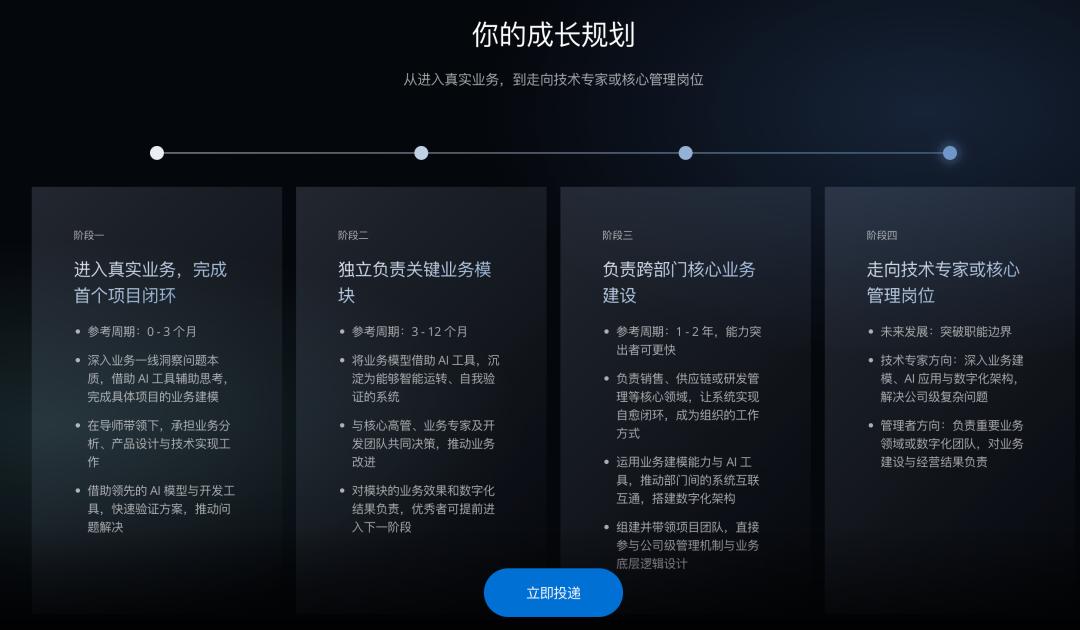
Some even directly delegate power, so that young people who just graduated from campus can quickly participate in company management and get the "opportunity to take part in top-level decision-making".
Even in this era of rapid AI development, the label of "fresh graduate" as the starting line of recruitment seems to be too late:
Some AI interns in enterprises earn thousands of yuan per day as internship salary, not to mention the stock options calculated from their first day at work;
Some enterprises break away from the traditional spring and autumn recruitment schedule, expand campus recruitment to the Class of 2028, or announce publicly that "positions are open for application all year round, with no restrictions on major or age, as long as you are competent enough";
Therefore, some post-2000 AI researchers have been promised an annual income of 3 million yuan after they become full-time employees by their supervisors, even before they get their graduation certificates;
Some HRs even seize the moment when students submit their graduation theses, and go to thesis defense sites and academic seminars to "recruit talents", persuading outstanding AI master's and doctoral students to give up their degrees for a more financially rewarding future.
Just like the iteration speed of various AI products, all enterprises show an urgent sense of "cannot wait any longer" in recruiting talents, to the point that some companies have started to "place bets" on primary and secondary school students:
In Beijing, some schools start to cultivate AI talents from Grade 9, where students cooperate with big tech companies on technical projects, and after three years of study, some even get the chance to directly join ByteDance as interns;
In Hangzhou, Yunquan School selected 16 students from junior high school graduates to form a special AI class, inviting the former CTO of Alibaba as the chief consultant to guide them to work on real technical projects;
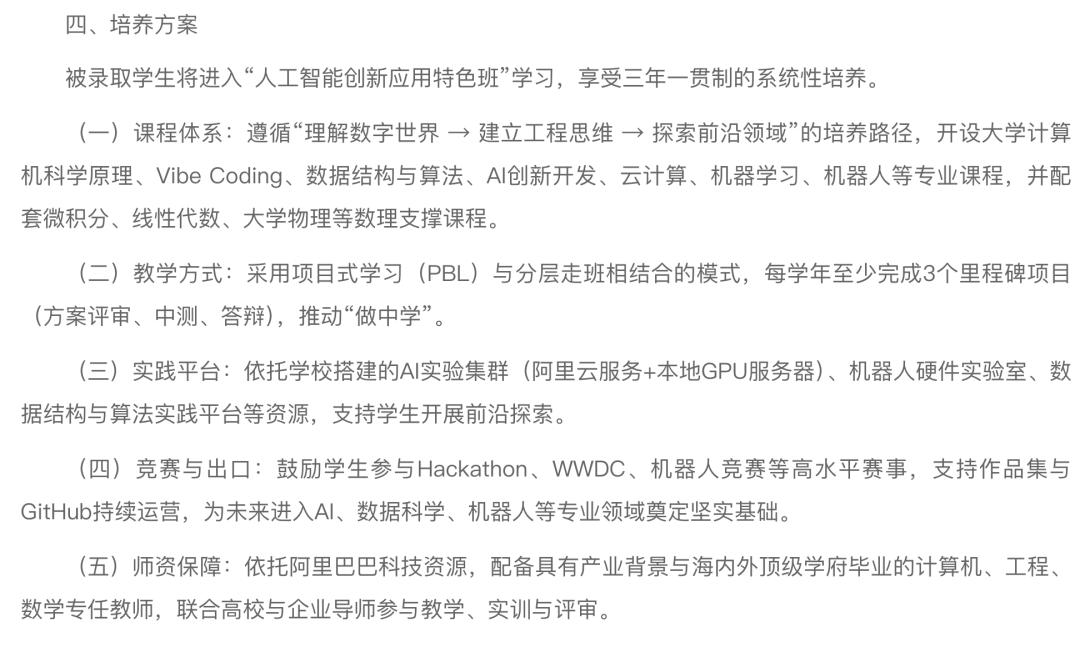
At the Xiamen Middle School Student AI Elite Summit, a group of teenagers who want to communicate with technical experts from big tech companies and work on AI projects have to pass several rounds of fierce written tests and interviews first.
High salaries, recruiting young talents in advance, early cultivation...
This is the favorable trend brought by the AI era, but it seems to only benefit a tiny group of people in this huge technology bubble.
While a small number of AI geniuses have been booked in advance by multiple enterprises before graduation with their market value soaring, more ordinary fresh graduates find in this autumn recruitment that even entry-level positions are no longer hiring new people.
In the AI era, have ordinary young people lost their "grace period" for beginners?
While top students from elite universities are held in high esteem for their AI competence, most young people have lost access to entry-level jobs due to AI.
Writing basic codes, sorting out operation data, collecting relevant materials, modifying design materials... These simple but necessary repetitive tasks used to be the inevitable process for countless fresh graduates to transition from campus to workplace.

But now, with the popularization of a series of "AI efficiency tools" such as local Agent deployment, those so-called inevitable processes have become the labor costs that enterprises are most eager to cut.
Some enterprises that recruited 5 interns last year now only need 1 AI position; some companies cut their recruitment budget by half, and spend the money that used to hire new employees on purchasing Tokens and running Agents;
The recruitment requirement for some solution specialist positions has been quietly changed from "accepting candidates with less than 3 years of experience" to "requiring more than 5 years of experience"; an AI startup founder told the interviewer that "we barely recruit junior positions requiring 0-1 years of experience".
According to a survey report released by ShanghaiTech University in July this year, in the current job market, positions that pay 5000 to 8000 yuan per month and require 1 to 3 years of experience are the most severely impacted by AI.

In other words, the recruitment logic used to be "get in first, learn slowly", then it became "compete to get in, learn fast", and after the AI era fully arrives and reshapes the market, the current rule has become "master all the required skills first, then talk to us about getting the job".
Therefore, this autumn, more and more enterprises have adopted a new recruitment logic: they need a group of "veteran new hires" who are fresh graduates but can independently complete a full project:
The recruitment notice says it targets fresh graduates of the Class of 2027, but requires you to have "more than 1 year of AI-related development experience" before you leave campus;
An AI art design position in this autumn recruitment not only requires you to be proficient in the full process of image generation, but also requires you to "formulate operation standards, write user manuals, and even answer daily questions from other team members";
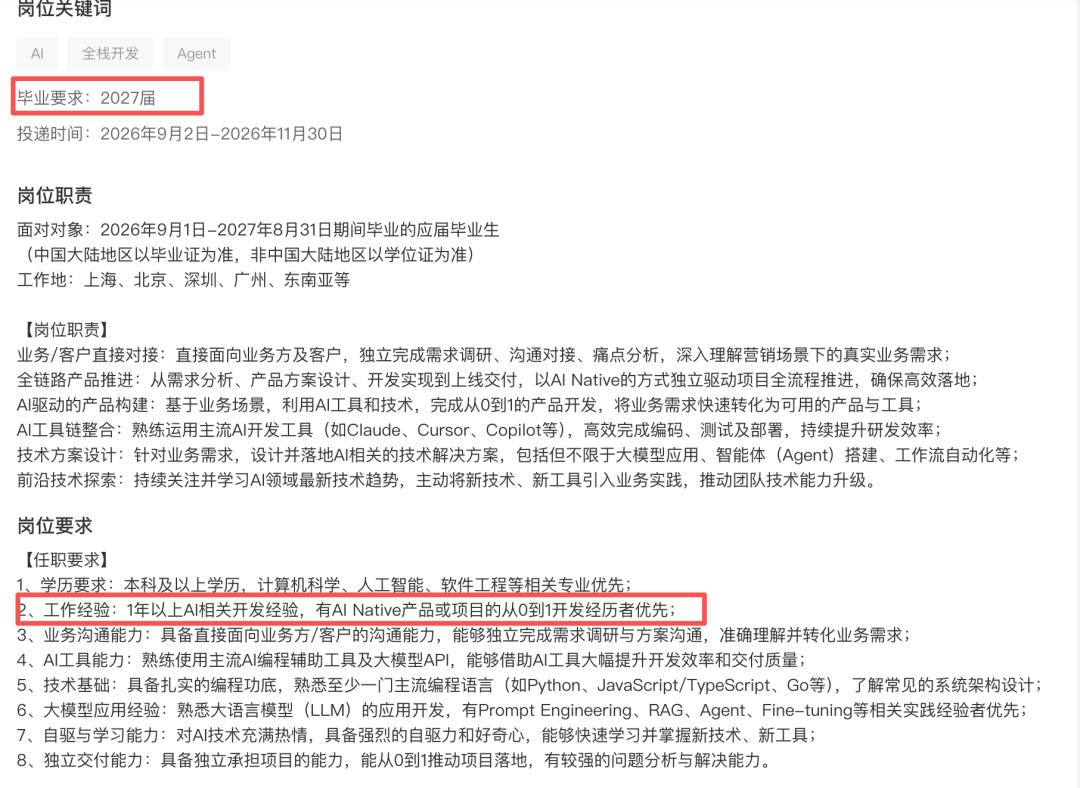
Some companies require machine vision interns this year to have "more than 3 years of practical coding experience" before onboarding, and preferably relevant industry work experience, so that they can not only develop codes, but also make solutions and follow up projects for clients;
Even for a part-time Xiaohongshu content operation (AI direction) position with a monthly salary of 9000 to 12000 yuan, the requirements clearly state that "the output and quality of content produced by one person should be equivalent to that of a small team in the past".
The materials that prove a fresh graduate's competence have expanded from portfolios to "AI chat records":
Some companies have added an upload entry for "AI application experience" on their campus recruitment page, allowing applicants to upload their detailed chat records with AI in the past 6 months, to demonstrate their "AI capability" in mastering Agents and decomposing complex tasks.
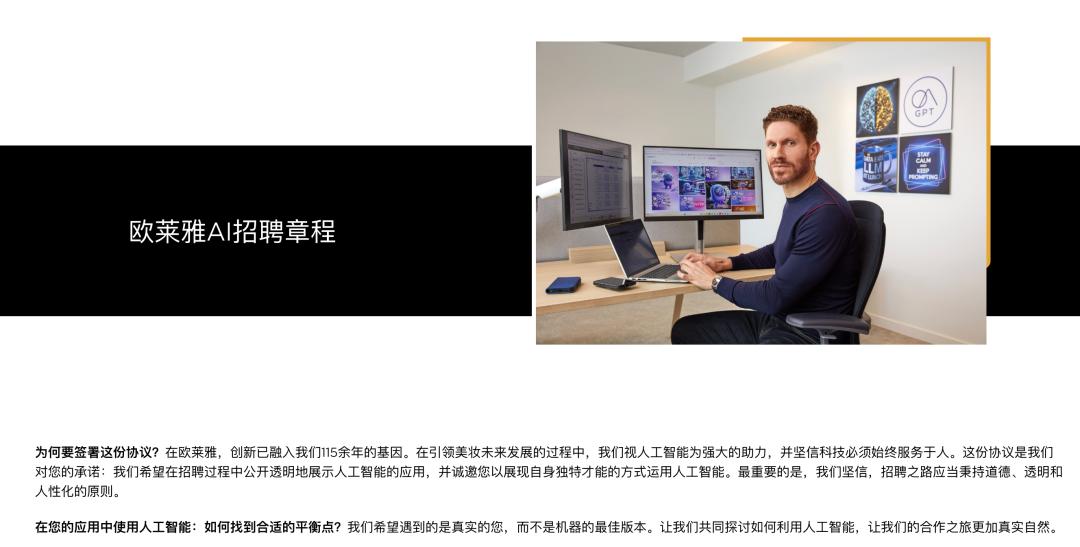
At the same time, the traditional routine interview is also undergoing a wave of "dehumanization":
The banking industry has widely introduced AI interviewers in this autumn recruitment - job seekers answer four or five questions to a mechanical female voice, then leave their fate to the black box of algorithms.
The recruitment side's efficiency has improved, but job seekers feel more confused than before.
Even some enterprises directly skip the interview step, and require applicants to work on real projects during the job hunting process:
They ask candidates to independently produce a set of implementable plans with AI within 3 hours, or run a profitable immersive cultural tourism activity within 3 days. The interviewers do not care how many Agents you use in the process, they only care whether you can deliver tangible phased results.
In the past, companies tested whether you had the ability to work for them, but now, they have existing tasks at hand, and you need to finish