Proving the Big Bang, the entire mathematics community is upended, and AI has pushed Terence Tao to bring forth "Mathematics 2.0"
On October 9 this year, a lecture delayed by one full year was held at Beckman Auditorium, California Institute of Technology.
The person standing on the stage is Terence Tao, Fields Medal laureate.
The original title was "Machine-Assisted Proof". But in these months when AI is advancing at a blistering pace, the world has been completely transformed.
So he rewrote the entire speech, setting the latest title as — Math 2.0.
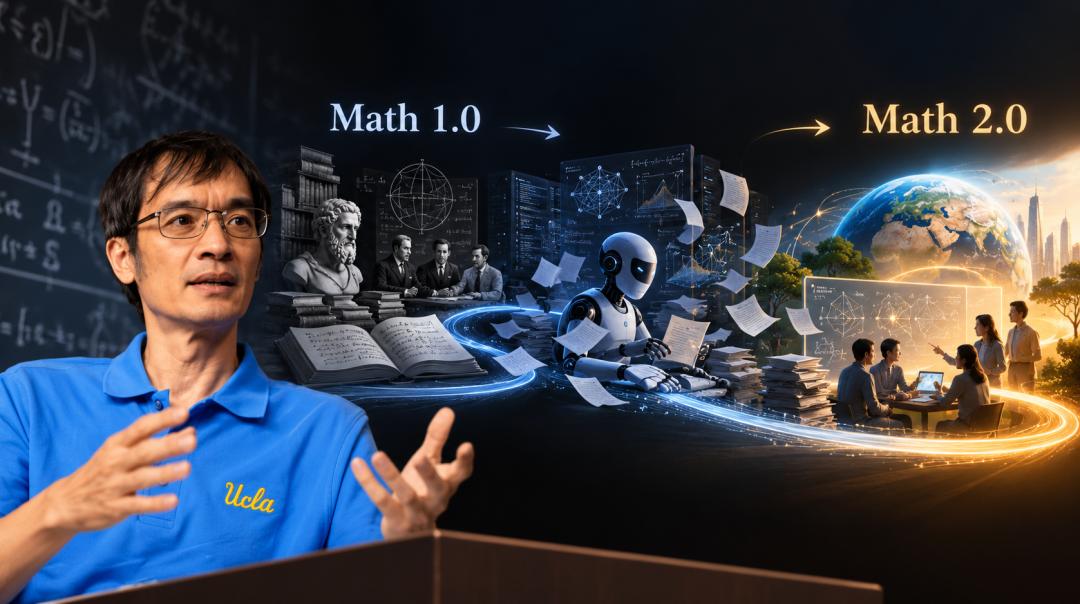
Cutting-edge AI has already kicked the mathematics community out of the old era of "proof scarcity" straight into a new era of "proof surplus". But if we indulge in letting AI churn out problems nonstop, humanity will eventually be backfired by the "gods" we created ourselves.
Why now? Because the mathematical singularity has arrived.
The Mathematical Singularity Has Arrived, Proofs Are Accessible At One Click
The singularity in the field of mathematics has arrived.
Scott Aaronson, a top global quantum computing researcher who once worked on safety research at OpenAI for two years, recently made this assertion.
This is a total upheaval.
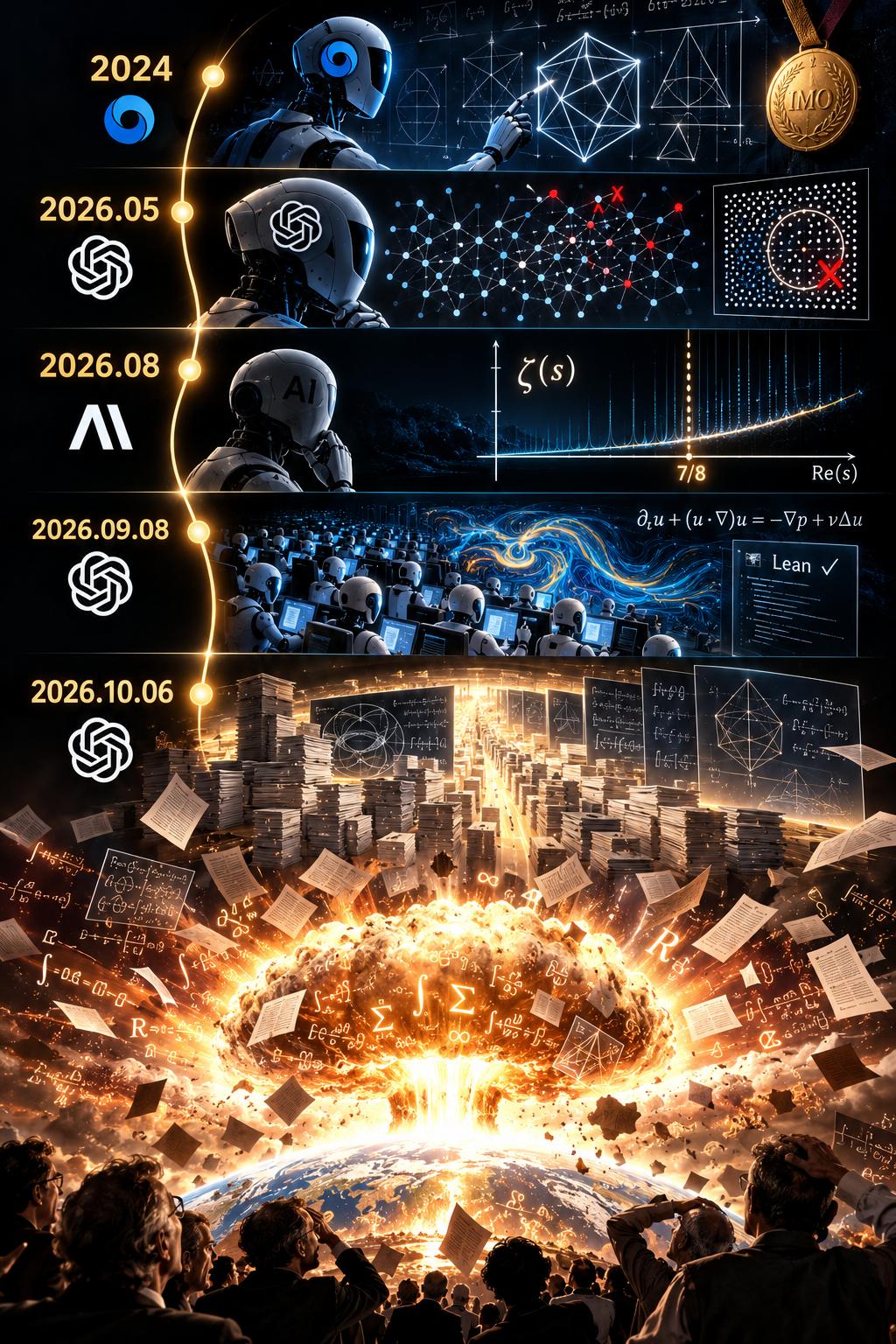
In May, OpenAI used AI to solve the Erdős unit distance problem — which is likely the first major mathematical problem ever solved by an AI model.
On September 8, a Millennium Prize Problem was cracked.
OpenAI deployed an undisclosed internal giant model, coordinating roughly 10,000 AI agents. They spent 88 hours to deliver a finite-time singularity proof for the Navier-Stokes equations, and completed formal verification in the Lean language.
This is one of the "Seven Millennium Mathematical Problems" that the Clay Mathematics Institute offers a $1 million reward for. Human mathematicians have struggled for decades without any progress, while AI took less than four days.
But from OpenAI's perspective, this is not a historic leap in human science, but just a trivial "AI capability demonstration".
On October 6, OpenAI released more than 700 mathematical manuscripts all at once.
One of their public repositories on GitHub contains over 700 independently AI-generated mathematical papers, covering 372 results.
For each extremely complex open mathematical problem on average, the model only spent 3 hours of computing power to work on it. It even proved that the zeta function has no zeros when Re(s)>7/8, pushing forward the core boundary of the Riemann Hypothesis.
Another tech giant Anthropic also previously announced that Claude raised the lower bound of non-trivial zeros of the Riemann zeta function from 41.6% to 67.2% by a large margin.
And Google DeepMind's AlphaProof has long reached the gold medal level of the International Mathematical Olympiad (IMO).
The game of Go died in 2016. That year, AlphaGo defeated Lee Sedol, and human Go matches have since been reduced to a pure "recreational activity".
Ten years later today, mathematics, the glory of human intellect, seems to be following the same path. Has thousands of years of human civilization ultimately only served to pave the way for AI?
Mathematicians panicked, and the entire mathematics community was thrown into chaos.
Shortly after, 25 Fields Medal winners issued a joint statement, warning that AI's objectives are severely misaligned.
At this crossroads where all human mathematicians are facing an intellectual crisis, Terence Tao stepped forward and delivered the "Math 2.0" speech.
The End of Math 1.0 — From "Scarcity" to "Abundance"
To understand this seismic shift, we must first clarify where we came from.
Terence Tao defines the past thousands of years as the "Math 1.0 era".
The most fundamental logic of this era can be summed up in four words: proof scarcity.
What is proof scarcity?
Looking back at history, mathematics was the domain of a tiny handful of geniuses.
Fermat's Last Theorem puzzled humanity for more than 300 years, until Andrew Wiles spent seven years working in seclusion in his attic to prove it.
The Poincaré Conjecture defeated countless mathematicians, until Grigori Perelman emerged to solve it.
Under the rules of "Math 1.0", the truth was extremely costly.
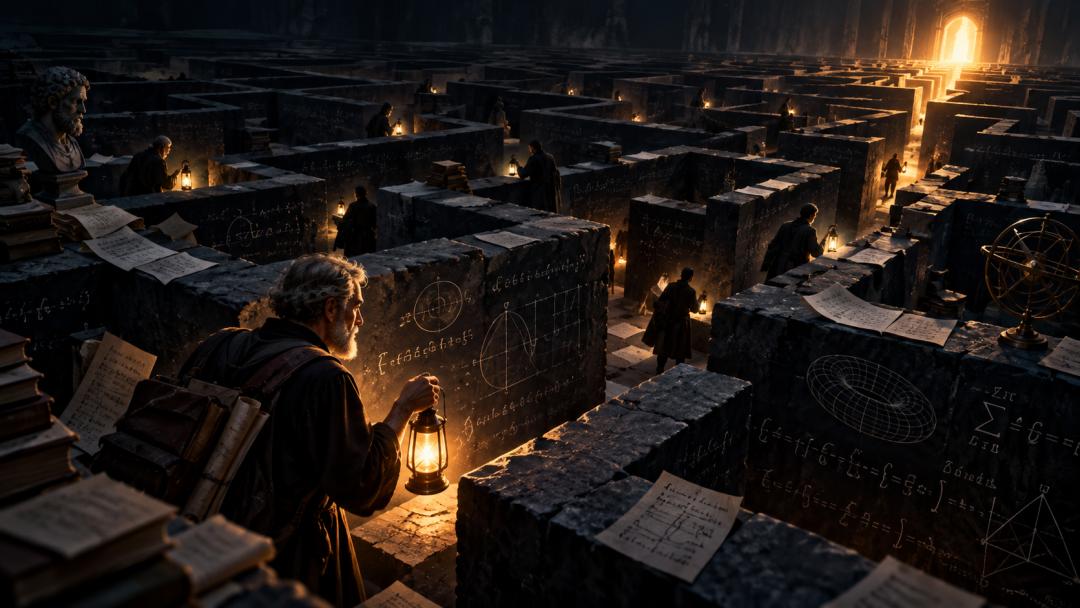
Proving a theorem required the painstaking efforts of one generation or even several generations. Mathematicians groped their way through a dark maze, relying on their extremely sharp intuition to piece together the path to the exit little by little.
Humans were the absolute center of this system. Without human flashes of insight, there would be no progress in mathematics.
But now, the wall has collapsed.
The "proofs" that were once incredibly rare and valuable can now be churned out continuously by AI like a money printer, as long as sufficient computing power and electricity are supplied.
This is the historic turning point Terence Tao described: we have officially entered the era of "proof surplus".
In the past, we struggled to find answers. Now, there are so many answers that we cannot possibly go through all of them.
Many people are cheering for this.
They believe that the ultimate form of mathematics is to let AI take over everything. As long as we throw problems to machines, and machines deliver perfect "correct" or "incorrect" proofs, the gears of science will spin at an unprecedented speed.
But this is exactly what makes Terence Tao feel deeply concerned.
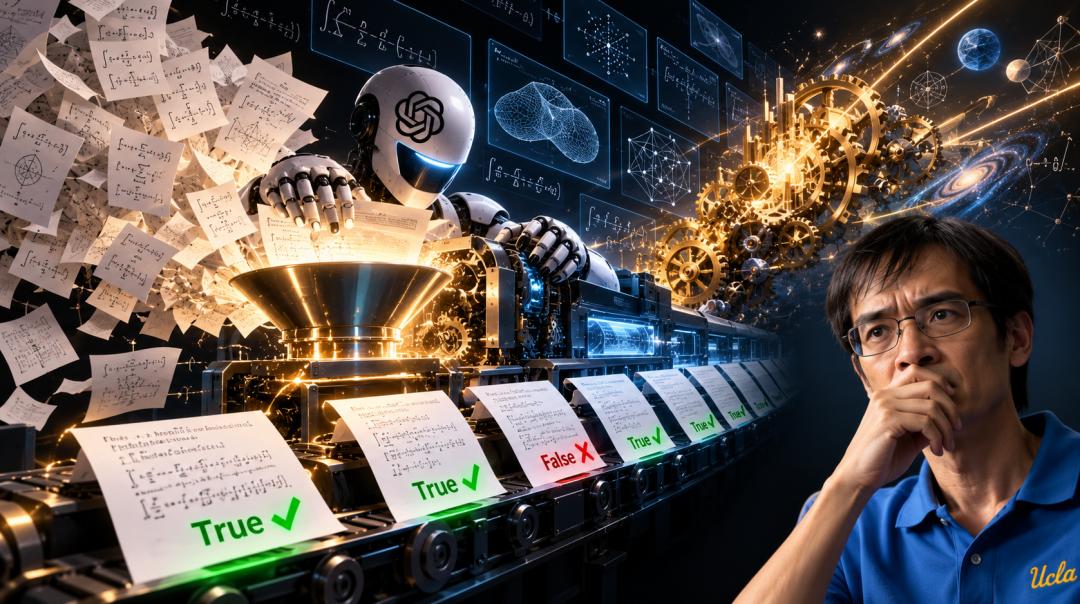
The Fatal Blind Box — The "Anti-Cancer Drug" Thought Experiment
While everyone is immersed in the carnival of AI solving open problems nonstop, Terence Tao puts forward an extremely sharp, chilling "thought experiment".
He asked everyone a question:
"If AI gives you a perfect anti-cancer drug, would you dare to use it?"
Imagine this scenario: after hundreds of millions of simulations, superintelligence synthesizes a brand new "compound". It tells you that this compound can cure all cancers.
But here comes the problem: Doctors, biologists or chemists cannot understand it, no one can figure out the working mechanism of this drug.
Its molecular structure completely exceeds the existing boundaries of human medical knowledge. It is a total black box.
Now, this drug is handed to you. Would you dare to take it?
Can AI avoid fatal chronic side effects? Should the Nobel Prize be awarded to AI?
This is Terence Tao's warning.
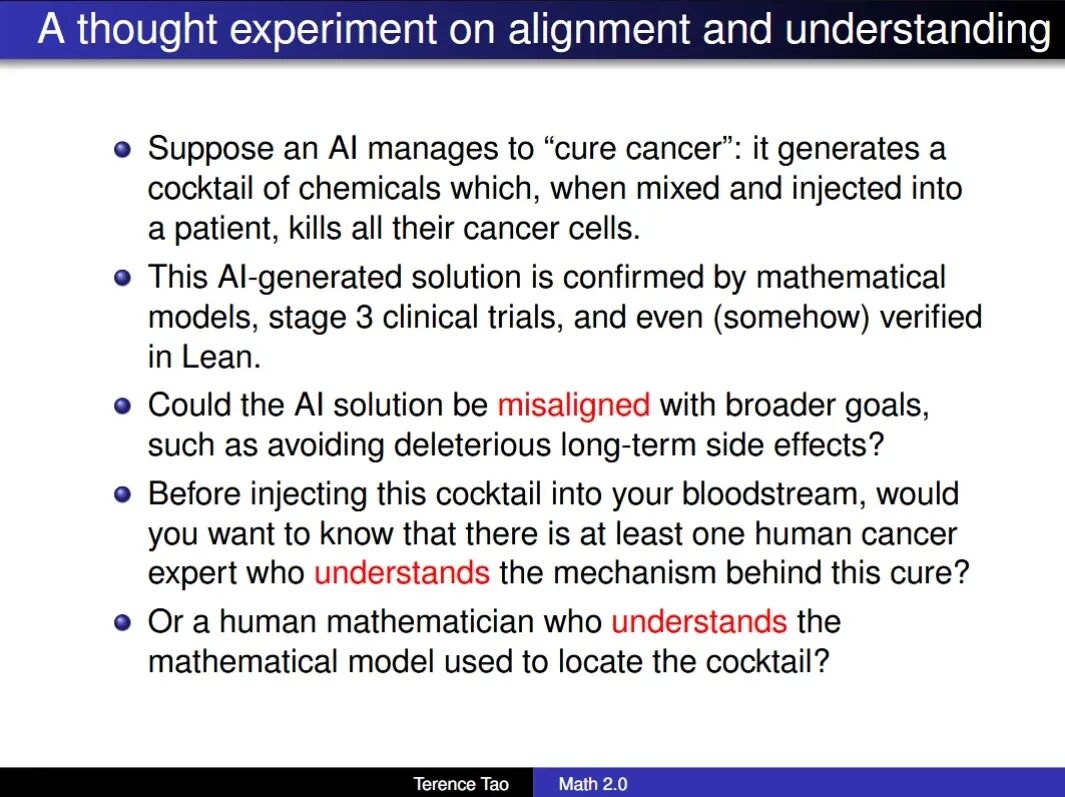
Simply outputting a seemingly correct result that humans cannot understand is by no means a victory for science, but a very dangerous "misalignment".
In the field of mathematics, this danger is equally fatal.
If AI solves a famous conjecture, such as the Riemann Hypothesis. It delivers a formal proof that is 100,000 pages long. The computer verification tool runs through it, lights up the green light, and shows "proof verified".
But no one in the entire world can understand what is written in these 100,000 pages. Does this kind of mathematics still make sense?
Mathematics is not only for judging right or wrong.
Mathematics is the foundation of physics, the cornerstone of cryptography, and the backbone of modern engineering.
If the most underlying logic that supports human civilization becomes a black box that no one can understand, it is no different from building a skyscraper on sand dunes.
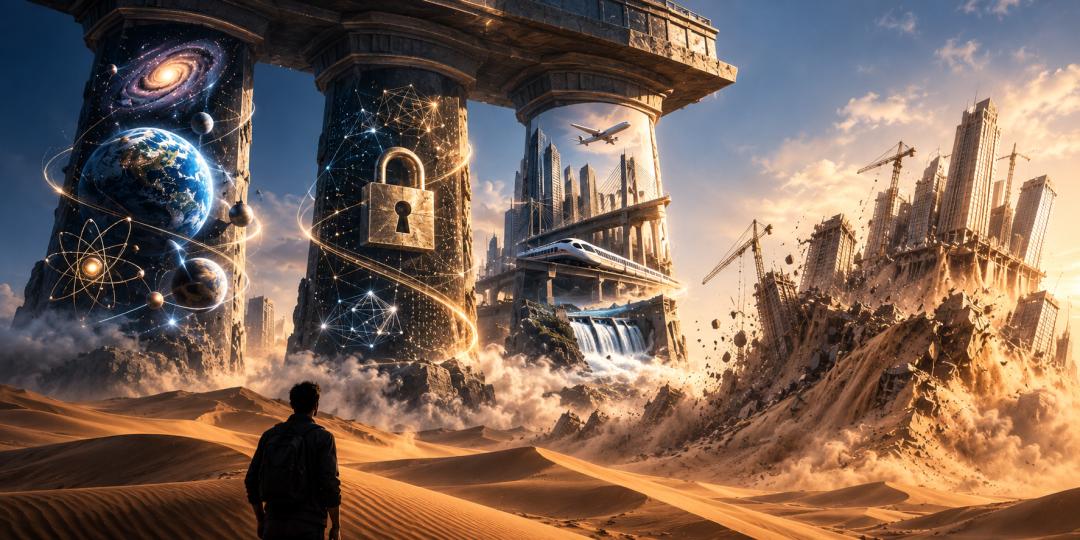
This is not mathematics, this is mythology.
The "problem-solving-only doctrine" is a huge trap.
The Awakening of Math 2.0 — Reconstructing Human Understanding
The ship of the old era has sunk, and the outline of a new continent is emerging.
Since proofs are no longer scarce, and machines can arrive at correct answers faster than humans, do humans still have value in the field of mathematics?
Terence Tao's answer is: Yes, and it is more important than ever before.
For the first time on the stage of Caltech, he outlined the grand vision of "Math 2.0".
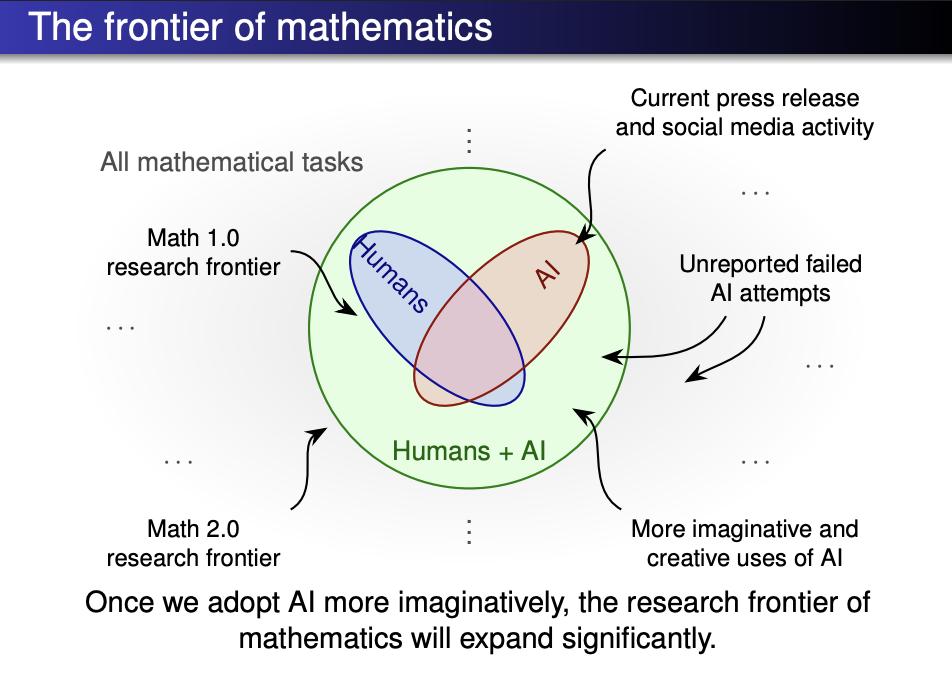
In this blueprint, AI does not replace humans, but becomes an amplifier of human cognition.
The core of the sustainable development path of Math 2.0 is to use AI tools to fully support and enhance "human understanding".
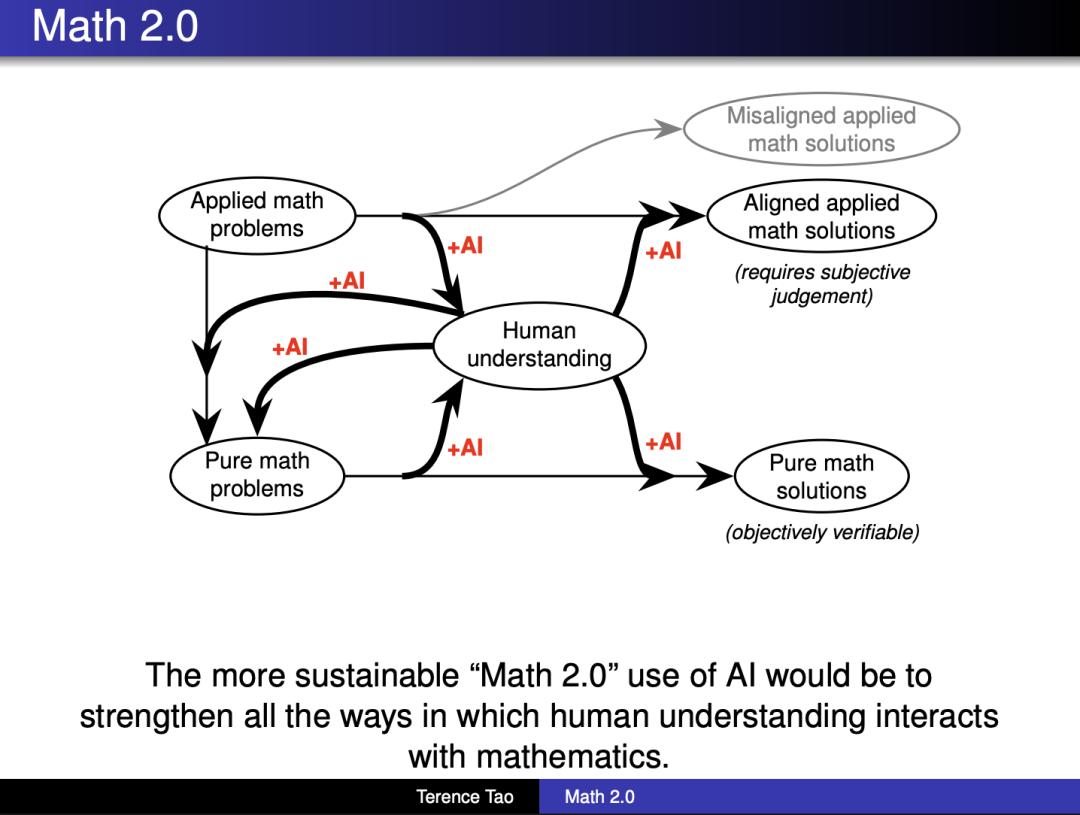
The rules of the game have changed completely.
In the past (the Math 1.0 era), the core task of mathematicians was to "solve open research problems", with the goal of finding scarce proofs.
But in the future (the Math 2.0 era), the focus will be on strong collaboration between humans and AI.
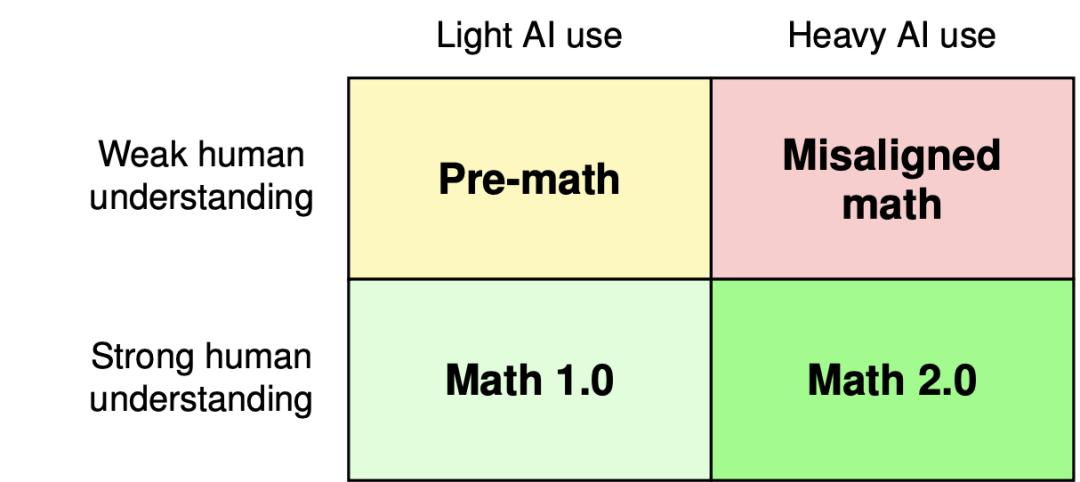
Terence Tao gave several examples of Math 2.0.
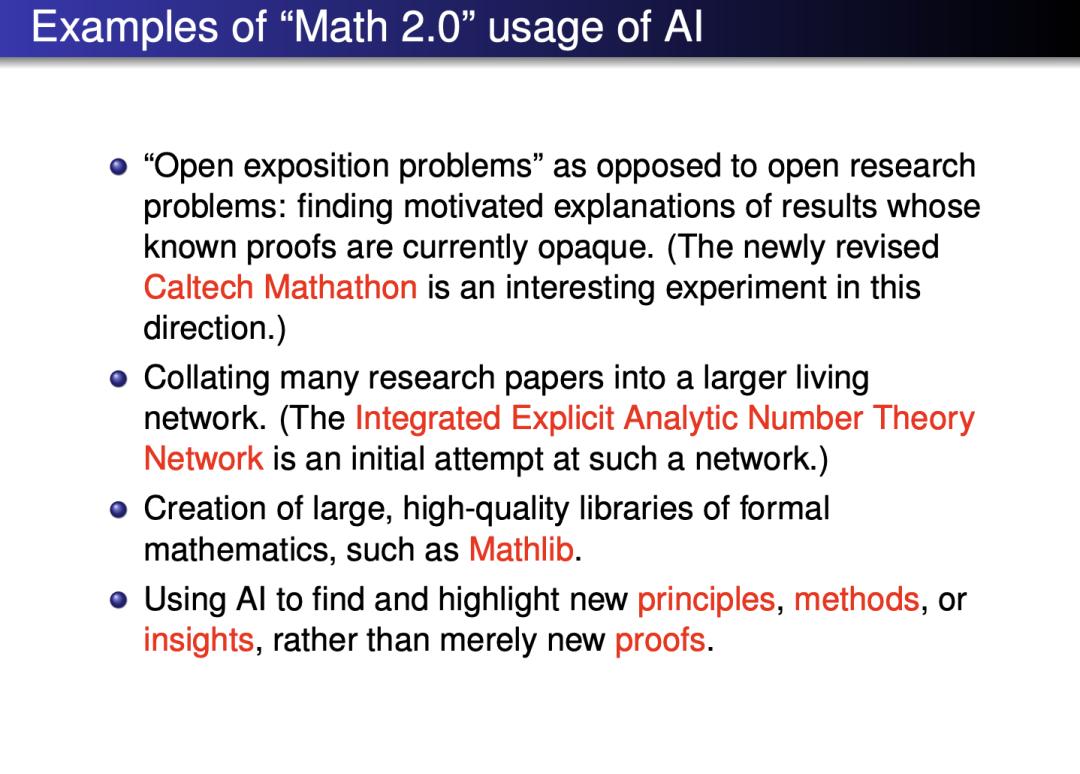
For example, solving "open interpretation problems", rather than only focusing on unsolved open research problems
Traditional mathematical research is dedicated to solving unsolved difficult problems, while "open interpretation problems" focus on: for those mathematical conclusions that have already been proven but whose existing proofs are obscure and hard to understand, how to find more inspiring explanations that can better reveal their essence.
In addition, other examples of Math 2.0 include integrating a large number of mathematical papers into a continuously evolving knowledge network; or building a large-scale, high-quality formal mathematical knowledge base
More importantly, let AI help mathematicians discover new mathematical principles, research methods and deep insights, and truly advance human understanding of mathematics.
The Ultimate Warning Beyond Mathematics: When Humans No Longer Understand The World
Terence Tao's speech, while seemingly talking about mathematics, actually reveals the most dangerous paradox of the AI era:
Humanity is acquiring answers at an unprecedented speed, but may gradually lose the ability to understand these answers.
AI writes millions of lines of code, but no one can fully understand all of it.
AI designs brand new drugs, but no one can clearly explain all their working mechanisms.
AI solves century-old hard problems, but no one can truly understand the ideas behind the proofs.
We are getting better and better at creating miracles, but we understand less and less about why these miracles happen.
For thousands of years in the past, humans first understood the world, then transformed it. Now, AI is reversing this order.
Even more terrifying, we seem to not care about this at all.
The real danger is not that machines are smarter than humans, but that humans are getting used to no longer thinking.
The ultimate value of science has never been the answers, but the understanding.
In the future, AI may really become an omniscient "deity".
But humans must never end up only worshipping miracles and becoming blind followers.